
You've opened a job application, apprenticeship form or university application, and there it is: Functional Skills maths required. Your stomach tightens. You may have spent years telling yourself that maths isn't your thing, while worrying that everyone else understands it easily.
That feeling doesn't mean you can't pass. It usually means you haven't had the right explanation, enough practice or a clear picture of what the assessment expects. The functional skills maths test is built around practical numeracy for work, daily life and further study, rather than a memory test filled with abstract school exercises.
The current framework in England asks learners to use maths in functional situations, including numbers, shape, space, data, statistics and probability. It's used by apprentices, adults improving workplace skills and learners who don't hold a GCSE grade 3 or above, as explained in the government's Functional Skills maths subject content.
Whether you're studying to earn more, move into a fulfilling career, reach university or show your children that learning can happen at any age, you have a route forward. If you want a gentle starting point, these ways to study for maths can help you begin without feeling overwhelmed.
You Are Not Alone on This Maths Journey
Many adult learners begin in the same place. They're sitting at the kitchen table after work, helping a child with homework or filling in an application form, and wondering whether a maths exam will expose everything they struggled with at school.
You might be worried about looking foolish in front of a tutor. You might remember rushing through old lessons, copying methods without understanding them or freezing whenever a question included fractions. Those memories can feel powerful, but they aren't proof of your ability today.
The qualification has a clear purpose. Government guidance describes Functional Skills maths as a qualification for practical application, including workplace and real-life contexts. Learners may use it to progress through an apprenticeship, improve their workplace skills or meet an education requirement, and there are no pre-entry requirements or minimum age for registration under the official conditions and requirements for the qualification: Functional Skills mathematics conditions and requirements.
Remember: Feeling nervous before maths practice doesn't mean you're bad at maths. It means the result matters to you.
A question about a payslip, a recipe, a timetable or a household budget gives you something familiar to hold on to. You're not being asked to become a mathematician. You're being asked to make sensible decisions with numbers, show your method and explain what your answer means.
You can also use the official Functional Skills requirements to remove some of the mystery. Once you understand the levels, sections and question styles, preparation becomes a set of small tasks rather than one frightening mountain.
What the Functional Skills Maths Test Actually Tests
The test is easiest to understand through a weekly supermarket shop. Suppose you have a budget, a list of meals to plan and several offers to compare.
Representing the situation
Representing means turning the problem into something you can work with. You write down the items, quantities and prices. You might convert a family's meal plan into a list of ingredients, or turn a word problem into a calculation.
If the question says that one packet serves several people and you need enough for a larger group, you identify the numbers that matter. A quick sketch, table or written calculation can stop the words from becoming confusing.
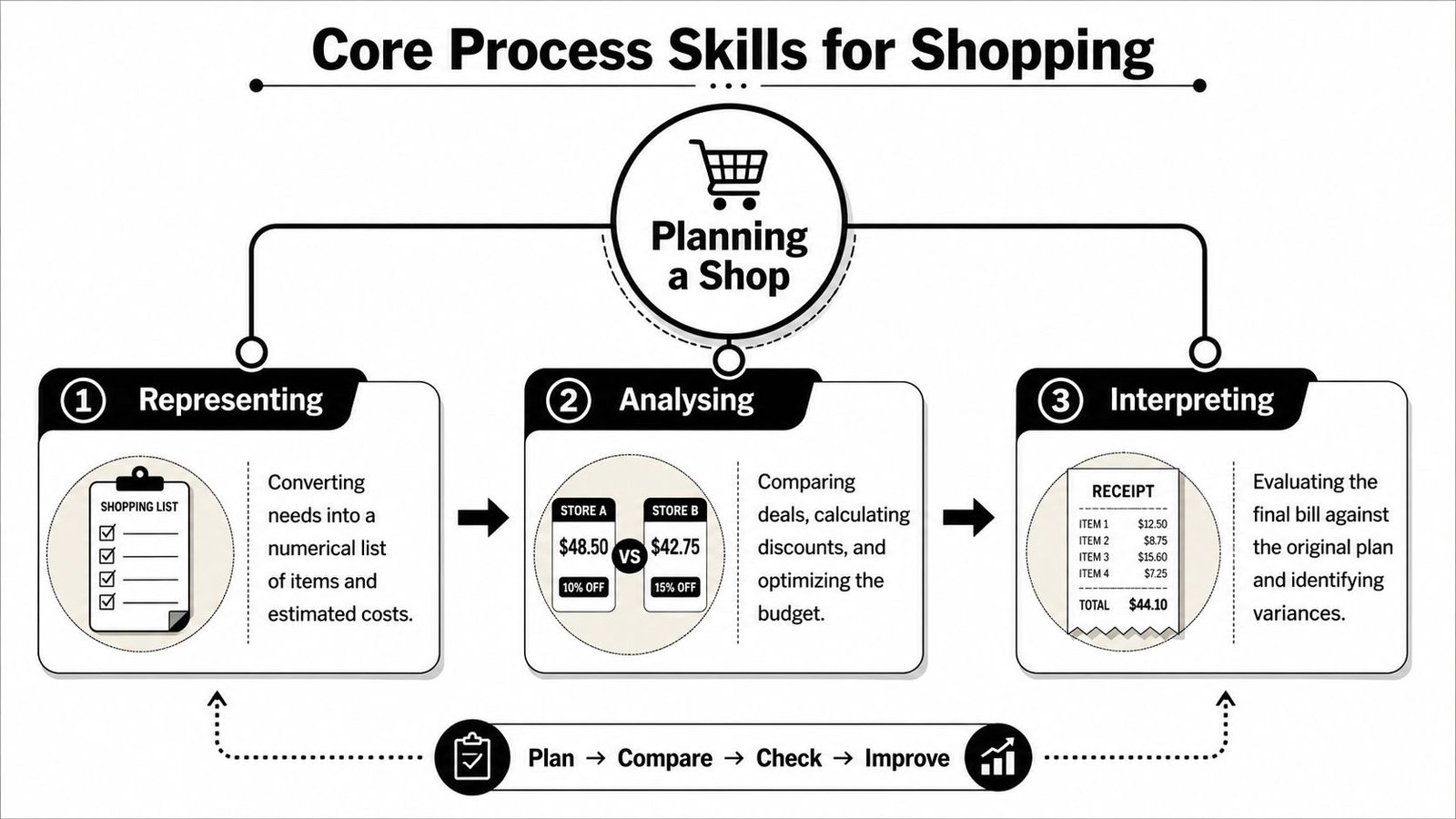
Analysing the choices
Analysing means deciding how to solve the problem. You compare a multi-buy offer with a lower-priced individual item, work out the cost per item and choose the option that fits the budget.
This could involve fractions, decimals, percentages, ratio, measurement or a calculator. The important skill is not blindly choosing the biggest discount. It's checking the actual numbers.
Interpreting the answer
Interpreting means asking whether your answer makes sense. You check the receipt against your list, decide whether the discount was applied and explain the difference between your expected total and the final bill.
The official assessment model uses these three process skills, Representing, Analysing and Interpreting, across the subject areas of Using Numbers, Shape and Space, and Handling Data. At Level 2, learners must handle statistics and probability, interpret tables and diagrams, calculate averages such as mean, median and mode, compare data sets, identify trends and recognise simple correlation, as set out in the government subject content.
That's why a question may appear to be about shopping but tests several skills. Tools such as test prep centre software can help education centres organise practice, learner progress and assessment preparation, but your own job is to understand the thinking behind each answer.
The Three Levels and Which One You Need
Functional Skills maths has Entry Level 1, Entry Level 2 and Entry Level 3, followed by Level 1 and Level 2. The best level depends on your starting point and your next goal.
| Level | GCSE Equivalent | Who Takes It | Key Maths Covered |
|---|---|---|---|
| Entry Level 1 to 3 | Below GCSE level | Learners building confidence and working towards Level 1 | Counting, basic calculations, simple percentages, everyday money and timetables |
| Level 1 | Roughly GCSE grades 1 to 3 | Learners developing practical numeracy for work, training and daily life | Fractions, decimals, percentages, money, measures and straightforward charts |
| Level 2 | Commonly accepted as comparable to GCSE grade 4 | Learners needing a higher qualification for work, training or further study | Multi-step calculations, data, averages, probability, ratio, geometry and problem solving |
Entry Level can be a sensible place to rebuild confidence. It isn't a sign that you've failed. It gives you a foundation, especially if you've been away from education for a long time or basic calculations feel rusty.
Level 1 is often the practical middle step. You'll meet familiar situations involving shopping, wages, travel, measurements and simple data. A learner who can manage these tasks but struggles with longer, multi-step questions may be ready for Level 1.
Level 2 is usually the target if you're aiming for an apprenticeship, a better job, university access or a career change. However, acceptance rules can differ between universities, employers and courses, so check the exact entry requirement before booking an assessment. You can explore a structured Functional Skills Level 2 maths and English route if this is the level your goal requires.
Ask yourself two questions. Have you used formal maths recently? What does your next step specifically request? If your confidence is very low, start with a diagnostic assessment rather than guessing.
How the Test Is Set Up and What You Sit
The assessment format matters because it tests both unaided calculation and sensible calculator use. The official rules state that Level 1 and Level 2 Functional Skills maths assessments are 100% external, with at least 75% open-response questions, and calculators are permitted within assessments. You won't complete a coursework portfolio instead of the exam.
The two sections
The reformed qualification has one external assessment split into two sections:
- Section A: Non-calculator work comes first. You'll use mental methods and written calculations.
- Section B: Calculator work follows. You'll solve longer problems and use a calculator appropriately.
The exact timing, layout and question count depend on the awarding organisation and assessment version. Don't rely on unofficial claims about one universal duration, total mark or fixed pass percentage. Your centre should give you the current assessment instructions for the awarding body you're taking.
Questions can involve unit conversions, percentages, payslips, area, charts, tables, averages and probability. For example, you might need to change a length from one unit to another, find a percentage of a wage, calculate the area of a room or decide what a chart says about spending.
Read every question slowly enough to identify the task. Underline key information on paper if your centre allows it. If you're given a calculator, use it to check sensible calculations, but don't enter numbers before deciding what the question is asking.
For online assessments, the calculator is normally provided on screen. You can't assume you may bring your own physical calculator, so ask your centre exactly what equipment and software will be available before exam day.
Why Pass Rates Are Lower Than You Might Expect
A practice paper can feel manageable until a question combines several skills. Functional Skills maths is accessible, but it still requires careful reading, accurate methods and sensible time control. Pearson reported 2024/25 overall individual-learner pass rates of 57% for Level 1 maths and 50% for Level 2 maths, with first-time pass rates of 47% and 40% respectively. These figures appear in Pearson's 2024/25 Functional Skills pass-rate update.
Results differ between awarding organisations and learner groups. NCFE reported 2024/25 overall pass rates of 47% for Level 1 maths and 50% for Level 2 maths, while another Pearson figure in the same verified national data set reports 38% for Level 1 and 36% for Level 2 in that reporting context. The NCFE Functional Skills pass-rate release shows why one headline figure cannot predict every learner's experience.
| Level | Adult Pass Rate | Main Reason for Failure |
|---|---|---|
| Level 1 | Results vary by awarding organisation and cohort, including the published figures above | Gaps in number skills, weak reading of practical questions or poor time control |
| Level 2 | Results vary by awarding organisation and cohort, including the published figures above | Multi-step reasoning, data interpretation, reading load and limited exam practice |
These figures do not decide your result. They point to the value of a diagnostic check before revision, particularly if you are returning to study after several years. A learner may know how to calculate a percentage yet miss the question because the information is presented in a payslip, table or workplace situation.
Treat mistakes like labels on a map. Record whether each error involves fractions, ratio, measures, geometry, data, reading or time management. Practise one weak skill using worked examples, explain each step aloud, then try a similar question before moving to a timed paper. That steady process turns a worrying result into a clear starting point.
Where to Sit the Test and How to Register
You normally book through an approved assessment centre rather than entering the exam completely alone. Common awarding organisations include City & Guilds, NCFE, Pearson Edexcel and Open Awards. Your centre should confirm the awarding organisation, level, assessment method and current registration arrangements.
Three common routes
A local further education college may offer classroom teaching and arrange your exam booking. This suits learners who want set lessons, face-to-face support and a regular routine.
An online provider may offer distance learning with remote invigilation. This can work well if you have shifts, children or caring responsibilities, but you'll need a quiet room, suitable technology and a reliable internet connection that meets the centre's rules.
If you're already on an apprenticeship or training programme, your provider may register you through its own centre. Ask whether maths is mandatory for your particular pathway, what level is expected and whether the assessment is included.
A supported course can be useful because a tutor may spot a weak topic before it becomes a barrier. Some providers also include practice activities, mock assessments and help with booking. Before paying, check the centre's approval for your chosen level and ask what happens if you need another attempt.
Choose support that fits your life, not a timetable that makes you feel guilty. A short study session you can keep is more useful than a perfect plan you abandon after a busy week.
A Practical Plan to Prepare With Confidence
A six-week plan gives you enough structure without asking you to put family life on hold. You can adjust the length of each session, but keep the order. First find the gaps, then build skills, then practise under pressure.
Weeks one and two
Week one, assess and gather. Take a diagnostic paper or topic check. Collect the current materials from your awarding organisation and create a mistake log with three columns: the question, what went wrong and the corrected method.
Week two, rebuild number skills. Work on addition, subtraction, multiplication, division, fractions, decimals and percentages. Use short examples and explain each step aloud. If a family member asks what you're doing, teach them one calculation. Explaining a method helps you notice whether you understand it.
Weeks three and four
Week three, practise data and measures. Read tables, charts and diagrams. Convert units, compare values and calculate averages where required. Focus on the words in the question as much as the arithmetic.
Week four, tackle geometry and problem solving. Practise area, perimeter, angles, ratio and multi-step word problems. Draw a quick diagram when the question describes a shape. Write down the information before reaching for a calculator.
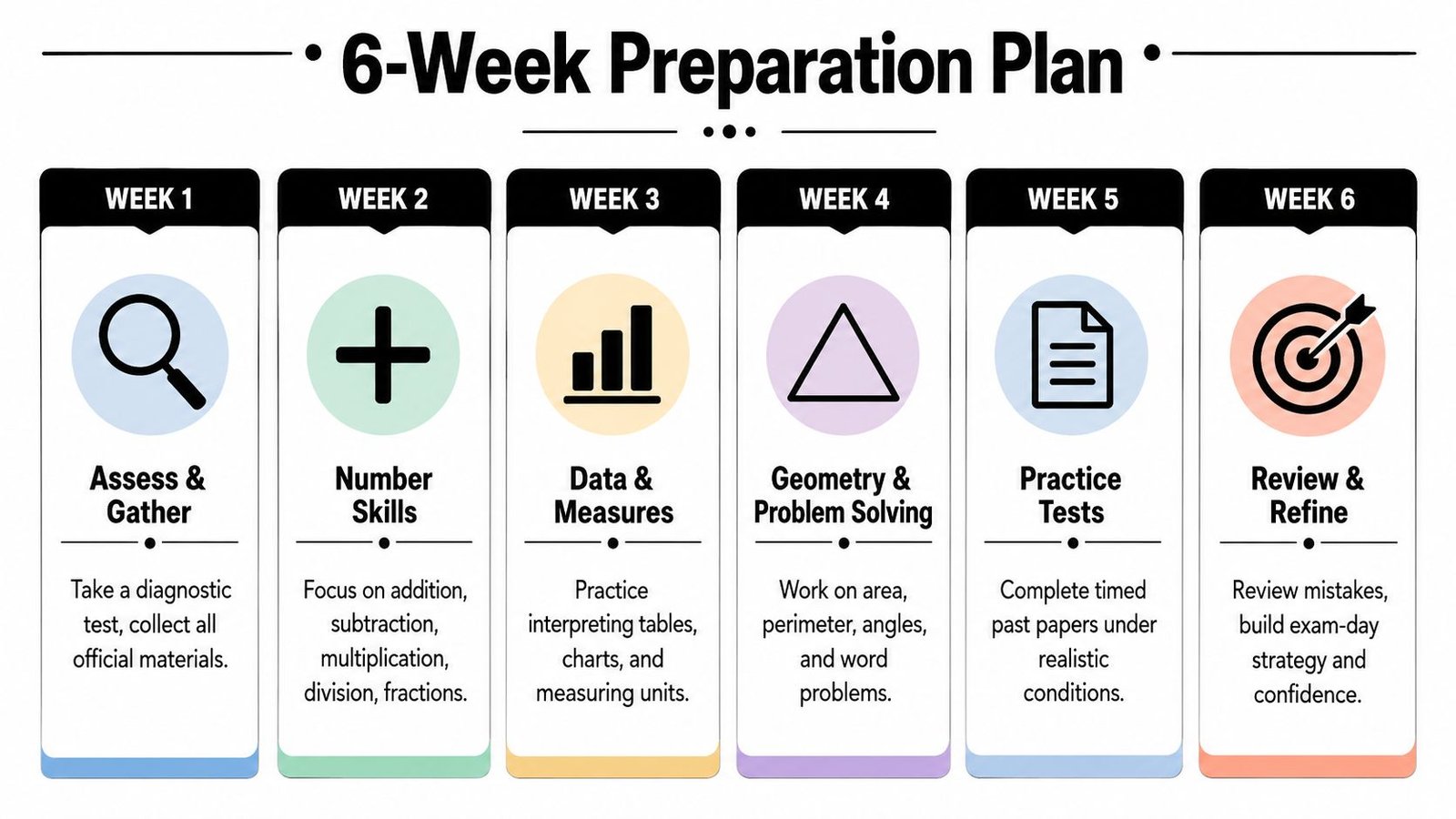
Weeks five and six
Week five, use timed papers. Complete past papers from sources such as Open Awards, City & Guilds and NCFE when they match your level and awarding organisation. The Functional Skills maths past papers can help you practise the question style and review your working.
Week six, review and refine. Sit mock assessments in realistic conditions. Revisit your mistake log, practise your weakest areas and prepare your exam-day routine.
Try 25-minute study blocks followed by a short break. Keep your phone away, reward consistency and use BBC Skillswise videos when you need a quick refresher. A tool described as a reliable AI maths app can help you explore a worked solution, but don't copy an answer without understanding the steps.
Write this simple checklist somewhere visible:
- Diagnostic: I know my starting topics.
- Practice: I've worked on my weakest skills.
- Explain: I can teach a method in plain words.
- Timing: I've practised without stopping at every difficult question.
- Review: I understand my common mistakes.
- Confidence: I've pictured myself arriving prepared and calm.
Do Adults Still Need This Test in 2026
The answer depends on your route. Many adults still need English and maths qualifications for progression, but the apprenticeship rules changed in 2025.
On 11 February 2025, the Department for Education changed the rules so apprentices aged 19 or older at the start of training no longer have to achieve English and maths qualifications to complete their apprenticeship. Apprentices aged 16 to 18 still have to meet the English and maths requirement. The policy consultation explains the change in the Department for Education's Functional Skills reform information.
That means adult apprentices shouldn't automatically assume the test is compulsory. Your training provider or employer must confirm your individual position, especially if your apprenticeship began under different arrangements or your programme has its own progression requirement.
When the qualification still matters
You may still need Level 2 if:
- Your course requires it: Some university and further education courses ask for GCSE maths or an accepted equivalent.
- Your employer sets it: Certain roles, including some public sector pathways, may require evidence of numeracy.
- You lack a GCSE grade 4 equivalent: A Functional Skills Level 2 pass may provide the qualification your next step accepts.
- You want a recognised route forward: An Access to Higher Education course, career change or promotion may make the certificate valuable even when the law doesn't force you to take it.
Check your chosen university, employer or training provider directly. Some accept Functional Skills Level 2, while others may ask for GCSE maths, a GCSE resit or another form of prior achievement.
Why take it voluntarily
A qualification can remove a barrier faster than continuing to avoid the subject. It can help you apply for work with more confidence, move towards higher education and handle everyday tasks such as budgeting, payslips and measurements without asking someone else to check every answer.
There's also a personal reason. Passing tells your children that education doesn't belong only to people who succeed at school. They'll see you study after a long day, make mistakes, return to the question and keep going. That example can matter just as much as the certificate.
You may be hoping to earn more, enter a fulfilling career, reach university or support your family in a new way. The maths test can become one practical step towards those goals. It can also help you reclaim confidence you lost years ago.
Sitting the test is an act of courage. Preparing for it is proof that your past experience doesn't have to decide your future.
Your first action is simple. Book a free initial assessment with a recommended online provider this week, choose a study slot in your diary and commit to attending it. You don't need perfect confidence before you begin. Maths ability is learned, not fixed, and your best days are still ahead.
Next Level Online College offers flexible Functional Skills Mathematics courses at NCFE Level 1 and Level 2, with structured learning, revision support and online exam delivery with remote invigilation. Visit Next Level Online College to explore a supported route that fits around your work and family commitments.