
You may be studying after a full shift, helping your children with homework, and trying to find quiet time before bed. Then you open a search page for Functional Skills maths past papers and find papers from different awarding bodies, levels, years and formats. It's easy to feel that you're already behind.
You're not. The right paper, used in the right way, can turn revision into a clear routine. It shows you how questions are written, reveals the small mistakes that cost marks and gives you evidence of progress. Whether you need maths for an apprenticeship, a new career or a university application, you can build confidence one question at a time.
Why Past Papers Are Your Secret Weapon
Consider an adult learner who has avoided maths since school. At first, a Level 1 or Level 2 paper can look like a wall of words. A question about a bill, measurement or a chart may seem harder than the calculation itself. After working through several suitable papers, the same learner starts to recognise the clues. “Increase” suggests a percentage, “share” suggests ratio, and “how much remains” may require subtraction.
That change matters. Past papers don't just test what you know. They make an unfamiliar exam feel familiar. The government subject content for Functional Skills maths describes a progression from practical number skills at Entry Level through fractions, decimals, percentages, measures and problem solving at higher levels. Papers reflect that practical purpose, so you need to practise applying maths in everyday situations, not only completing isolated sums.
Choose papers with a reason
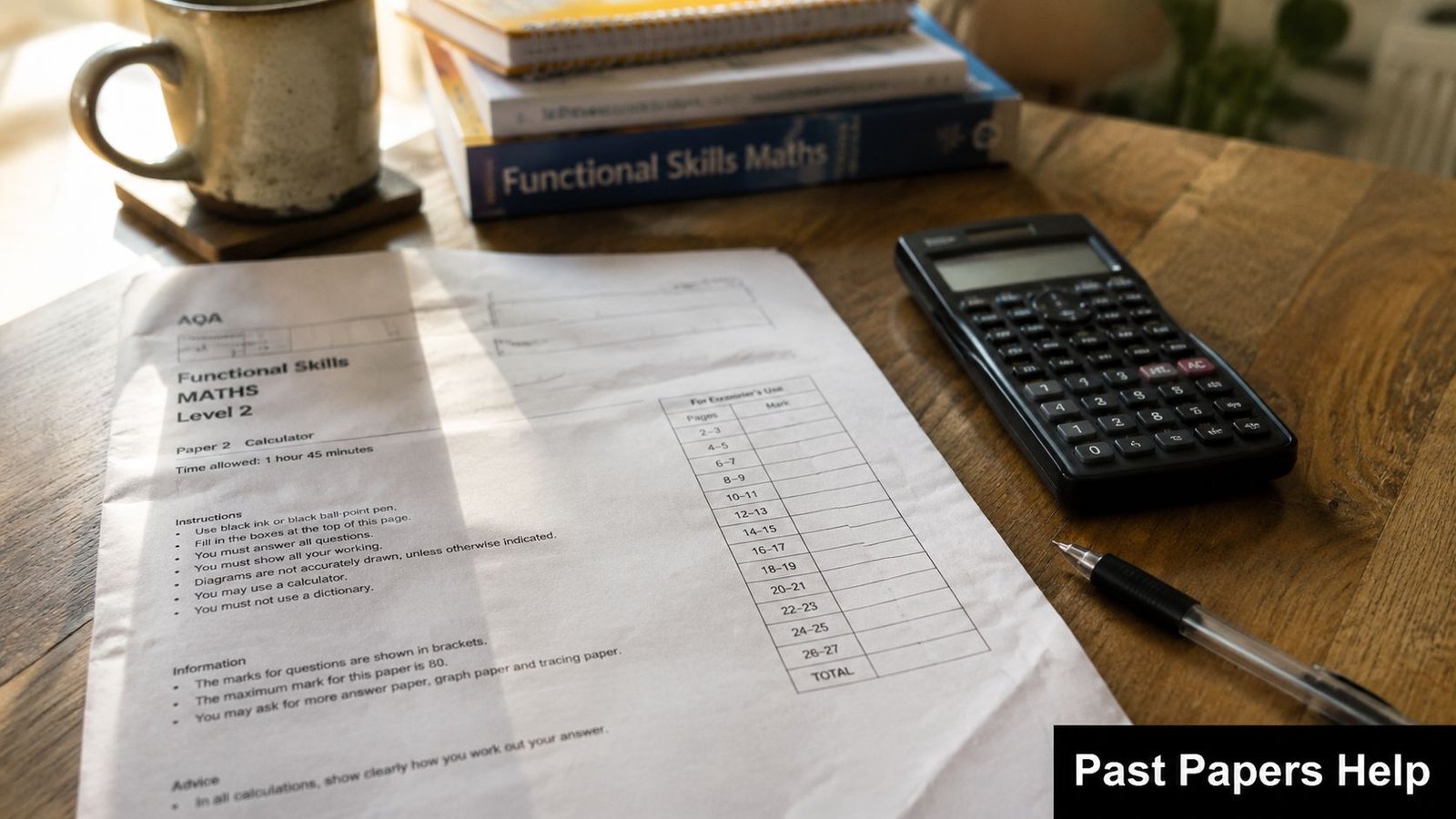
A large folder of random downloads isn't a revision plan. Start with your qualification level, awarding body and the current specification. A paper that resembles your exam lets you practise the question style, calculator rules and balance of skills you're likely to meet.
Past papers also help you measure progress. Complete one paper without help, mark it carefully, then record the topics behind each lost mark. You might discover that your main issue isn't percentages. It could be reading the question, converting units or giving the answer in the requested form.
Practical rule: Use a past paper to find your next learning task, not to judge your intelligence.
Confidence comes from evidence
Adults often wait to feel confident before they practise. In maths, confidence usually arrives after you have practised, checked your work and seen that you can correct mistakes. A completed paper gives you something concrete to celebrate, even if the first score isn't where you want it to be.
Your progress can also become a powerful example for your family. Children notice when an adult returns to learning after a difficult day and keeps going. You aren't only preparing for an assessment. You're showing that education can lead to wider choices, fulfilling work and a future you can feel proud of.
Finding Legitimate Past Papers and Mark Schemes
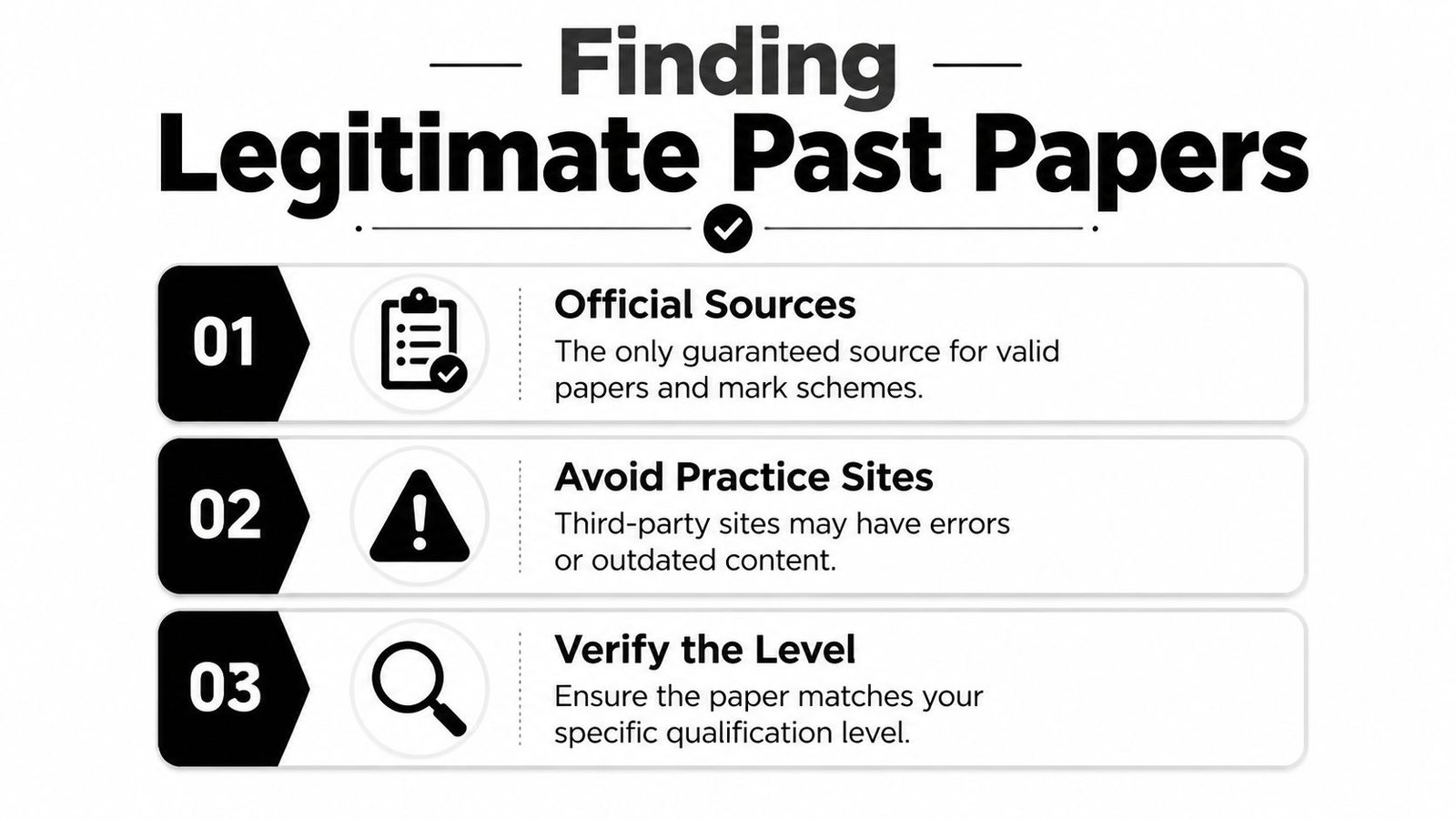
The safest papers come from the awarding body or a trusted provider that clearly identifies the source. Functional Skills maths collections are available across Entry Level, Level 1 and Level 2, and many include mark schemes and downloadable PDFs. Before you save anything, check the details on the front page.
Use this paper-checking process
Confirm the awarding body. Look for Pearson, City & Guilds, NCFE or the board named by your centre. Don't assume that a paper labelled “Functional Maths” matches every current Functional Skills qualification.
Check the qualification level. Entry Level, Level 1 and Level 2 papers test different stages of mathematical understanding. A Level 2 learner may gain useful practice from a simpler paper for a weak topic, but it shouldn't replace current Level 2 exam practice.
Verify the specification date. Functional Skills maths in England was reformed for qualifications awarded to learners registered on or after 1 September 2019, with all qualifications awarded on or after 1 September 2020 covered by the reformed requirements. The government collection of Functional Skills qualifications requirements explains why current revision should match the reformed specification.
Find both paper and mark scheme. A question paper tells you what to answer. The mark scheme shows how credit is awarded and whether working matters. Keep both files together in a clearly named folder.
Label calculator and non-calculator papers. Current collections may separate these formats. Practising the wrong section can give you a misleading idea of your readiness.
Reformed papers versus legacy papers
Older papers can still help you practise a single skill, such as fractions or measurement. They may not be reliable guides to the current exam structure, however. The reformed assessment changed the balance between underpinning skills and problem solving, and it introduced a discrete non-calculator component. For that reason, use older material as extra topic practice, not as your main mock.
Public archives show a long history of Functional Maths papers, including Edexcel-style papers from January 2009, later annual series and reformed papers from late 2019 or early 2020 through at least March 2023. The Functional Skills UK Level 1 past-paper archive illustrates how wide the available range is, while also explaining access limits.
Pearson states that papers sat within the most recent 12 months are restricted to teachers, while older papers remain accessible. This protects live assessment material, so you may not be able to find the newest learner paper online. The Pearson Functional Skills Mathematics past-paper page is useful for checking what Pearson has made available.
If you're preparing for Level 2, you can also use this Level 2 Functional Skills maths exam guide to compare the qualification with your own study needs.
Understanding the Reformed Exam Structure
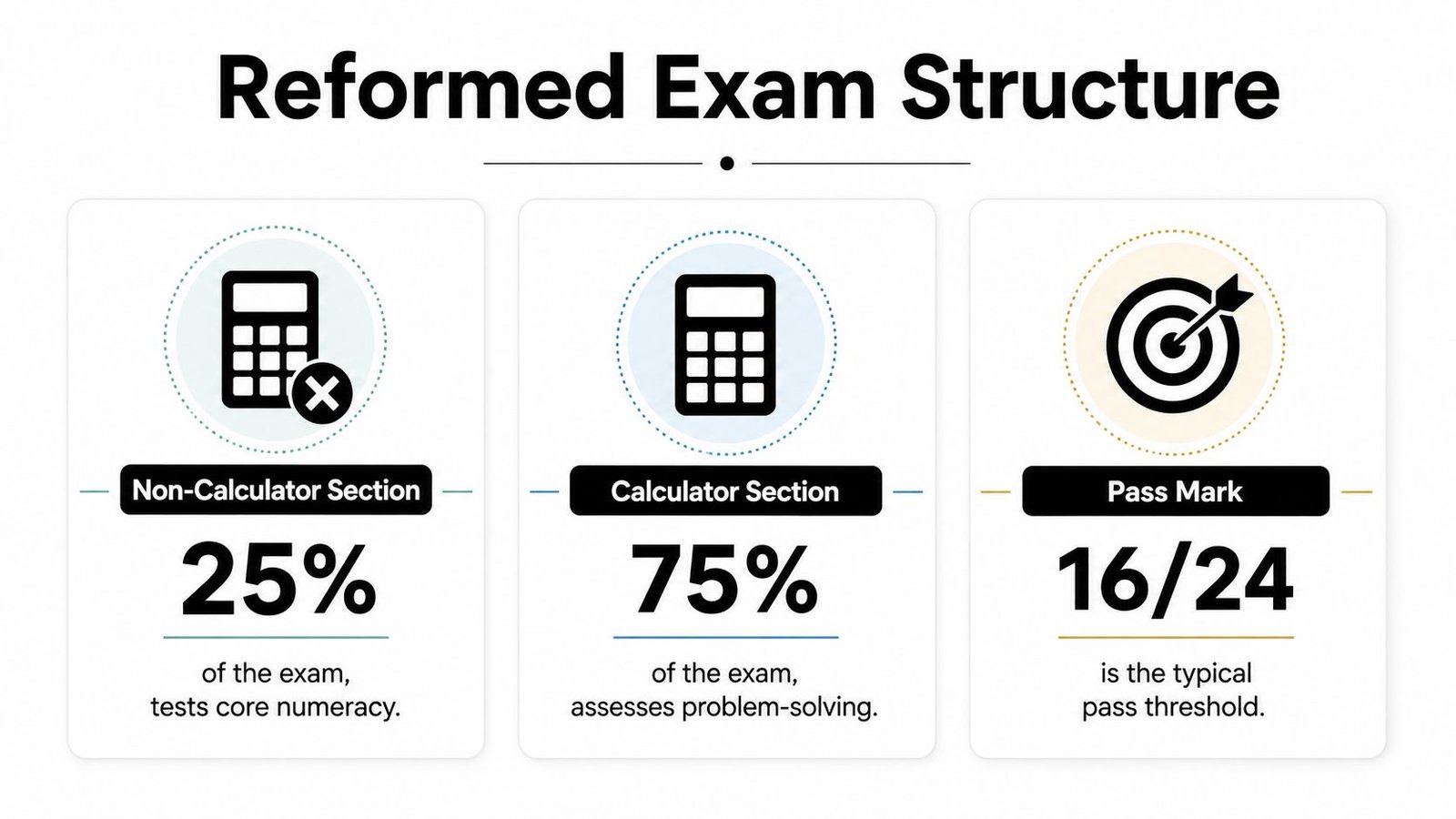
The reformed assessment rewards two different abilities. You need underpinning skills, such as carrying out calculations accurately, but you must also use those skills to solve problems in realistic settings. Ofqual set the weighting at 25% for underpinning skills and 75% for problem solving in the reformed Functional Skills maths assessment. The Ofqual review of reformed Functional Skills qualifications explains this assessment design.
There's another feature that affects revision. The assessment includes a discrete non-calculator component worth 25% of the qualification. The remaining work uses a calculator, but calculator access doesn't remove the need to understand the question. You still have to choose the correct operation, enter information accurately and present the answer properly.
What this means at each level
At Entry Level, questions build practical number confidence. You may work with counting, reading numbers, comparing quantities and basic operations. At Level 1, the questions demand more independence with number, measures and everyday problems. At Level 2, you'll apply fractions, decimals, percentages, ratio, measures, data and multi-step problem solving.
The exact paper will depend on the awarding body, so don't treat one provider's layout as universal. Instead, use a current paper from your board to learn the instructions, section order and response style.
Revise the application, not just the method
A learner may know how to calculate a percentage but still lose marks when a question places that percentage inside a workplace budget. Your practice should therefore include reading the scenario, selecting useful information, showing working and checking whether the result makes sense.
Try asking three questions after each problem:
- What was the question asking me to find?
- Which information did I need?
- Does my final answer fit the situation?
That habit links calculation to judgement, which is exactly what practical maths requires.
Your Step-by-Step Past Paper Revision Plan
A busy adult learner needs a plan that works in short, focused sessions. The most useful approach is a two-stage mock cycle. First, complete a timed baseline mock. Then use the result to target weak areas before attempting another mock.
Stage one, establish your baseline
Choose a current reformed paper for your level and awarding body. Sit it as realistically as possible. Put away notes, use the correct calculator rules and avoid checking answers while you work.
Mark it only after finishing. Create an error log with four headings:
| Question | What went wrong | Error type | Next action |
|---|---|---|---|
| Question reference | Brief description | Method, reading, units or accuracy | Specific practice task |
Don't write “I'm bad at maths” in the error column. Write “I multiplied instead of dividing” or “I missed the unit in the final answer”. A precise description gives you something you can fix.
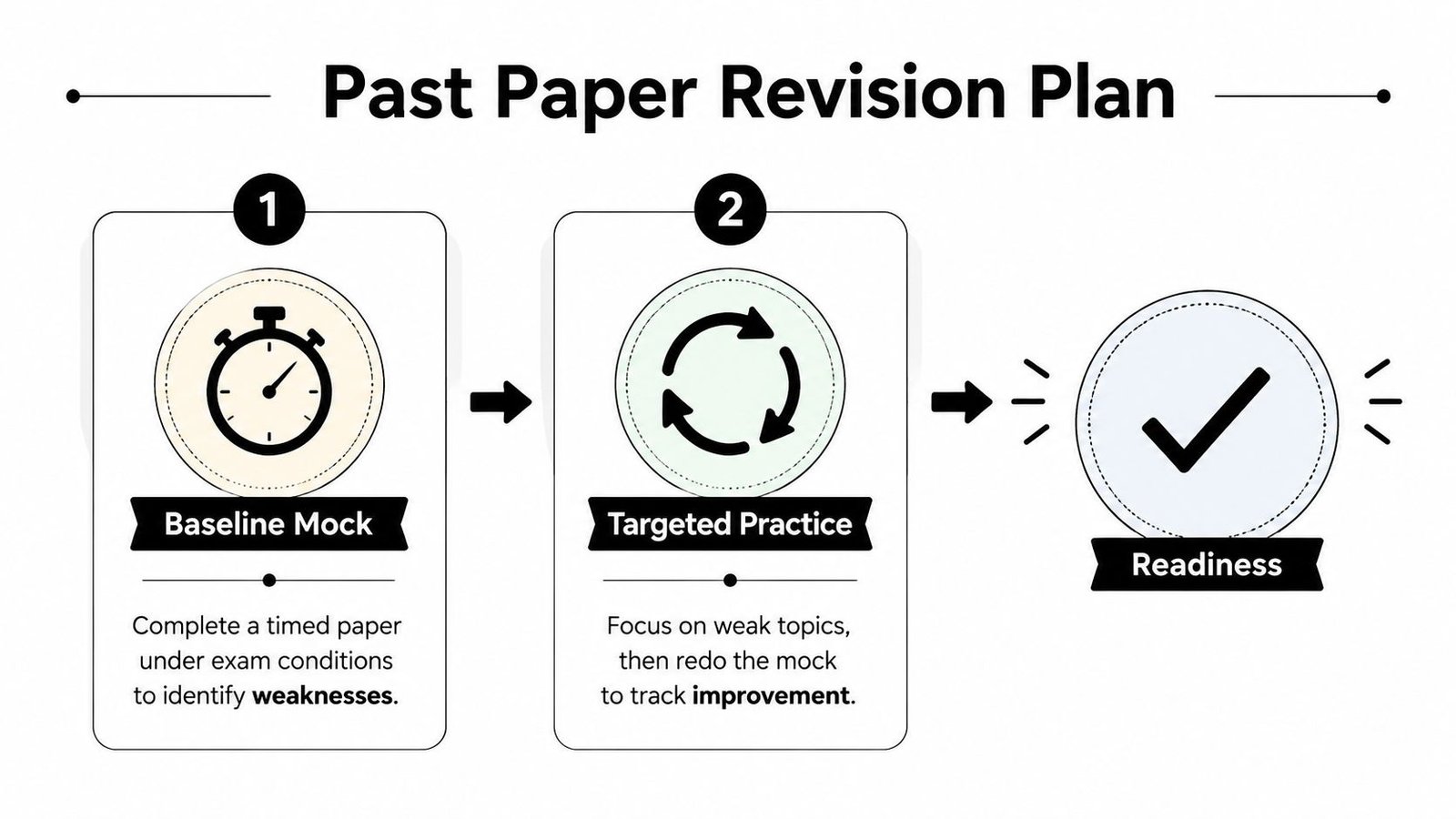
Stage two, run a targeted resit loop
Group your errors. If several questions involve percentages, spend your next study session on percentage methods and worded examples. If the calculations are correct but the answers lose units or rounding marks, practise presenting final answers.
A useful weekly pattern might look like this:
- Short session: Review one weak skill and complete a few focused questions.
- Second session: Return to the questions you missed and solve them without looking at the answer.
- Later session: Complete a timed section, concentrating on your error pattern.
- Review session: Update the error log and choose the next target.
The point isn't to repeat an entire paper immediately. It's to repair the reason you lost marks. Once you've practised the weak areas, complete another suitable mock and compare the quality of your working, not only the final score.
Study reminder: A resit is not proof that you failed. It's a planned opportunity to show that a particular mistake no longer controls your result.
Use an open-book approach when learning a new topic, then move to timed sections and finally full papers. You can find further guidance in this Functional Skills maths pass strategy.
Make limited time count
Keep your materials ready in one place. A folder containing the current specification, papers, mark schemes and error log removes decision fatigue when you only have time after work or once the children are asleep.
Don't wait for a perfect free day. A short session with one clear target can be more useful than an unfocused afternoon. Your plan should fit your real life, because a routine you can maintain will support you better than an ambitious timetable you abandon.
Modelling Exam Conditions and Avoiding Common Mistakes
A paper completed on the sofa with unlimited time can tell you whether you understand a topic. It can't tell you whether you can manage pressure, read carefully and maintain accuracy throughout an assessment. At least some of your practice must copy the conditions you'll face, including the correct calculator or non-calculator rules and no help from notes.
Clear your table, silence your phone and tell your household that you need uninterrupted time. Read the instructions before starting, keep your working visible and mark the point where you begin. If you need to pause for a genuine family reason during ordinary revision, record the pause. That way, you won't confuse relaxed practice with timed performance.
Protect the marks you've already earned
Examiner feedback shows that learners often lose marks through small procedural errors rather than a complete lack of understanding. The NCFE chief examiner report highlights problems including missing units, money answers written to the wrong decimal precision and faulty metric or imperial conversions.
Before submitting an answer, check:
- Units: Have you written metres, kilograms, pounds or another requested unit?
- Money: Does the answer use the decimal precision requested by the question?
- Conversions: Have you checked whether you moved between units in the correct direction?
- Response type: Did the question ask for a whole number, decimal, fraction or percentage?
- Reasonableness: Does the result make sense in the real-life situation?
A decimal answer can be mathematically related to a whole-number answer and still fail to follow the instruction. Read the final line again before moving on.
Use the calculator as a checking tool
On the calculator section, write the calculation first. Then enter it carefully and compare the display with your estimate. Brackets, decimal points and copied figures can change the result, so slow down at the input stage.
For non-calculator work, write each step clearly. Use known facts, estimation and simple written methods. Showing your process helps you spot errors and may demonstrate your method when the final answer isn't correct.
Tracking Progress and Building Exam-Day Confidence
Confidence grows when you can see what has changed. Keep a simple record of the paper date, level, topics practised, errors corrected and questions you can now complete independently. Avoid comparing your journey with another learner. Your useful comparison is between your first honest baseline and your latest attempt.
The regulator's outcomes dashboard defines success as the percentage of learners achieving a pass in any attempt during the reporting period. Provider data also shows that first-time outcomes can vary by level. For example, NCFE's 2024/25 data reports a first-time pass rate of 47% for Level 1 maths and 40% for Level 2 maths, with higher individual-learner pass rates after resits, as shown in its Functional Skills pass-rate report. Treat that as a reason to prepare strategically, not as a prediction about your own result.
Use a study planner template to turn your next target into a specific appointment. Before exam day, prepare your materials, check the paper format you've been practising and remind yourself that nerves are a normal response to something important.
During the assessment, breathe slowly, read the question in small parts and return to any difficult item rather than allowing it to stop your whole paper. You're not the same learner who opened that first confusing PDF. You've built familiarity, corrected patterns and proved that you can keep learning while caring for the people you love.
Next Level Online College offers flexible Functional Skills maths courses, structured revision support and assessment preparation designed for adults balancing work and family. Visit Next Level Online College to explore a supported route from past-paper practice to a recognised qualification and your next education or career goal.