
Somewhere in your life, there may be a quiet thought that keeps coming back. You want more. More choices. More confidence. More security for your family. Maybe you want a better job, a place at university, or even the feeling that you've finally proved something to yourself.
At the same time, maths may bring back old memories. A classroom where you felt left behind. A test paper that made your stomach sink. Years of telling yourself, “I'm just not a maths person.”
If that sounds like you, take a breath. You are not behind. You are not too late. And you are not the only adult who feels nervous about taking the Functional Skills Maths Level 2 exam.
It Is Never Too Late to Build the Life You Deserve
A lot of adult learners carry a heavy story about themselves. They work hard, care for others, show up every day, yet still feel held back by one missing qualification. They might be excellent at their job, brilliant with people, and full of determination, but when an application asks for maths, everything stops.
That feeling can affect more than work. It can creep into family life too. You might want to help your child with homework, speak with more confidence at school meetings, or show your children that learning doesn't end when life gets busy. You want them to see courage in action.

The turning point often starts quietly
For many adults, the change doesn't begin with a huge dramatic moment. It starts when they get tired of saying “maybe one day”. It starts when they realise that one qualification could help them move forward in work, training, or higher study.
The Functional Skills Maths Level 2 exam can become that first brave step. Not because it's easy, but because it's purposeful. It gives you a practical target and a recognised result that can help you move into a stronger future.
You don't need to become a different person to pass maths. You need support, practice, and a reason to keep going.
You are allowed to start again
Starting again as an adult takes courage. You may be fitting study around shifts, school runs, bills, and tired evenings. You may worry that your memory isn't what it used to be. You may even feel embarrassed about asking basic questions.
Please don't be.
Adult learners often bring strengths that school children are still developing. You understand responsibility. You know why this matters. You've handled real life, real pressure, and real setbacks. That resilience matters when you return to education.
Here's what often changes everything:
- A clearer reason: You're not studying because someone told you to. You're studying because you want a better future.
- A stronger mindset: You've already survived difficult things. One exam doesn't define your worth.
- A bigger purpose: This isn't only about you. It's also about what your children see when you keep going.
Passing a maths qualification can mean far more than a certificate. It can mean pride at the kitchen table. It can mean walking into interviews with your head up. It can mean showing your family that fear doesn't get the final say.
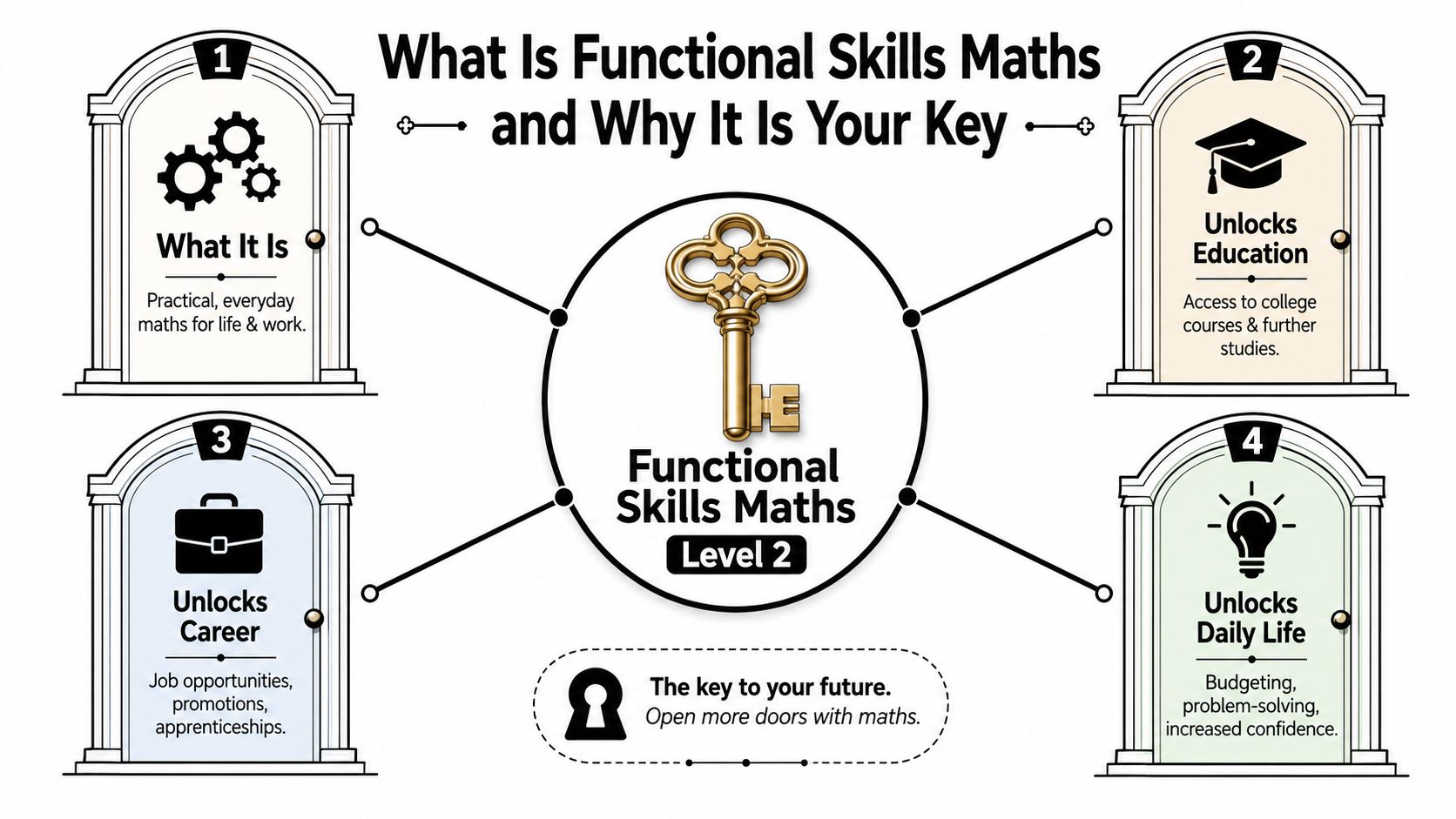
What Is Functional Skills Maths and Why It Is Your Key
The easiest way to think about Functional Skills Maths Level 2 is this. It is a key. One qualification, but many doors.
It can help open doors to job applications, apprenticeships, college routes, and university pathways. It can also foster something more personal. The belief that you are capable of learning, growing, and reaching goals that once felt out of reach.
A recognised qualification that carries real value
The Functional Skills Maths Level 2 exam is officially equivalent to a GCSE grade 4, formerly grade C, and it is used as a recognised benchmark for adult learners in the UK who need the standard minimum requirement for employment, apprenticeships, and university entry without taking a full GCSE course, as explained by Pass Functional Skills.
That matters because you're not working towards something vague. You're working towards a qualification that employers and education providers understand.
If you've ever wondered how this compares with school qualifications, this guide on what Functional Skills Level 2 is equivalent to can help make that clearer.
Why many adults prefer this route
School maths often felt broad, theory-heavy, and hard to connect to everyday life. Functional Skills is different in spirit. It focuses on practical maths you can use, such as working with percentages, ratios, and data in real-world situations.
That makes it a better fit for many adults who don't want to spend months buried in topics that feel distant from work or home life.
A simple way to look at it is this:
| Door it can unlock | What it can mean for you |
|---|---|
| Education | A route into further study or university-related progression |
| Work | A recognised maths qualification for roles that ask for GCSE or equivalent |
| Training | Access to apprenticeships and Level 3 opportunities |
| Daily life | More confidence with money, measurements, and information |
This qualification is about usefulness
When adults come back to study, they usually want progress they can feel. They want to know the effort is going somewhere. Functional Skills Maths Level 2 offers that sense of direction.
Main takeaway: This qualification isn't about proving you were good at school. It's about proving you can use maths in life, work, and future study now.
That shift matters. It turns the exam from a reminder of the past into a tool for the future.
Your Guide to the Exam Format and Rules
Fear often grows in the dark. Once you know what the exam looks like, it usually feels much less frightening.
The Functional Skills Maths Level 2 exam has a clear structure. It isn't one giant mystery paper. It is organised, timed, and split into two parts.
According to Intech Centre's exam information, the Functional Skills Maths Level 2 exam is a computer-based assessment with a fixed duration of 1 hour and 45 minutes, divided into a non-calculator section and a calculator section.
The two sections in simple terms
The first part checks that you can handle key calculations without relying on a calculator. The second part lets you use a calculator for more involved problem-solving.
That means the exam tests two useful things:
- Number confidence: Can you do essential maths by yourself?
- Problem-solving skills: Can you use tools properly when the task gets more complex?
Functional Skills Maths Level 2 exam sections at a glance
| Feature | Section 1 Non-Calculator | Section 2 Calculator |
|---|---|---|
| Calculator use | Not allowed | Allowed |
| Main focus | Basic arithmetic and number fluency | More detailed calculations and applied problems |
| Skills tested | Core maths methods done by hand or mentally | Solving practical questions with calculator support |
| What to expect | Straightforward working with care and accuracy | Multi-step questions using maths in realistic contexts |
What the format means for your revision
A lot of learners hear “maths exam” and imagine everything crashing down at once. That isn't what's happening here. The structure gives you a calm revision plan.
You can prepare in a focused way:
- Build your basics first so the non-calculator section feels manageable.
- Practise applied questions next so you get used to choosing the right method.
- Work on timing so the full exam feels familiar instead of rushed.
Practical rule: Revise for the exam in the same two-part way it will test you. Don't mix everything together from the start.
Rules that help rather than scare
Rules can sound strict, but they also make the assessment predictable. Predictable is good when you're nervous. You know there will be one section where calculator use isn't allowed, and another where it is. You know the full exam lasts 1 hour and 45 minutes. You know it is computer-based.
That gives you something solid to prepare for. The more familiar the format becomes, the less power anxiety has on the day.
What Kinds of Questions Will You Face
Many learners are relieved when they discover what Functional Skills maths looks like. The questions are practical. They are built around situations that feel more like life than school.
You may be asked to work with number, measure, shape, space, or data. At first those words can sound formal. In real terms, they often connect to shopping, budgeting, travel, room sizes, containers, charts, and everyday decisions.
The everyday side of the maths
Think about the sort of maths people already use without calling it maths.
You compare prices in shops. You split a bill. You check whether you've been paid correctly. You work out how long a journey will take. You decide if furniture will fit through a doorway. Those are all the same habits the exam is trying to build and test.
A question on percentages might feel like checking a discount. A question on fractions or decimals might feel like sharing costs fairly. A data question might look like reading information from a chart or table.
Shape, space and practical problem-solving
Some learners worry most about geometry because it sounds technical. But even that often connects to real tasks.
The content can include areas and perimeters of simple and composite rectangular shapes, volumes of cubes and cuboids, and interpreting 2-D plans, elevations, and nets of 3-D shapes, as outlined in NCFE assessment materials.
That may sound like a lot, so let's turn it into everyday language:
- Area and perimeter can feel like checking the size of a room or the length around a garden edge.
- Volume can feel like working out how much space is inside a box.
- Plans and elevations can feel like looking at drawings for furniture, storage, or simple building layouts.
Examples that make the topics less scary
Here are the kinds of thoughts behind the maths:
- At home: Will this new sofa fit in the living room?
- At work: Can I read this chart properly and use the figures?
- With money: Can I compare deals and spot which one makes sense?
- With practical tasks: Can I measure space, length, or amount accurately?
The exam isn't asking you to become a mathematician. It's asking you to use maths sensibly in situations that resemble real life.
Questions often involve more than one skill
One important thing to remember is that a single question may mix topics together. You might read a short problem, pull numbers from a table, choose the right operation, and then check whether your answer is reasonable.
That's why understanding the situation matters just as much as doing the sum.
When learners struggle, it's often not because they can't calculate. It's because they rush, miss a word, or don't stop to ask, “What is this question really asking me to find?” Slowing down and reading carefully can make a huge difference.
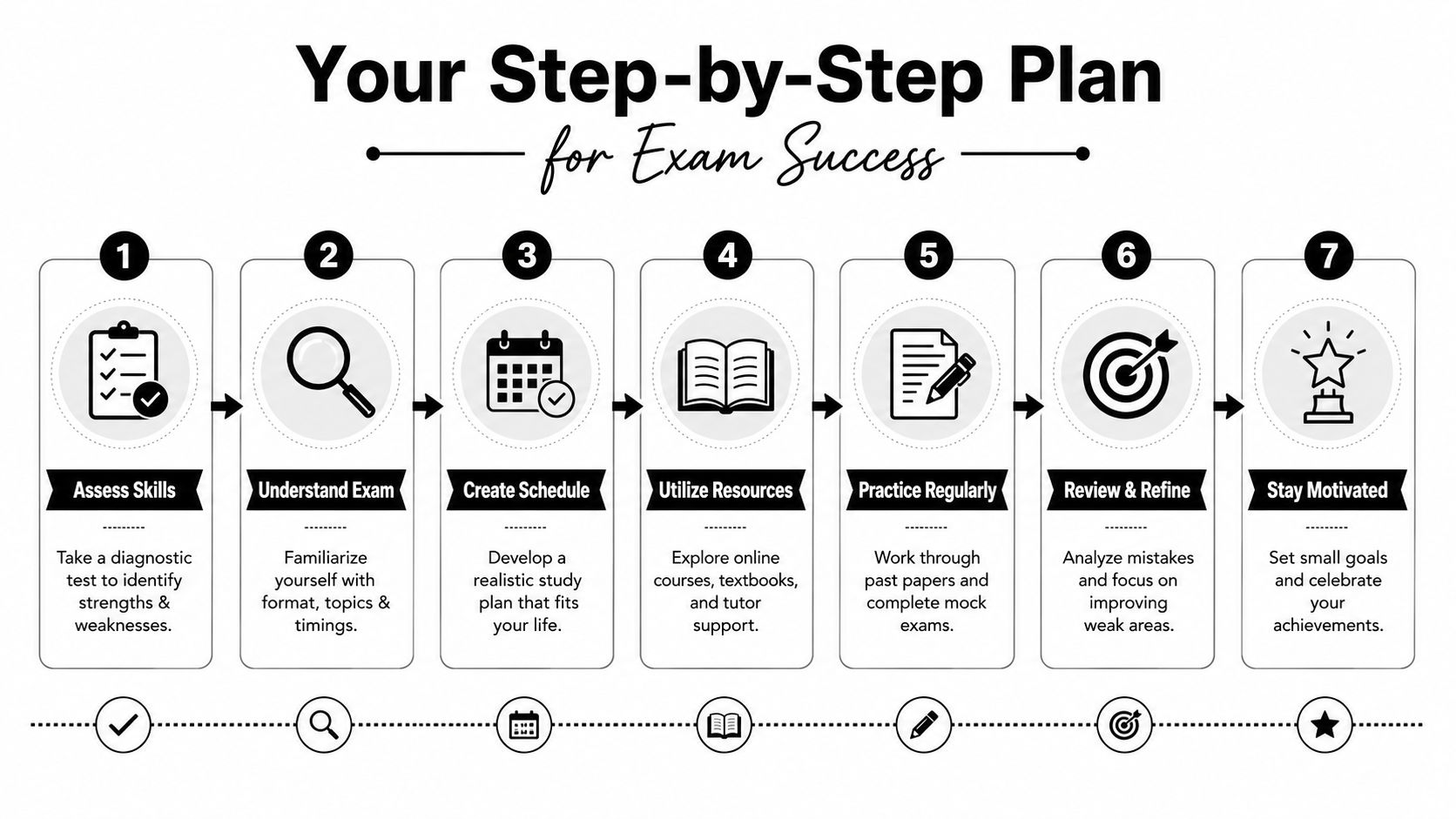
Your Step-by-Step Plan for Exam Success
The best study plan is not the one that looks impressive on paper. It's the one you can stick to when life is busy.
That matters if you're juggling work, children, tired evenings, and all the normal demands of adult life. You don't need a perfect routine. You need a realistic one.
The qualification has a clear size. The NCFE-regulated Functional Skills Mathematics Level 2 qualification has a Total Qualification Time of 54 hours, made up of 45 Guided Learning Hours and 9 hours of unsupervised preparation time, according to the NCFE qualification specification. That gives you a real finish line.
Start small and stay steady
A solid plan usually looks like this:
Find your starting point
Take a simple assessment or sample paper. Don't use it to judge yourself. Use it to spot where you're already stronger than you think, and where you need support.Learn the exam shape
Get comfortable with the topics, timing, and section rules. The more familiar the exam feels, the less threatening it becomes.Create a study pattern that fits your life
Short, regular sessions often work better than trying to do everything in one long burst. Consistency beats pressure.
If you want a flexible online route, this page on Functional Skills Maths online study shows what that learning path can look like.
A short video can also help the process feel more real and manageable:
Build topic confidence one layer at a time
Don't try to conquer every topic at once. Pick one area, work on it, then move to the next. A simple rhythm helps:
| Study focus | What to do |
|---|---|
| Number basics | Practise arithmetic, decimals, fractions, percentages, and checking answers |
| Applied questions | Read short problem-solving tasks and decide what the question wants |
| Measure and shape | Work on area, perimeter, volume, and practical measurement |
| Data skills | Read charts, tables, and information carefully |
Use practice to turn nerves into familiarity
Once you've covered the basics, begin doing exam-style questions regularly. Through this, confidence starts to grow, because the paper stops feeling strange.
A good cycle is:
- Attempt a question
- Check the answer and method
- Notice the exact point where you got stuck
- Redo a similar question while the lesson is fresh
Study reminder: Don't say “I got it wrong, so I'm bad at maths.” Say “I found the step I need to practise.”
Keep your motivation tied to your real life
Your reason matters. Write it down somewhere visible. It might be “I want to apply for university.” It might be “I want my children to see me finish something.” It might be “I want a better job and more options.”
When motivation drops, go back to that reason.
The Functional Skills Maths Level 2 exam is a practical goal, but the deeper win is personal. Every study session says the same thing. You are building something better, one step at a time.
Top Tips for Adult Learners Balancing Life and Study
Adult learners rarely struggle because they don't care. They struggle because life is full. Work deadlines, family needs, money worries, tiredness, and self-doubt can all crowd into the same week.
That's why success often depends on smart habits rather than long study hours. A gentle plan you can keep going with is far more powerful than a strict plan you give up after a few days.
Protect small pockets of time
You may not have whole free evenings. That's fine. Many adults do better when they use short study windows.
Try things like:
- Early starts: A short session before the house wakes up
- Lunch break practice: One topic or a few questions instead of scrolling
- Weekend resets: A quiet hour to review the week's learning
- Family study time: Sit with your child while they do homework and do your own work too
These moments add up. You don't need study to take over your life. You need it to become part of your routine.
Don't hide from maths anxiety
Maths anxiety is real. It can make simple questions feel harder because panic arrives first. The answer isn't to be tough with yourself. The answer is to lower the pressure and repeat the basics until they feel familiar.
When your mind goes blank, come back to a few simple actions:
- Read the question twice
- Underline what you need to find
- Write down the numbers clearly
- Choose one step to do first
That gives your brain something steady to hold on to.
Practise the online exam experience
This is one of the most overlooked parts of preparation. Some learners lose marks not because the maths is beyond them, but because the screen format feels awkward.
As noted in Stonebridge's guidance on passing Functional Skills maths, learners can lose marks because they are unfamiliar with the online exam experience, including using the mandatory on-screen calculator and handling chart data on the interface.
That means practising the digital side matters. If you're preparing for the Functional Skills Maths Level 2 exam, don't only revise with paper and a pen. Spend time getting used to answering on screen.
You may find this guide on how to prepare for exams helpful as part of that routine.
Get comfortable with the tool as well as the topic. Confidence on the screen can protect marks you've already earned with your knowledge.
Keep your self-talk honest and kind
Many adults speak to themselves in a way they would never speak to a friend. They say, “I'm hopeless,” or “I should know this by now.” That kind of thinking makes study heavier than it needs to be.
Try replacing that with something more truthful:
- “I'm learning this now.”
- “This is hard for me, but I can improve.”
- “I don't know it yet.”
That small word, “yet”, matters. It leaves room for growth.
Your New Beginning Starts Today
There's a reason this goal stays on your mind. It matters to you because your future matters to you.
Passing the Functional Skills Maths Level 2 exam won't magically solve every problem overnight. But it can change the direction of your life. It can turn “I wish I could” into “I did it.” It can help you apply for opportunities that once felt closed. It can give you a qualification with purpose, and just as significantly, a new level of belief in yourself.
This is bigger than one exam
For many adults, the greatest reward isn't the result slip. It's the moment they realise they didn't give up on themselves.
It's the pride of finishing something hard. It's the look on a child's face when they see their parent studying, trying, and succeeding. It's the quiet confidence that grows when you stop letting old school memories decide who you are today.
That's why this matters so much. You're not just revising maths. You're changing the story.
The future can look different from the past
You can become the person who goes back to learning and keeps going. You can become the person who qualifies, progresses, and aims higher. You can become the role model your family already needs.
And if university is your dream, or a better career is your goal, this can be one of the steps that helps carry you there. The brave part isn't knowing everything before you begin. The brave part is beginning anyway.
A qualification can open a door. Confidence can help you walk through it.
Start where you are. Use the time you have. Ask for help when you need it. Keep moving, even if some days are slow.
Your new beginning doesn't start when you feel perfectly ready. It starts when you decide your future is worth the effort.
If you're ready to take that first step, Next Level Online College offers flexible online learning designed for adult learners who are building confidence, balancing family and work, and working towards recognised qualifications that can lead to further study, career progress, and a future you can feel proud of.