
You might be reading this after the children are in bed. Or on your lunch break. Or in that small, quiet moment when the house is finally still and you can hear your own thoughts again.
Part of you feels ready. Another part is nervous. You may be wondering if you've left it too late, if your memory is still good enough, or if exams are only for younger people who have more time and fewer responsibilities.
They aren't.
Choosing to study as an adult is a brave step. You're not only learning facts and passing papers. You're showing yourself, and the people who love you, that your future can still grow. That matters. It matters if you want to move into a better paid job, qualify for university, change career, or prove to yourself that you can do this.
Your Time to Shine Is Now
Many adults feel a quiet shame about going back to education. They think they should already have sorted this. They think asking for help means they aren't clever enough.
That's not true. Adult learners often carry more than students in school ever have to think about. Work. Bills. Children. Caring responsibilities. Tiredness. Self-doubt. All of that sits in the same room as your revision.
Many exam guides miss that reality. They sound like they were written for someone with long afternoons free and no one asking what's for tea. Yet adult learning patterns in the UK show a real drop with age. In 2024, 23.5% of adults aged 25 to 34 had done job-related training or education in the previous three months, falling to 13.2% for ages 55 to 64 according to UK adult learning participation figures referenced here. That doesn't mean older adults can't succeed. It shows many people are trying to study while life pulls hard in the other direction.
Feeling out of practice doesn't mean you're not capable
If you haven't sat an exam in years, of course it feels daunting. You may worry about writing speed, remembering information, or understanding the wording of questions.
Those worries are normal. They are not signs that you should stop.
You do not need to feel confident before you begin. Often, confidence arrives because you begin.
Adults also bring strengths that younger learners often haven't built yet. You know why this matters. You understand responsibility. You can keep going when something is difficult. You have a reason bigger than just "getting through school".
That reason might be your children watching you revise at the kitchen table. It might be the university place you've dreamed about. It might be the chance to move from surviving to building a stable future.
Your exams can change more than your grades
Passing an exam can open a door. A Functional Skills qualification can help you move forward. A GCSE resit can remove a barrier. An A level can support a university application. A new qualification can help you move towards work that feels meaningful and secure.
Here is what adult success often looks like in real life:
- A parent becomes a role model because their child sees that learning doesn't stop when school ends.
- A worker changes direction because a qualification creates a route into a new profession.
- A learner rebuilds self-belief because they finally finish something they once thought was beyond them.
- A family benefits together because one person's progress can lift everyone around them.
If you're nervous, that's fine. If you're determined, that's powerful. We can work with determined.
Build Your Winning Game Plan
Individuals don't need a stricter personality. They need a clearer plan.
When you're learning how to prepare for exams as an adult, the first job isn't to buy fancy stationery or colour-code folders. The first job is to make your study life fit your real life.
Start with the exam, not the textbook
In the UK, success in qualifications such as GCSEs and A levels depends on matching your revision to the published assessment objectives. The most efficient approach is to work backwards from the official specification and past papers, because that's how the qualification is assessed, as explained in this UK-focused guide to specification-led exam preparation.
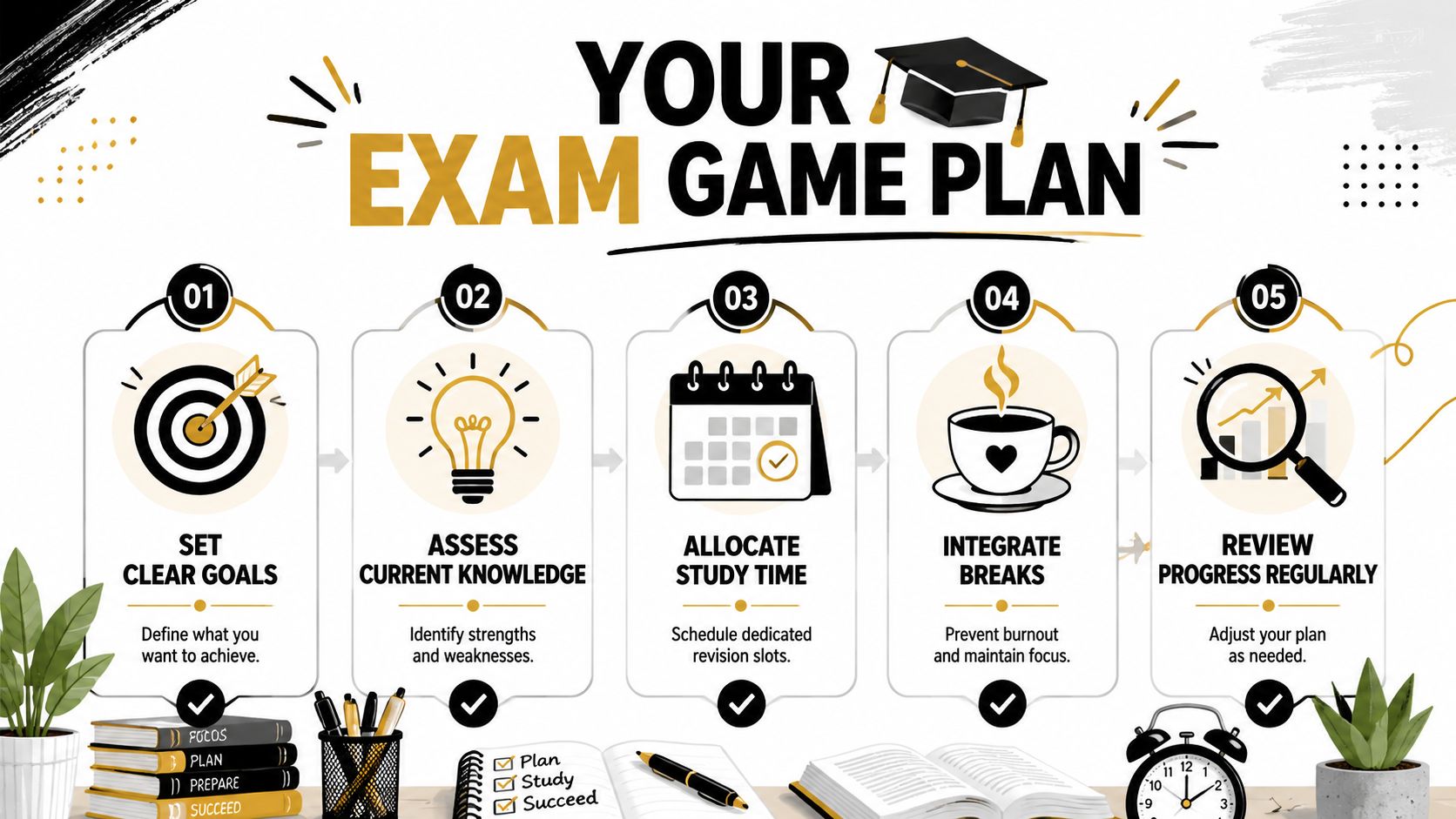
That means your study plan should begin with these questions:
- What is the exam date?
- What topics are listed on the specification?
- Which question types come up again and again?
- Where are you strongest?
- Where do you keep getting stuck?
Do a real-life time check
A perfect timetable that ignores your actual week won't last. A useful one will.
Try this simple approach:
| Part of your week | What to look for | What to do |
|---|---|---|
| Work hours | Fixed commitments | Block them first |
| Family duties | School runs, meals, care | Treat them as non-negotiable |
| Small spare pockets | Early mornings, lunch breaks, evenings | Use these for short revision bursts |
| Best energy times | When your mind works best | Put harder topics there |
| Low-energy times | When you're tired | Save lighter tasks for these slots |
You don't need huge blocks of time. You need regular, honest ones.
Build a plan you can keep
A workable plan usually includes:
- Small topic blocks instead of vague tasks like "revise maths"
- Specific actions such as "answer five algebra questions" or "learn key quotes for one poem"
- Catch-up space so one difficult day doesn't ruin the whole week
- One review point each week to check what's working and what isn't
Practical rule: If your timetable only works on a perfect week, it isn't your timetable. It's a fantasy.
If planning is hard, it helps to learn a few simple routines for protecting your study time. Our guide to time management for students balancing busy lives can help you turn good intentions into something more organised.
Keep the plan visible and kind
Write your plan somewhere you can see it. A paper diary, wall planner, notes app, or calendar all work. The tool matters less than the habit.
And be kind in the way you write it. Don't fill every space. Leave room for normal life. Busy adults don't fail because they need flexibility. They succeed when their plan expects reality from the start.
Study Smarter Not Harder
A lot of adults revise the way they used to at school. They read notes. Highlight lines. Re-read pages. Then they feel busy, but not secure.
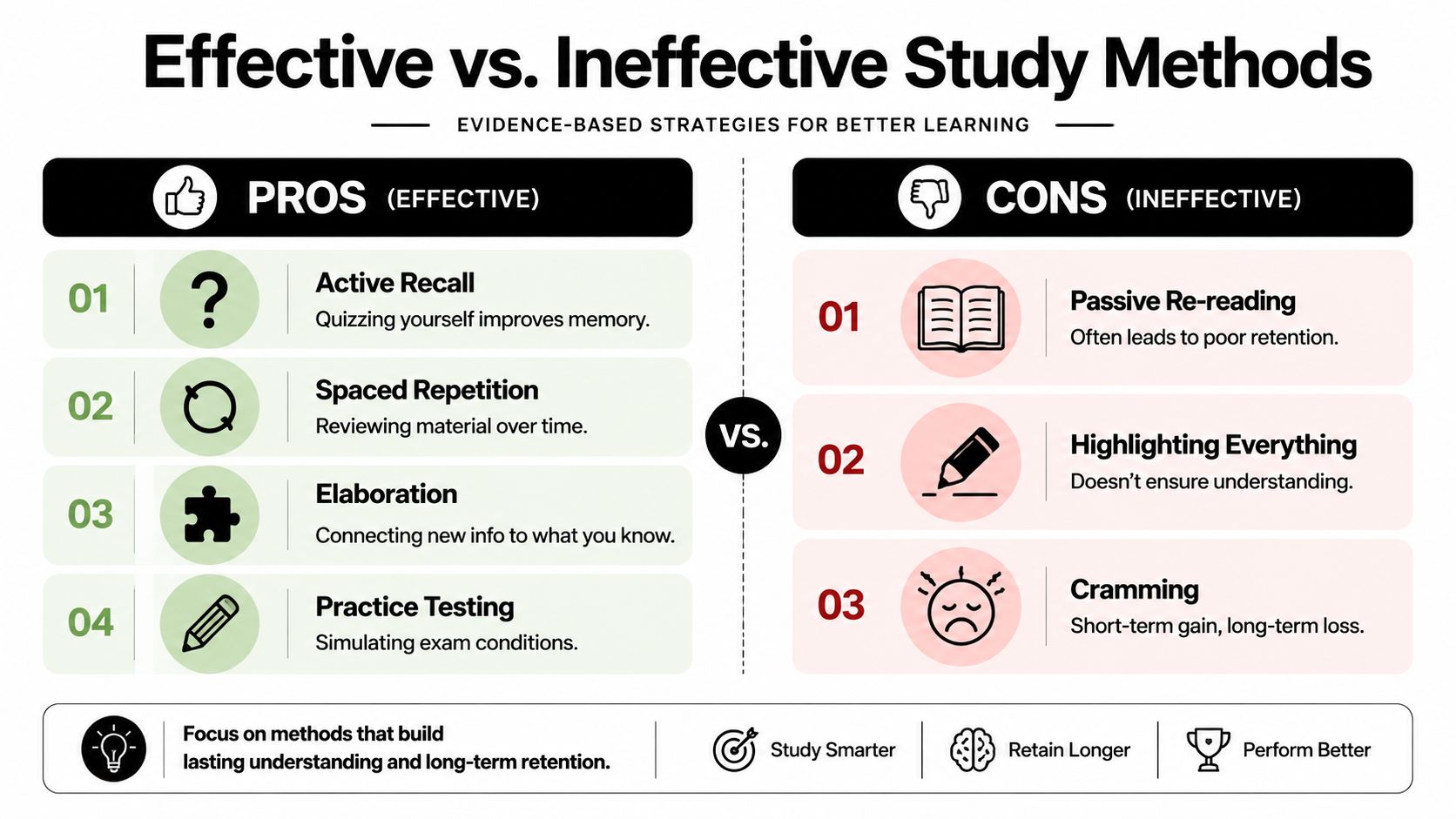
The problem is simple. Recognition is not the same as recall. Looking at information and thinking "yes, I know that" is much easier than producing it on your own in an exam.
Why passive revision feels good but lets you down
Passive revision can feel comforting because it is familiar. Your notes look neat. The pages become full of colour. You spend hours "doing revision".
Then the exam asks you a question and your mind goes blank.
That happens because exams don't ask whether material looks familiar. They ask whether you can bring it back without support.
Evidence from the Education Endowment Foundation shows that self-regulation strategies such as active recall and spaced practice can produce an average of +7 months' progress when used well, as summarised in this review of effective exam preparation methods. For a busy adult, that matters because each study hour needs to work harder.
What active recall looks like in plain English
Active recall means trying to remember something without looking at the answer first.
You can do that in simple ways:
- Cover and say: Read a point, cover it, then explain it out loud.
- Question cards: Put a question on one side and answer on the other.
- Blank page method: Write everything you remember on a topic, then check what you missed.
- Self-quizzing: Ask yourself short questions at the end of every session.
A good test is this. If your revision session doesn't ask your brain to retrieve information, you are probably not training for the exam.
Use spaced practice instead of one long panic session
Spaced practice means coming back to a topic over time instead of trying to force it all in at once.
A simple pattern might be:
- Learn a topic today.
- Test yourself on it tomorrow.
- Check it again a few days later.
- Return to it the following week.
That repeat contact helps the information stick. It also shows you what you know, not just what you read once.
Your memory strengthens when you make it work a little.
If you'd like practical ways to make your sessions more active, these active learning strategies for adult learners show how to turn revision into something more effective than endless rereading.
Make each session small and clear
Try to finish each study session with one visible result. For example:
- one set of solved questions
- one page of key facts recalled from memory
- one short paragraph written in exam style
- one list of mistakes to fix next time
That way, your revision feels real. You can see progress. And when confidence is low, visible progress matters.
Practise Under Pressure to Build Confidence
Many adult learners know more than they think. The problem isn't always knowledge. It's performance under pressure.
A common story goes like this. Someone studies hard, reads the textbook carefully, and understands the topic when no timer is running. Then they sit a practice paper, rush the final questions, misread a command word, and come away convinced they aren't good enough.
They are good enough. They just haven't practised the exam itself yet.
Past papers teach you what revision alone cannot
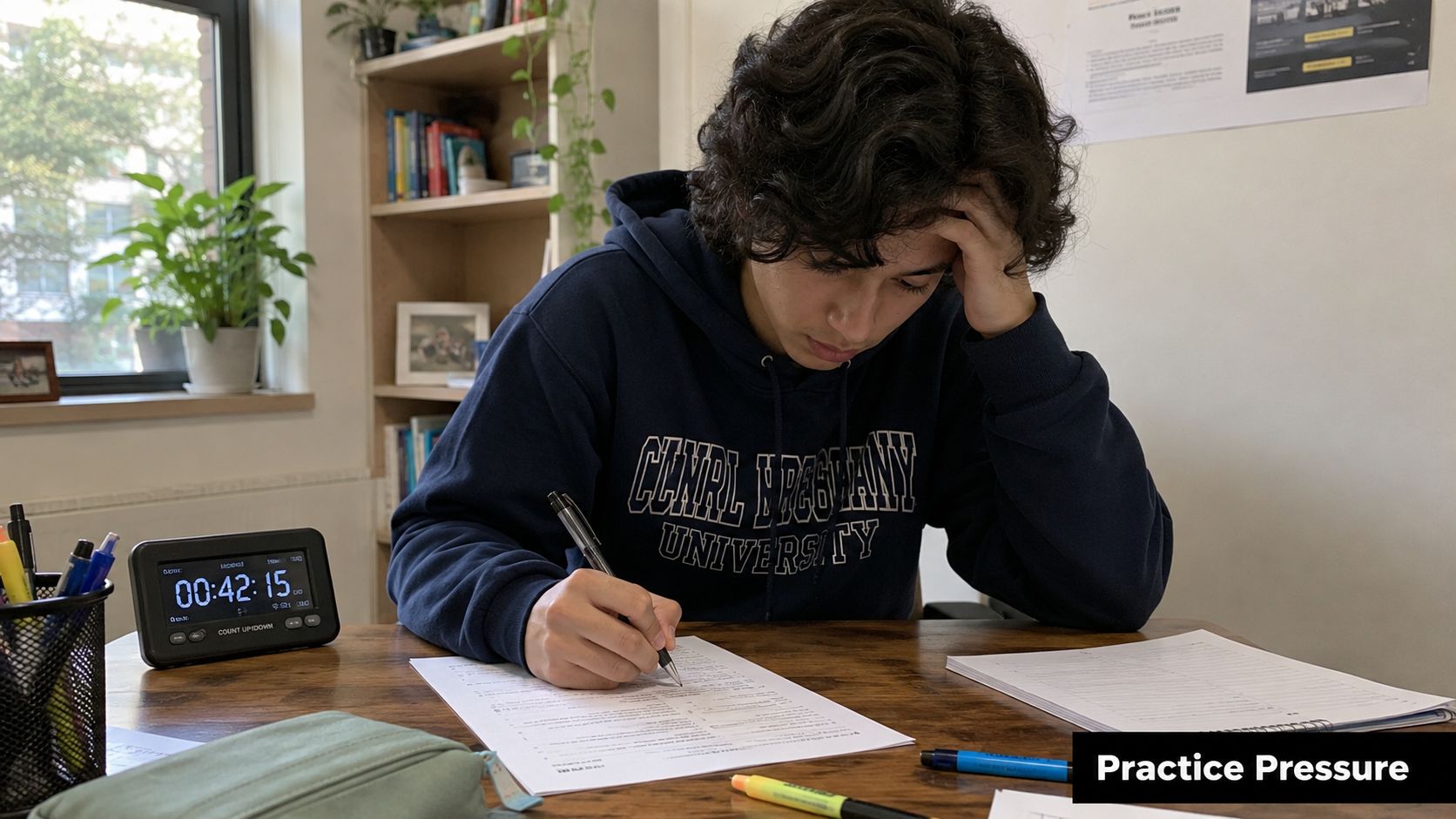
UK qualification guidance shows that students often lose marks because of exam technique, not only because they lack knowledge. Common problems include running out of time and misreading command words. Timed past-paper practice is one of the strongest ways to fix those problems, as described in this guidance on exam preparation and realistic practice conditions.
That matters because an exam is a skill as well as a test.
You need to know things, yes. But you also need to:
- understand what the question is really asking
- match your answer to the mark scheme
- write enough, but not too much
- keep moving when time is tight
Turn practice papers into a training tool
Don't use past papers only to measure yourself. Use them to train yourself.
A strong routine looks like this:
- Sit one paper under timed conditions. Quiet room. No notes. Same length as the exam if possible.
- Mark it using the mark scheme.
- Sort your mistakes into two groups. Knowledge gaps and technique gaps.
- Rewrite weak answers so you can see what a stronger response looks like.
- Repeat later and look for patterns.
Here is a simple way to track what went wrong:
| Mistake type | Example | What to do next |
|---|---|---|
| Knowledge gap | You didn't know the formula | Relearn that topic and test it again |
| Technique gap | You ignored the command word | Practise matching answer style to the question |
| Timing issue | Final question unfinished | Train with shorter timed sections |
| Careless slip | Sign error or missed word | Slow down at checking stage |
A poor score on a practice paper is not a verdict. It's a map.
Make the pressure familiar
When something feels unfamiliar, it feels frightening. Repeating exam conditions makes the experience less sharp and less shocking.
Try some of these:
- Use a visible timer so pacing becomes normal
- Practise starting quickly rather than spending ages frozen at question one
- Sit at a desk or table instead of revising only on the sofa
- Mark command words like explain, compare, calculate, evaluate
If you'd like a guided walkthrough, this short video is useful before your next mock.
The fear usually drops after a few rounds of proper practice. Not because the exam becomes easy, but because it stops feeling unknown.
Look After Yourself Through the Finish Line
Exams don't only test what you know. They also test how well you can function when you're tired, busy, or worried.
That is why wellbeing isn't a luxury extra. It is part of exam preparation.
The Education Endowment Foundation highlights that effective learners plan, monitor and evaluate their study. That kind of self-regulation also reduces overwhelm and makes study more sustainable, especially for older learners, as outlined in this summary of metacognition and self-regulation for exam study.
Protect your energy, not just your hours
Some adults try to make up for lost time by studying late into the night every day. It usually backfires. You end up reading while exhausted, forgetting what you studied, and feeling guilty on top of that.
A steadier routine works better.
- Sleep matters: A tired brain struggles to focus and retrieve information.
- Short breaks help: Walk, stretch, make tea, breathe. Then come back.
- Simple meals help concentration: You don't need perfection, just enough fuel.
- One thing at a time helps calm: Multitasking often increases stress.
Build a calm exam-day routine
The night before an exam should feel organised, not frantic.
Try this checklist:
- Prepare your essentials early so you're not hunting for them in the morning
- Choose your clothes the night before to remove one more decision
- Set more than one alarm if you're worried about oversleeping
- Eat something familiar rather than skipping food or trying to force a big meal
- Arrive with time to settle so your first feeling isn't panic
If your mind starts racing, come back to the next small action. Sit down. Breathe. Read the first question slowly.
Let people support you
You don't have to carry exam stress in silence. Tell your family what this period is like for you. Ask for practical help if you can. Even small support matters, such as a quieter evening, help with dinner, or someone asking how your revision went.
Also notice the wins. One finished topic. One better mock. One evening where you revised even though you were tired. Those moments count. They are proof that you're moving.
Your Next Step to a New Future
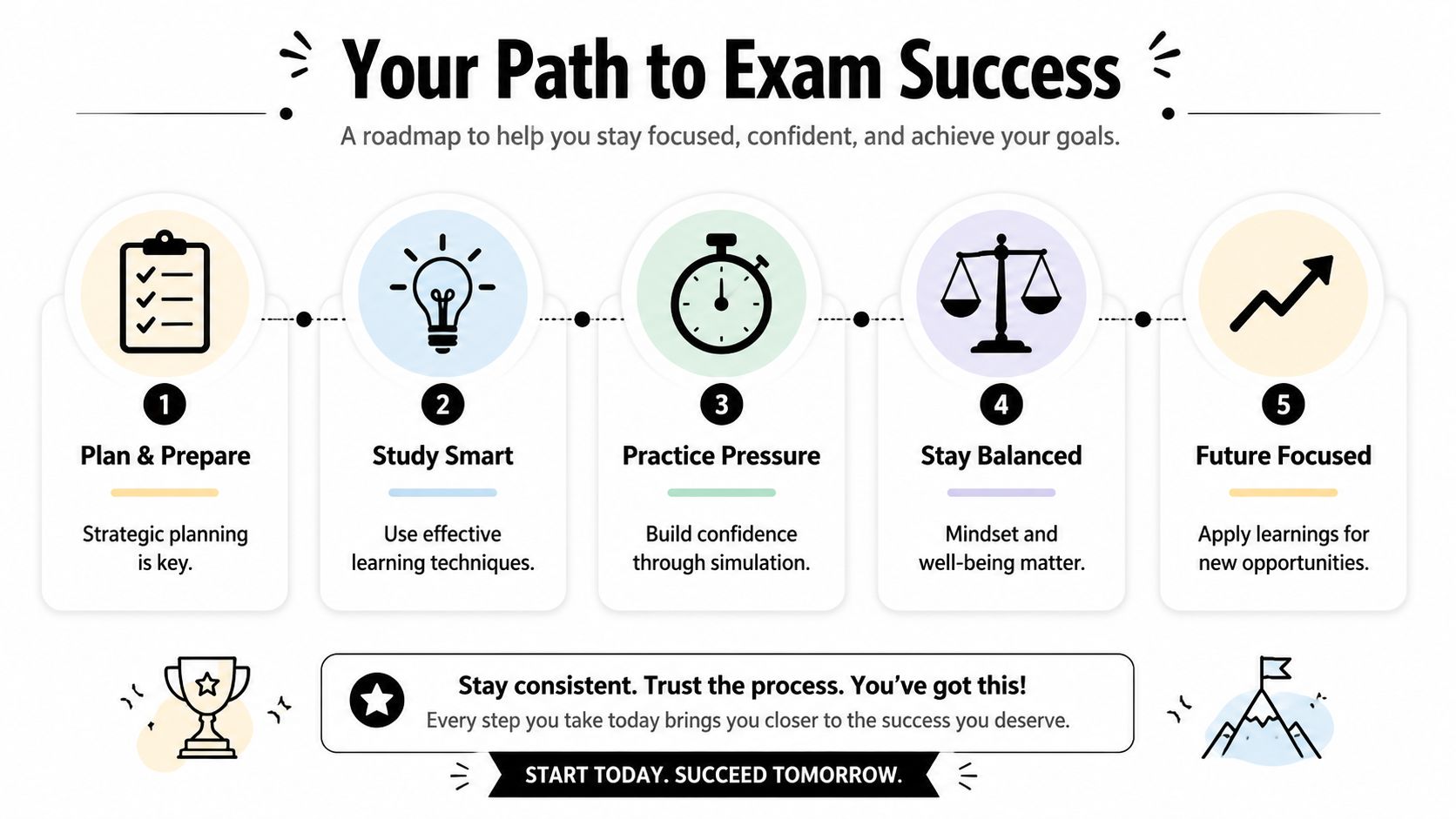
If you've been wondering how to prepare for exams without falling apart, the answer is simpler than it first seems. Make a realistic plan. Use methods that make your memory work. Practise the actual exam, not just the content. Look after yourself so you can keep going.
That combination is powerful because it respects your real life.
You are not starting from behind
You are starting with purpose. That changes things.
Adult learners often think they are late. In truth, many are finally ready. Ready to focus. Ready to ask for help. Ready to connect study to a bigger goal. That goal might be university, a new career, more stable income, or the pride of showing your family what persistence looks like.
If higher education is part of your plan, it helps to understand the route clearly. This guide on how to get into universities as an adult learner can help you see how qualifications connect to your next move.
Support can make the journey steadier
Some learners study alone and do well. Many do better with structure, tutor guidance, and clear progression routes. One option is Next Level Online College, which offers online courses for adult learners in Functional Skills, GCSEs, A levels and Access to HE Diplomas, with academic and pastoral support designed around work and family commitments.
What matters most is choosing support that fits your life and keeps you moving when motivation dips.
Keep the bigger picture in view
Exams are not the whole story. They are a bridge.
On one side is the version of you who doubted whether returning to education was realistic. On the other side is the version of you who followed through, earned the qualification, and created new choices. That person becomes an example to their children. That person can apply for opportunities that once felt closed. That person walks differently because they know what they overcame.
You don't need to have everything sorted today. You only need to take the next right step, then the one after that.
If you're ready to turn determination into a clear study path, Next Level Online College offers flexible online courses and support for adult learners working towards Functional Skills, GCSEs, A levels and Access to HE. The right course can help you build confidence, prepare properly, and move towards the future you want for yourself and your family.