
The children are finally in bed. You're sitting at the kitchen table with a laptop open, searching “study GCSE online free” and wondering whether it's a real opportunity or just another advert. You may be worrying about money, fitting lessons around work, or feeling too old to return to education.
Those worries are understandable, but they don't mean you can't succeed. This guide explains what “free” really means in the UK, who may qualify for funded GCSE English and maths, how private exam entry works, and how to build a study routine around family life. It also shows why free resources alone may not be enough if you need a recognised GCSE certificate.
You don't need to enrol on a paid course before you begin. In the next seven days, you can watch a free lesson, try a short maths or English assessment, check your local college's funding rules and book your first study session. Start small, keep going and let each completed task rebuild your confidence.
You Can Study GCSEs Online for Free and Start This Week
A GCSE can feel like a locked door when you haven't studied since school. Perhaps you left education early, struggled with exams, or spent years putting work and family first. Opening a textbook now may bring back uncomfortable memories, but your past experience doesn't decide what you can achieve today.
GCSEs remain a widely used qualification in England. Ofqual's provisional data records 5,840,185 GCSE entries in England for summer 2026, which was 1.1% higher than in 2025. The same dataset tracks GCSE outcomes from 2008 to 2026, showing that this is an established national qualification, not a niche route. You can review the wider picture in this guide to the state of GCSEs and A levels in 2026.
A useful starting point: You don't need to feel ready before you begin. Confidence usually grows after you take a few manageable steps.
Online learning can help because you can pause a video, replay an explanation and study when the house is quiet. It can also give you a route back into education without asking you to sit in a classroom every day. If you're unsure whether this format suits your situation, read whether you can do a GCSE online before choosing a provider.
Over the next week, keep your actions simple:
- Choose one subject: Start with English or maths if you need a qualification for work, training or further study.
- Try one free lesson: Use BBC Bitesize, Seneca, YouTube or an awarding body's sample materials.
- Book a short session: Put a 20-minute appointment in your phone calendar.
- Check local funding: Contact a further education college or the National Careers Service and ask about adult GCSE eligibility.
- Write down the next exam window: Knowing the destination makes your first study session feel purposeful.
You're not too old. You're an adult bringing patience, life experience and a reason to succeed. Your children may see you learning after a long day, and that can show them that education remains possible at any stage.
What Free Really Means for Adult GCSE Learners in the UK
The word free can describe several very different things. Before you choose a course, identify which type you're being offered. A website may give you free lessons, while the exam, tutor feedback or certificate still costs money.
The three honest tiers
Tier one is free revision material. BBC Bitesize, YouTube channels, Seneca, practice questions and past papers can help you learn. They don't enrol you for an exam and they don't award a GCSE certificate.
Tier two is a free, non-accredited course. A taster course or MOOC may teach a useful topic and help you decide whether you enjoy the subject. It still isn't the same as studying towards an official GCSE with an approved assessment route.
Tier three is a funded accredited GCSE. An eligible adult may study through a further education college or training provider without paying the tuition fee. The provider will normally assess your starting point, organise teaching and prepare you for a real exam. Attendance, assignments and registration requirements may still apply, even when the learning itself is funded.
Government guidance says adults aged 19 and over can receive fully funded English and maths up to and including Level 2 if they don't already hold GCSE grade 4/C or above. The Adult Skills Fund guidance explains the wider policy position.
Check the details before enrolling
Funding rules can depend on your age, previous qualification, employment situation, income and location. For 2025/26, eligible learners may study GCSE English and maths free if they're aged 19 to 23 without grade 4, or if they're aged 19 or over and unemployed or earning under £25,750 per year. Confirm your own position with a local college or the National Careers Service because providers must check your circumstances.
| Tier | What you get | What it doesn't include | Best for |
|---|---|---|---|
| One | Free lessons, videos, quizzes and papers | GCSE entry, marking support and certificate | Independent revision |
| Two | Subject teaching through a free course | An accredited GCSE qualification and exam route | Exploring a subject |
| Three | Funded teaching towards an official GCSE | Exam entry or extra support may still need checking | Eligible adults seeking a recognised qualification |
Free tuition doesn't always mean free exam entry. Be cautious if a provider promises a “free GCSE with no exam”. A GCSE certificate requires assessment through an awarding body, so ask who sets the exam, where you'll sit it and whether the fee is included.
If you're designing learning for adults at work or supporting different kinds of learners, creating effective workplace training offers useful ideas about how people take in and practise new information. For help with financial support connected to study, you can also review online bursary options.
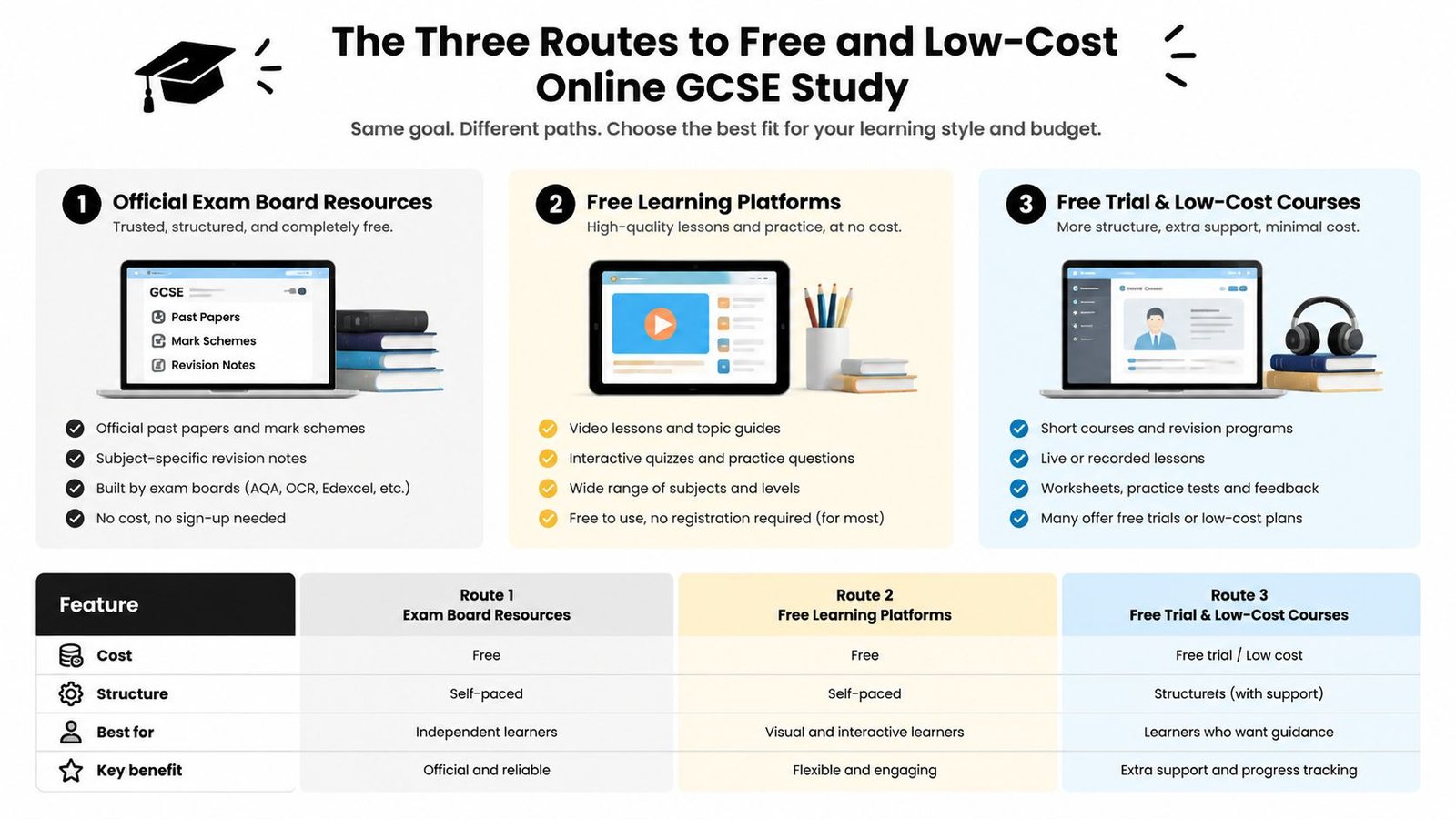
The Three Routes to Free and Low-Cost Online GCSE Study
You have three practical choices. The right one depends on whether your priority is spending as little as possible, receiving regular tutor support or studying at home with maximum flexibility.
Route A, free resources and a privately booked exam
You can teach yourself with BBC Bitesize, Seneca, YouTube, textbooks and past papers, then arrange an exam through a private candidate centre. This route can keep learning costs very low, but you'll need to pay for the exam and manage your own plan.
There's no regular tutor checking your work unless you arrange one. English language can also include spoken language requirements, and some subjects have practical or controlled assessment arrangements. Check the specification before you commit.
This route suits a disciplined learner who can identify weak topics, mark work accurately and keep studying without weekly deadlines. It's less suitable if you need someone to explain mistakes or help you stay accountable.
Route B, a funded college or training-provider GCSE
An eligible adult may be able to study GCSE English or maths without paying tuition. A college might offer online lessons, evening sessions or a blended programme, although the exact timetable differs between providers.
You'll usually complete an initial assessment and follow the provider's attendance and coursework expectations. Enrolment windows can close before the exam season, so don't wait until you feel completely prepared before asking about places.
This is often the safest option for a learner who wants a recognised qualification and regular guidance. Ask whether online attendance is live, recorded or a mixture of both.
Route C, a paid online GCSE course
A private online course lets you study at home and may offer tutor marking, structured lessons and exam preparation. You'll pay the provider's fee, and you may still need to arrange and pay for the exam separately.
The main benefit is control. You can study around shifts, childcare and travel, rather than following a college timetable. The trade-off is that you must check exactly what support and assessment are included.
Before paying any provider, ask:
- Exam inclusion: Is the official exam fee included, or will you arrange it yourself?
- Awarding body: Is the qualification with AQA, OCR, Pearson Edexcel or WJEC?
- Marking support: Who marks written work, and can you ask questions between assignments?
- Resits: What happens if you don't pass the first time?
- Assessment requirements: Does the subject include practical, spoken or controlled assessment?
- Progression: Will the qualification meet the entry requirement for your next step?
GCSEs and alternatives don't serve exactly the same purpose. Read what counts as a GCSE equivalent before deciding whether you need the GCSE itself or another Level 2 route.
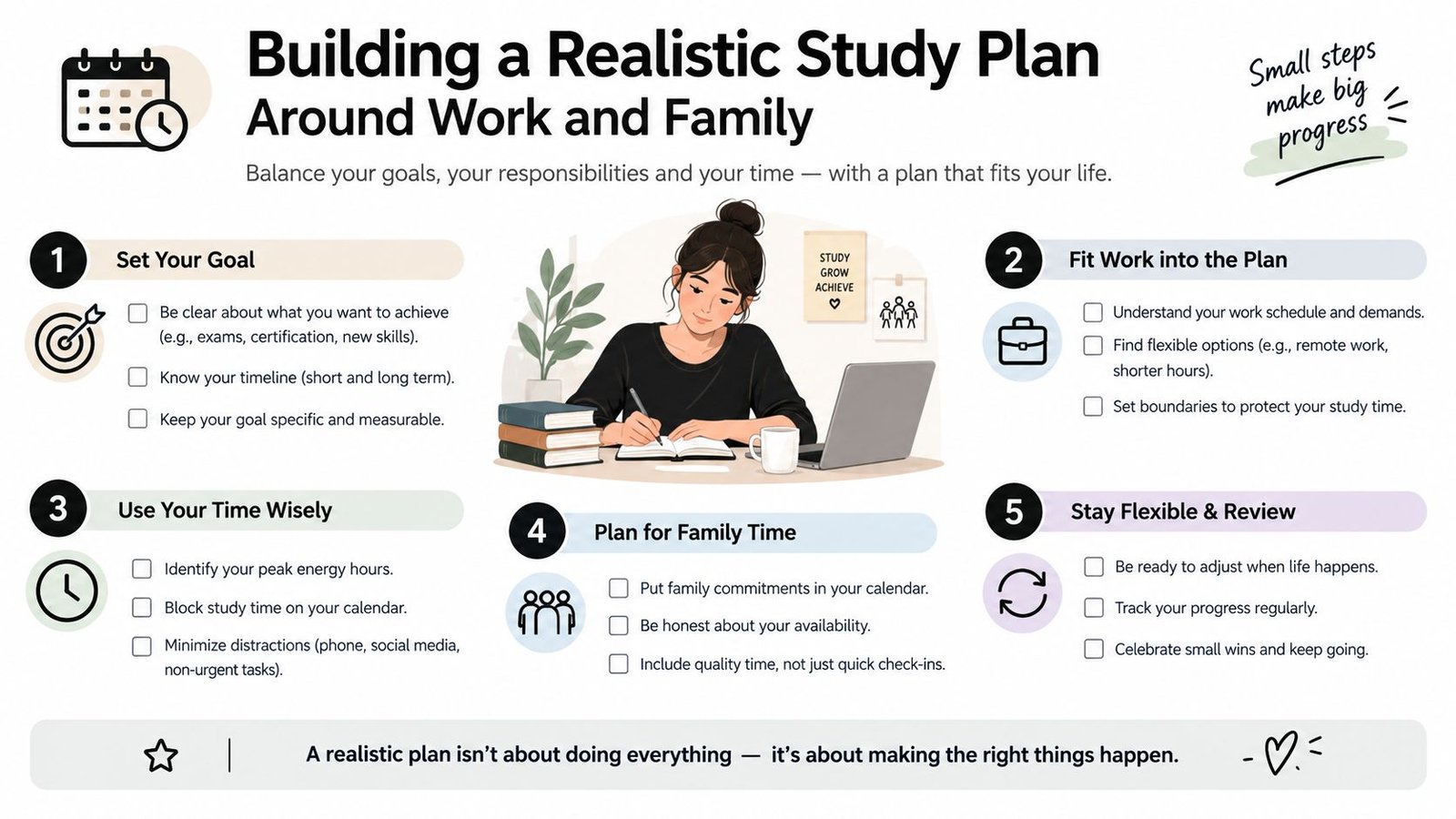
Building a Realistic Study Plan Around Work and Family
A plan that ignores your real life won't last. You don't need to cram for long hours each week. Regular study beats an ambitious timetable that collapses after a few days.
Start with an honest audit. Write down your work shifts, school runs, meal times, caring duties and the parts of the day when your energy drops. Don't plan difficult algebra after a night shift if you know you'll be exhausted. Use that time for flashcards or a short video instead.
Four steps that make study possible
Choose one fixed anchor. This might be 7pm after the children are in bed, or Sunday morning with a cup of tea. A regular anchor turns study into an appointment rather than a decision you have to make repeatedly.
Work in topic blocks. Give yourself a clear block for a maths topic, an English reading skill or another chosen subject. Rotate subjects across blocks so you don't become tired of one type of work.
Use small spare windows. A phone app can help you revise vocabulary while waiting for a bus or practise number skills during a lunch break. If you need reading, screen or input support, guidance on inclusive assistive tech for students may help you choose tools that reduce friction.
Make progress visible. Put a wall calendar beside your desk, set phone reminders or print a tick sheet. Seeing completed sessions is powerful when your confidence is low.
A parent with nursery drop-offs might study for 20 minutes after the morning school run, then complete a short quiz while waiting for collection time. A hospital worker on night shifts could watch a lesson after waking, use a revision app during a quiet break and reserve one rested day for a full written task.
Begin with a 20-minute Pomodoro session. Study until the timer ends, take a short break and write down what you completed. Test yourself once each week instead of only rereading notes, and connect rewards to finished topic blocks, such as a favourite programme, a walk or time with your family.
Registering as a Private Adult Candidate for GCSE Exams
Self-study only leads to a qualification when you complete the official assessment. As a private candidate, you enter through an approved exam centre rather than through a school or college where you're enrolled.
The registration process
First, select the exam board and specification. Common boards include AQA, OCR, Pearson Edexcel and WJEC. Check that the exact subject and syllabus are still available for private entry. The specification matters because it sets the topics, papers and assessment rules you must follow.
Next, find an approved centre. Start with local secondary schools, sixth-form colleges and further education colleges. Awarding body directories may help, but you'll still need to contact the centre directly and ask whether it accepts external adult candidates.
Then, ask detailed questions early. Confirm the available exam date, entry fee, administration charge, identification requirements and any coursework or practical assessment. Private candidates can't usually enter components that depend on coursework-only arrangements unless the centre can support the required assessment.
Finally, register and pay. Entry fees typically range from £50 to £120 per subject, plus any centre administration charge. These figures can vary, so treat the centre's written quote as the final cost.
| Step | Action | Typical cost | Timing |
|---|---|---|---|
| One | Choose the board and specification | No fixed cost | Before contacting centres |
| Two | Find an approved external-candidate centre | No fixed cost to enquire | Early in the academic year |
| Three | Confirm papers, assessments and arrangements | May include centre charges | Before registration closes |
| Four | Submit details and pay | £50 to £120 per subject, plus administration | By the centre's deadline |
Most centres close summer entries by late January, although their own deadlines may be earlier. Contact several centres if the first one can't accept you. Ask about access arrangements as soon as possible if you have a documented learning need, because evidence and approval can take time.
Keep every email, invoice and confirmation. Write down the exam board, specification code and centre contact details. That small record can prevent confusion when you're revising several months later.
How Grading and Resit Data Shape Your Study Approach
The GCSE scale runs from 9 to 1. Grade 4 is generally treated as a standard pass, while grade 5 is commonly described as a strong pass. English and maths grade 4 results are often used in entry requirements for employment, apprenticeships and further study, so your revision should focus on the skills that earn marks under timed conditions.
Adult learners need to take exam performance seriously. In 2026, candidates aged 17 and over achieved grade 4 or higher in only 19.8% of English language entries and 15.3% of maths entries. That age group represented 24.3% of all English language and maths entries. The reported GCSE resit figures show why adults shouldn't rely on just reading notes and hoping the knowledge appears in the exam.
Turn revision into marked practice
Aim beyond the minimum where you can. A grade 5 target gives you some protection if a difficult paper or a small marking difference leaves you just below the grade 4 boundary.
Use this cycle:
- Complete a full timed paper: Do one under realistic exam conditions every fortnight.
- Mark it promptly: Use the official mark scheme the same evening, while you still remember your decisions.
- Keep an error log: Record the question, the mistake, the correct method and what you'll do differently.
- Repeat weak topics: Return to the error log before attempting another paper.
Ofqual's outcomes data tracks GCSE results from 2008 to 2026 and includes outcomes by centre type, which can help you compare progress with national patterns rather than relying on advertising claims. The Ofqual GCSE outcomes dashboard is useful for understanding grade thresholds and results.
| Grade | Typical boundary | First attempt pass rate | Resit pass rate |
|---|---|---|---|
| 5 | Strong pass level | Varies by subject and series | Varies by subject and series |
| 4 | Standard pass level | Varies by subject and series | Varies by subject and series |
| Below 4 | Not normally a pass | Varies by subject and series | Varies by subject and series |
The table avoids invented rates because pass results change by subject, exam series and candidate group. Independent UK tuition evidence cited in the supplied Ofqual-linked data reports that students attending at least one term of tuition achieved maths and English pass rates 70% and 76% above the national average, respectively. That comparison highlights the weakness of unsupported self-study, especially when nobody checks your marking or explains repeated errors.
Adults can usually resit GCSEs, but exam-board rules limit immediate resits in the same series and allow later sittings. Check the specific board and centre rules before planning your next attempt.
Your Next Step Toward GCSE Success and a Brighter Future
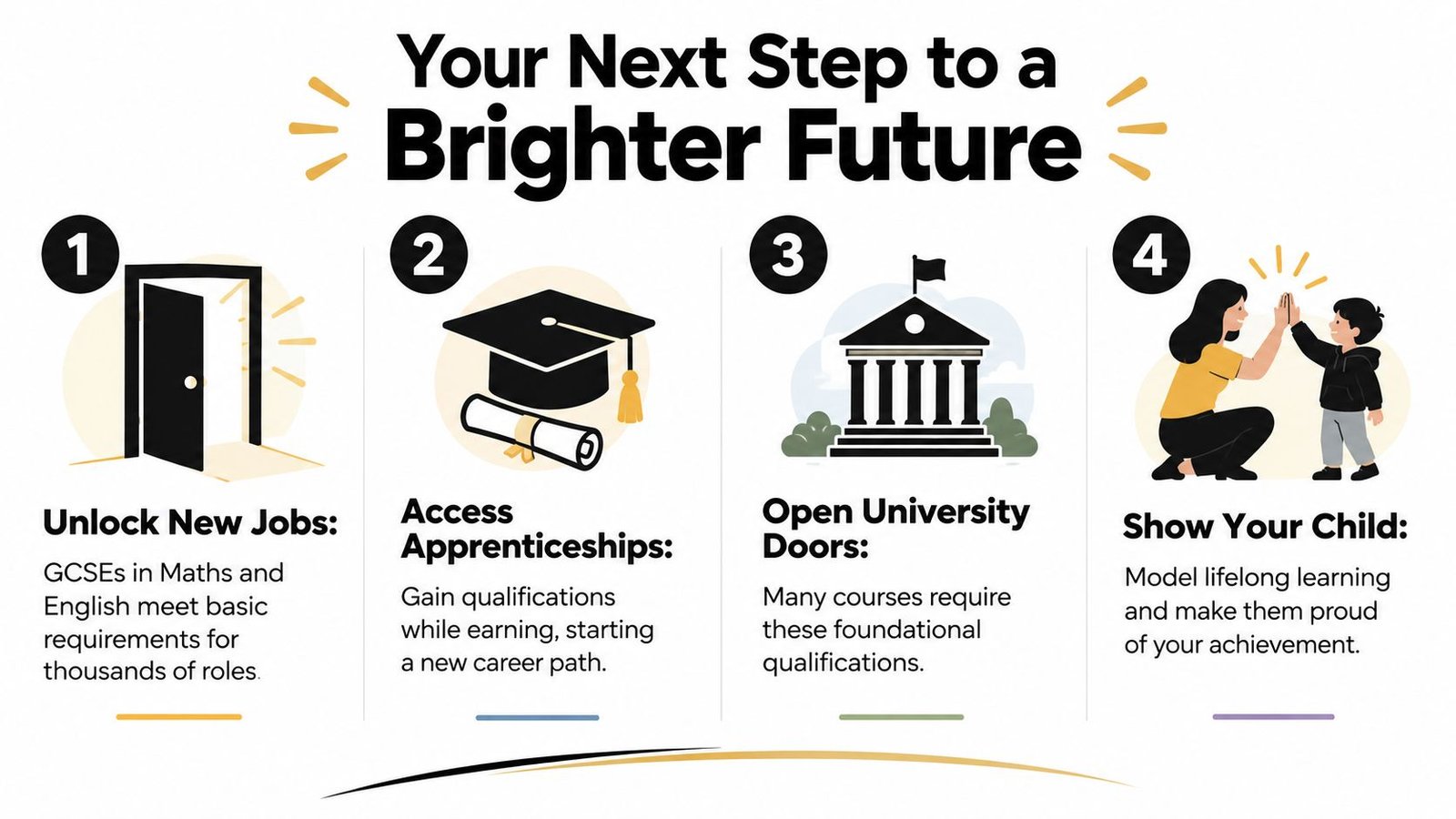
Returning to education may feel frightening because the exam represents more than a piece of paper. It can stand for the job you couldn't apply for, the apprenticeship you postponed or the university application you thought belonged to someone else.
A GCSE won't solve every problem on its own, but it can remove a barrier. English and maths may support applications for new jobs, apprenticeships and further study. If university is your goal, an Access to Higher Education Diploma can provide a Level 3 route. Government guidance says an Access diploma contains 60 credits, with one credit equal to 10 notional learning hours, and uses a 600-hour threshold when setting funding rates. You can read the relevant adult education funding rules.
Make the future specific
Research destinations that connect with your interests:
- NHS apprenticeships: Look at healthcare, administration and support roles that combine employment with training.
- Policing: Check the English and maths requirements for the force and role you're considering.
- Teacher training: Explore the GCSE requirements for later teacher-training routes.
- University Access courses: Find out which GCSE results your chosen Access provider asks for.
- Career changes: Search job adverts and write down the qualifications employers repeatedly request.
The adult learning field is large. Government figures record 316,200 adult learners in essential skills courses in 2025/26 to date, while adult participation in education and training was 1,174,940 in 2024/25. Participation fell 4.8% from the previous year, after several years of increases since 2020/21, so flexible and accessible routes remain important for people balancing employment and family life. These figures come from the Further Education and Skills statistics.
Your action list for this week is deliberately short:
- Choose one subject and write down why you need it.
- Open one free resource and complete one lesson or quiz.
- Book a 20-minute study slot that fits your actual routine.
- Contact a local college to ask about funded GCSE English or maths.
- Note the next exam deadline if private entry may be your route.
You may be studying because you want more money, a fulfilling career or the chance to make a bigger difference in your community. You may also be doing it because you want your child or grandchild to see you keep a promise to yourself. Both reasons matter.
Don't wait for fear to disappear. Let your first small win come before confidence. Read the second section again with fresh eyes, decide which meaning of “free” applies to you and take the next practical step today.
Next Level Online College offers flexible online GCSEs, Functional Skills, A Levels and Access to Higher Education diplomas, with academic and pastoral support for adults fitting study around work and family. Visit Next Level Online College to explore a supported route towards a recognised qualification and the future you're working to build.