
You may be sitting at the kitchen table after the children have gone to bed, looking at a Functional Skills course and wondering, “Is Functional Skills Level 2 hard?” Perhaps you need English or maths for work, an apprenticeship, further study or a university application. You may also be carrying memories of school exams, low marks or a long gap since you last opened a textbook.
The honest answer is that Level 2 can be challenging, especially if your confidence has taken a knock. But it isn't an impossible test, and you don't need to be perfect. Functional Skills is built around practical English and maths, so the main challenge is usually steady practice, understanding questions and finding a study routine that fits around real life.
Facing the Fear of Returning to Education
Returning to education can feel much bigger than the qualification itself. You might be working during the day, caring for children, managing bills and trying to study when your energy is already low. The thought of sitting an assessment can bring back the feeling of being judged in a classroom.
Those feelings are common, but they aren't proof that you can't succeed. They show that the result matters to you. Many adult learners begin with rusty skills and little confidence, then improve when they receive clear explanations and regular encouragement.

Turn one large worry into small tasks
A Level 2 qualification can look like a wall from a distance. Up close, it's a set of smaller skills. In maths, you might practise percentages, measurements, data or everyday calculations. In English, you might work on reading information, writing clearly and communicating ideas.
Think of learning like filling a box with bricks. One session may help you understand a percentage question. Another may show you how to organise a formal email. Each small improvement gives you something solid to build on.
A useful mindset: You don't have to feel confident before you begin. Confidence often arrives after you've completed a few manageable tasks.
Try replacing “I was never good at maths” with “I haven't practised this skill for a while.” Try replacing “I'm too old to study” with “I have life experience that helps me understand practical problems.” Adults often bring useful knowledge from work, parenting, budgeting and communication.
Your reason can carry you through
You may be studying because you want a better job, a new career or access to a course that once seemed out of reach. You may want your children to see that learning doesn't stop when school ends. That purpose can help you return to your notes on a difficult day.
Start with curiosity rather than fear. Ask, “What does this question want me to do?” Then solve one part at a time. A wrong answer isn't a verdict on your ability. It's information showing you what to practise next.
How It Compares to Traditional GCSEs
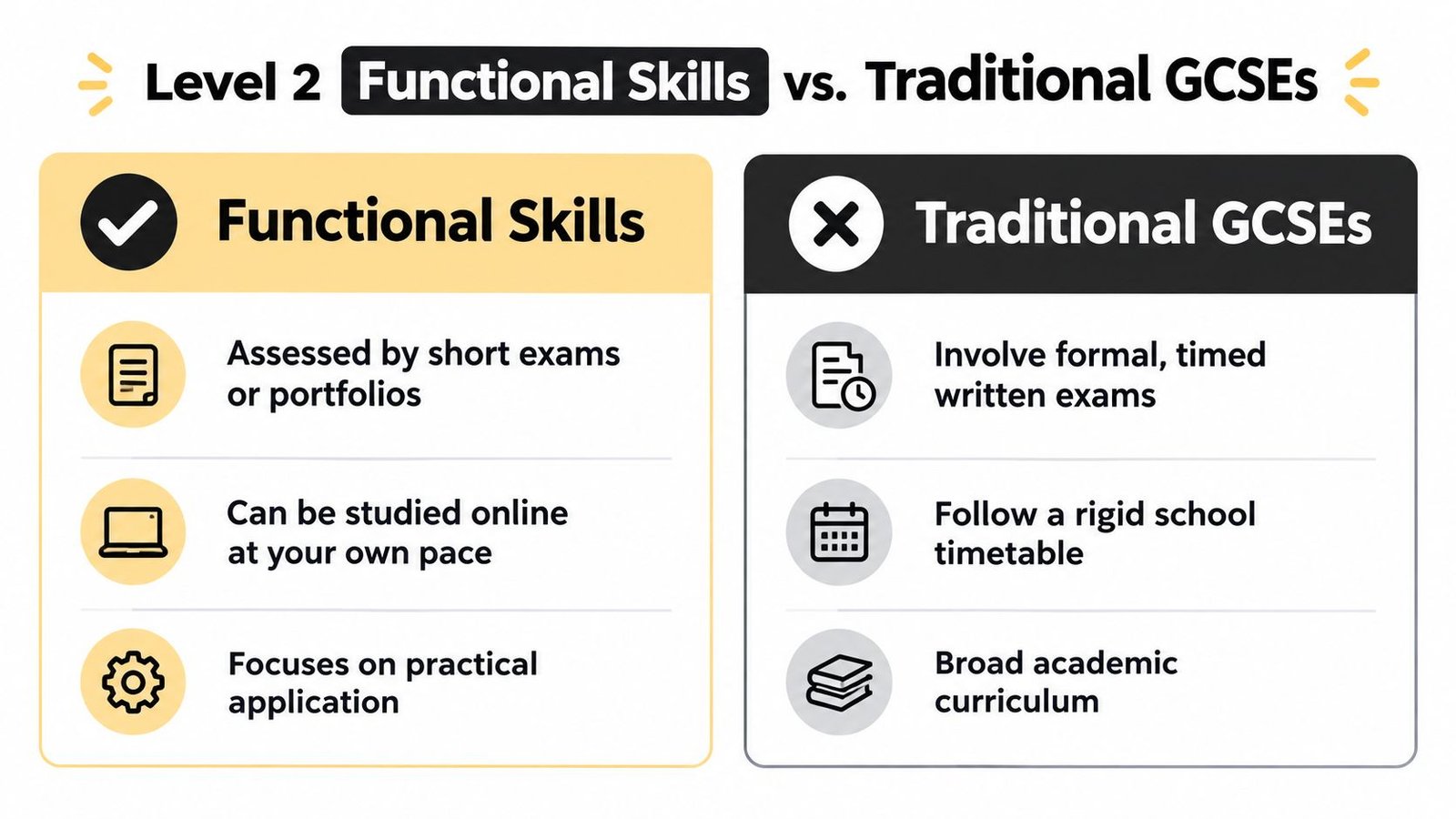
For an adult learner returning to study, the word “equivalent” can sound like a promise that two qualifications are identical. Functional Skills Level 2 and GCSEs sit at Level 2 on the Regulated Qualifications Framework, with GCSE grades 9–4 occupying that level. Their purpose and assessment style differ, however. Functional Skills focuses on practical English or maths for work, further study and everyday situations, rather than asking you to revise a wide academic syllabus.
A GCSE generally covers more topics and explores theory in greater depth. Functional Skills asks you to apply a smaller set of skills in situations that may feel familiar, such as reading workplace information, checking a bill or presenting an idea clearly. That practical context can make the qualification feel more manageable when anxiety about returning to education is the main obstacle.
A practical toolkit rather than a large textbook
GCSE maths may include abstract subjects that seem far removed from daily routines. Functional Skills maths puts numbers, measurements, shape, space and data into practical problems. You might check whether a bill is accurate, compare prices, read a chart or calculate measurements for a household task.
Functional Skills English develops communication you can use beyond the exam. Practice may include finding information in a text, identifying opinions or bias, writing an email, letter or article, and choosing the right tone for different readers. Careful reading and well-organised answers matter more than memorising long passages.
| Qualification | Main emphasis | How it may feel to an adult learner |
|---|---|---|
| Functional Skills Level 2 | Practical application of English and maths | Familiar situations, with focused skills to practise |
| Traditional GCSE | Wider academic content and deeper theory | Broader revision, with more topics and concepts |
| Both qualifications | Recognised Level 2 study | A route towards work, further education or progression |
What “equivalent” really means
Equivalent means that the qualification is placed at the same regulated level as the relevant GCSE standard. It does not guarantee that every employer, college or university will accept both routes in exactly the same way. Check the entry requirements for your intended course before you enrol, particularly if you are planning university study.
Functional Skills may meet an English or maths requirement on some routes, but it does not provide UCAS Tariff points. UCAS Tariff points apply to Level 3 qualifications. For a clearer comparison of the two routes, read this guide to Functional Skills and GCSE equivalence. A flexible online course with tutor support can also make the practical route easier to fit around work, parenting and other responsibilities.
Understanding Pass Marks and Boundaries
A pass mark can feel intimidating when it is presented as a single figure without context. Functional Skills assessments do not use one permanent percentage across every awarding organisation, paper or test version. Boundaries may change between assessment sessions because awarding bodies set a standard for the particular assessment being taken.
For example, one published NCFE update gave different Level 2 figures for each component, including Maths, English Reading and English Writing. The figures applied to specific assessments, rather than serving as a universal rule for every learner. That distinction matters: your course provider should explain which awarding organisation and assessment format apply to you.
What a pass boundary means
A pass boundary is the mark required on a particular assessment. It is not a prediction of how difficult your whole learning journey will feel. You can review how one awarding organisation explains Functional Skills pass marks in OCR's explanation of Functional Skills pass marks.
| Subject area | What the boundary tells you | What this means for you |
|---|---|---|
| Maths Level 2 | The required mark depends on the assessment | Consistent accuracy matters more than a perfect paper |
| English Reading Level 2 | The boundary applies to that specific test | Careful reading and selecting evidence matter |
| English Writing Level 2 | The result reflects several writing skills | Spelling, punctuation, grammar and organisation all count |
OCR describes Level 2 mathematics pass marks using its own assessment scale, while other awarding organisations may publish boundaries in a different form. Comparing the figures directly can therefore create unnecessary worry. A mark on one organisation's paper is not automatically equivalent to the same-looking mark on another paper.
Ask your provider for the current assessment rules. Practise with papers that match your course, including the question style and time limits. This is like training with the same map you will use on the day. It makes the route more familiar and gives your preparation a clear purpose.
Why pass rates can look lower than the boundary
A pass boundary and a pass rate measure different things. The boundary is the mark an individual learner needs on an assessment. The pass rate is the proportion of learners who achieve the qualification in a particular group or session.
Published assessment material has reported varying Level 2 mathematics and wider Functional Skills outcomes across different sessions, including lower results during a period of major disruption. Those figures show that the qualification deserves steady preparation, particularly in maths. They do not determine your result or describe your ability as an individual. Your starting point, practice, support and familiarity with the assessment all affect how ready you feel.
Small improvements add up. Understanding one question type, checking one calculation carefully and correcting one repeated writing error can make the next practice paper feel more manageable.
For a practical explanation of what assessment practice involves, use this guide to the Functional Skills test. Aim for dependable performance across the core skills, not perfection. With patient guidance and flexible online study, an anxious first attempt can become a series of achievable steps.
Smart Study Habits for Busy Parents and Workers
The hardest part may not be the content. It may be finding a quiet moment before somebody needs dinner, help with homework or a lift to work. A flexible routine works better than a heroic plan that leaves you exhausted after a few days.
Build a routine you can repeat
Choose a small study block that matches your life. You might revise during a work break, after the school run or while the house is quiet. Short, focused sessions are easier to protect than vague promises to study “later”.
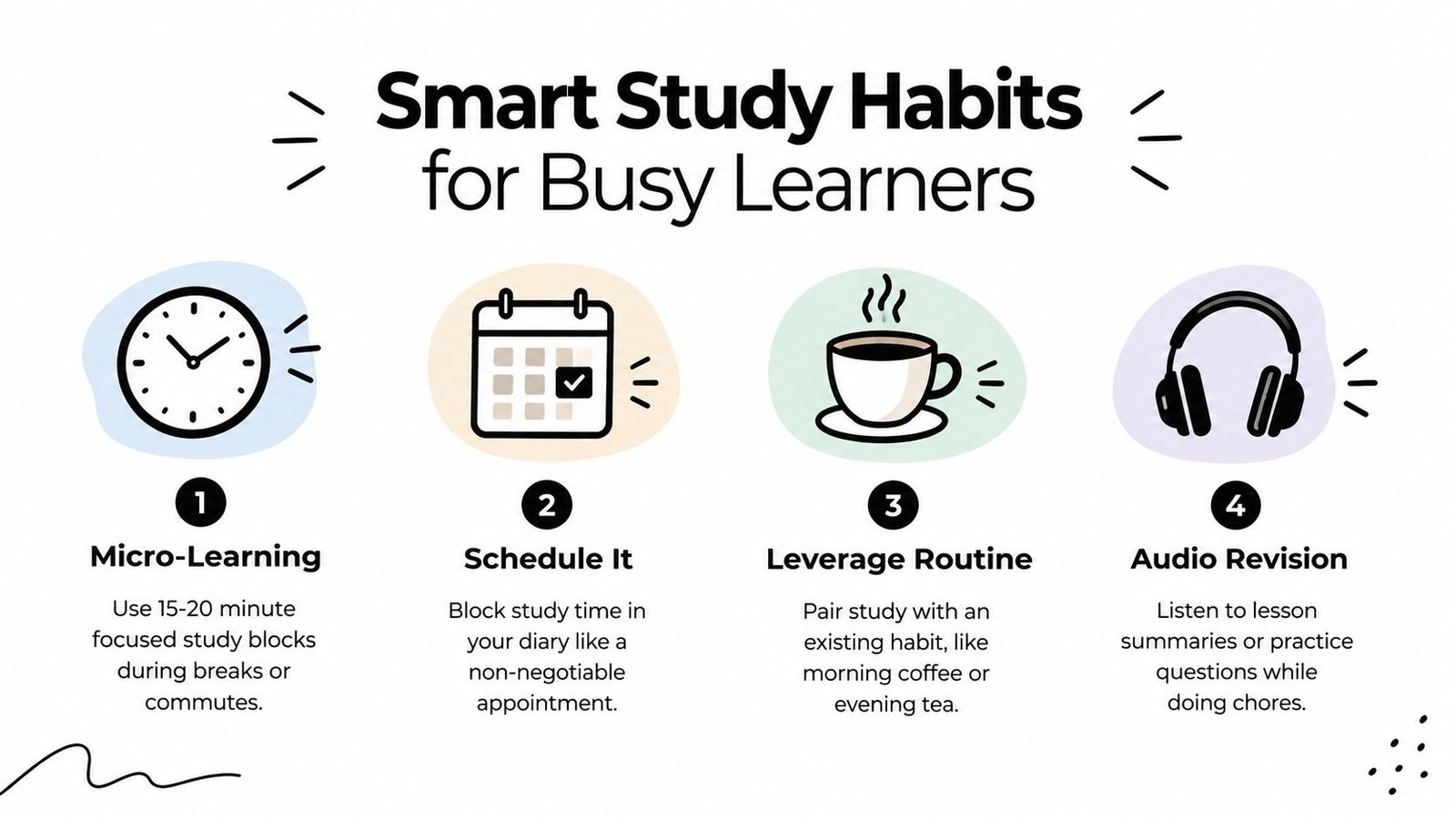
Try these practical habits:
- Use micro-learning: Work through one focused topic during a short break rather than trying to complete a whole unit.
- Schedule study time: Put sessions in your diary and treat them like an important appointment.
- Connect learning to routine: Review a short lesson with your morning coffee or evening tea.
- Use audio revision: Listen to lesson summaries or questions while doing safe household tasks.
A utility bill can become a maths exercise. Look at the figures, compare charges and check whether the information makes sense. Helping your child with homework can also refresh your own skills, but remember that your Level 2 work may use different methods, so ask your tutor when you're unsure.
Keep moving when your mind freezes
When a question feels impossible, don't stare at it until frustration takes over. Read it slowly, underline the important information, write down what you already know and identify the exact instruction. If you're still stuck, mark it, move on and return later.
Keep a simple progress record. Write down the topic you practised, one thing you understand better and one question to ask. This turns study into visible evidence of progress, which is especially helpful when your confidence is low.
Small-win rule: Count completed practice, not just correct answers. Every honest attempt gives you information you can use.
Support at home can make this routine easier. If you need ideas for staying consistent and involving another person, explore this resource on how to find accountability for students at home. You can also find practical planning guidance in this guide to time management for students.
This video can provide another way to revisit study habits when reading feels tiring:
Why Supported Online Learning Changes Everything
A textbook can show you a method, but it can't notice when you keep making the same mistake. It can't reassure you after a difficult practice paper or explain a question in words that make sense to you. Adult learners often need access to real people, not just a login and a collection of pages.
A supported online course can remove several barriers at once. You can study around work and family responsibilities, revisit lessons when needed and ask questions before confusion grows. A tutor can help you identify whether the problem is a missing skill, a misunderstanding of the question or nerves under timed conditions.
Look for support that matches adult life
Before choosing a provider, ask practical questions:
- Can I study flexibly? Check whether lessons can fit around shifts, childcare and changing routines.
- Who answers my questions? Find out whether subject specialists or tutors provide guidance.
- How will I prepare for assessment? Ask about practice tasks, mock exams and feedback.
- What happens if confidence drops? Look for pastoral or wellbeing support, not only course materials.
- Which awarding organisation is involved? Confirm the qualification, assessment format and progression rules.
This kind of support doesn't remove the need to study. It makes your effort more effective. Instead of spending an evening searching for a basic explanation, you can ask a focused question and use the answer to practise correctly.
Support can change your experience of difficulty
Two learners may use the same syllabus and have very different experiences. One studies alone, guesses what to revise and avoids difficult topics. The other receives a clear plan, checks understanding regularly and gets help before small gaps become large ones.
Next Level Online College offers online Functional Skills English and maths courses with structured learning, assessment preparation and academic and pastoral support for adult learners. It is one option to consider if you want flexible study with guidance rather than trying to manage every part of the process alone.
You still have responsibility for attending to your learning, completing practice and asking for help. But you don't have to carry the uncertainty by yourself.
Building a Proud Legacy for Your Family
Passing Functional Skills Level 2 can change what you believe about yourself. The certificate matters because it may support a job application, further study or a university pathway. The deeper achievement is proving that a difficult chapter in your education doesn't have to define the rest of your life.
Your children may remember the small moments. They may see you study after work, ask questions, practise again after a mistake and keep going when the answer doesn't come quickly. You won't need a perfect speech about the value of education. Your actions will show them that adults can learn, change direction and recover from setbacks.
A qualification can open a wider path
Functional Skills Level 2 may help you meet an English or maths requirement for a chosen route, but always check the specific rules of the employer, college or university you want to approach. It doesn't provide UCAS Tariff points, so you may need a Level 3 qualification or other entry requirement for degree study.
That doesn't make Level 2 unimportant. It can be the piece that helps you move forward to the next stage. From there, you may work towards a career that offers greater responsibility, stronger earning potential and more meaningful work. Your route might lead through an apprenticeship, a college course, professional training or university.
Let progress replace old labels
You don't need to become a different person overnight. Start by finding your current level, choosing English or maths, and making a study plan that respects your responsibilities. Celebrate understanding a topic, completing a practice task or asking for help. Those moments build the confidence you need for the assessment.
Your family can be part of the journey without carrying the pressure. Tell them what you're working towards, share a small success and let them see that progress is built through regular effort. One day, the lesson they remember may be simple: you believed a better future was possible, and you took action.
Next Level Online College offers flexible, supported Functional Skills English and maths courses for adults studying around work and family life, with structured learning and assessment preparation. Visit Next Level Online College to explore your options and take the first practical step towards a qualification that can support your next career or education goal.