

At 9pm, the house is finally quiet. Your laptop is open, GCSE books are spread across the table, and the coffee beside you has gone cold. You've finished work, helped with dinner, answered messages and perhaps settled the children. Now you're wondering, “How do you revise for GCSE when you're already tired?”
The answer isn't to copy a teenager's school-day routine. You need a plan that fits your real life, uses your time carefully and shows you exactly what to practise next. Revision is a skill you can learn, even if you haven't studied for years. It can help you build confidence, become a positive example for your family and open doors to university, better work and a more fulfilling career.
Starting Where You Are Right Now
You may feel embarrassed by what you've forgotten. Please don't. Memory fades when you haven't used a subject for a long time, but that doesn't mean you can't learn it again. An adult learner often brings patience, purpose and real-world experience that they didn't have at school.
Before you buy flashcards or create a colourful timetable, carry out a simple self-check. Choose one subject and answer these questions with a pen:
- What feels familiar? Write down topics you recognise, even if you couldn't answer questions on them yet.
- What feels shaky? List areas that make you stop, guess or avoid the page.
- What has disappeared? Note facts, rules, words or methods you remember learning but can't now explain.
- When can you study? Look at one normal week and mark time you can protect.
Be honest, but don't judge yourself. If you work shifts, care for children or travel to work, your available time may change from one week to the next. That's why a flexible plan is more useful than a perfect one. A simple routine can help you feel calmer with planning when your week already feels full.
Turn the audit into a starting point
Suppose your maths audit shows that fractions feel difficult, your English answers lack structure and biology facts vanish after a few days. Those are not signs that you're bad at learning. They're useful directions.
Start with the topic that is both important and uncertain. Don't try to repair every weakness in one evening. Choose one small task, such as answering five fraction questions or recalling the stages of a required practical from memory.
Your first goal isn't to feel ready. It's to find the next useful thing to do.
Keep your audit somewhere visible. Review it each week and add evidence from your practice questions. Your revision plan should respond to what you discover, not to guilt or comparison. A busy adult can make steady progress through small sessions, repeated often, with clear feedback.
Understanding the 9 to 1 Grading System and Your Exam Board
GCSEs in England use a 9 to 1 grading scale. Grade 9 is the highest grade and grade 1 is the lowest awarded grade, replacing the old A to G system since 2017. A grade 4 is widely used as the key pass benchmark, while grade 5 is commonly described as a strong pass. You can read a plain-English explanation in this guide to what GCSE grades mean.
| Grade | What It Means | Roughly Equal To |
|---|---|---|
| 9 | Highest level of attainment | Above the old A* |
| 8 | Very strong performance | Between A* and A |
| 7 | Strong performance | A |
| 6 | Good performance | B |
| 5 | Strong pass | Between B and C |
| 4 | Standard pass | C |
| 3 | Below the standard pass | D |
| 2 | Low performance | E |
| 1 | Lowest awarded grade | F or G |
These comparisons are only rough guides. Your college, employer or university may ask for a particular grade, so check the exact entry requirement rather than relying on an old letter grade.
Check your tier before you revise
Some subjects have foundation and higher tiers. Not every subject is tiered, but tiering is especially associated with maths, science and modern foreign languages. Foundation tier allows grades 5 to 1, while higher tier allows grades 9 to 4, with a narrow grade 3 safety net in higher-tier combined science. Ofqual says learners expected to achieve grade 4 or 5 should usually be entered for foundation tier, and the same grade has equal value on either tier. You can check the current guidance in the Ofqual guide for schools and colleges.
Ask your centre which tier you're entered for. A grade 4 English Language pass means you've reached the standard pass level in that subject. A grade 5 maths pass means you've reached the strong-pass level. Those targets give your revision a shape.
Find the correct board
Your exam board affects question wording, mark schemes and the past papers you should use. Common boards include AQA, OCR, Edexcel and WJEC. BBC Bitesize organises resources for boards including AQA, Edexcel, OCR and CCEA, and provides question papers, mark schemes and worked examples. Start with the board printed on your course information, then download resources that match it.
Building a Realistic Adult Revision Timetable
A useful timetable begins with your real week, not an imaginary school day. Put work shifts, childcare, appointments, travel and meals on a calendar first. Treat those commitments as fixed, then look for small spaces around them.
You might find a quiet slot before the children wake up, a lunch break, a train journey or an hour after bedtime. Aim for focused blocks of 20 to 40 minutes, followed by a 10-minute break. One block should cover one small topic, not an entire subject.
Build the week in layers
Use a different colour for fixed commitments and study. Then add three or four study windows that you can protect. Keep one evening as a buffer for unfinished work and one full day for rest. A timetable that survives a difficult week is more valuable than one that looks impressive on Sunday.
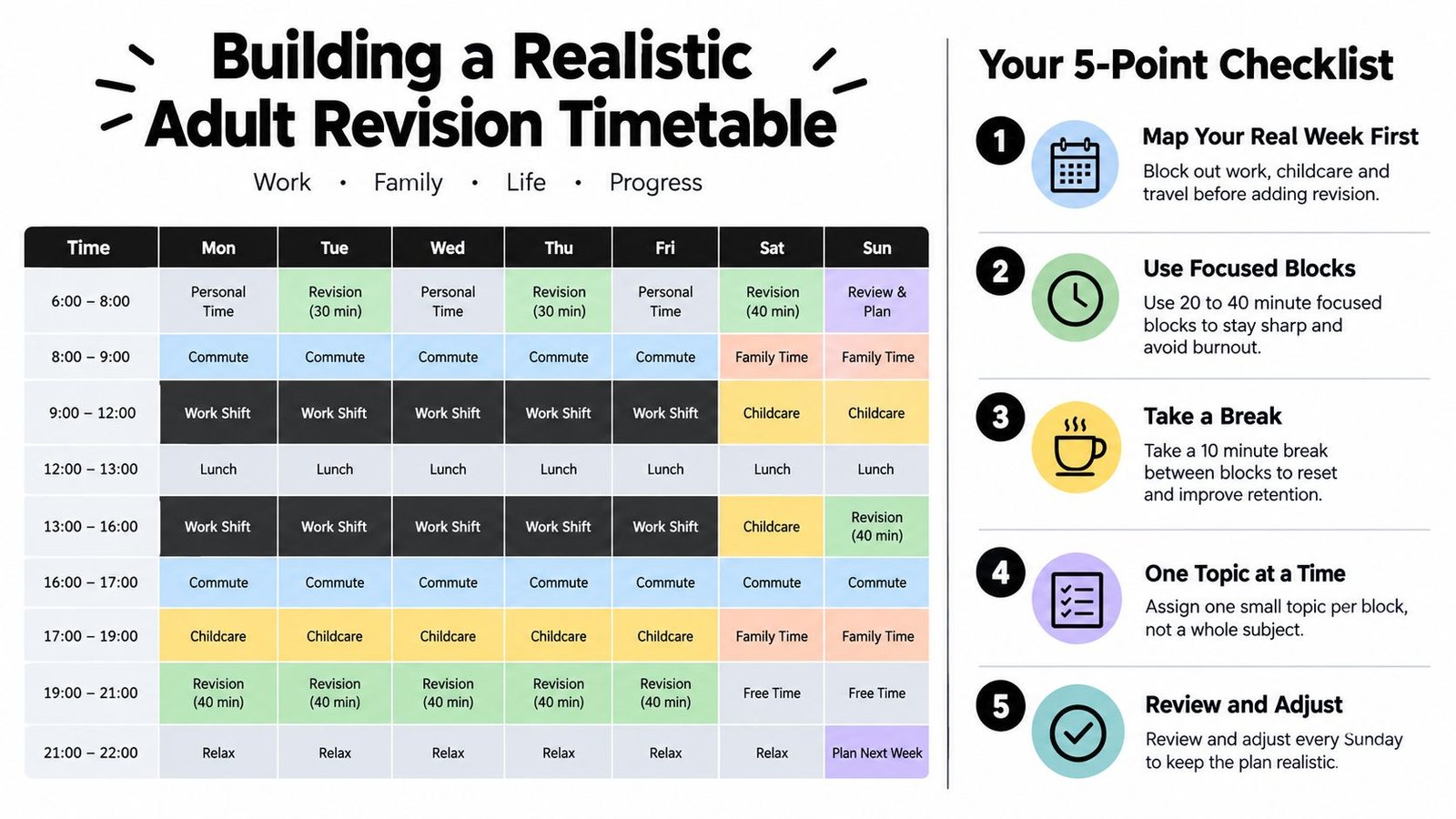
Here's an example of a 15-hour study week:
| Day | Study plan |
|---|---|
| Monday | Maths, 2 hours |
| Tuesday | English, 2 hours |
| Wednesday | Biology, 2 hours |
| Thursday | Maths, 2 hours |
| Friday | English, 1 hour, then weekly review |
| Saturday | Biology, 3 hours |
| Sunday | Maths and English, 3 hours, with breaks |
You can split those hours into shorter blocks. A two-hour evening might contain three 30-minute sessions, with breaks between them, rather than two hours of staring at a book.
Review the timetable every Sunday
Ask yourself three questions:
- What did I complete?
- Which sessions were unrealistic?
- What must change next week?
Move a missed session into the buffer evening instead of doubling your workload. If a shift pattern changes, adjust the timetable without treating the change as failure. Templates can make this easier, especially if you want a printable plan or a digital version. These study planner templates can give you a starting structure.
Active Recall and Spaced Repetition That Actually Works
Re-reading feels comfortable because the information is in front of you. Highlighting also creates visible activity. But recognition isn't the same as remembering. You may understand a page while looking at it and then struggle to explain it when the book is closed.
A large UK survey of nearly 40,000 students found that 37% of revision time was still spent re-reading, highlighting and making notes, although these methods are widely considered among the least effective for long-term retention. The same evidence base found that 76% of learners in Years 10 to 13 didn't space their revision consistently, as reported by Century Tech.
Active recall means trying to retrieve information without looking at the answer. Spaced repetition means returning to that information after gaps of time. Together, they turn revision into a memory workout.
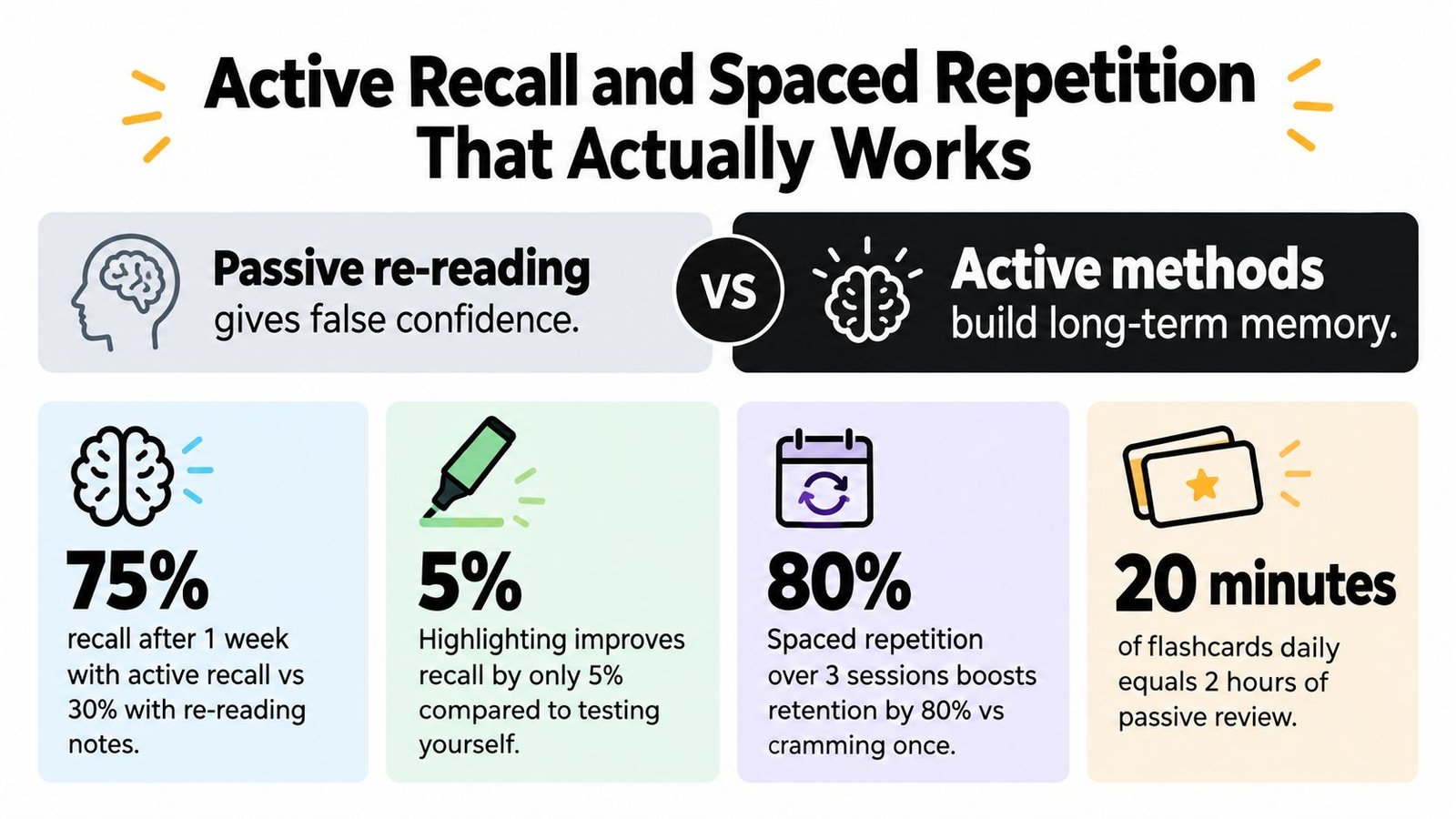
Three ways to use the methods
On the train, close your notes and ask yourself a question. For example, “What is the difference between diffusion and osmosis?” Write or say the answer, then check it.
Turn one page of notes into flashcards. Put cards you forget into a daily pile, cards you nearly know into an every-three-day pile and secure cards into a weekly pile. The piles should change as your memory improves.
On Friday, run a five-minute test on the week's key facts. Mark it accurately and write down only the points you missed. The next session should begin with those points.
A simple review pattern might look like this:
| Review | What to do |
|---|---|
| First session | Learn the idea and test yourself |
| Next session | Recall it without notes |
| Later session | Mix it with older topics |
| Weekly review | Test it in exam-style questions |
The practical cycle is closed-book recall, spaced re-testing and mixed questions. This approach uses limited adult study time more carefully than repeated reading. You can also explore more active learning strategies for ideas that suit different subjects.
Subject-Specific Techniques That Save Time
The right revision method depends on the subject. Maths rewards repeated problem solving. English needs recall, planning and careful analysis. Science asks you to remember knowledge and apply it to unfamiliar situations.
| Subject | Best Technique | Common Mistake | Quick Win |
|---|---|---|---|
| Maths | Short problem sets and worked examples | Reading solutions without attempting the question | Complete five questions on one weak topic, then redo the missed type |
| English Language and Literature | Quotation recall and timed paragraph plans | Rereading the whole text without practising answers | Create a closed-book quotation card for one character or theme |
| Combined or separate sciences | Diagrams from memory, practical flashcards and command words | Memorising facts without linking them to questions | Answer one six-mark question and underline every instruction word |
Maths needs pencil work
Start with a worked example. Cover the solution and reproduce the method. Then change the numbers and try a similar problem. If you make an error, write the exact step where your answer changed, rather than copying the correct answer.
For English Language and Literature, practise retrieving short quotations. Build paragraph plans under timed conditions, then compare your work with a model paragraph. Ask what evidence the writer used, how it was explained and how the paragraph answered the question.
Science revision should include diagrams drawn from memory. Make flashcards for required practicals and match command words to actions. “Describe”, “explain”, “compare” and “evaluate” each require a different kind of answer.
Digital tools can help you organise short notes, questions and corrections. If you're comparing options, this overview of student note apps may help you choose a system that works on your phone or computer.
Match the method to the mark. If the exam asks you to calculate, practise calculating. If it asks you to explain, practise explaining.
Making Past Papers Your Feedback Loop
A past paper isn't just a test of how anxious you feel. It's a diagnostic tool. It shows what you know, what you partly know and what the examiner expects you to do with the knowledge.
Use this four-part loop:
- Sit the paper properly. Use the correct exam board paper, follow the time limit and avoid checking notes.
- Mark it objectively. Use the official mark scheme and mark the paper on the same evening if you can.
- Sort every missed question. Label it as a content gap, an exam-skill gap or a simple mistake.
- Change next week's timetable. Give the biggest gap a short, specific practice session.
A content gap means you didn't know the topic. An exam-skill gap means you knew something but didn't apply it in the required way. A simple mistake might involve copying a number incorrectly or missing a key word in the question. Each problem needs a different fix.
BBC Bitesize explains that its quizzes are based on past papers and provides mark schemes and worked examples. You can also use official materials from AQA, OCR, Edexcel and WJEC, making sure the paper matches your board and tier.
Three full papers spaced across your revision period can reveal repeated patterns. One paper may show a bad day. Several papers help you see whether the same topic or question type keeps causing trouble.
For the next 30 days, try one paper every two weeks and complete a short feedback review each week. Keep a countdown beside your plan if that helps you see the remaining study window. A Countdown Calendar exam timing resource can provide a simple visual reminder.
Wellbeing, Support and Your Next Step Forward
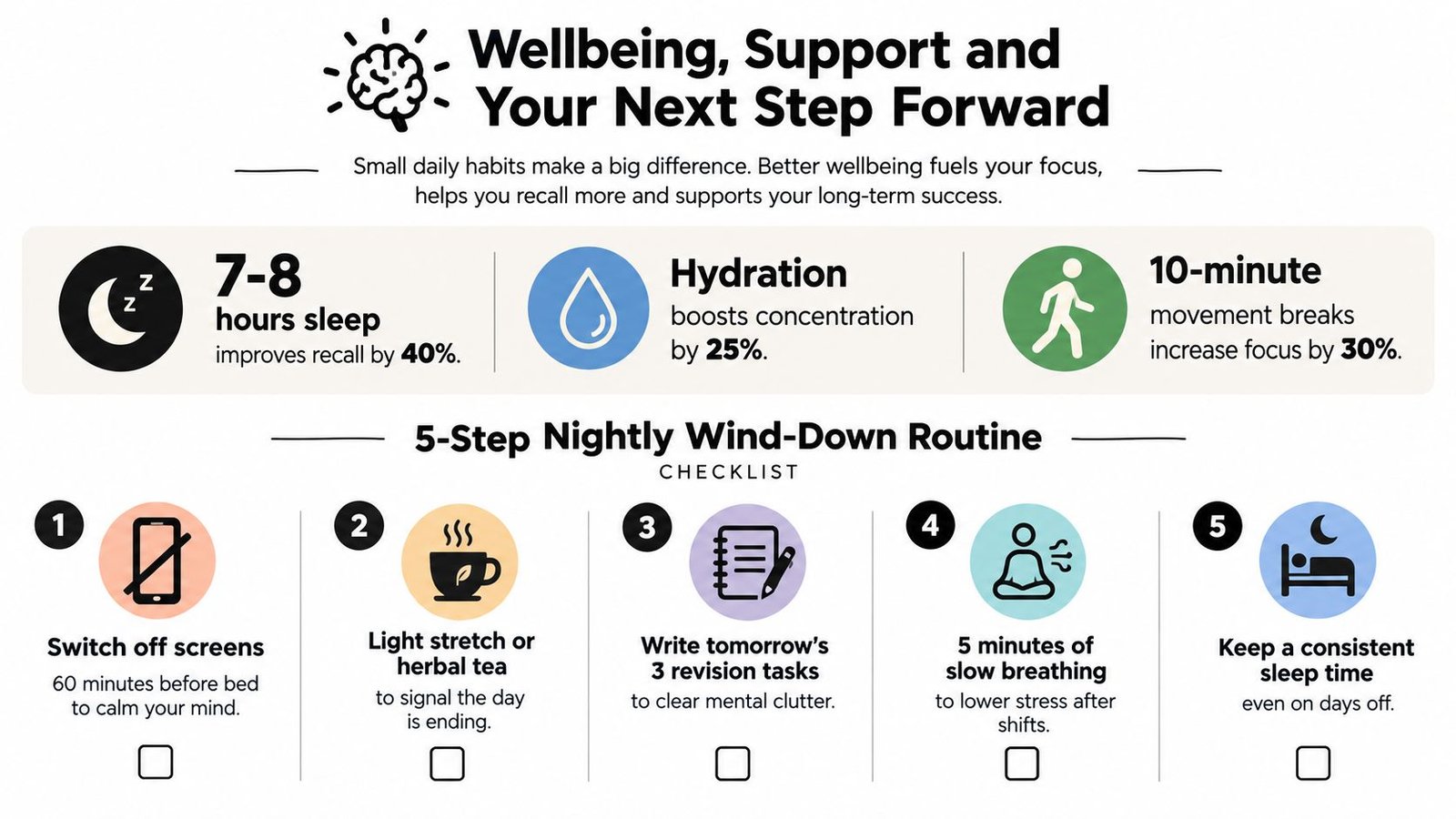
Wellbeing isn't a reward you earn after revising. It's part of revision. A tired, dehydrated brain finds recall harder, while short movement breaks can help you return to a task with more attention. For an adult managing work and family, protecting your energy may make the difference between a plan you follow and a plan you abandon.
Try this five-step wind-down routine after a shift or a busy family evening:
- Put your phone away. Give your mind a clear end to the study day.
- Stretch gently. A few minutes can help you move out of work mode.
- Write tomorrow's three tasks. Keep them small and clear.
- Breathe slowly. Spend a few quiet minutes settling your thoughts.
- Keep bedtime steady where possible. Your routine should support recovery, not create another demand.
Know when to pause
Normal fatigue improves after rest. Burnout may feel different. You might become unusually irritable, lose interest in work you normally value, struggle to sleep or feel unable to begin even a small task. If those signs continue, take a full rest day and speak with someone you trust. Adjusting your plan is a responsible choice, not giving up.
Name three people you can contact before you need help. One might be a tutor, another a family member and the third a study partner. Ask for a specific kind of support, such as checking your timetable, listening while you explain a topic or helping you protect one study slot.
Next Level Online College offers adult learners online GCSE courses with structured study, tutor messaging, flexible catch-up sessions and peer forums. Its wider support includes academic and pastoral guidance, which may suit learners who need a planned route around work and family commitments.
Your next actions can be simple:
- Book an initial guidance call.
- Choose one subject to pilot.
- Set three weekly study slots.
- Review the timetable after 14 days.
- Keep the evidence of every small improvement.
Your children don't need to see a perfect student. They can see someone who keeps learning, asks for help and moves towards a goal. That example can stay with them for life.
Next Level Online College offers flexible, supported GCSE study for adults, with tutor guidance and learning designed around work, family and other responsibilities. Visit Next Level Online College to explore your course options and take the first step towards the qualification, career or university pathway you're working for.