
Around half of adults in the UK are at or below Level 2 numeracy, and Functional Skills maths offers a practical, supported route back into education. The first step is choosing the right level, then building a revision plan around the skills and exam format you'll face.
You might be reading this after the children are in bed, with work finished and a practice question open on your phone. The numbers look familiar, but your confidence has disappeared. You're not alone. Many adults return to maths carrying old school memories, busy lives and the worry that they've left it too late.
You haven't. Functional Skills maths is about using numbers in work, everyday life and further study. With the right starting point, small regular sessions and patient support, you can rebuild your skills and work towards opportunities that once felt out of reach.
Why Functional Skills Maths Revision Can Change Your Life
Sam had avoided maths for years. At work, he could manage prices and measurements, but the word “exam” brought back the same tight feeling in his stomach. He wanted to progress into a better-paid role and show his children that learning doesn't stop when you become an adult. Still, opening a revision book felt like admitting he wasn't clever enough.
That feeling is painful, but it isn't proof of inability. National Numeracy's summary of OECD-based evidence says 57% of adults in England were at or below OECD Level 2 numeracy in 2011, equivalent to UK Entry Level 3. In the latest results, the figure had improved only slightly to 52%, meaning around half of adults remain below that benchmark. The same page refers to an estimate of 8.5 million working-age adults in England with low proficiency in literacy, numeracy or both.

A qualification built for real life
Functional Skills maths can help you work towards employment, training, further study and university progression. National Numeracy explains that Level 2 is roughly equivalent to GCSE grade 4 and above in England and Wales, while Level 1 is roughly equivalent to GCSE grades 2–3.
That makes the qualification more than a school subject. You may need it for a course application, a job pathway or an apprenticeship. You may want to stop feeling anxious when you handle household budgets, timetables or measurements. Every new skill gives you more choices.
Remember: You don't need to become a “maths person”. You need a clear method, useful practice and enough support to keep going when a question feels difficult.
This guide helps you make those decisions calmly. You'll learn why level selection comes before revision, how the papers are structured, which topics deserve attention and how to practise without turning your whole life upside down. Your progress can also become something your children see every week, a parent making time for a goal, learning from mistakes and trying again.
Understanding the Functional Skills Maths Exam Structure
Revision feels harder when the exam is unfamiliar. Before choosing topics, find out which level and awarding organisation apply to your course, because paper structure and assessment details can differ.
The qualification follows nationally defined content in the government's 2018 Functional Skills maths subject content, which remains the key reference for awarding organisations in England. At Level 1, learners work with tables, charts, graphs and simple statistics, including mean and range, as well as probabilities on a scale from 0 to 1. At Level 2, they also calculate median and mode, compare data sets, identify patterns and trends, and recognise simple correlation. You can read the official Functional Skills maths subject content for the full requirements.
Compare the formats before you practise
For major awarding organisations, Level 1 and Level 2 assessments commonly use 60 marks across a non-calculator paper or section and a calculator-allowed paper or section. AQA provides a clear example. Its non-calculator paper lasts 30 minutes and is worth 20 marks, while its calculator paper lasts 90 minutes and is worth 60 marks, as shown in the AQA Functional Skills teaching document.
| Awarding Body | Paper Structure | Pass Mark Range |
|---|---|---|
| AQA | 30-minute non-calculator paper worth 20 marks, followed by a 90-minute calculator paper worth 60 marks | Check the assessment materials for the relevant paper |
| OCR | Level 1 and Level 2 assessment design includes non-calculator and calculator work | 32–37 marks, as described by OCR's pass mark guidance |
| City & Guilds | Current assessment uses a 60-mark structure | 31–32 for Level 1 and 30–31 for Level 2, according to City & Guilds' indicative pass mark information |
Pass marks aren't fixed across every paper. OCR says its Level 1 and Level 2 pass marks are designed to fall within 32–37 marks, while City & Guilds gives current indicative ranges of 31–32 for Level 1 and 30–31 for Level 2 out of 60. Use these figures as guidance, not as a promise for every assessment.
Know your exam before exam day
Your revision should include the format you'll meet. If your assessment is on screen, practise reading questions and entering answers digitally. If you'll use a calculator only in one part, rehearse deciding which calculations you can complete mentally or on paper first.
You can also use this Functional Skills maths test resource to become more familiar with the kind of preparation involved. Knowing what lies ahead removes some of the fear, leaving more attention for the maths itself.
Finding Your Starting Point and Building a Study Plan
The most useful revision decision comes before the first worksheet. Choose Entry Level, Level 1 or Level 2 based on your current ability and your progression goal, rather than choosing the highest level because it sounds more impressive.
Start with a diagnostic assessment. Try a mixed set of questions without looking at the answers, then record three things: topics you understood, topics where your method broke down and questions where you misread the instruction. A short assessment can reveal whether you need to build foundations or focus on Level 2 application.
Match the level to the destination
Level 2 is often the target for university entry and job progression because of its broad GCSE-equivalent recognition. However, Level 1 can be the right route if you need to strengthen core skills first. Entry Level may offer the safest beginning when formal maths has been absent from your life for a long time.
Performance varies between learners and groups. A British Dyslexia Association report citing Ofqual-linked results gives a 61.3% Level 2 maths pass rate across assessments taken between 2021 Q4 and 2024 Q4. It also refers to a 14.2 percentage-point gap between non-disadvantaged and disadvantaged learners in Level 2 maths. Those figures don't define your ability. They show why a personal diagnosis and targeted practice are more useful than copying someone else's timetable.
Turn your diagnosis into a realistic routine
Build the plan around the time you can protect, not an ideal week that never happens. A manageable pattern could be 30 minutes a day, three times a week, with one session for learning, one for questions and one for reviewing mistakes.
Use a simple calendar to assign a topic, a small question set and a review point. If your exam is close, concentrate on the biggest gaps first. If you have longer, begin with number skills and gradually add applied problems, data and mixed papers.
Study planner templates can help you organise those sessions. Mark each completed task, even when it seems small. A tick beside “convert fractions to decimals” is evidence that you're moving forward.
A reliable short routine beats a heroic revision session followed by two weeks away from maths.
Topic-by-Topic Revision Checklist and Practice Questions
Once you know your level, work through topics in an order that builds confidence. Don't start with the hardest multi-step question. Secure the basic operation first, then apply it to money, measurements, charts or another realistic situation.
Use this checklist as a route
- Number: Master arithmetic, fractions, decimals and percentages. Practise converting between forms before solving discount or increase questions.
- Algebra: Simplify expressions and solve equations. Begin with one clear unknown, then check your answer by putting it back into the equation.
- Ratio and proportion: Set out equivalent ratios carefully and practise direct and inverse proportion problems.
- Geometry: Calculate area, perimeter, volume and angles. Write the correct unit beside the answer.
- Handling data: Read charts and tables, then calculate mean, median, mode and range at the level required.
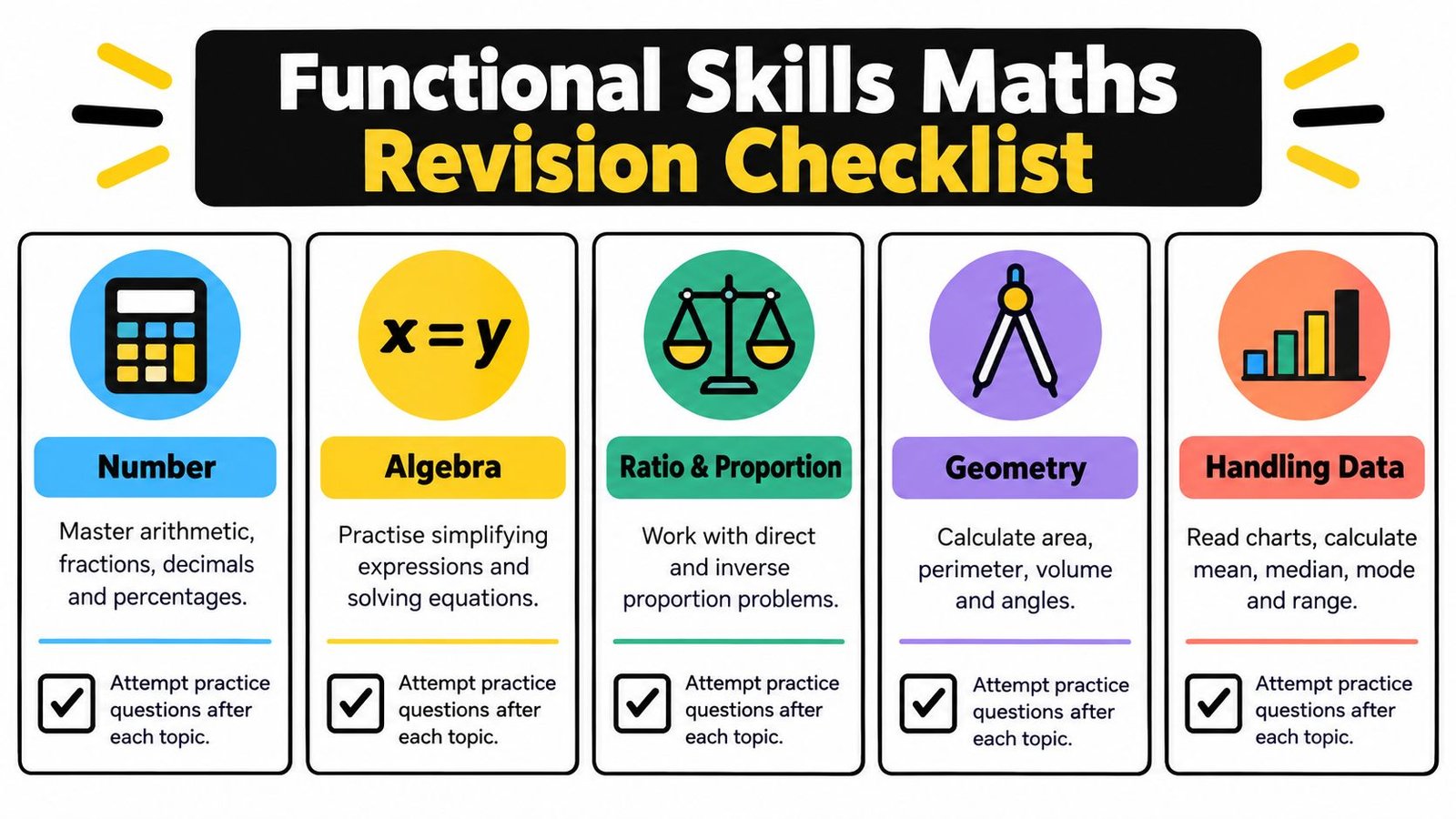
The movement from Level 1 to Level 2 is not just “more difficult sums”. Level 1 asks you to interpret information and use measures such as mean and range. Level 2 expects deeper comparison, including median, mode, trends and simple correlation. That's why you should check the official content for your level rather than revising every topic you can find.
Practise different question shapes
Include more than one style of question in each topic:
- A multiple-choice question can test whether you recognise the correct method.
- A short-answer question can check a single calculation, such as finding a percentage.
- A multi-step problem can ask you to compare prices, convert units and explain a decision.
For example, start by changing a simple fraction into a decimal. Then use that decimal to work out a discount on a realistic price. Finally, explain how you checked that the answer makes sense. This sequence teaches both the calculation and the reading skill behind it.
Use Functional Skills maths past papers from the relevant awarding organisation, alongside the mark scheme. After every set, write down the error, the reason for it and the habit that would prevent it next time. A wrong answer can become one of your most useful revision notes.
Smart Practice Strategies and Exam Technique Tips
Practice works best when it answers a specific question about your learning. If you already solve basic percentages comfortably, repeating them may feel reassuring but won't show you what needs attention. Choose questions that expose a gap, such as percentage change in a word problem, ratio with units or data comparison.
Make every question teach you something
Keep an error log with a short entry for each mistake:
- Reading error: I answered the first part but missed the instruction to compare.
- Method error: I divided when the question required multiplication.
- Presentation error: I gave a number but missed the unit.
- Checking error: My answer didn't fit the situation, but I submitted it anyway.
Look at the mark scheme after attempting the question, not before. It can show where method marks may be available and whether your written steps communicate the correct approach. Even when the final answer is wrong, clear working can demonstrate useful progress.
Practise the paper, not just the topic
Set a timer when you complete a full paper. This reveals whether you rush, spend too long on one problem or leave no time to check. During practice, use the same calculator rules and format you'll have in the assessment.
Many learners also overlook the difference between paper-based and on-screen assessments. Practise both if your awarding organisation allows different formats, and learn where tools such as the calculator, answer boxes and navigation buttons appear. Extra familiarity can prevent avoidable stress.
If you want another way to rehearse exam-style decisions, Exam Practice for GCSE from MasteryMind offers an exam mode that can help you practise working under timed conditions. The questions won't replace your Functional Skills materials, but the routine of reading, solving and checking can support your technique.
Aim with information, not perfection
Pass marks vary between papers and awarding bodies. OCR's designed range is 32–37 marks, while City & Guilds gives indicative ranges of 31–32 for Level 1 and 30–31 for Level 2, as described in the awarding-body guidance linked earlier. A sensible aim is to collect secure marks across the paper, show your working and return to harder questions rather than letting one problem take control.
Exam habit: Read the final instruction first, underline units and key figures, write the method, then check whether the answer fits real life.
How Next Level Online College Supports Your Revision Journey
Studying alone can work, but it isn't the only route. Many adult learners need a timetable that fits around work and family, feedback when a method goes wrong and encouragement when an old fear returns.

Next Level Online College is a UK-based online provider within the Cambridge Online Education Ltd group. It offers recognised Functional Skills maths courses designed for adult learners, with structured study, assessment preparation and support intended to fit around everyday responsibilities.
Support that includes the person, not only the subject
The college describes support from subject specialists, mentors and wellbeing advisers. That combination matters when confidence affects concentration. You can ask about a difficult topic, receive guidance on your study routine and get help staying engaged when life becomes busy.
The provider also offers progression routes towards university, further study and career development. Level 2 Functional Skills maths is roughly equivalent to GCSE grade 4 and above in England and Wales, according to National Numeracy's qualification guidance, so achieving it can support learners who need a recognised numeracy qualification for their next step.
A flexible online course won't remove the need to practise. It can, however, give your practice a clearer shape. You still complete questions and review mistakes, while experienced support can help you understand what to do next instead of staying stuck.
Watch the video to see how an online learning approach can fit into a wider education journey.
Before enrolling anywhere, check the awarding partner, assessment arrangements, level requirements, support included and payment options. Those details should match your goal and your life. The right course is one you can attend, use and sustain.
Your Next Step Towards Confidence and Success
Starting Functional Skills maths revision can feel like a small private decision. You open a notebook, write down one calculation and hope nobody notices how nervous you are. Yet that quiet moment can lead to a recognised qualification, a new course, a different job or the university application you've been postponing.
Think of a parent who studies for a short session while their child does homework nearby. At first, the parent apologises for getting answers wrong. Later, the child sees the same person checking a method, correcting an error and trying again. That is a powerful lesson. Success isn't only the final certificate. It's also the example you set by treating yourself as someone who deserves another chance.
Let small wins build a larger future
Choose one action today:
- Check whether your goal requires Entry Level, Level 1 or Level 2.
- Complete a mixed diagnostic paper without judging the result.
- Write three topics you want to improve.
- Schedule your first short revision session.
- Ask a course provider what academic and pastoral support is available.
You don't need to solve every problem this week. You need to make the next useful decision, then repeat that process. Each session can make work feel less frightening, give your family something to feel proud of and move you towards more fulfilling opportunities.
Your past result is information, not a life sentence. With a suitable level, a realistic plan and patient practice, you can become the learner your future self needs and the role model your children remember.
Next Level Online College offers flexible, supported Functional Skills maths courses with structured study and guidance for adult learners balancing work and family. Visit Next Level Online College to explore your options, check the route that fits your goals and take your first step towards confident revision.