
You may be reading this after a long shift, once the children are asleep, or while wondering whether your school years are far behind you. Perhaps you want a university place, a new career, or the quiet satisfaction of showing your family that learning doesn't stop when adult life begins. The thought of Further Maths A Level can feel intimidating, but feeling nervous isn't proof that you can't do it.
Further Maths is demanding, yet it is also learnable. With the right starting point, regular support and a study plan that fits around real responsibilities, you can build your confidence one problem at a time.
What Further Maths A Level Really Means
A parent working full time might open a course page and ask, “Could I really study this now?” Someone who left school years ago may remember struggling with algebra and assume that memory is a permanent judgement. It isn't. Your past experience tells you where support may help, not what you can achieve today.
Further Maths A Level is a full A Level qualification that goes beyond the ideas taught in A Level Maths. Students usually take it alongside A Level Maths, although adult learners may study it after completing an equivalent maths qualification. It introduces more advanced mathematical reasoning, including ideas that connect closely with university study.
It isn't a double award. It's one A Level, with its own content and assessment. The course can feel different from familiar school maths because you won't only apply a method. You'll often need to understand why a method works, choose an approach and explain a chain of reasoning.
From using tools to understanding them
A Level Maths might teach you how to solve a problem using a reliable technique. Further Maths may ask you to examine the structure behind that technique. You may meet abstract ideas, elegant proofs and mathematical tools used in science, engineering, computing and other technical fields.
The qualification has a prescribed core that makes up approximately 50% of the content, while the remaining content can vary between specifications. That gives the subject a shared foundation but means the precise mix of pure, mechanics, statistics and discrete mathematics depends on the exam board and provider. You can compare the official requirements through the government's Further Mathematics subject-content guidance.
A useful change in mindset: you don't need to feel like a natural mathematician before you begin. You need a starting point, a routine and permission to make mistakes while learning.
Adults also bring strengths that younger students may still be developing. You may understand how to manage a deadline, keep going through a difficult week and connect mathematics to work or family life. Those habits matter. Further Maths isn't reserved for gifted teenagers. It's a subject that rewards patient practice and thoughtful support.
How Further Maths Differs from A Level Maths
A simple comparison can help. A Level Maths is like learning to drive confidently, while Further Maths is closer to understanding how the engine, steering and control systems work. Both require skill, but Further Maths asks you to look beneath the surface.
The first difference is depth. Further Maths takes familiar ideas such as algebra, calculus and functions and pushes them further. You'll also meet additional topics, including complex numbers and matrices. The work often moves faster because the course assumes that your core mathematical skills are developing well.
The second difference is breadth. Depending on the specification, you may study advanced statistics, mechanics, discrete mathematics or additional pure mathematics. These topics can feel unfamiliar at first, especially if you're returning after a long break, but unfamiliar doesn't mean impossible.
A side-by-side view
| Feature | A Level Maths | Further Maths A Level |
|---|---|---|
| Purpose | Builds strong mathematical knowledge for many subjects and careers | Extends mathematical depth for advanced study and quantitative pathways |
| Content breadth | Pure maths with applied statistics and mechanics | Further pure maths plus additional options such as complex numbers, matrices and discrete topics |
| Difficulty level | Challenging, with a broad range of applications | More demanding, with faster progress and more abstract reasoning |
| Ideal learner profile | Someone building a mathematical foundation or preparing for many degree routes | Someone who enjoys problem-solving and wants deeper preparation for maths-heavy study |
Many providers look for GCSE Maths at grade 7 or above, or an equivalent standard, because the course depends heavily on algebraic fluency. That doesn't mean your old result is the whole story. A diagnostic assessment can show whether you're ready now or whether a short bridging course would make the start more comfortable.
If you need to strengthen your core skills first, an A Level Maths course may be the more suitable route. Choosing Maths before Further Maths isn't a failure. It can be the sensible foundation that makes later progress possible.
Inside the Course Content and Structure
The course becomes less frightening when you can name the parts. Your exact specification matters, but Further Maths commonly includes a compulsory core and optional strands.
The core ideas
You may study:
- Complex numbers, which extend the number system and help solve equations that have no ordinary real-number solution.
- Matrices, which organise numbers into rectangular arrays and support work in computing, geometry and transformations.
- Further algebra and functions, including more advanced manipulation and relationships between variables.
- Further calculus, where you investigate change, accumulation and mathematical models in greater depth.
- Further statistics, including summary statistics and standard statistical distributions.
- Further mechanics, which applies mathematics to movement, forces and physical systems.
The government guidance confirms that the qualification includes advanced statistical work, such as computing summary statistics and using standard statistical distributions. This raises the quantitative level beyond core A Level Maths and means success depends on both algebra and careful interpretation.
Options and exam-board differences
The optional half of the course can differ. AQA offers Options 1 and 2, while OCR uses A and B variants. Other boards organise their content differently. You shouldn't choose an option only because its title sounds easier. If you're considering engineering, physics, computing, economics or another technical degree, the best option may be the one that supports that plan.
The AMSP overview of A Level Further Mathematics specifications explains that the qualification is assessed at the end of the course and graded from A* to E. OCR's specification describes four A Level papers, each worth 25% and lasting 1 hour 30 minutes, with pure content and optional areas such as statistics, mechanics, discrete mathematics or additional pure mathematics. You can check the OCR specification at a glance before enrolling.
Short, repeated practice helps with the symbolic parts of the course. For trigonometric identities, spaced repetition trig flashcards can support recall between lessons, especially when you're building a routine around work and family.
Your provider should discuss the specification and option choices during enrolment. Ask which exam board you'll follow, which papers you'll sit and whether your intended university course recommends a particular area.
How Assessment and Grading Work
Many adults worry about being examined after years away from school. The exam room can feel unfamiliar, but the format becomes much calmer once you know what to expect.
Further Maths A Level is normally a linear qualification. That means you take the written assessments at the end of the course rather than completing regular coursework for a final portfolio. OCR's A Level route uses four written papers, each worth 25%, with pure core and optional applied content. Most specifications use a mixture of short questions, multi-step problems and longer tasks that test whether you can link ideas together.
Reading the paper structure
| Paper | Duration | Marks | Focus |
|---|---|---|---|
| Pure Core paper | Specification-dependent | Specification-dependent | Compulsory advanced pure mathematics |
| Further pure paper | Specification-dependent | Specification-dependent | Deeper algebra, functions, calculus or related pure topics |
| Optional applied paper | Specification-dependent | Specification-dependent | Mechanics, statistics, discrete mathematics or modelling |
| Additional option paper | Specification-dependent | Specification-dependent | The remaining assessed option content |
Exact timings and mark totals depend on your exam board, so your centre's specification should be your final reference. Some routes use papers lasting 1 hour 30 minutes, as shown in the OCR specification. Your tutor should also explain which formulae are supplied and which results or techniques you're expected to recall.
Grades run from A to E*. You don't need to understand every grade boundary before you start. What matters early on is learning how marks are awarded. A correct method with a small arithmetic error may still earn useful credit, while an unexplained answer can lose marks even when the final number looks right.
Exam confidence comes from familiarity. Work through real past-paper questions before revision becomes urgent, then study the mark scheme to see how examiners reward reasoning.
You can normally retake an A Level through an approved centre, although the centre must confirm its own entry arrangements and deadlines. Schools, further education colleges and online centres can enter candidates, but adult learners should ask who registers them and where the exams take place. Standardised assessment means your script is judged against the same qualification requirements wherever you studied.
Who Should Take It and How to Start
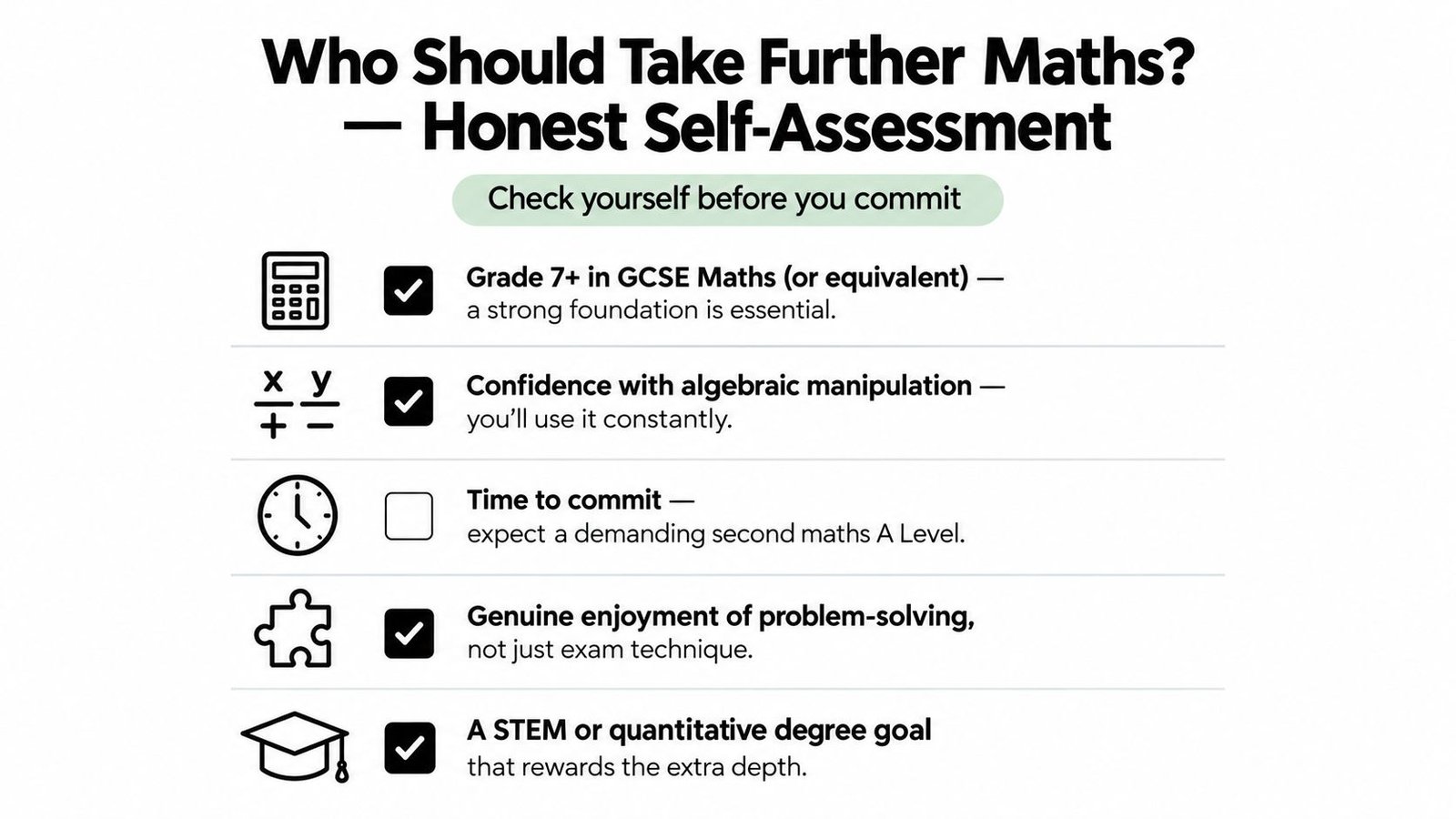
A strong starting profile usually includes GCSE Maths at grade 7 or above, or an equivalent qualification, plus confidence with algebraic manipulation. It also helps to be studying A Level Maths at the same time or to have already achieved an equivalent level.
That doesn't mean an old report card decides your future. If you left school years ago, a diagnostic test can identify gaps in fractions, algebra, graphs or trigonometry. You might need a short bridging module before the full course, and that can save frustration later.
Choose a route that fits real life
Full-time sixth-form study offers a fixed timetable and daily contact with teachers. Evening classes can work well if a local further education college provides the exact specification. Online or distance learning often gives working adults more control over lesson times, though you'll still need a clear plan and access to an approved exam centre.
A practical start might look like this:
- Check your foundation. Review your maths qualification and ask for a diagnostic assessment.
- Speak to a provider. Confirm the exam board, course length, tuition and tutor access.
- Choose your options. Match them to your university or career direction, not to rumours about easy papers.
- Confirm the exam centre. Ask where and when you'll sit the written assessments.
- Check adjustments early. If you need reasonable adjustments, discuss evidence and arrangements before entry deadlines.
Tell your employer that study will support a clear progression goal, then ask about study leave or flexible working. Pick a start date that respects busy family periods. The right course isn't the one that looks impressive on paper. It's the one you can attend, practise and sustain.
Realistic Workload and Study Tips
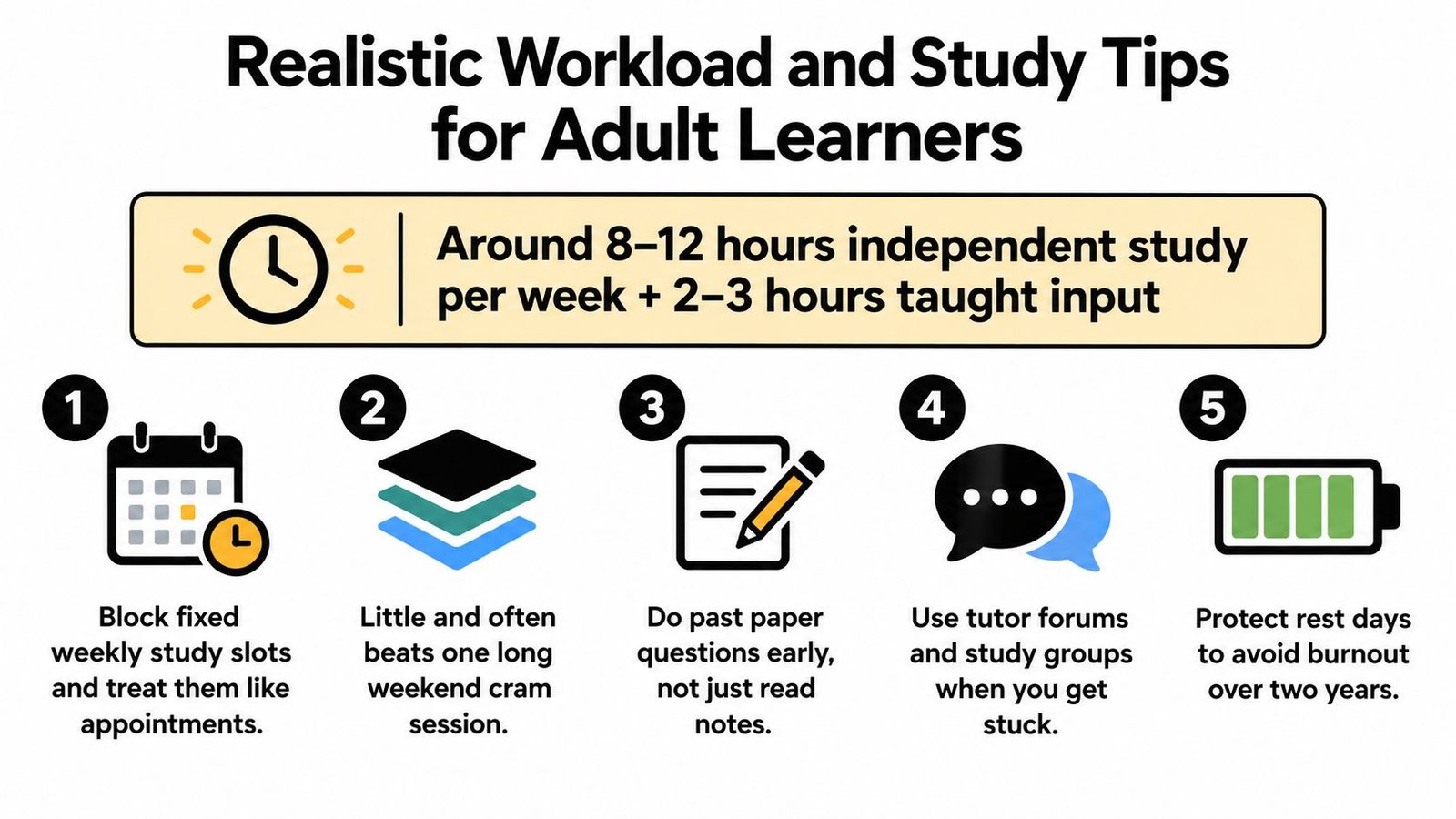
An adult learner needs a plan that fits around life, not a promise to study every spare minute. A realistic two-year course may involve around 8 to 12 hours of independent study each week, plus 2 to 3 hours of taught input. A one-year fast-track route needs a faster pace and less room for missed weeks.
Four focused 30-minute sessions can be more useful than one exhausting weekend block. Try this weekly rhythm:
- Learn: review a new idea from your lesson or textbook.
- Practise: complete worked examples without looking at the solution.
- Apply: attempt exam-board questions with a time limit.
- Review: keep an error log and redo questions you previously missed.
Use fixed appointments in your calendar. Protect sleep, take short Pomodoro-style breaks and consider body doubling, where you study alongside another learner or join an online study group. Asking for help early is a strength, not an admission that you don't belong.
Use small tools consistently
Anki can help you recall formulae and definitions through spaced repetition. YouTube explanations can provide a second visual explanation when a textbook feels too dense. Exam-board past papers show you how topics appear under pressure, while mark schemes help you understand the difference between a correct idea and a complete answer.
Resources about effective study habits for teens can also be useful for families studying together, even though your timetable and responsibilities will be different.
Short daily practice is especially helpful for algebra, identities and notation. Use the video below as an example of visual reinforcement, then return to written questions so that recognition becomes independent problem-solving.
A guide on how to study for A Levels can help you turn these ideas into a broader revision routine. Consistency beats intensity. A calm study habit repeated each week will carry you further than occasional bursts followed by exhaustion.
Where Further Maths Can Take You
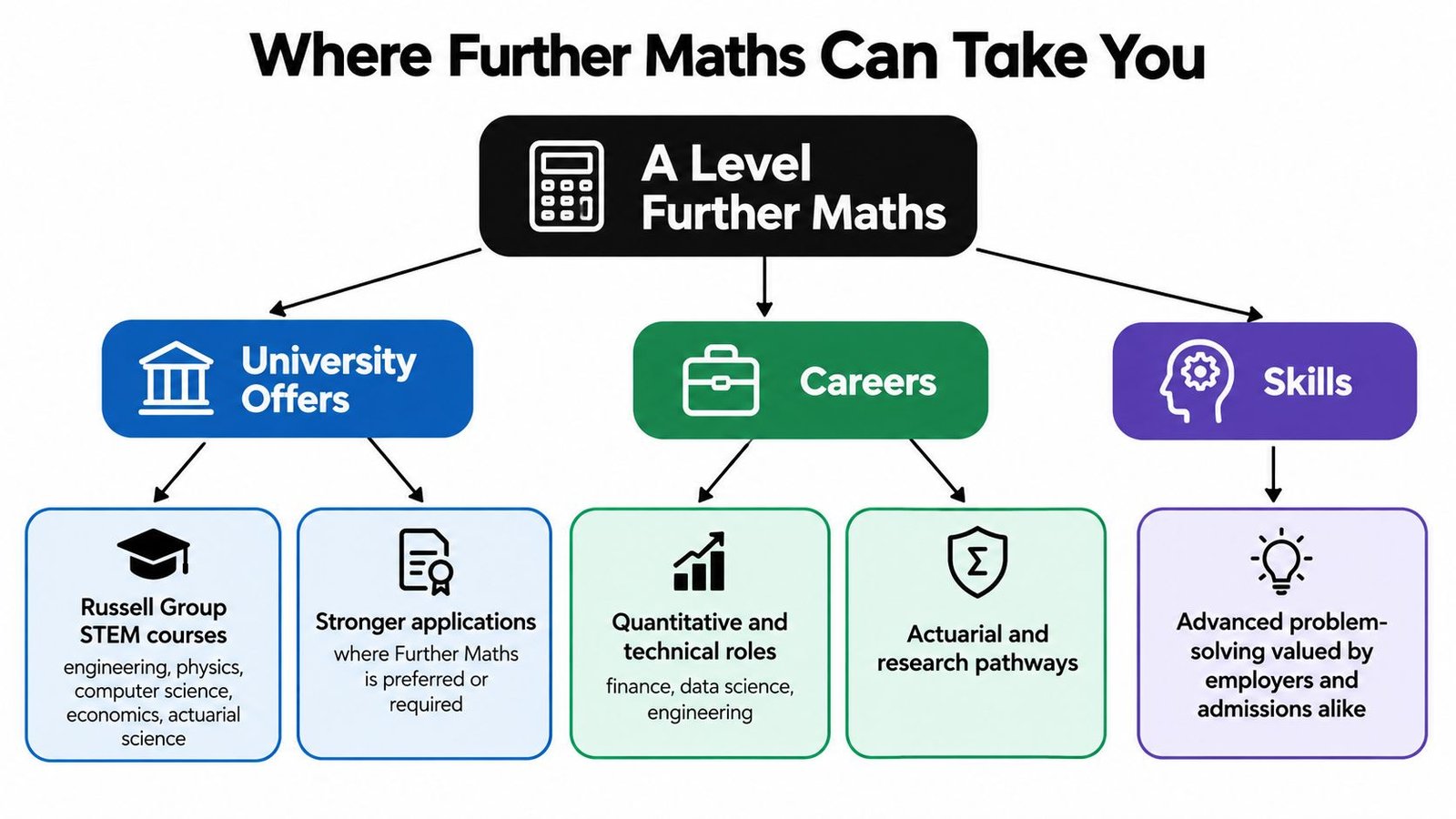
Further Maths can support several university and career directions, but its value depends on your destination. It may strengthen an application for a maths-heavy degree, help you prepare for advanced course content or show that you can work carefully with difficult ideas.
Universities may consider it for degrees such as engineering, physics, computer science, economics, mathematics and actuarial science. Some competitive courses may prefer or require it, while others treat it as useful preparation rather than an entry condition. Manchester's 2026 Mathematics entry requirements accept Further Mathematics within strong offers and note that an A grade in Further Mathematics may be required in some configurations. You can check the details on the University of Manchester Mathematics course page.
Why the qualification can matter
In England, entries for A Level Further Mathematics rose from 13,730 in 2019 to 17,140 in 2024, a 20.0% increase, according to the AMSP summary of 2024 entries and results. The same source reports that 58.7% of male entrants and 57.0% of female entrants achieved A to A in 2024*. Those outcomes show a subject with strong participation and a high concentration of top grades, but they shouldn't be used to tell you that everyone must follow the same route.
The qualification can support pathways into data science, software engineering, quantitative finance, research, teaching, engineering and numeracy-focused public sector work. Employers may also value the habits behind the grade, including structured problem-solving, persistence and the ability to explain complex information.
For an adult learner, the benefit can reach beyond a course application. Your children may see you practise after work, recover from a difficult topic and keep a promise to yourself. You may return to employment after a break, move into a technical field or become a positive example of lifelong learning. Further Maths won't guarantee a particular salary or job, but it can become one part of a carefully planned change.
Your Next Steps and Where to Find Support
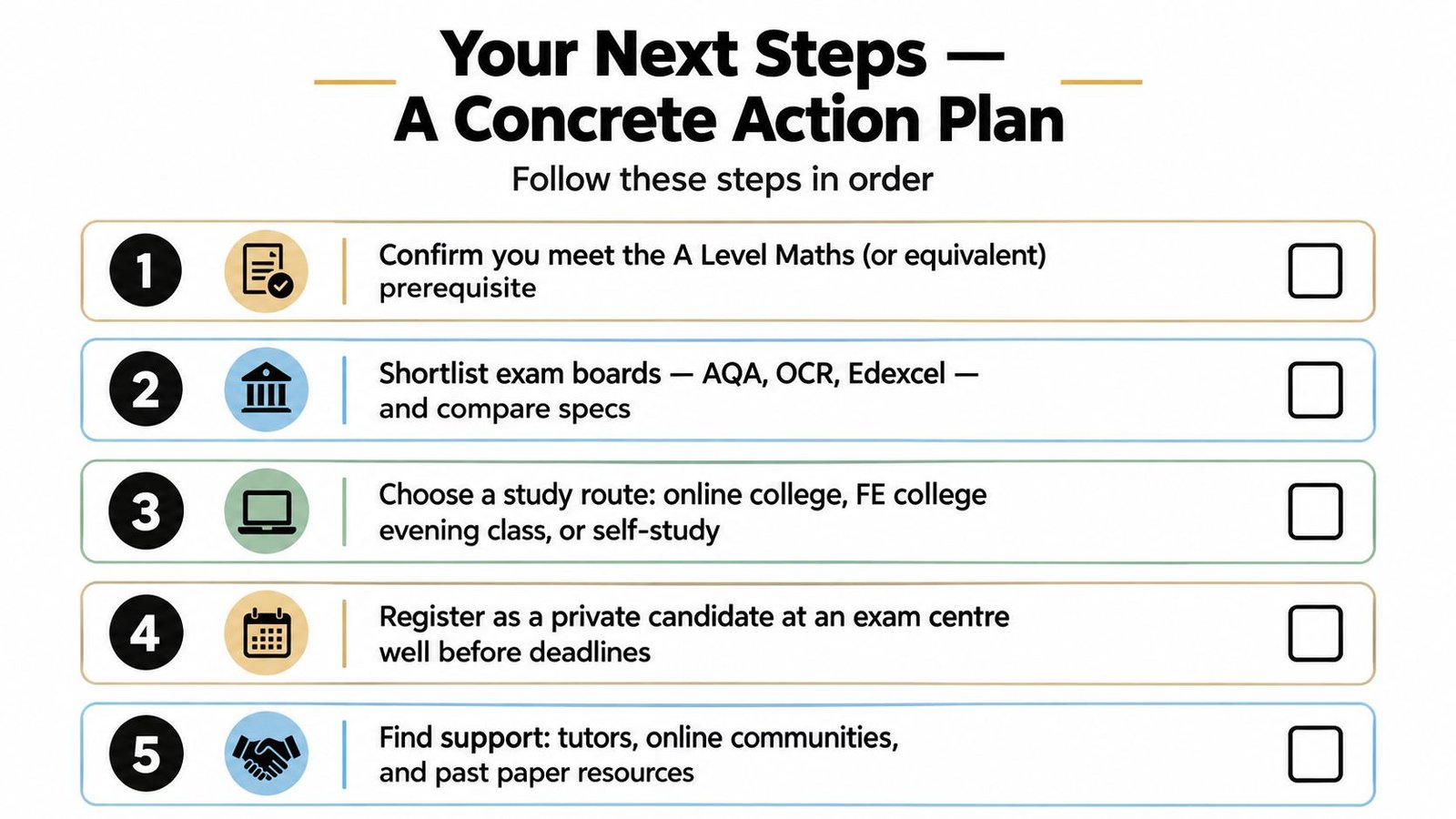
You don't need to decide everything tonight. Start with a short fact-finding process, and let each answer guide the next decision.
- Confirm the foundation. Check your A Level Maths or equivalent qualification. If you're unsure, request a diagnostic assessment.
- Compare specifications. Look at AQA, OCR and Edexcel content, then ask which options support your intended degree.
- Choose your route. Consider an online college, an FE college evening class or self-study with a private exam entry.
- Check dates and finance. Ask about September or January starts, exam entry deadlines, an Advanced Learner Loan and other funding for which you may be eligible.
- Build your support network. Confirm tutor contact, study forums, past-paper access and the location of your exam centre.
Order core textbooks early once your provider confirms the specification. Don't buy several books before you know which board and option papers you'll study. OpenLearn materials can help you refresh foundational ideas, while university widening-participation teams may offer subject tasters or advice for mature applicants.
Ask better questions before enrolling
When you contact a provider, ask:
- Support: How quickly can a tutor respond when you're stuck?
- Assessment: Which exam board and options does the course cover?
- Practical arrangements: Who enters you for the exam, and how do you find a centre?
- Flexibility: Can you study around shifts, caring responsibilities and holidays?
- Progression: Can the provider explain how the qualification fits your university plan?
The University application guidance for adult learners can help you think about entry requirements and progression before you commit. The first step is making an enquiry. You're allowed to ask questions, compare routes and take time to choose.
Next Level Online College offers a flexible online A Level Further Maths route, including Cambridge International AS & A Level Further Mathematics and Pearson Edexcel A Level Further Maths, with structured learning and academic support for adult learners. Visit Next Level Online College to review the course and ask how it could fit around your work, family and university plans.