
You might be reading this after the kids have gone to bed. The washing-up is still on the side. Your phone keeps buzzing. Part of you wants a better future, maybe university, maybe a new career, maybe the pride of proving to yourself that you can still do this. Another part of you worries that you've been away from education too long.
That feeling is normal. It doesn't mean you're not ready.
A Levels can look big from a distance, but they become much more manageable when you see what they really are. In England, 835,950 A Level results were issued to 320,505 students in summer 2026, and students took 3 A Levels on average according to the official 2026 qualification results for England. That matters because it shows the challenge is usually about depth across a small number of subjects, not trying to learn everything at once.
If you're an adult learner, that's good news. You don't need to be a genius. You need a calm plan, steady effort, and study methods that work when life is busy.
Introduction to Studying for A Levels as an Adult
You may be opening your notes at 9.30pm, with work behind you and family jobs still half-done. That starting point is more common than you might think. Adult learners rarely have perfect study conditions, yet many still do well because they learn to study in a way that fits real life.
A lot of adults worry they have left it too late. After guiding many returners back into education, I've seen something more encouraging. Adults often bring patience, grit, and a clear reason for studying. Those qualities matter a great deal in A Levels.

Why A Levels feel hard at first
A Levels can feel unfamiliar because the job is bigger than learning facts. You have to explain ideas clearly, compare viewpoints, show working, judge evidence, and shape answers in the style the exam board rewards. For an adult coming back after years away, that can feel like learning the subject and learning the rules of the game at the same time.
That is why early study can feel slow.
The good news is that slow at the start is normal. A Levels are part of a structured exam system, and many learners find the jump in standard challenging at first. The official government release on summer 2026 results shows how large that system is, with entries being issued across England in a wide range of subjects through schools and colleges in the 2026 qualification results for England.
What makes adult study different
School-based advice often assumes you have whole afternoons free and someone else organising your day. Adult life does not work like that. You may be fitting study around shifts, school runs, caring, or plain tiredness after dinner.
So your approach needs to be built for maintenance, not bursts of effort.
A good adult study routine works a bit like keeping a house warm in winter. Small, regular heat keeps everything going. One huge blast now and then does far less. In the same way, a few steady study blocks each week usually beat occasional long sessions that leave you drained for days.
What helps adults succeed
Adults often make progress when they stop chasing the perfect plan and start using a repeatable one. That usually means short catch-up habits during busy weeks, 2-hour study blocks when time allows, and a clear focus on the marks available in the exam.
Practical rule: Build a routine you can still keep on a tired week, not just on a good week.
It also helps to understand early that exam success is not only about knowing the topic. It is about knowing what earns marks. Mark schemes are a guidebook, not a mystery. Once you learn to read them, you start seeing what strong answers include, what common mistakes cost, and why some answers feel “right” but still score poorly.
A steadier way to look at the year
Your A Level year works more like training for a long walk than a sprint. Progress comes from steady steps, regular rest, and starting again quickly after a missed day. One difficult week does not ruin the whole journey.
You already have useful strengths. You know how to turn up when you are tired, solve problems on the spot, and keep going when life is busy. Those are real study strengths, and they give you a stronger starting point than you may realise.
Creating Your Personalised A Level Study Schedule That Fits Real Life
It is 8.30pm. The kitchen is finally quiet, you are tired from work, and there are still lunches to sort for tomorrow. This is the moment many adult learners think, "There is no point starting now."
A real study plan makes that moment easier. It gives you a short list, a clear start, and study times that fit around your life instead of fighting with it.
Start with your fixed week, not your best week
Adult timetables work like packing around the furniture in a room. You do not start with the ornaments. You start with the sofa.
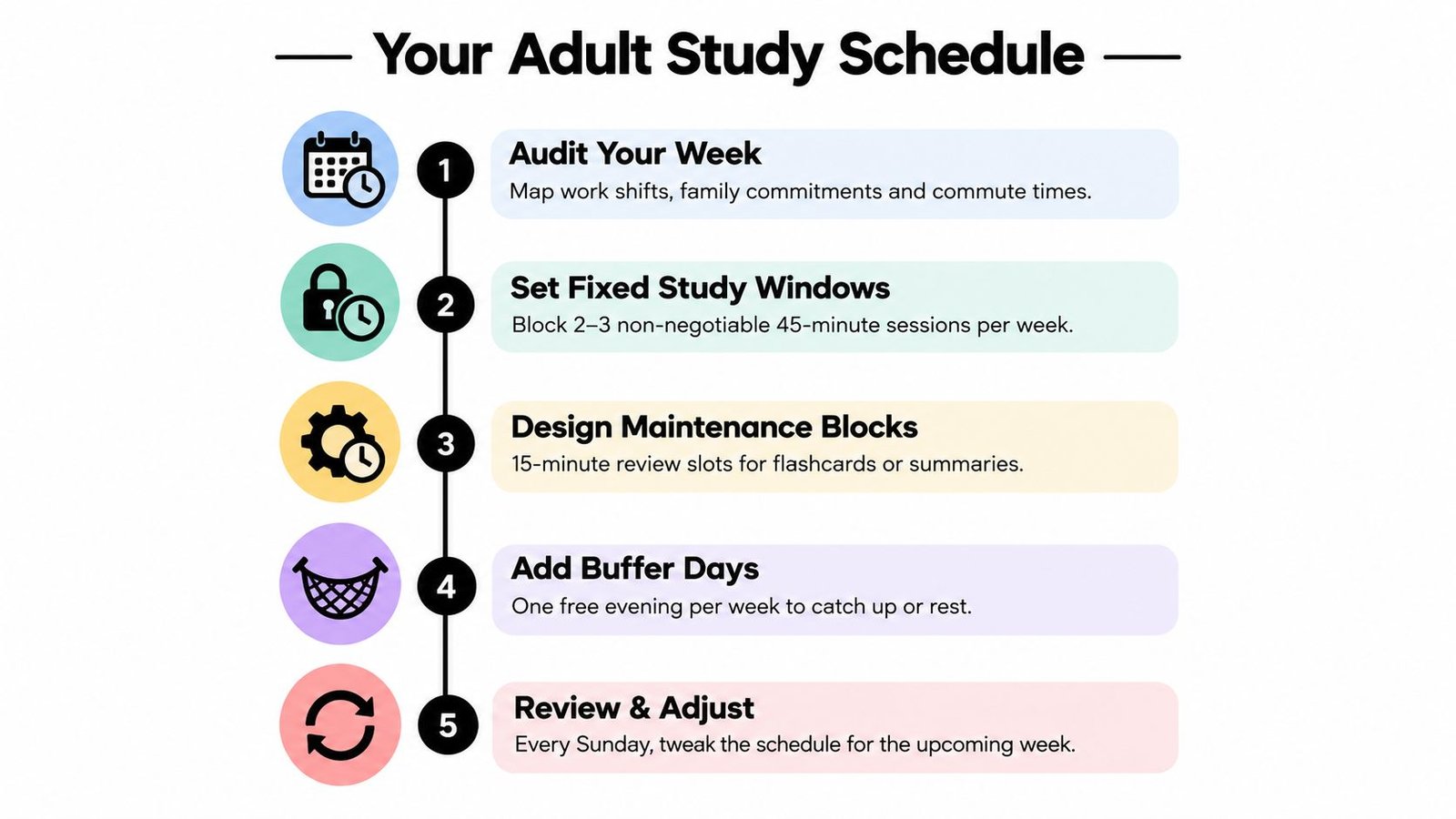
So begin with the parts of the week that cannot move. Add work shifts, commuting, school runs, childcare, meals, appointments, and sleep. Then mark the times when your brain is usually flat. For many adults, that matters just as much as free time. An hour when you are exhausted is not really an hour you can use well.
After that, look for your study windows. You are not hunting for huge empty spaces. You are looking for repeatable ones. Two weekday evenings and one weekend block is enough to build real progress if you keep using them.
If you want a simple layout, these study planner templates for adult learners can help you map the week on paper before you fill every slot.
Build around 2-hour blocks
For adult learners, a 2-hour block is often the sweet spot. It is long enough to get into a topic, but short enough to fit around jobs and family life.
That does not mean two straight hours of reading.
A good block has jobs inside it, like rooms in a house:
- 15 minutes. Set up, check what you did last time, and write one target for this block.
- 45 minutes. Learn one topic or one small part of a topic.
- 10 minutes. Take a short break.
- 35 minutes. Answer questions, recall from memory, or complete one exam task.
- 15 minutes. Mark it, note what went wrong, and choose the next step.
This matters for a simple reason. Tired brains cope better with clear stages than with a vague plan to "do revision".
Give each study slot one job
A common problem is trying to learn new content, revise old work, make notes, and do exam practice in the same sitting. That often feels busy but leads to slow progress.
It is easier to give each block one main purpose.
| Study type | What it means | Example |
|---|---|---|
| New learning | Meeting a topic for the first time or fixing a gap | Learn a Biology process or a Sociology theory |
| Practice | Using what you know to answer questions | Complete a set of Maths questions or a short essay plan |
| Review | Checking what stuck and what needs another go | Self-test, mark answers, and list weak points |
| Backup | Space for life going off-plan | Catch up, shorten a task, or rest |
Backup time is not wasted time. It keeps one rough day from breaking the whole week.
Plan by subject weight, not by guilt
Adults often spend too long on the subject that feels safest because it is easier to start. The subject you avoid usually needs the clearest place in the week.
Try a simple split. Put your hardest subject into your freshest study slot. Use a second slot for a medium-strength subject. Save shorter or lower-energy times for lighter tasks such as reviewing flashcards, checking key terms, or marking work.
If you study three A Levels, your week might look like this:
- One 2-hour block for your weakest subject
- One 2-hour block for your next subject
- One 2-hour block shared between review, catch-up, and small tasks across all subjects
That is only six focused hours. For a working adult, six focused hours done every week can carry you a long way.
Make the timetable easy to keep
The best timetable is one you can still follow in a messy week.
Keep the routine simple enough that you can restart quickly after illness, overtime, or family problems. A wall chart, fridge tracker, or notebook tick list helps because it makes progress visible. Small ticks matter. They show you that you are still in the race, even if the week was not perfect.
One more point often gets missed. Put admin jobs in their own small slot if possible. Printing notes, finding past papers, or organising folders can swallow your study time if you let them drift into every session.
Use the exam to shape the week
Your schedule should slowly move closer to the way the exam asks you to work. Early on, more time may go into learning content. Later, more time should go into question practice and checking answers against the mark scheme.
A useful guide from a UK revision booklet on planning revision time suggests mapping exam dates, blocking out unavailable time, spotting weak topics, and building revision in stages. For adult learners, the helpful part is not making the plan bigger. It is making each block specific enough that you can begin, even on a tired Tuesday.
A timetable should feel like a rail, not a chain. It keeps you moving, but it does not need to be perfect to work.
Active Learning and Memory Techniques That Make Revision Stick
You finish a two-hour evening study block, shut the folder, and feel pleased because you covered a lot of pages. Then, the next morning, someone asks what you remember. Your mind goes blank.
That is a very common adult learner problem. The study session felt full, but your memory did very little lifting. A Level revision starts to stick when you ask your brain to fetch information, sort it, and use it.
Why active learning works better
Memory works a bit like a footpath across a field. If you only look at the path, it fades. If you walk it again and again, it becomes clear and easy to follow.
That is what active learning does. It gives your brain practice at finding the route back to the information.
For adults with jobs, children, and tired evenings, this matters a lot. You do not have endless hours, so each study block needs to do more than create neat notes. It needs to help you remember enough to answer exam questions later.
Four methods that make short sessions count
These four methods work well in two-hour blocks because they keep you doing, checking, and trying again.
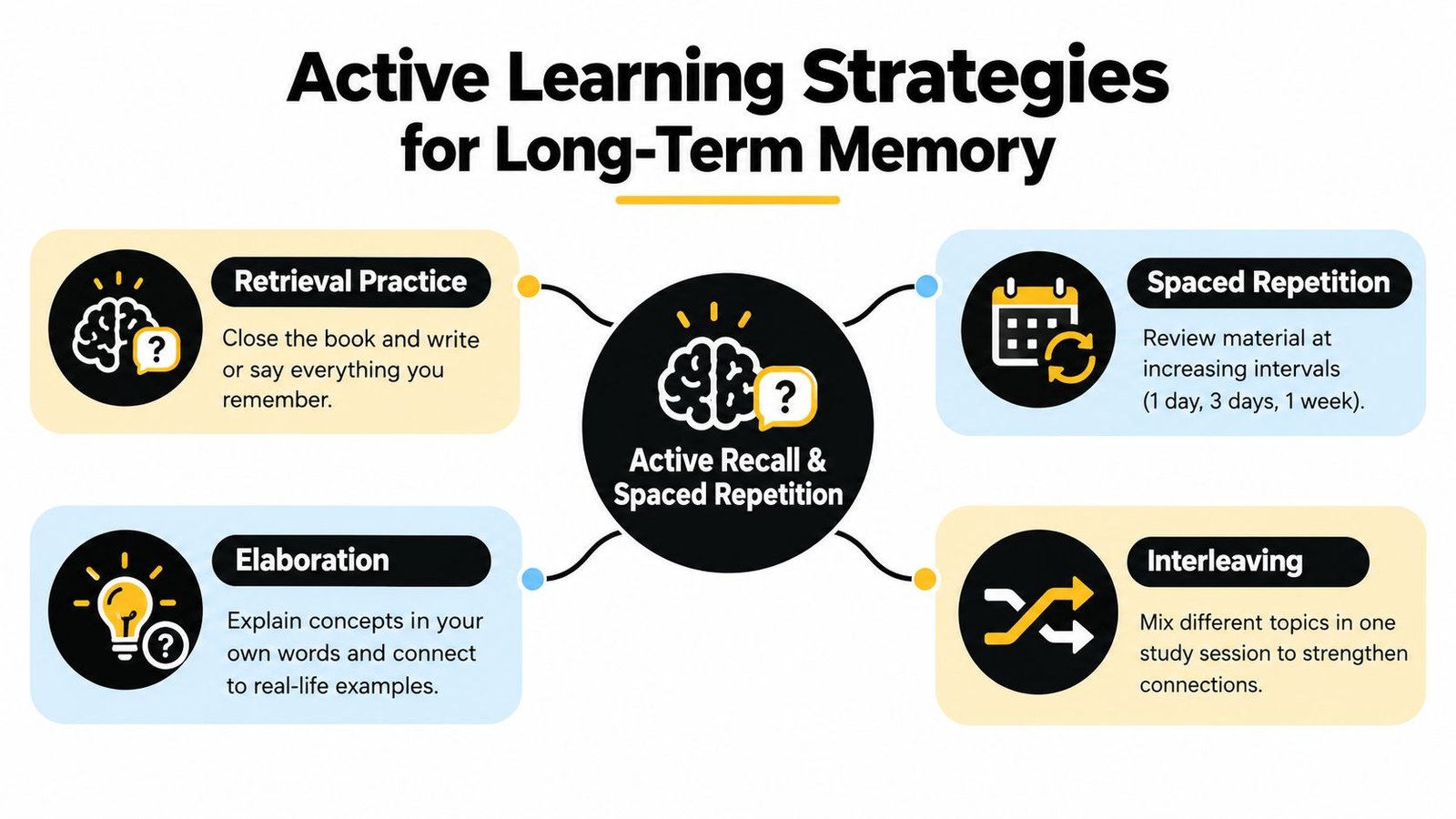
- Retrieval practice. Shut the book and write or say what you remember from memory.
- Spaced repetition. Return to the same topic after a gap so the memory gets stronger over time.
- Elaboration. Explain the idea in plain words, as if you were teaching someone at the kitchen table.
- Interleaving. Mix topics or question types so you practise choosing the right method, not just repeating one routine.
If you want more examples you can adapt to home study, this guide to active learning strategies is a useful starting point.
What this looks like in real A Level study
An English Literature student might read a poem once, close the book, then list the themes, quotes, and language methods they can still recall.
A Biology student might draw a process from memory, label each stage, then check what is missing.
A Maths student might do one algebra question, one trigonometry question, and one statistics question in the same session. That trains recognition, which is exactly what exams require.
The point is simple. You are not trying to prove you have seen the topic before. You are training yourself to bring it back under pressure.
A better shape for a two-hour block
Adult learners often do best with a routine they can repeat even after a busy day. Try this:
- Ten minutes: read a small part of the topic and spot the key ideas.
- Twenty minutes: hide the notes and write everything you can remember.
- Twenty minutes: check the notes, fill the gaps, and correct mistakes in a different colour.
- Thirty minutes: answer a few short questions, or make your own from the page headings.
- Ten minutes: say the topic aloud in simple English.
- Later in the week: test yourself again without looking first.
This pattern works like exercise. The strain is small, but it is the part that builds strength.
Memory tools you can make yourself
You do not need expensive apps or perfect folders.
- Flashcards for terms, quotes, formulas, dates, and case studies
- Blurting pages where you empty your memory onto paper
- Question banks made from textbook headings and class notes
- Teach-back practice while walking, cooking, or driving
- One-page recap sheets with only the facts you keep forgetting
One extra habit helps many adult learners. Keep a short “forgot again” list at the back of your notebook. If the same quote, formula, or definition keeps slipping away, it goes on that list. That gives you a maintenance routine. You spend less time revising everything and more time repairing the weak spots.
For more structured support with this approach, some learners use active learning guidance for online study.
Key takeaway: Revision sticks when you make memory do the work first, then use your notes to repair what was missing.
A short video can help bring these methods to life:
Mastering Past Papers and Mock Exams for Exam Confidence
You finish a two-hour study block after work, sit down with a past paper, and suddenly the topic you revised yesterday feels different on the page. That is normal. Exams test knowledge, but they also test how quickly you can spot what the question wants and shape your answer to fit it.
That is why past papers matter so much for adult learners. If your study time is limited, you need revision that does two jobs at once. A past paper checks what you know and trains exam technique in the same session.
In summer 2026, 9.6% of A Level entries were graded A*, 28.5% were graded A* or A, and the overall A* to E pass rate was 97.5%, broadly unchanged from 2025, according to the 2026 A Level results summary reported with Ofqual context. That steady picture is one reason past papers and mark schemes are so useful. The rules of the exam stay clear enough for practice to pay off.
Why past papers matter so much
A past paper is practice under actual test conditions. Reading notes is like sitting in a parked car and learning the controls. Useful, yes. But the true test is driving in traffic.
Past papers show you three things fast:
- Selection. Which facts, quotes, methods, or case studies fit this question?
- Timing. Can you keep moving, or do you get stuck polishing one answer?
- Accuracy. Did you answer the exact question, or a version you hoped would come up?
This is especially helpful if you are studying in 2-hour blocks. You do not always need to complete a whole paper. One evening, you might do a single essay. Another day, you might do three shorter questions under timed conditions. Small, regular contact with real exam questions often helps more than saving everything for one long weekend session.
Learn the mark scheme language
Many adults avoid mark schemes at first because they look stiff and full of exam jargon. Stay with them. They are one of the clearest guides you have.
Mark schemes show how knowledge turns into marks. They help you stop guessing.
Look for patterns like these:
- Command words. “Explain”, “assess”, “compare”, and “calculate” each need a different kind of answer.
- Level descriptions. In essay subjects, top-band answers usually need a clear line of argument, relevant evidence, and a reasoned judgement.
- Method marks. In maths and science subjects, correct steps can still earn credit even when the final answer is wrong.
- Repeated weak points. Vague wording, missing units, no evaluation, or too little development often cost marks.
A useful habit is to keep a short “mark scheme words” page in your notebook. Write down phrases that come up again and again, such as “clear comparison”, “supported judgement”, or “fully developed explanation”. Over time, you start to hear what examiners are asking for.
The better question is: “Can I show what I know in the form the exam rewards?”
A review loop that works
The score matters less than the diagnosis.
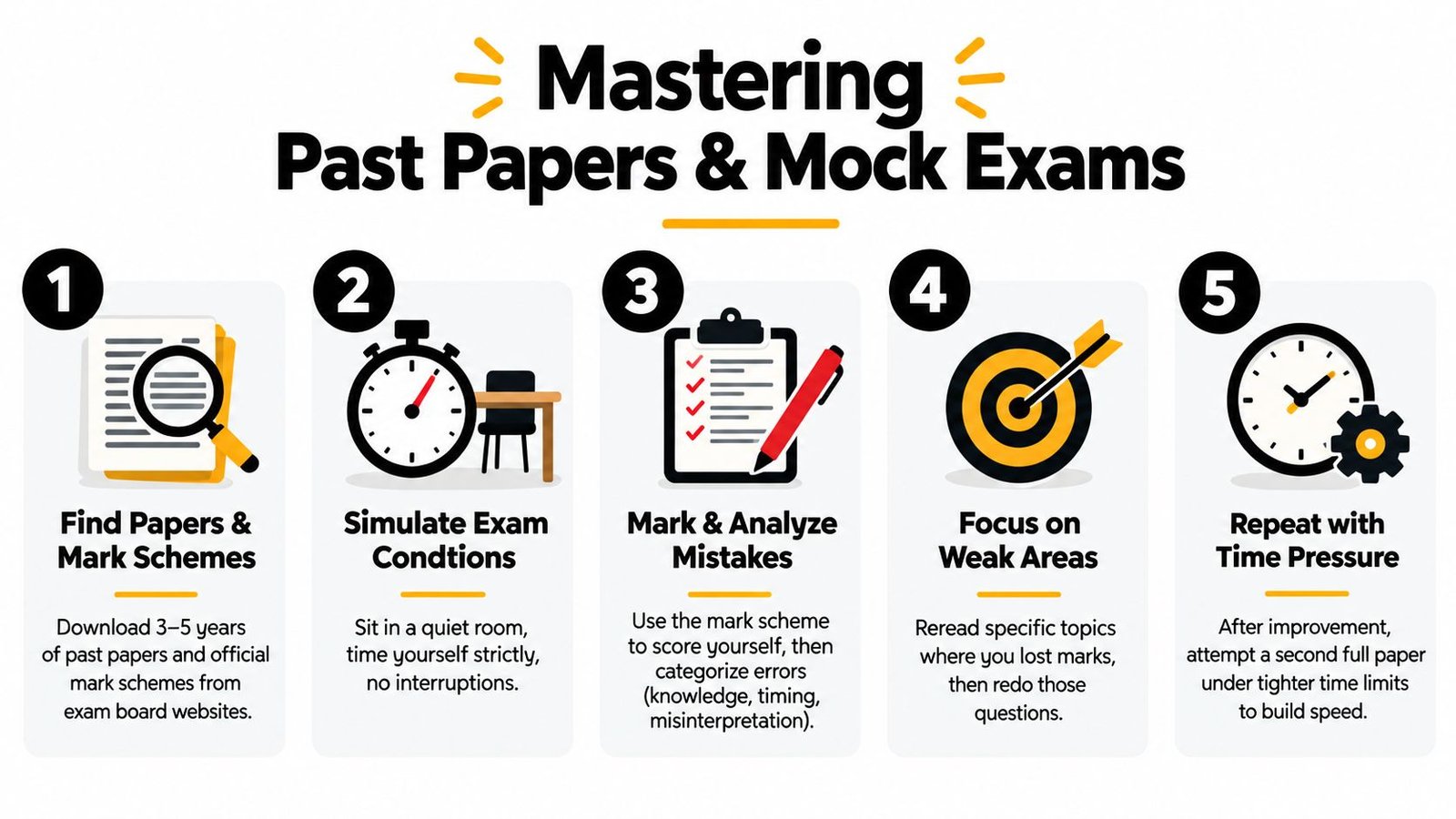
After each paper or mock, spend ten to fifteen minutes sorting your mistakes into types. This keeps revision focused, which matters when you are fitting study around work, children, and everything else.
| Error type | What it usually means | What to do next |
|---|---|---|
| Knowledge gap | You did not know the content well enough | Relearn that topic, then test it again a few days later |
| Misread question | You rushed or missed the command word | Slow down for the first 30 seconds and underline what the question is asking |
| Weak exam technique | You knew the point but did not shape it into a mark-worthy answer | Rewrite one answer using the mark scheme or examiner wording |
| Timing problem | You ran out of time or overfilled early answers | Practise shorter timed sections and set a hard stop for each question |
This review loop works like fixing leaks in a bucket. If you only keep pouring in more revision, but never seal the holes, progress feels slow. If you repair the leaks, each study block starts to hold.
Some adults also like using exam preparation advice for online learners to build this habit into a weekly routine.
Use mocks as diagnosis, not judgement
Mocks are most useful when you treat them as a rehearsal, not a verdict. A weak mock does not mean you are weak at the subject. It means pressure exposed the parts that still need support.
That is good information.
If a mock goes badly, ask three simple questions. Which topics fell apart? Which question types slowed me down? Which errors can I fix before the next paper? Those answers give you a practical plan for your next 2-hour blocks.
Confidence usually grows this way for adult learners. Not from one perfect paper, but from seeing that each attempt becomes clearer, calmer, and more accurate than the last.
Time Management Wellbeing and Motivation Tips for Working Adults
Most study plans fail for emotional reasons before they fail for academic ones. People get tired. They miss a week. They feel behind. Then shame takes over, and they stop. That's why wellbeing isn't a “nice extra”. It protects continuity.
Adult learning remains a major route in the UK. Government statistics report 1,298,590 adults participated in government-funded further education and skills in 2025/26, a 2.3% decrease from 1,329,160 in 2024/25, as shown in the UK further education and skills statistics. You're part of a large group of adults trying to build something better through learning.
Manage energy, not just time
A tired brain learns slowly. If your life is busy, stop pretending every hour is equal.
Think about your best and worst times:
- Best-focus time might be early morning, a lunch break, or Saturday afternoon.
- Low-energy time might suit flashcards, listening to notes, or checking errors.
- Very hard days might only allow ten minutes of review. That still counts.
This matters even more for adults because many are studying around work and family. Official data show there were 424,610 learners on level 2 courses in 2024/25, with 405,580 of those in regulated qualifications, according to the further education and skills data release. Flexible routines matter because many learners aren't living school-style lives.
Protect your confidence when progress feels slow
Adult learners often speak to themselves more harshly than they'd ever speak to their children. One missed week becomes “I've messed it up.” One low score becomes “I'm not clever enough.”
Replace that script with better questions:
- What did I manage this week?
- What blocked me?
- What is the smallest useful step I can take today?
- What would I say to a friend in my position?
Studying as an adult is not proof that you fell behind. It's proof that you're brave enough to move forward.
Build motivation from real reasons
Motivation lasts longer when it is tied to something personal. For many adults, that reason is bigger than grades. It's being the parent who shows that education matters. It's opening the door to university. It's moving towards more fulfilling work and better pay. It's showing your children that hard things can be done.
UCAS says some universities and colleges use Tariff points in entry requirements, and for A Levels the current scale is A* = 56 points, A = 48, B = 40, C = 32, D = 24 and E = 16, so three A Levels can total from 48 points for EEE up to 168 points for A*A*A* in the UCAS entry requirements guide. For many adult learners, that makes the journey feel more real. Your weekly study sessions can lead to an application, a place, and a future that once felt out of reach.
Small systems that keep you going
You don't need endless motivation. You need support and visible proof of progress.
Try a few of these:
- A wall chart or notebook tracker so you can see completed sessions.
- A family conversation about your study times, so people know when you need quiet.
- A restart rule that says one bad week doesn't become two.
- A support person who asks how things are going.
- A reward habit such as tea, a walk, or an early night after a solid session.
If you're working towards level 3 study through another route first, it may also help to know that the government's methodology states learners on free courses for jobs must be aged 19 or over, must not already have a level 3 qualification, and the course must be on the national qualification list, as explained in this guide discussing eligibility and progression routes.
Your Next Steps to A Level Success and a Brighter Future
A Levels can change the direction of your life, but they don't require perfection. They require a method you can keep following when life is full. That's the answer to how to study for A Levels as a busy adult.
Keep the picture simple. Build a schedule around your real week. Study actively instead of passively. Use past papers to learn how marks are won. Protect your energy and confidence so you don't disappear from your own plan.
Your starting checklist for today
- Choose your study windows for the coming week.
- List your three subjects and mark the topics you find hardest.
- Prepare one 2-hour block with one clear target.
- Create one recall tool such as flashcards or a blurting page.
- Find one past paper and one mark scheme for each subject.
- Set a weekly review time so your plan stays alive.
There is also a wider reason to keep going. A Level study sits inside a big national exam system, and entries in England reached 845,485 in 2026, rising 2.9% year on year, while the 18-year-old population grew by 4.3%, according to the 2026 A Level environment analysis. That changing environment makes efficient workload planning and mark-scheme awareness even more important, especially for adults who can't waste precious study time.
What success can look like
Success might mean the first assignment you submit after years away from education. It might mean understanding a topic that once scared you. It might mean earning the grades that move you towards university and a career you're proud of.
And success has a human side too. Your children see you trying. They see you reading, planning, and getting back up after setbacks. That example can shape a family for years.
You do not need to have it all figured out before you begin. You need to begin, then keep going.
Next Level Online College offers flexible online A Levels and other recognised courses for adults who need study to fit around work, family, and everyday life. If you want structured learning, tutor support, and a route that can help you move towards university or a new career, visit Next Level Online College.