
You might be reading this after a long day at work, with washing to do, messages to answer, and a quiet feeling that you want more from life. Not just for yourself, but for your children, your partner, and your future. Maybe you left school years ago. Maybe you still think of yourself as “not academic”. Maybe you want a real qualification but can't see how study could fit into your life now.
That feeling is more common than you think. Returning to education isn't strange or selfish. It's one of the bravest things an adult can do. It says, “I still believe my future can grow.”
Your Time to Shine with an Online Psychology A Level
A lot of adults carry old school memories into later life. You may remember feeling behind, unseen, or told that certain paths weren't for people like you. Those experiences can remain in the background for years. Then one day, you start thinking about university, a new career, or proving to yourself that you can do more.
That's where A Level Psychology online can become much more than a course.

You are not behind
Returning to learning is already normal for many adults. Nearly half of all adults in the UK, 49%, have participated in learning within the last three years, and 13% of adults from lower socio-economic groups can lack the confidence to start, according to FE Week's report on adult education participation. If your confidence has taken a knock, that doesn't mean you're not capable. It means you're human.
Many adult learners don't need pressure. They need reassurance, structure, and a clear path.
If that sounds like you, support designed for mature students taking A Levels can help you see that studying later in life isn't a second-best option. For many people, it's the moment things finally start to click.
A fresh start in education doesn't erase your past. It builds on your strength, your patience, and everything life has already taught you.
Why psychology feels so personal
Psychology isn't just about textbooks and theories. It's about people. It helps you understand memory, behaviour, relationships, stress, confidence, and why people act the way they do. For a parent, that can feel especially powerful. You start learning ideas that connect with daily life, your family, and your own story.
That matters because qualifications are never only about grades. They can lead to university, open doors to better-paid work, and help you become the kind of role model your children remember. They see you trying. They see you learning. They see you not giving up.
That example can shape a family for years.
What You Will Actually Learn in A Level Psychology
You open a lesson after dinner, half expecting pages of jargon and theories that feel miles away from real life. Instead, you find topics that connect with things you already know well. How memory works under stress. How children form bonds. Why people follow the crowd. For many adult learners, that is the point where psychology starts to feel possible.
The course is broad, but it is not a muddle. It follows a clear syllabus, and each part builds on the last. If you are exploring online A Levels in the UK for adult learners, it helps to know that psychology is taught in stages, so you are not expected to grasp everything at once.
Topics that feel familiar
A Level Psychology often surprises adults because so much of it links back to everyday experience. You are learning academic ideas, but you are also learning a new way to make sense of family life, work, relationships, confidence, and behaviour.
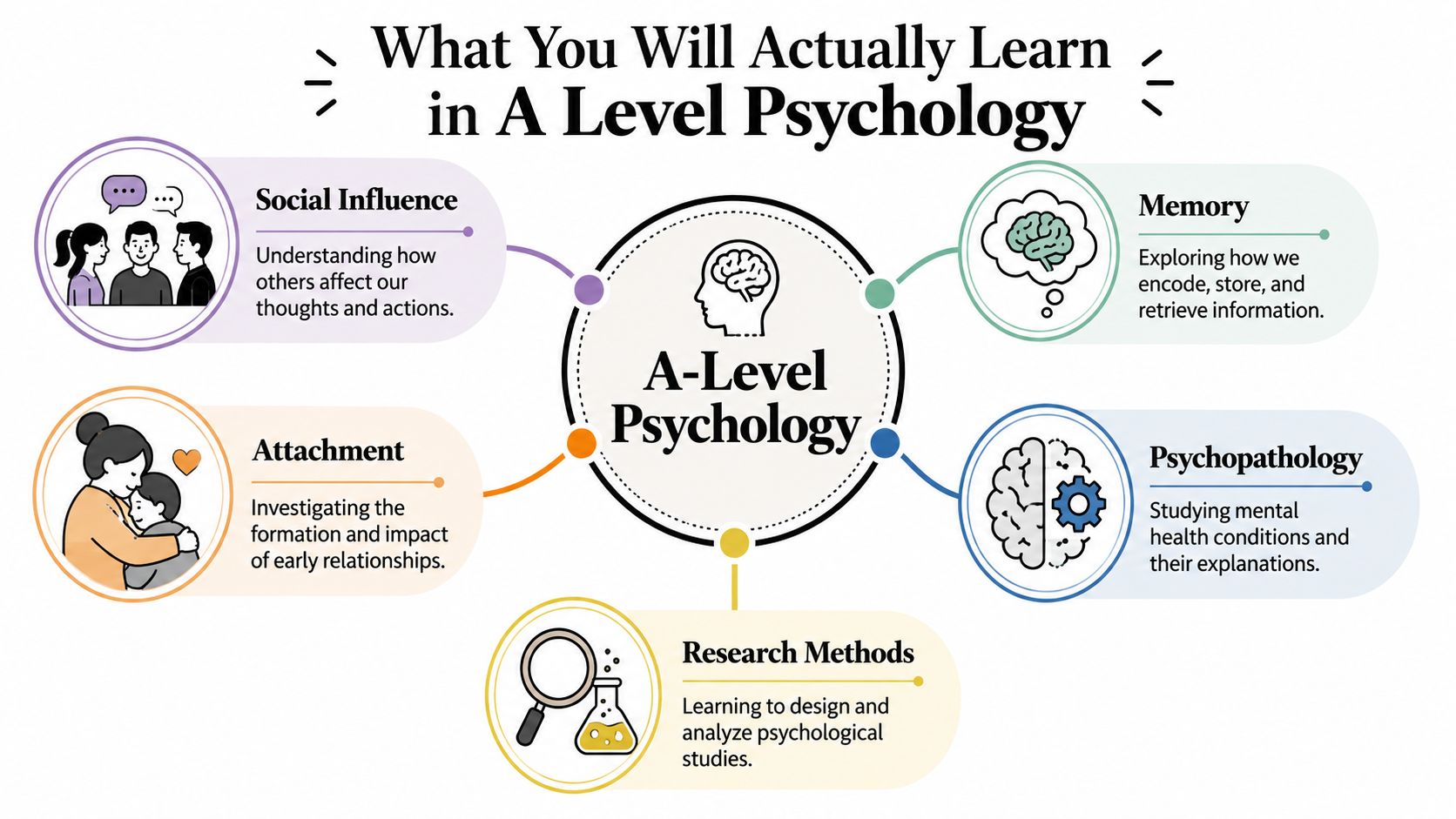
| Topic | What it means in simple terms | Everyday example |
|---|---|---|
| Memory | How we take in, store, and recall information | Why you remember a stressful day clearly but forget where you put your keys |
| Attachment | How early relationships affect us | The bond between a parent and child, and how trust develops |
| Social Influence | How other people affect behaviour | Why people copy a group, even when they feel unsure |
| Clinical Psychology | Different ways of understanding mental health | Looking at how psychologists explain and treat distress |
| Research Methods | How studies are planned and judged | Learning how to ask, “Was this a fair test?” |
These topics matter for another reason. They often help adults feel more confident about learning because the subject has handles you can grip. You are not starting from nothing. Life has already given you examples.
How the learning builds
Psychology works a bit like building a house. First you lay the foundations by learning key theories and studies. Then you add structure by comparing explanations, testing evidence, and learning how to form a clear argument. Later, you learn to evaluate research and interpret data with more confidence.
That last part can sound intimidating.
In practice, it means learning to read a study carefully, spot weaknesses, and explain what makes evidence strong or weak. Those are valuable skills far beyond the exam room. They can help at work, in further study, and in everyday decisions where you want to trust your own judgement.
A short video can make the subject feel more real before you begin.
What often surprises adult learners
Some adults come back to study worried that psychology will be all opinion, or that they will be expected to write like an academic from day one. The course is much more structured than that. You learn named theories, well-known studies, research methods, and exam skills. Your writing improves step by step as your understanding grows.
That gradual progress matters, especially if education once made you feel left behind.
Many adults find that psychology gives them more than a qualification. It gives them proof that they can study serious material, express their ideas clearly, and keep going even when confidence dips. That pride can reach beyond you. Children notice when a parent sticks with something difficult. Families remember the moment someone decided their education was worth fighting for.
Studying psychology often helps adults understand not only other people, but also their own confidence, habits, and reactions in a new way.
That is why the subject can feel so motivating. You are learning content for an A Level, but you are also rebuilding trust in your own ability.
How Studying Online Really Fits Into Your Life
Online study doesn't mean sitting at a desk all day like a school pupil. For most adults, it looks much more ordinary than that.
A parent might read through a lesson after the children are asleep. A care worker might study on days off. Someone in an office job might use part of a lunch break to review notes. Another learner might spend a Sunday morning planning the week's study before the house gets busy. This is what makes A Level Psychology online different from a fixed timetable. It bends around your life.
A realistic week
A typical week might look like this:
- Monday evening you spend a short session reading about memory and making simple notes.
- Wednesday lunch break you review key terms on your phone or in a notebook.
- Thursday night you work on a tutor-marked assignment after the house settles down.
- Saturday morning you go back over feedback and improve one answer.
- Sunday you plan what to do next, so Monday doesn't feel confusing.
That rhythm often works better for adults than trying to study in long blocks. Small sessions add up.
Online doesn't mean alone
A big fear for returning learners is isolation. People worry that online study will feel cold or unsupported. Good online learning should feel the opposite. It should give you clear materials, a proper route through the course, and someone to turn to when a topic doesn't make sense.
Support matters because adult learners don't just bring challenges. They bring responsibilities. Work, family, caring duties, and tiredness are real. Flexible study works best when the course respects those realities.
If you're comparing options, looking at online A Levels in the UK can help you picture what this kind of study looks like in practice.
Good online study gives you freedom with structure. You choose when to learn, but you're still guided.
Why this format helps confidence
Traditional classrooms can make some adults feel exposed. Online study often feels calmer. You can read something twice without embarrassment. You can pause, take notes, and go back over a lesson in your own time. You don't need to keep up with a room full of teenagers. You just need to keep moving forward.
That change matters. Confidence doesn't usually return all at once. It grows when you complete one task, then another, then realise you're doing something you once thought was out of reach.
Your Path to Getting Qualified
Many adults stop before they start because they think they won't be allowed onto the course. Much confusion often begins here.
One of the biggest myths is that you must already have top science or maths grades just to study psychology. That isn't always true.
The myth that puts adults off
According to ICS Learn's A Level Psychology page, a common myth is that you need top STEM GCSEs to study A Level Psychology online. Some universities may want those subjects for a specific degree route, but many course providers don't require them for the A Level itself. The same source explains that the course is assessed through 3 linear exam papers and can give you up to 56 UCAS points for university entry.
That difference matters.
You might not currently meet the entry profile for every university psychology degree. But that does not mean you're blocked from starting the A Level. The course itself can still be open to you, especially if you have solid reading and writing skills and a serious attitude to learning.
What the qualification journey looks like
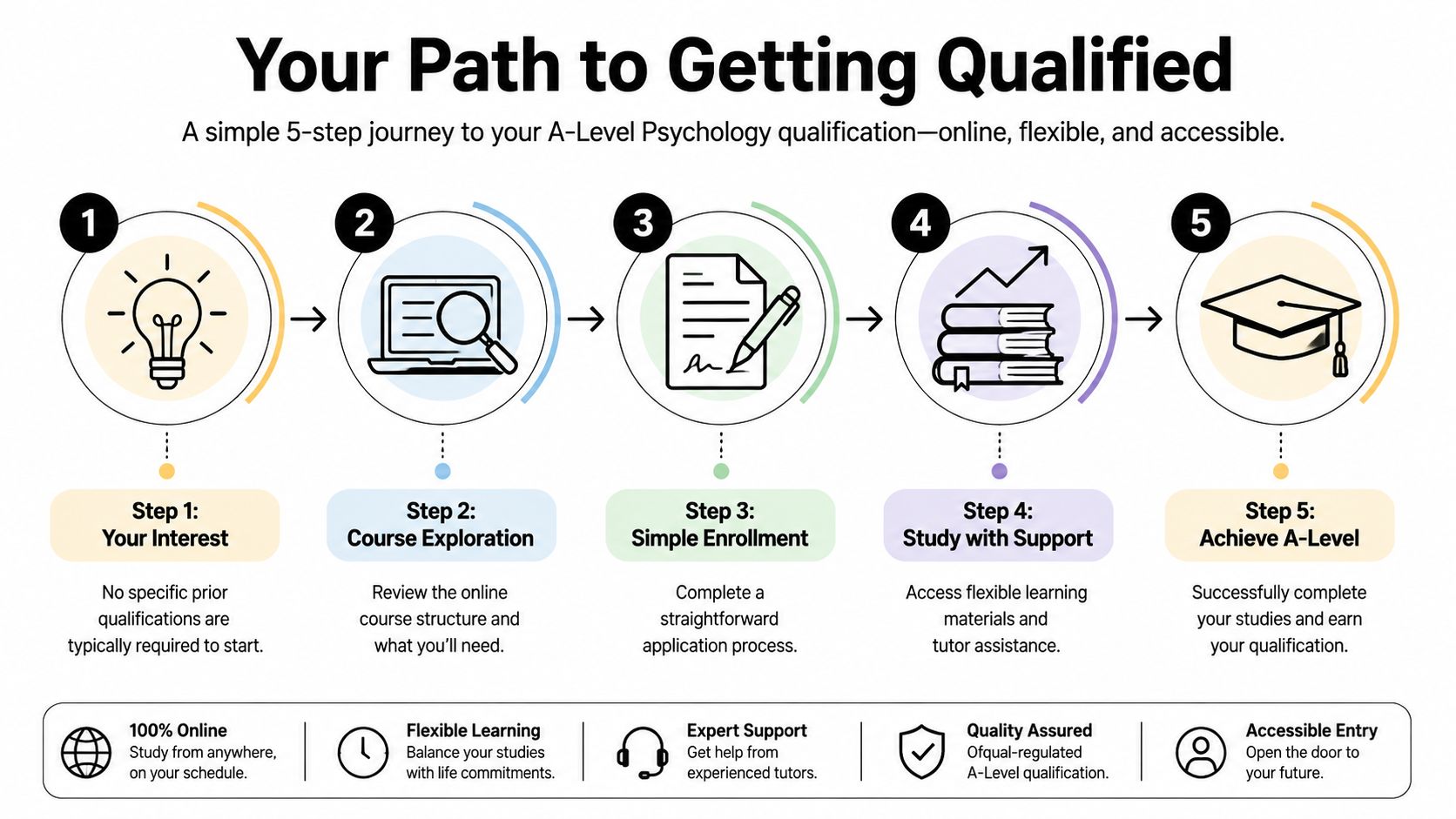
For most adult learners, the process is simpler than expected:
Choose the course
Look at the syllabus, the support offered, and whether the study style suits your routine.Start learning online
Work through the course materials module by module.Complete assignments
These help you practise writing and build confidence before the final exams.Prepare for the exams
A Level Psychology is assessed through three final papers.Sit your exams at a centre
Online study happens from home, but the final exams are taken in person.
What are the three papers?
The papers cover broad parts of the course, including introductory topics, psychology in context, and issues and options in psychology. That may sound formal, but the key point is simple. The assessment is clear and standardised. You know what you're working towards.
You don't need to be fearless to begin. You need a clear process and the willingness to take the first step.
For many adults, the official nature of the qualification is part of the appeal. You aren't doing a hobby course. You're working towards a recognised A Level that can support future study and real progression.
Building Your New Future and Career
An A Level can change more than your CV. It can change how you see yourself.
When adults return to study, they're often chasing something deeper than a certificate. They want stability. They want pride. They want work that feels meaningful and pays properly. They want to show their children that it's possible to rebuild, even after setbacks.
Skills employers respect
Psychology teaches useful skills for many workplaces. You learn how to understand behaviour, communicate clearly, analyse information, and weigh up evidence before making a judgment. Those skills matter in roles where you work with people, support others, explain ideas, or solve problems calmly.
That can make psychology a helpful subject for areas such as:
- Human resources, where understanding motivation and behaviour matters
- Marketing, where teams study what influences decisions
- Social care, where empathy and clear communication are essential
- Teaching and education support, where child development and behaviour matter
- Counselling-related pathways, where further study can lead to more specialised roles
If you want to explore where the subject can lead, this guide to careers involving psychology gives a helpful starting point.
A better future can start with one subject
You may not know your final destination yet. That's fine. Many adults begin with one qualification because they want options again. A Level Psychology can help create those options. It can support university applications, prepare you for related training, or strengthen your profile for people-focused work.
It can also shift something powerful at home.
Your children notice effort. They notice books on the table, revision notes on the fridge, and the way you keep going even when you're tired. That example has weight. It shows them that learning doesn't end at school and that setbacks don't get the final word.
A qualification can open doors. The bigger change is often the person you become while earning it.
That new version of you may be more confident in interviews, more ambitious about work, and more willing to reach for a life that once felt out of bounds.
Smart Study Habits for Busy Adults
A lot of adults don't fail because the subject is too hard. They struggle because they expect themselves to study as if they have endless free time. Most don't.
According to Open Study College's A Level Psychology information, many adults drop out because of unrealistic time-management rather than course difficulty. The same source notes that the curriculum takes around 360 hours and can be spread across a two-year completion window, which makes it easier to break into manageable parts.
Study in small pieces
You do not need perfect days. You need a repeatable routine.
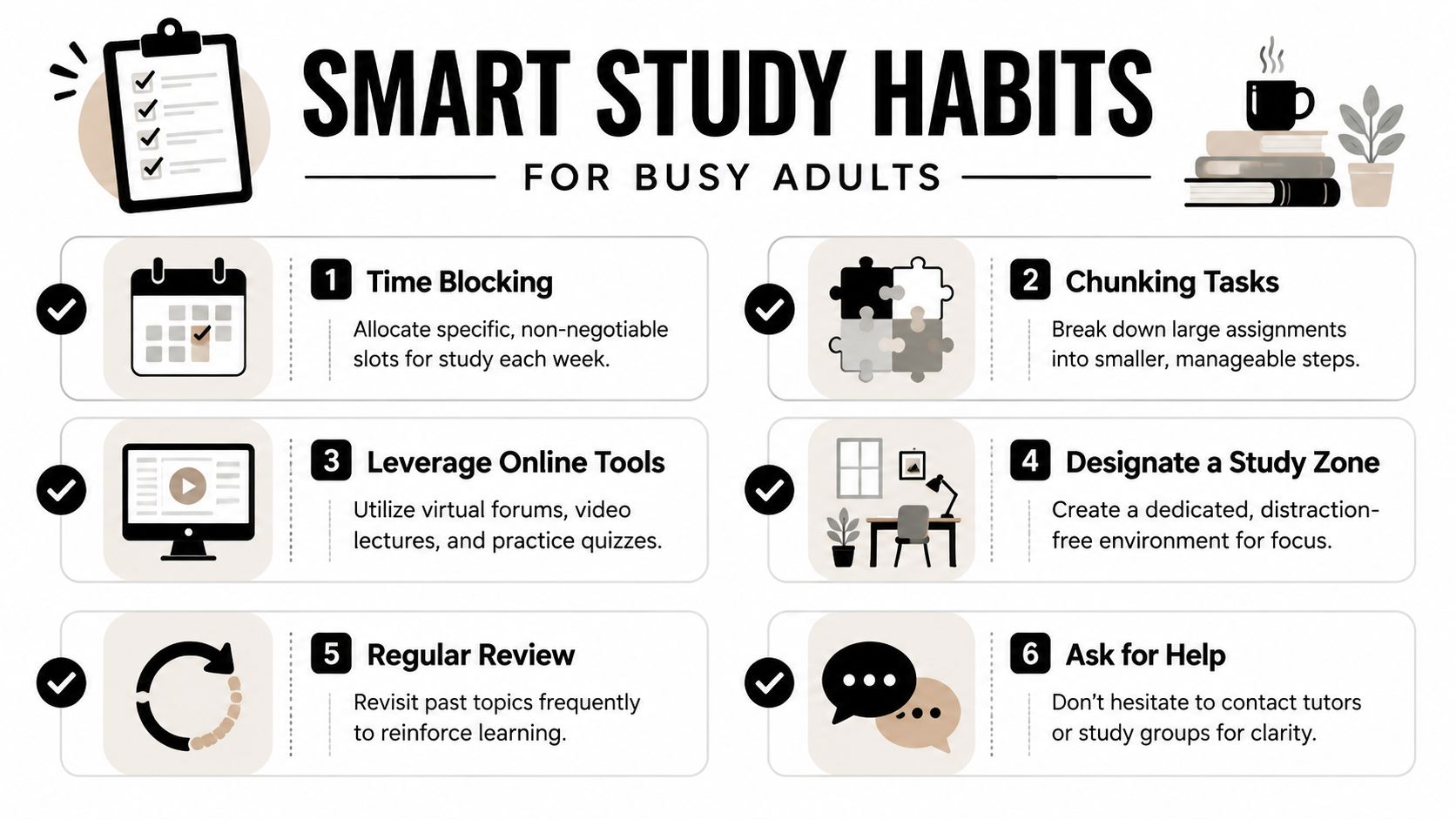
Try habits like these:
Use a 20-minute start
If you feel overwhelmed, promise yourself only 20 minutes. Starting is often the hardest part.Split one task into three
Instead of “study attachment”, read for one session, make notes in another, and answer one question later.Keep a small notebook nearby
Write down key terms while the kettle boils or while you're waiting in the car.Plan your week before it begins
Decide where study will fit, rather than hoping spare time appears.
Protect your best study time
Not all hours feel the same. Some people think clearly early in the morning. Others work better at night. Use your sharpest time for demanding tasks like essay planning or research methods. Save easier tasks, such as reviewing notes, for tired moments.
A simple pattern can help:
| Task type | Best time to do it |
|---|---|
| Reading a new topic | When your mind feels fresh |
| Making flashcards | Short gaps in the day |
| Essay practice | Protected quiet time |
| Revision review | Evenings or travel time |
| Checking feedback | Weekend catch-up sessions |
Ask for help early
Adults sometimes stay silent because they don't want to look foolish. That slows progress. If a term, theory, or assignment confuses you, ask early. One small question now can stop one big panic later.
Practical rule: Don't wait until you feel completely stuck. Ask for support when something first starts to wobble.
Progress matters more than perfection. Some weeks will go well. Some won't. A missed session doesn't mean you've failed. It means you need to restart, kindly and quickly.
Your Questions Answered by Our Experts
Adults often carry very personal worries about study. Here are some of the ones I hear most often.
Am I too old to do A Levels
No. According to Oxbridge Home Learning's guide for mature students, eligibility to study A-levels does not depend on age. Adults in their 20s, 30s, 40s, and beyond can enrol and go on to university. The same source notes that online colleges have over 25 years of experience supporting adult learners.
Age can help you. Many adults are more focused, more determined, and clearer about why they're studying.
What if I haven't written an essay in years
That's common. Writing is a skill, not a fixed talent. It comes back with practice, feedback, and repetition. Most adult learners improve by doing one piece at a time rather than worrying about being brilliant straight away.
What if I struggle with a topic
Struggling doesn't mean you aren't suited to the course. It usually means the topic is new and needs breaking down. Psychology includes ideas that can feel unfamiliar at first. Once they're explained in plain language, most become much easier to follow.
Can I really do this with a busy family life
Yes, if you build a routine that fits your life instead of fighting it. Adult study works best when it is honest, flexible, and steady. You don't need huge amounts of free time. You need commitment, a plan, and support when things get busy.
You are allowed to begin before you feel fully confident. Many people do.
If you're ready to take a proud step towards university, a better career, and a future your family can celebrate, Next Level Online College offers flexible online learning designed for adult returners who want real support and a qualification that can move life forward.