

Some evenings feel heavier than others. You clear the dinner things, glance at the clock, and think about the life you want. Better work. More money coming in. A real chance at university. A feeling that you've done something important for yourself, and for the people who look up to you.
Then the doubts creep in. Maybe you left school years ago. Maybe your confidence took a knock. Maybe you worry you've missed your chance.
You haven't.
A level study from home can be more than a qualification plan. It can be the moment you decide your past doesn't get the final word. It can be the start of a future where your children see you keep going, keep learning, and keep building something better.
It's Never Too Late to Be Who You Might Have Been
If you've been telling yourself you're too old, too busy, or too far behind, take a breath. That fear is common, but it isn't the truth.
Age is not a barrier to studying A Levels. According to guidance on mature students and A Levels, eligibility to study A Levels does not depend on age, which means adults in their 20s, 30s, 40s, and beyond can qualify just like younger students. That matters because it opens a real path to recognised qualifications, better earnings, fulfilling careers, and university.

Why this matters more than you think
When adults return to education, they're rarely doing it just for a certificate. They're doing it because they want life to change.
You might want to move into a job that feels meaningful. You might want to apply for university and prove to yourself that you can do it. You might want your children to see what courage looks like in real life. Those are powerful reasons, and they count.
For many people, the biggest hurdle isn't the course content. It's the story they've been telling themselves. “I wasn't academic.” “I'm not clever enough.” “I should have done this years ago.” Those thoughts can feel loud, especially if school was hard the first time round.
You do not need a perfect past to build a strong future.
You are allowed to start again
Starting A Levels as an adult isn't going backwards. It's moving forwards with more purpose than ever.
Adult learners often bring strengths younger students are still developing. You know why you're doing this. You understand responsibility. You've handled work, family, pressure, and setbacks. That gives your study real direction.
If you're exploring A Levels for mature students, hold onto this thought. You are not late. You are arriving with life experience, determination, and a reason that matters.
A level study from home can become a turning point. Not because it's easy every day, but because each hour you invest says something important. It says you still believe your life can grow. It says your children can watch you be brave. It says your future is worth effort.
Finding the Right A Level Path for Your Goals
Choosing A Levels can feel big at first. That's normal. The simplest way to make it manageable is to stop asking, “What should someone like me do?” and start asking, “What future am I trying to build?”
That shift changes everything.
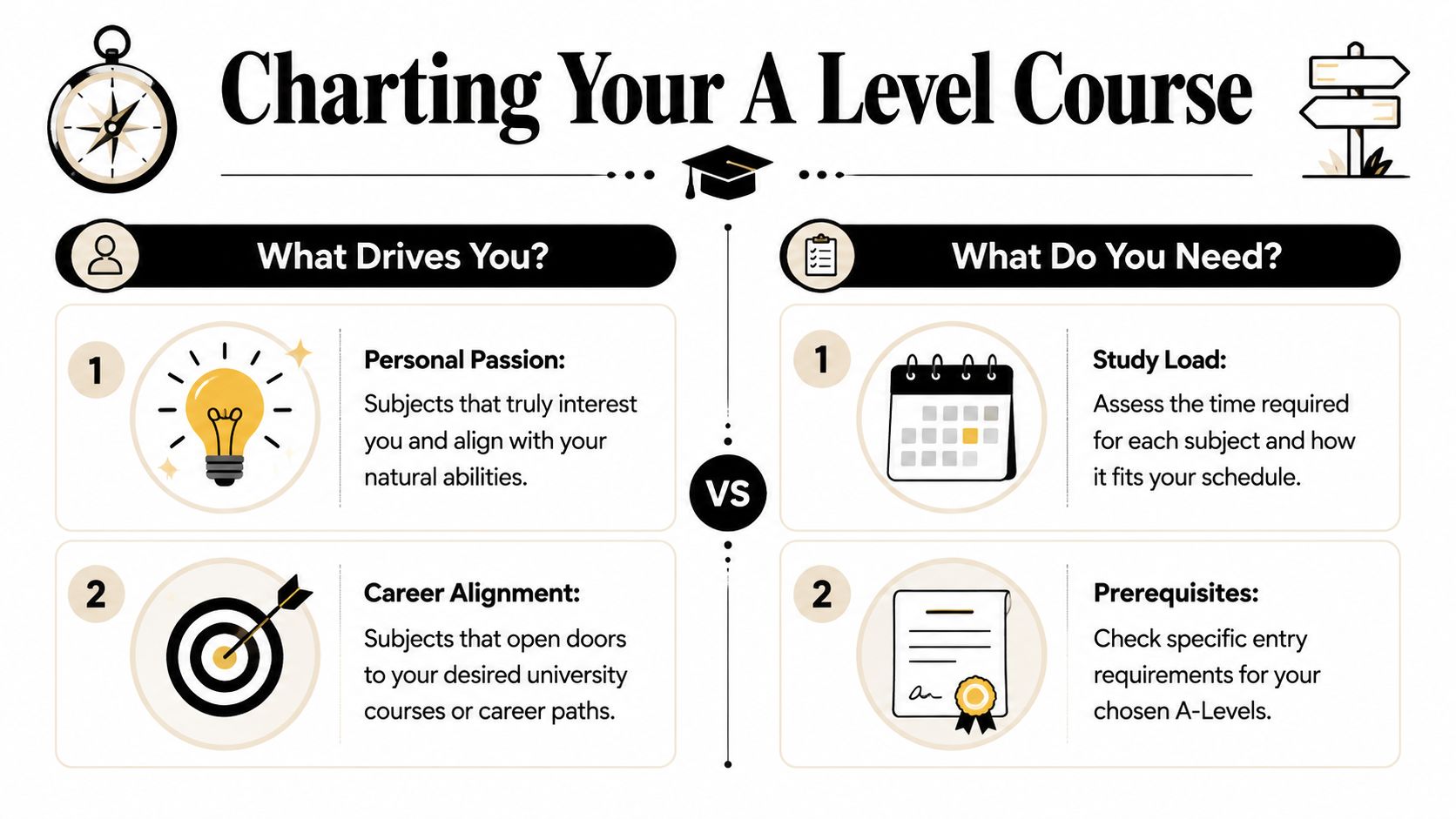
Choose subjects with both heart and purpose
Some adults make the mistake of choosing subjects only by what sounds practical. Others choose only by what they liked years ago. The best choice usually sits in the middle.
Use these questions to guide yourself:
- What do you enjoy enough to stay with? If a subject interests you, it's easier to return to it after a long work day.
- What opens the next door? If you want university or a specific career, check what subjects are commonly expected.
- What suits your current strengths? You don't need to pick the hardest option to prove anything.
- What fits your life now? A good subject choice is one you can realistically study alongside family and work.
A simple example helps. If you're aiming for nursing, psychology or biology may feel relevant. If you're drawn to teaching, English or history might support that path. If you want broader options, combining one subject you enjoy with one that supports progression can work well.
Decide how you want to study
The next choice is study mode. For adults, this often matters just as much as the subjects.
Many learners need flexibility more than anything else. They need study that fits around school runs, shifts, caring duties, and the days when life doesn't go to plan. That's why online learning appeals to so many adults.
According to research on the benefits of online A Level courses, online A-Level students in the UK achieve 20% higher grades and pass their courses approximately 30% faster than students in traditional colleges. The same source links that uplift to flexible home study, personalised pacing, and quick access to exam preparation materials.
A good study path doesn't ask you to live like a full-time teenager. It works with your real life.
A quick way to compare your options
| Question | Study at home | Fixed classroom study |
|---|---|---|
| Can you fit it around work? | Often easier | Can be harder |
| Can you study at your own pace? | Yes, usually | Less flexible |
| Can you revisit lessons when needed? | Often yes | Not always |
| Do you need to travel to a centre? | Less often for learning | Usually yes |
That doesn't mean one route suits everyone. It means you should choose the one that gives you the best chance of staying consistent.
If your goal is a better future, the right A Level path is the one you can keep walking. Not the one that looks impressive on paper, but the one that fits your life and keeps moving you closer to university, a career change, or greater confidence.
Creating a Study Plan That Fits Your Life
Most adults don't struggle because they lack ability. They struggle because life is full.
There are children to sort out, meals to cook, jobs to hold down, bills to think about, and tired evenings when your brain feels done for the day. That's why a level study from home works best when your plan is flexible, kind, and realistic.
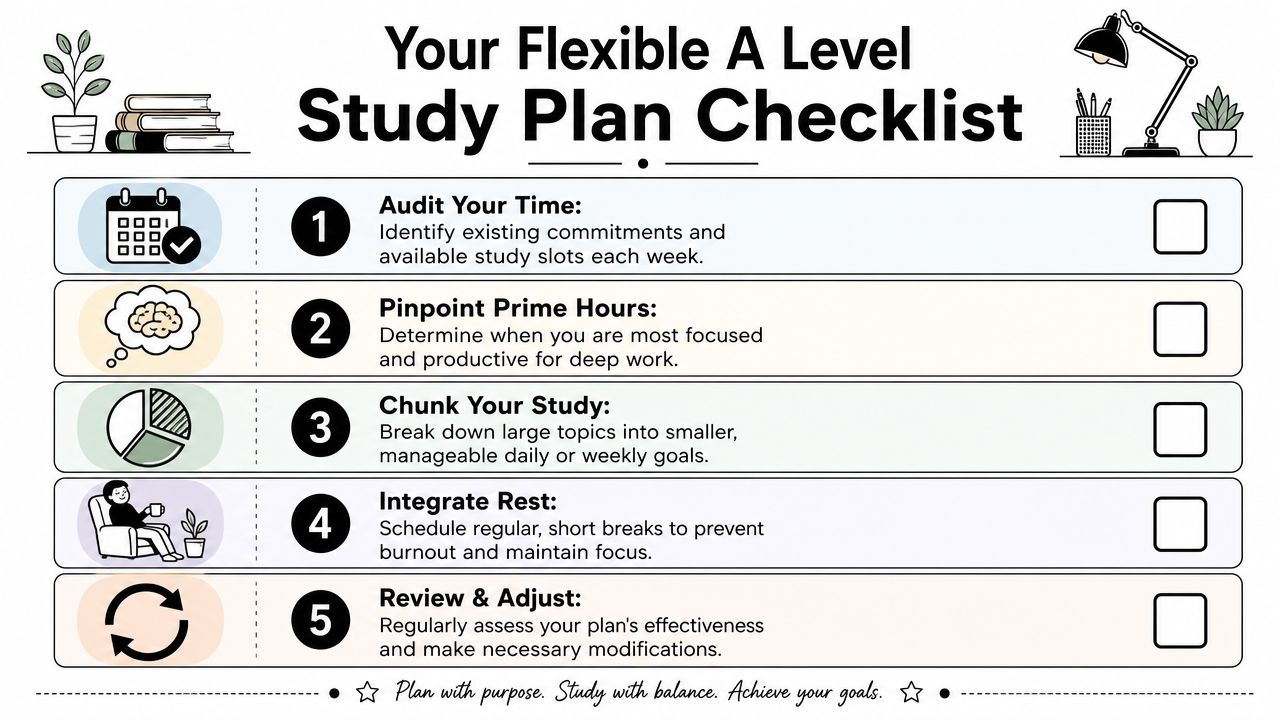
One learner might study for forty minutes while the children do their homework. Another might use a quiet hour before the house wakes up. Someone else may listen to recorded notes on the bus, then do written work after dinner. None of these approaches is wrong. They're smart because they use the time that already exists.
Build around study pockets
You don't need a huge empty timetable. You need repeatable pockets of time.
Try thinking like this:
- Morning pocket: A short session before work for reading or flashcards.
- Travel pocket: Audio notes, revision questions, or planning your next task.
- Evening pocket: One focused task after the children are in bed.
- Weekend pocket: A longer session for essays, past papers, or catching up.
That approach feels less frightening because it turns “I need to study everything” into “I need to do the next small thing”.
Practical rule: Consistency beats intensity. Three steady sessions each week will help you more than one exhausted marathon.
A short planning tool can make this easier. If you want a ready-made structure, these study planner templates can help you map your week in a simple way.
Make your study space easy to return to
Your study space doesn't need to look like a perfect home office. It just needs to help you begin.
A corner of the kitchen table can work. A laptop tray on the sofa can work. A small box with pens, notes, and highlighters can work. The key is reducing the effort it takes to start. If you have to hunt for everything each time, you're more likely to put it off.
Here's a helpful guide to getting into a practical rhythm:
Let your family support the plan
Many adult learners try to do everything on their own. That can make study feel lonely and heavy.
Tell your family what this means to you. Be specific. You might say, “On Tuesday and Thursday from 7 to 8, I need uninterrupted study time.” Children often respond well when they understand they're part of something important. They can see that Mum or Dad is working towards a goal.
A simple routine can help:
- Choose your weekly slots and put them somewhere visible.
- Set one clear task for each session, such as one topic or one essay plan.
- Finish with a tiny reset so it's easy to start next time.
Give yourself credit for small wins
Some weeks will go well. Some won't. That's part of adult learning.
If you miss a session, don't turn it into a story about failure. Return to the next session. If you complete a difficult chapter, notice it. If you sit down even when you don't feel confident, that counts too.
A strong study plan isn't strict. It's forgiving enough to survive real life.
Your Guide to A Level Exams and Registration
For many adults, exams are the part that feels most confusing. Not the revision itself, but the registration. Who do you contact? Which board do you use? Where do you sit the exam if you're studying at home?
If you've felt unsure, you're in good company. Guidance on self-studying A Levels says 78% of UK adults do not know how to self-register as private candidates with exam boards such as AQA or OCR. That tells you something important. The confusion is common. It's not a sign that you're incapable.
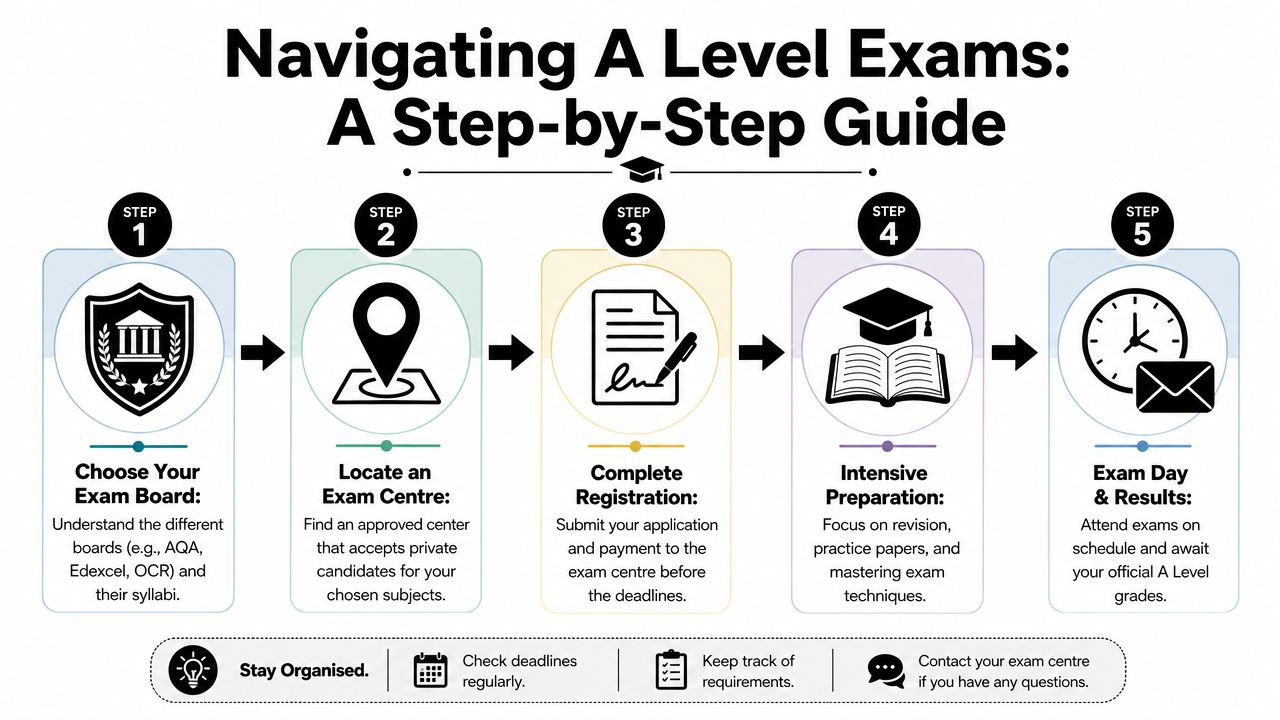
What a private candidate means
A private candidate is someone who takes an exam without being entered through a school or college in the usual way.
That often applies to adults studying from home. You prepare independently or through an online course, then register through an exam centre that accepts private candidates. Once you know that term, the whole process starts to make more sense.
If you're still weighing up the route, this guide on whether you can do A Levels online explains the home study option clearly.
A simple exam checklist
The process becomes easier when you break it into small actions.
Choose your subject and specification
Make sure you know exactly which syllabus you're studying. Exam boards such as AQA, OCR, and Edexcel may structure topics slightly differently.Find a centre that accepts private candidates
Not every centre does. Start this early so you have time to compare options and confirm availability.Ask what the centre needs from you
Some centres may want identification, subject details, or forms completed in a specific way.Check deadlines carefully
Registration windows matter. Don't leave this until the last minute.Prepare with the exam in mind
Past papers, timed practice, and mark schemes help you move from “I know the topic” to “I can answer under exam conditions”.
The exam process looks intimidating when it's one giant question mark. It feels manageable when it becomes a short list.
Questions adults often ask
| Question | Plain answer |
|---|---|
| Do I need to attend lessons in person? | Not for home study itself, but you usually attend a centre for the exam. |
| Can I choose my exam board? | You normally choose the board that matches your course materials and available centre options. |
| Should I register late if I'm unsure? | It's better to check early and keep your options open. |
| Do I need special planning for exam practice? | Yes. Revision and exam technique are not the same thing. |
The key is this. Don't let exam admin scare you out of a goal that matters. Once you understand the steps, it stops being a foggy problem and becomes a practical task list.
You Are Not Alone on This Journey
One fear many adults harbor is this: “If I study at home, I'll be doing it all by myself.”
That fear makes sense. Home study can sound isolated from the outside. But support matters far more than location. A learner can sit in a classroom and still feel lost. A learner at home can feel guided, encouraged, and understood when the right support is in place.
Support should fit real adult life
Adult learners don't just need subject knowledge. They often need help staying organised, rebuilding confidence, and getting back on track after a difficult week.
That support can include:
- Subject guidance: Help when a topic doesn't click the first time.
- Study skills support: Advice on revision, note-making, and handling assignments.
- Pastoral encouragement: Someone who understands that life pressures affect study.
- Steady accountability: Check-ins that help you keep moving even when motivation dips.
This matters even more for learners who are neurodivergent.
According to discussion of the gap in ADHD-friendly A Level home-study guidance, 97% of existing content focuses on children or generic schedules, and only 12% of online providers offer explicit ADHD-friendly curricula. For adults with ADHD or similar traits, that gap can make ordinary advice feel frustrating or impossible to use.
If your brain works differently, your study plan should too
Many adults have spent years feeling that they are the problem, when the actual issue is that the support wasn't designed for them.
You may need shorter chunks of study. You may focus better with movement breaks. You may need clearer deadlines, simpler task lists, or help breaking large assignments into smaller parts. That isn't weakness. It's self-awareness.
Good support doesn't ask every learner to work in the same way. It helps each person work in the way they learn best.
Here are signs that support is likely to be helpful:
- Instructions are clear: You know what to do next.
- Tasks are broken down: Big goals become smaller steps.
- Questions are welcome: You don't feel silly asking for help.
- Encouragement is practical: You get useful advice, not empty praise.
Connection keeps confidence alive
Studying from home doesn't mean closing yourself off. It means building a support circle on purpose.
That might include a tutor, a mentor, a family member who protects your study hour, or a friend who checks in before exams. It might mean asking for help sooner instead of waiting until you feel overwhelmed.
When adults return to education, confidence often grows slowly. First you understand one topic. Then you finish an assignment. Then you realise you're coping with things that used to scare you. Support helps those moments happen more often.
You do not need to carry the whole journey alone. You need people, systems, and habits that keep you moving when your confidence wobbles.
From A Levels to a Life You Love
A Levels matter because of what they can lead to.
For some adults, they are the bridge to university. For others, they are the step that makes a career change possible. Sometimes they help you qualify for training, apply for a new role, or finally go after work that feels more secure and meaningful.
If university is your goal, A Levels can support that route. You'll usually look at course entry requirements, compare subject expectations, and prepare an application through UCAS. If work is your focus, your A Levels can show employers something powerful. You can commit, learn, and finish what you started.
The result is bigger than the certificate
There's also a quieter result, and it matters just as much.
You become someone your family has watched grow. Your children see that learning doesn't stop when school ends. They see that hard things can be done bit by bit. They see that a parent can feel afraid and still keep going. That lesson will stay with them.
According to adult education participation reporting, 49% of adults in the UK have taken part in learning within the last three years. That tells us adult learning is part of real life for many people. It isn't unusual. It isn't out of reach. It belongs to ordinary adults who decide their future is worth investing in.
Keep your eyes on the life you're building
When revision feels tiring or progress feels slow, remember what this is for.
- A stronger career path
- A real chance at university
- More confidence in your own ability
- A powerful example for your children
- A future that feels chosen, not settled for
You don't need to have it all figured out today. You only need to take the next step and trust that small, steady effort can change a life.
Your A Levels won't just show what you learned. They'll show who you became while earning them.
If you're ready to turn hope into action, Next Level Online College offers flexible online courses for adults who want recognised qualifications, caring support, and a study route that fits around work and family life. It's a practical first step towards university, a better career, and a future you can feel proud of.