
You may be working all day, caring for your family in the evening, and wondering whether it's too late to return to education. Perhaps your child asks about homework while you're opening a study book of your own. Feeling nervous is normal, especially if you've been away from lessons for years, but nervousness isn't proof that you can't succeed.
A levels courses are open to adult learners too. People usually take them at 16 to 18, but there's no upper age limit for adults who want to study them. Oxford College explains that adults can take A levels without an upper age limit. You'll study the same recognised specifications as school leavers, but you can choose a route that fits your work, caring duties and home life.

Online learning can make the first step feel less frightening. You might study after your children are asleep, listen to a lesson during a quiet break, or complete practice questions at the weekend. If reading, writing or navigating online lessons feels difficult, a practical guide to speech recognition tools may help you find technology that makes studying more accessible.
Remember: You don't need to feel confident before you begin. Confidence often grows because you keep taking small, manageable steps.
A levels can lead to university, a career change or the subjects you need for a more fulfilling role. They can also show your children that learning doesn't belong only to the young. When they see you revise, ask for help and keep going after a difficult topic, they see a powerful example of courage.
This guide will help you understand what A levels are, how flexible study works, how to choose subjects, what assessment involves and how to select a supportive provider. You're not starting from nothing. Your work, parenting and life experience have already taught you planning, patience and problem-solving. Those skills matter.
Introduction to A Levels Courses for Adult Learners
A levels can feel like a locked door when you first look at them. The names of subjects may remind you of school, and words such as “specification”, “exam centre” and “UCAS” can sound complicated. In reality, the qualification is built from smaller pieces, much like learning to cook a new meal one step at a time.
You choose a subject, learn the key ideas, practise using them and prepare for assessment. A flexible course gives you a planned route through those stages, rather than leaving you to guess what to do next. That structure can be especially helpful if you're balancing employment, childcare or caring for another family member.
A qualification that fits more than one kind of life
There isn't a separate adult A level specification. Adult learners sit the same qualification as school leavers, which means the standard is recognised equally. The difference is the support and study pattern you need to reach that standard.
A classroom course may expect you to attend at set times. An online course can let you study at home and arrange learning around the parts of life that can't be moved. You'll still need commitment, but commitment doesn't have to mean studying for hours every day. It can mean following a sensible weekly routine and returning to your work even when a topic feels unfamiliar.
Adult education participation has become a serious concern. The Institute for Fiscal Studies recorded a 33% fall in adults taking Level 3 qualifications and a 50% fall in Level 2 and below, as discussed in this analysis of adult education participation. Clear guidance and personal support matter because many adults need a route that respects real responsibilities.
Why your reasons are important
You may want to reach university, qualify for a new career or earn more in a role that uses your abilities. You may also want your children to see that a difficult beginning doesn't decide the ending.
Those reasons can carry you through the weeks when revision feels slow. You're not merely collecting grades. You're building choices for your future and showing your family that progress can happen at any stage.
A kind starting point: Choose one small action today, such as comparing subjects or checking an entry requirement. Small actions turn a frightening plan into a real one.
What A Levels Are and How They Work in the UK
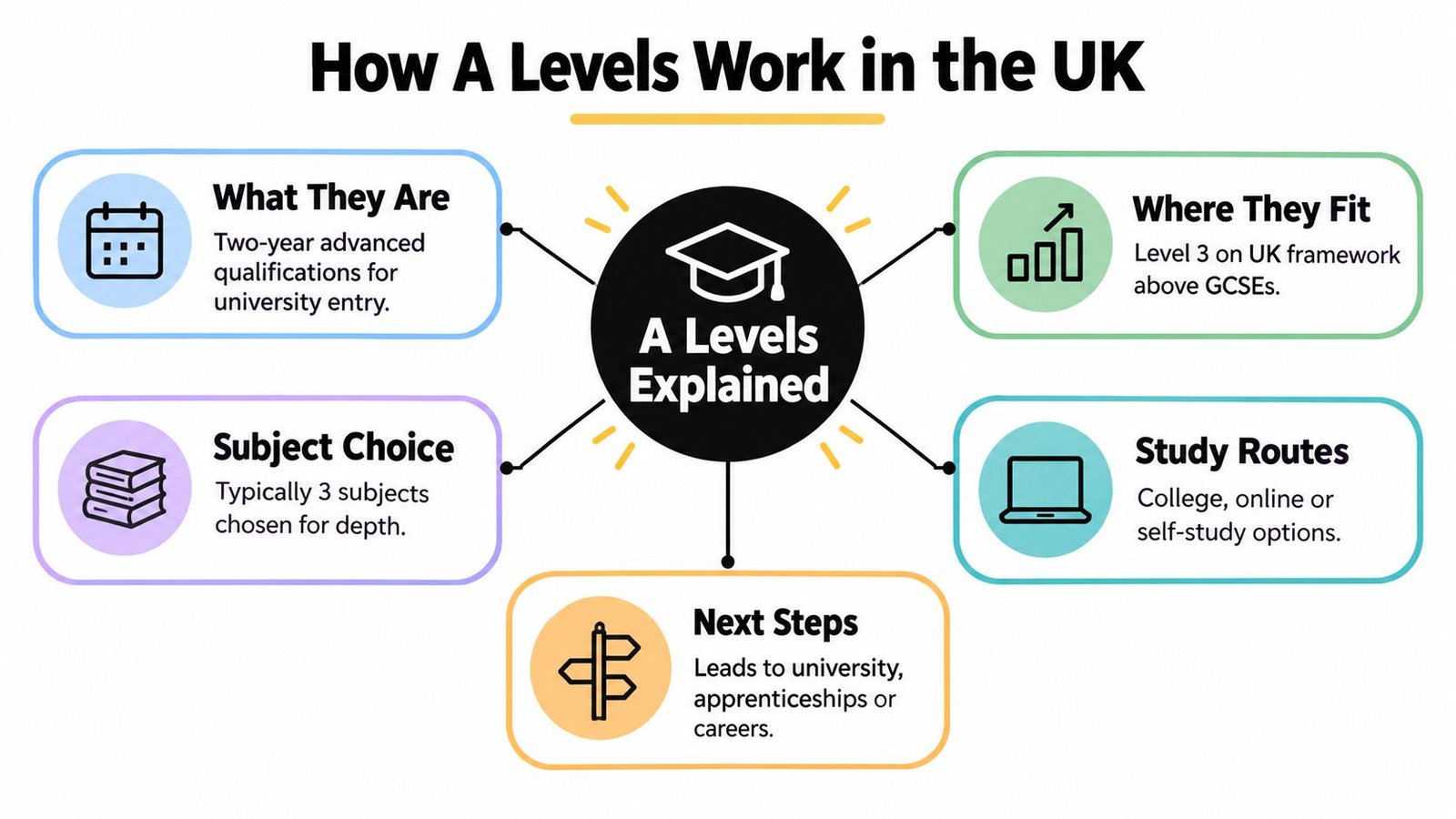
Think of GCSEs as learning the basic tools in a workshop. A levels let you choose a smaller set of tools and learn to use them with much more depth. They're advanced Level 3 qualifications and are commonly used for progression to university and further study.
The qualification sits within the UK's 16-to-19 academic pathway. Students normally study several subjects after GCSEs, then use their grades to apply for higher education, employment or another form of training. For adults, the same framework provides a recognised way to meet university subject and grade requirements.
The basic structure
Most learners choose three A levels and study them in depth. Each subject has its own content, skills and assessment. Biology involves understanding living systems, while English Literature involves close reading and thoughtful interpretation. Mathematics develops methods for solving problems and explaining patterns.
A levels have deep roots in the UK's post-war education system. Wartime reforms were shaping the modern qualification in 1941, and the Norwood Report in June 1943 recommended abolishing the Higher School Certificate, which came before A levels. That change helped establish the framework that made A levels the main academic route towards university and advanced study in England. The UK government's A level results information describes this history and the qualification's national role.
The qualification remains nationally important. The government reported 814,335 A level results issued in summer 2025, while provisional entries for summer 2026 reached 845,485, a 2.9% increase from 821,875 in summer 2025. The same statistics recorded 896,130 total entries across GCSE, AS and A level qualifications in summer 2026, showing the size of the wider examination system.
How grades make sense
A levels are graded from A* at the highest level through A, B, C, D and E. A result below E is normally recorded as a failure. The grade tells universities and employers how well you met the requirements of the subject.
Results in England rose during the pandemic period and later returned closer to earlier patterns. The proportion gaining grade C or above was 77.3% in 2017, 76.8% in 2018, 75.5% in 2019, 87.5% in 2020, 88.2% in 2021, 82.1% in 2022, 75.4% in 2023 and 76.0% in 2024. The Department for Education publishes these A level outcome figures. For you, this means grades provide a national benchmark, not a personal judgement about your intelligence.
Online and Flexible Ways to Study A Levels as an Adult
The best study method is the one you can continue using when life becomes busy. A fixed classroom timetable can provide strong routine, while online learning can remove travel and let you work at times that suit you. Blended learning sits between the two.
| Study route | What it offers | A possible challenge |
|---|---|---|
| Classroom | Set lessons and face-to-face teacher contact | Travel and fixed times may clash with work or family |
| Blended | A mixture of live support and independent online study | You'll need to manage both scheduled and flexible work |
| Fully online | Study from home at times that fit your routine | You'll need reliable planning and regular contact with tutors |
Classroom learning
A classroom can help if you learn best by speaking to a teacher straight away. You'll meet other learners, ask questions in person and receive a timetable that tells you where to be. This structure can be reassuring when you've lost your old study habits.
The drawback is practical. Travel, work shifts, school runs and caring duties may make attendance difficult. Missing a lesson can also make you feel as though you're falling behind, even when the problem is that the timetable doesn't match your life.
Blended learning
Blended study combines scheduled contact with online materials. You might attend a tutorial, then complete exercises and reading at home. This can offer more human connection than fully independent study while giving you some control over your week.
Ask how often you must attend, whether sessions are recorded and how quickly tutors answer questions. A course can be called blended but still feel rigid if most important activities happen at fixed times.
Fully online learning
Fully online A levels can suit adults who need to study early in the morning, during lunch breaks or after family responsibilities are finished. You'll usually access lessons, activities and feedback through an online learning system. A good provider should also explain how tutor contact, pastoral care and exam preparation work.
You can explore distance learning for A levels when comparing online options. Look for a clear course plan, regular feedback and a named person to contact when you're worried.
Ask before enrolling: Who helps when you're stuck, how is progress checked, and what happens if work or family life interrupts your planned timetable?
Support is important because adults don't return to study with identical needs. One learner may need help rebuilding maths knowledge, while another may need confidence with essays or technology. The course should make space for both academic questions and the emotional side of returning.
Choosing Your A Level Subjects and Understanding Entry Requirements
Subject choice is like choosing the right keys for a door. The subjects you study should match the university course or career you want to enter, not the subjects that sound easiest today.
Many UK colleges and sixth forms ask for at least five GCSEs at grades 4/C to 9/A, including at least grade 6/B in the subjects you want to study. Mathematically or scientifically demanding subjects may ask for a grade 6 or 7 in GCSE Maths and Science because the course moves quickly and expects confident use of earlier knowledge. Prospects outlines common A level entry requirements, but each provider can set its own rules.
Start with the destination
Write down a few possible university degrees or careers. Then check their actual requirements. A medicine-related route may expect particular science subjects, while a humanities degree may focus more on essay-based preparation. Universities can also ask for GCSE English and maths, specific A level grades or an admissions test.
Most university offers are based on three A levels, often using profiles such as AAA to ABB. Taking four subjects isn't automatically better. If an offer is calculated from your strongest three grades, careful subject selection and steady performance may be more useful than adding a fourth subject and weakening your time across all of them. The University of Manchester explains how offers can be based on three A levels and how subject combinations affect entry.
A useful subject-planning resource is this guide to good A level combinations. Use it as a starting point, then confirm the requirements for each degree directly with the university.
Understanding UCAS points
UCAS tariff points give grades a numerical value. For A levels, A* is 56 points, A is 48, B is 40, C is 32, D is 24 and E is 16. This UCAS tariff points table explains the grade values.
| Grade Combination | UCAS Points Breakdown | Total Points |
|---|---|---|
| AAB | 48 + 48 + 40 | 136 |
| ABB | 48 + 40 + 40 | 128 |
These examples show why a single grade can change your total. AAB is commonly represented as 136 points and ABB as 128 points. However, points don't replace subject requirements. A university may reject an application that has enough total points if the required subject or grade is missing.
How A Levels Are Assessed Timelines and Typical Costs
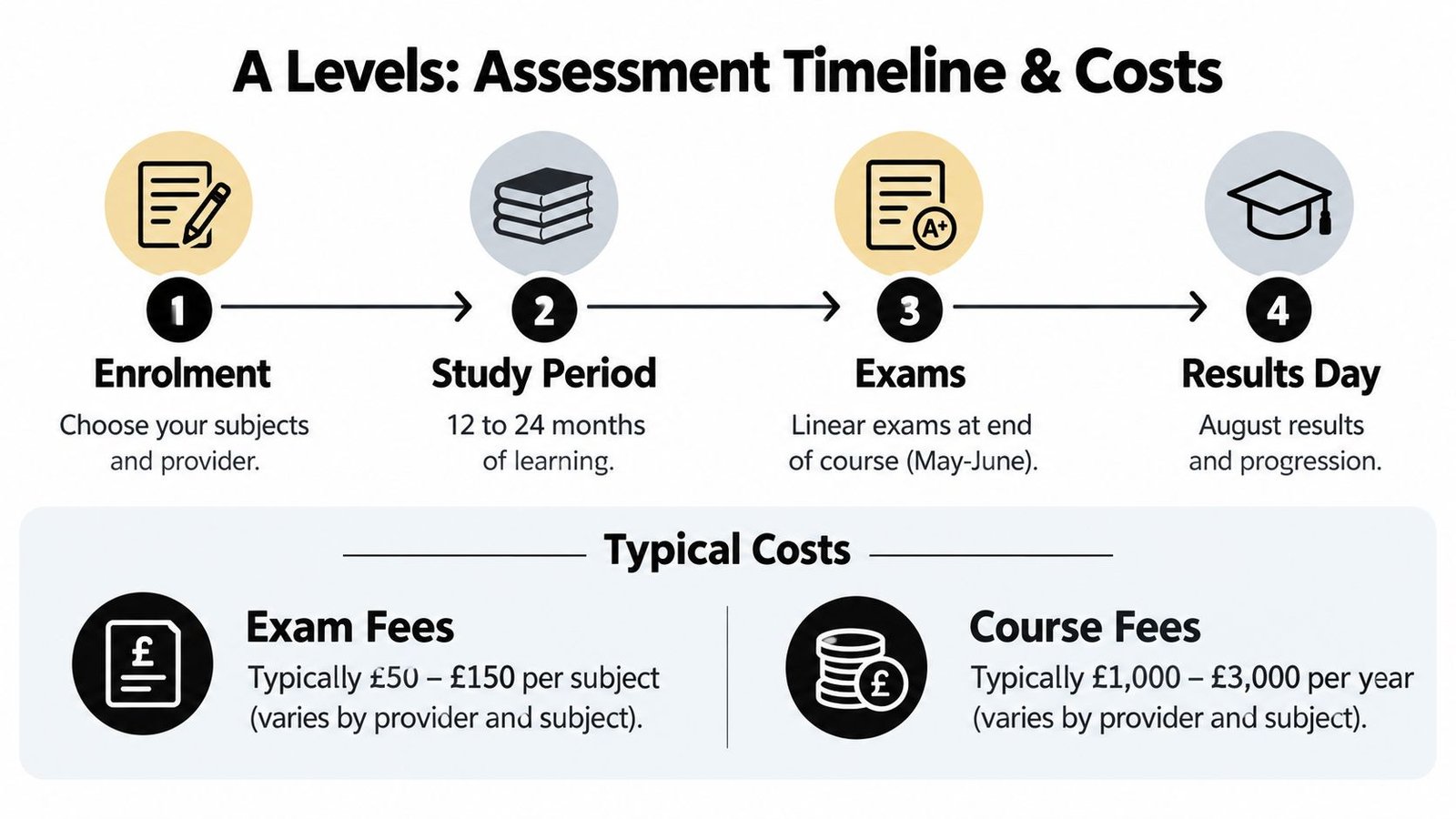
A flexible A level course is easier to manage when you can see the journey in order. You enrol, learn the content, practise, sit the exams and receive your results. Each stage has a job, so you don't need to solve the whole process on your first day.
From enrolment to preparation
First, choose your subjects and check that the provider supports the correct awarding specification. Ask whether the course includes tutor marking, revision guidance and help finding an approved exam centre.
Next comes the study period. Adults may complete a course over 12 to 24 months, depending on the subject, available time and provider arrangement. A longer pace can make sense if you work full time or care for children, while a shorter plan may suit someone who can study more consistently.
Create a weekly pattern rather than relying on motivation. For example, you might reserve one evening for new learning, another for practice questions and a weekend session for reviewing mistakes. The exact routine is yours to choose, but regular contact with the material helps prevent a long gap from becoming a confidence problem.
Linear exams and results
A levels are commonly assessed through linear examinations at the end of the course. This means the final assessment can cover the full specification, so your revision should build throughout the programme rather than begin shortly before the exam.
You'll normally sit exams at an approved exam centre. Online study doesn't mean online exams. Your provider should explain registration deadlines, centre arrangements, required identification and what happens if you need to resit.
You can use this guide to A level grades to understand how results are described and how grades relate to progression.
Planning the budget
Costs vary according to the number of subjects, course support, awarding body arrangements and exam fees. Some providers include certain fees in the course cost, while others ask you to pay exam fees separately. Ask for a complete written breakdown before enrolling, including any registration, assessment or resit charges.
Practical rule: Never compare course prices without checking what support and exam arrangements are included.
Where A Levels Can Take You and How to Succeed as an Adult Returner
An A level can be a bridge. On one side is your current situation, perhaps a job that no longer feels right or a qualification you couldn't access earlier. On the other side may be university, a different profession and work that gives you a stronger sense of purpose.
University applications involve more than adding up tariff points. Courses can ask for specific grades, subject combinations, GCSE English and maths, and sometimes admissions tests. Competitive courses may require offers such as A*AA or higher. UCAS course information shows how requirements can include more than a general points total.
That's why your subject plan matters. A carefully chosen group of A levels can prepare you for the next stage more effectively than collecting subjects without a clear destination.
Build confidence through evidence
Low confidence often says, “I'm not a study person.” Replace that thought with something you can check: “I completed a practice question,” “I understood this page,” or “I asked for help before the problem grew.” Each completed task gives your brain evidence that you're making progress.
Use a simple study system:
- Set a small target: Decide what you'll finish before you sit down.
- Practise actively: Answer questions, explain ideas aloud or create short memory prompts.
- Review mistakes: Treat an incorrect answer as information about what to practise next.
- Keep support close: Contact your tutor or mentor before confusion turns into avoidance.
- Protect your energy: Sleep, breaks and realistic planning help you study for the long term.
Your family may notice the change before you do. They'll see you making time for a goal, handling setbacks and continuing with care. That example can encourage your children to believe that education is available to them too.
A new qualification may help you apply for fulfilling work, qualify for a profession or improve your earning potential. It can also help you contribute to society through work that serves other people. The result isn't only a certificate. It's a wider set of choices for you and the people who depend on you.
Your Next Step to Choosing the Right A Levels Provider
Choosing a provider is a practical decision, not a test of loyalty. Compare what each organisation offers and whether its approach matches your responsibilities.
Check these points before you commit:
- Recognition: Confirm the qualification, awarding partner and exam arrangements.
- Flexibility: Ask whether you can set your own study times and adjust your pace.
- Academic help: Find out who marks work, gives feedback and answers subject questions.
- Pastoral support: Check whether someone can help with motivation, stress and confidence.
- Progression advice: Look for guidance on subject choices, university requirements and applications.
- Full costs: Request a clear explanation of course, registration, exam and possible resit fees.
Next Level Online College is part of Cambridge Online Education Ltd and provides online A levels, GCSEs, Functional Skills in English and maths, and Access to Higher Education diplomas. Its courses are designed for adult learners and combine structured study with academic and pastoral support, including help from subject specialists, mentors and wellbeing advisers.
You don't need to become a different person to succeed. You need a realistic course, a clear subject plan and people who will help you keep moving when a topic feels hard. Your first step could lead to university, a new career and the pride of showing your family what steady effort can achieve.
Next Level Online College offers flexible online A levels with structured learning, subject guidance and support for adults studying around work and family life. Visit Next Level Online College to explore suitable subjects, check your progression route and take the first confident step towards your future.