
You're standing at the kitchen table with a mug going cold, checking course pages after work, trying to work out which A levels make sense for your life now. The choices feel heavy because this isn't just about subjects, it's about your children seeing you stick with something hard, your next job, and whether university still feels possible. The good news is that good A level combinations are not a mystery, they're a practical decision you can make with a calm head and the right information.
Why Choosing the Right A Level Combination Matters
When you return to study as an adult, every subject choice carries real-life weight. You are not only choosing what to learn, you are deciding how to fit study around work, children, money, and the energy you have left. That is why the right good A level combinations matter so much at this stage.

Each A level works like a key. Some keys open a narrow door, such as Medicine or Engineering. Others fit a wider set of courses because universities commonly recognise and value them, including the kinds of subjects Cambridge highlights in its subject guidance on choosing high school subjects. Cambridge's subject guidance shows that a strong mix can be built around subjects such as English Literature, a language, History, Mathematics, Biology, and Physics.
Practical rule: choose subjects that support your destination, not just subjects that sound impressive on paper.
For adult learners, that choice has an extra layer. Time is limited, so a combination that supports your next step can make study feel purposeful instead of scattered. A sensible mix can help you aim for university, a career change, or a better-paid role without stacking avoidable pressure onto an already full life.
Thousands of adult learners return to education with work, children, and the usual chaos of life still going on around them. If you want guidance shaped for that reality, see A level options for mature students. The College Future Foundation found that 82% of adult learners who complete a qualification report improved confidence in their ability to learn, which matters because confidence is often the first thing people need to rebuild before the grades follow.
Understanding What Makes a Combination Good
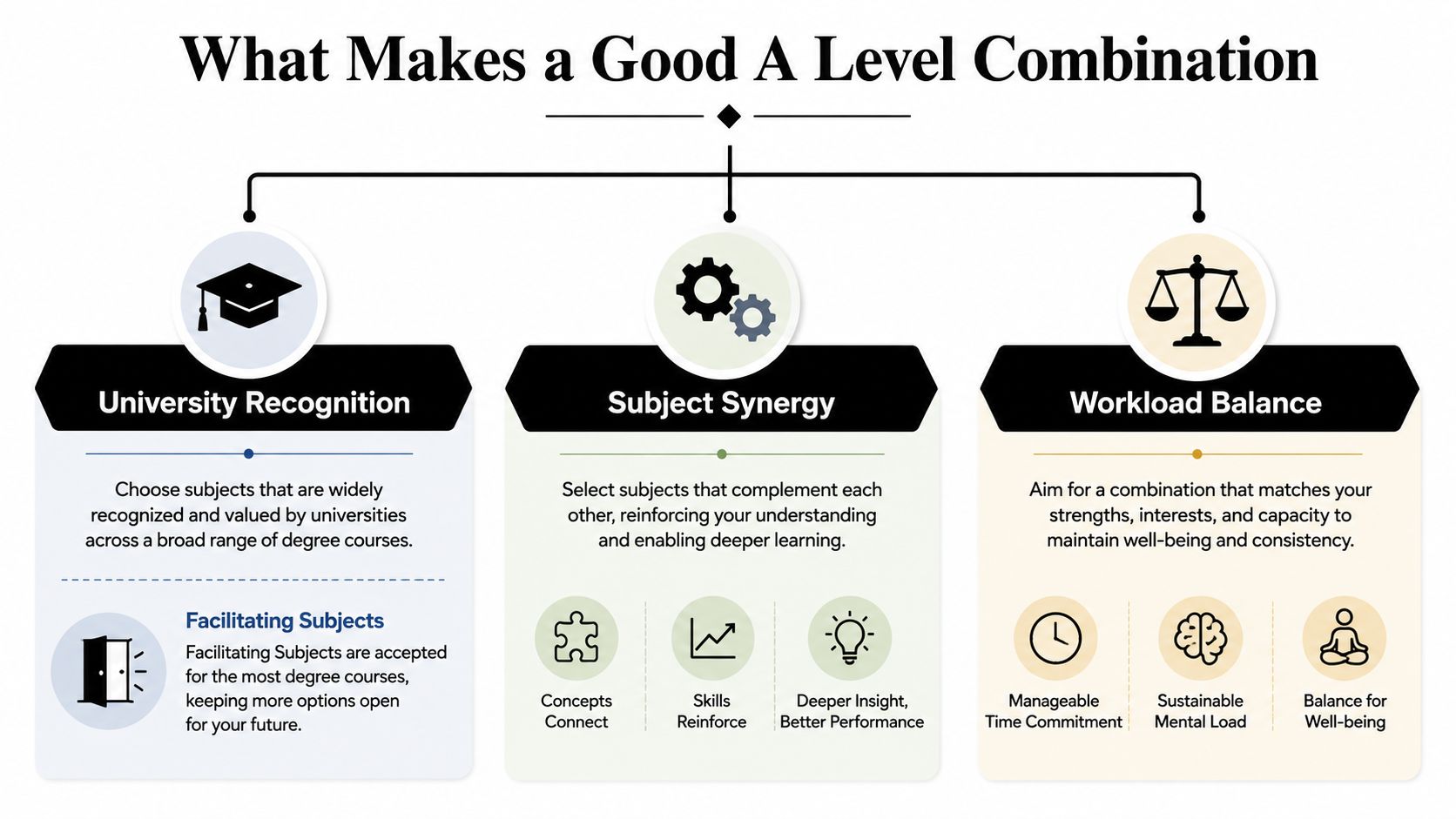
A good A level combination usually does three jobs at once. It is recognised by universities, the subjects work well together, and the workload is realistic for the person studying them. If one of those parts is missing, the combination can feel awkward later.
University recognition
Some subjects keep more doors open than others. In UK admissions, people often talk about facilitating subjects, which means subjects that are widely accepted and can support entry to a broad range of degree courses. The point isn't to chase the hardest possible options, it's to choose subjects that universities understand and value.
Subject synergy
Subjects should also help each other. Maths and Physics share problem-solving skills, so ideas from one subject often support the other. Biology, Chemistry, and Maths also fit well together because the knowledge overlaps in a useful way without being the same thing repeated three times.
A strong combination feels joined up. You're learning different skills, but they still belong to the same bigger plan.
Workload balance
The third part is balance. Three very content-heavy subjects can feel brutal if they all demand constant memorising, essays, or calculations. A better mix is usually one that gives you variety, like one analytical subject, one essay-based subject, and one that is more technical, depending on your target course.
Planning a meal is a good analogy. You want a main dish, a side, and something that adds contrast. Three versions of the same thing can feel too heavy, and that's true of subjects too. A combination that you can study consistently, revise properly, and still enjoy is often stronger than one that just sounds elite.
The Most Popular and Proven Combinations
The clearest pattern in England is the continued strength of science-led choices. A major historical analysis found that Biology, Chemistry and Maths was the most popular three-subject combination, and FFT Education Datalab said it was taken by more than twice as many students as the second-most popular combination, Chemistry, Maths and Physics. FFT Education Datalab's analysis shows how strongly the science route dominates the A level subject choices.
That doesn't mean everyone must take STEM subjects. It does mean these combinations have a proven track record, clear university recognition, and a familiar route into demanding courses. For adult learners, that familiarity can be reassuring because it means there are established study paths, revision materials, and lots of people who've taken the same route before.
The Department for Education's results data also show how sharply outcomes vary across combinations. Among 262,104 A level result combinations, 2.2% achieved three As or better, 4.9% achieved at least AAA, 9.1% reached A*AA or better, and 12.7% reached AAA or better. The same dataset shows 30.7% reached ABC or better and 30.3% reached BBB or better. The government grade combinations data shows why balance matters as much as ambition.
| A Level Combination | Common Degree Paths | Career Examples |
|---|---|---|
| Biology, Chemistry and Maths | Medicine, Dentistry, Veterinary Medicine, Biosciences | Doctor, dentist, vet, biomedical scientist |
| Chemistry, Maths and Physics | Engineering, Physics, Materials, some Computing routes | Engineer, physicist, data-focused technical roles |
| Biology, Chemistry and Psychology | Psychology, healthcare, public health, related life sciences | Clinical support roles, psychologist pathways, health careers |
Useful takeaway: popular combinations are popular for a reason. They line up with well-known degree routes and usually make revision habits easier to build because the subjects connect.
The strongest choice is usually the one that gives you both access and manageability. If a combination is respected by universities and you can sustain the workload, it's doing its job.
Matching Combinations to Your Career Goals
The smartest way to choose is to work backwards from the future you want. If you already know the career area you're aiming for, the subject choices become much easier to sort out. You're not guessing, you're building towards a target.
Medicine and healthcare
Medicine, Dentistry and Veterinary Medicine usually require Biology and Chemistry, with Maths often recommended as a third A level. UK guidance on A level combinations for medicine and related routes says Chemistry is strongly recommended and Biology is often preferred, which matches the usual university expectation for these courses. Psychology can sometimes support health-related interests too, but it doesn't replace the core science requirements.
Engineering and computing
For Engineering, Maths and Physics are the key pair, and Chemistry or Further Maths can strengthen the profile. For Computing, Maths is the main anchor, with Computer Science and Physics often making sense as supporting subjects. These combinations work because they train the same kind of thinking universities expect, careful logic, problem-solving, and comfort with abstract ideas.
Law, business and economics
Law does not always demand a fixed trio, which gives you room to be strategic. English Literature, History, and a language are strong because they build reading, writing, and argument skills. Cambridge's guidance also notes that Mathematics is useful for Law, which means a mix like Maths, Economics, and a language can be a very strong profile for Economics, Business, and some law applicants too. Cambridge's admissions guidance is helpful here because it shows universities value thoughtful subject stories, not just the most obvious trio.
Here's a simple way to consider it:
- Medicine route: Biology, Chemistry, plus Maths or Psychology.
- Engineering route: Maths, Physics, plus Chemistry or Further Maths.
- Law route: English Literature, History, plus a language or Maths.
- Business and Economics route: Maths, Economics, plus Business or a language.
- Computing route: Maths, Computer Science, plus Physics or Further Maths.
Choose the subjects that fit the degree first, then check the exact university entry rules second.
This UCAS points guide can also help you understand how grades may sit alongside your overall application plan.
Practical Considerations for Adult Learners
Adult learners often need a different checklist from school leavers. The subject choice still matters, but so do access, pacing, and support. A combination that looks ideal on paper can become stressful if it doesn't fit the reality of your week.
Entry requirements and study setup
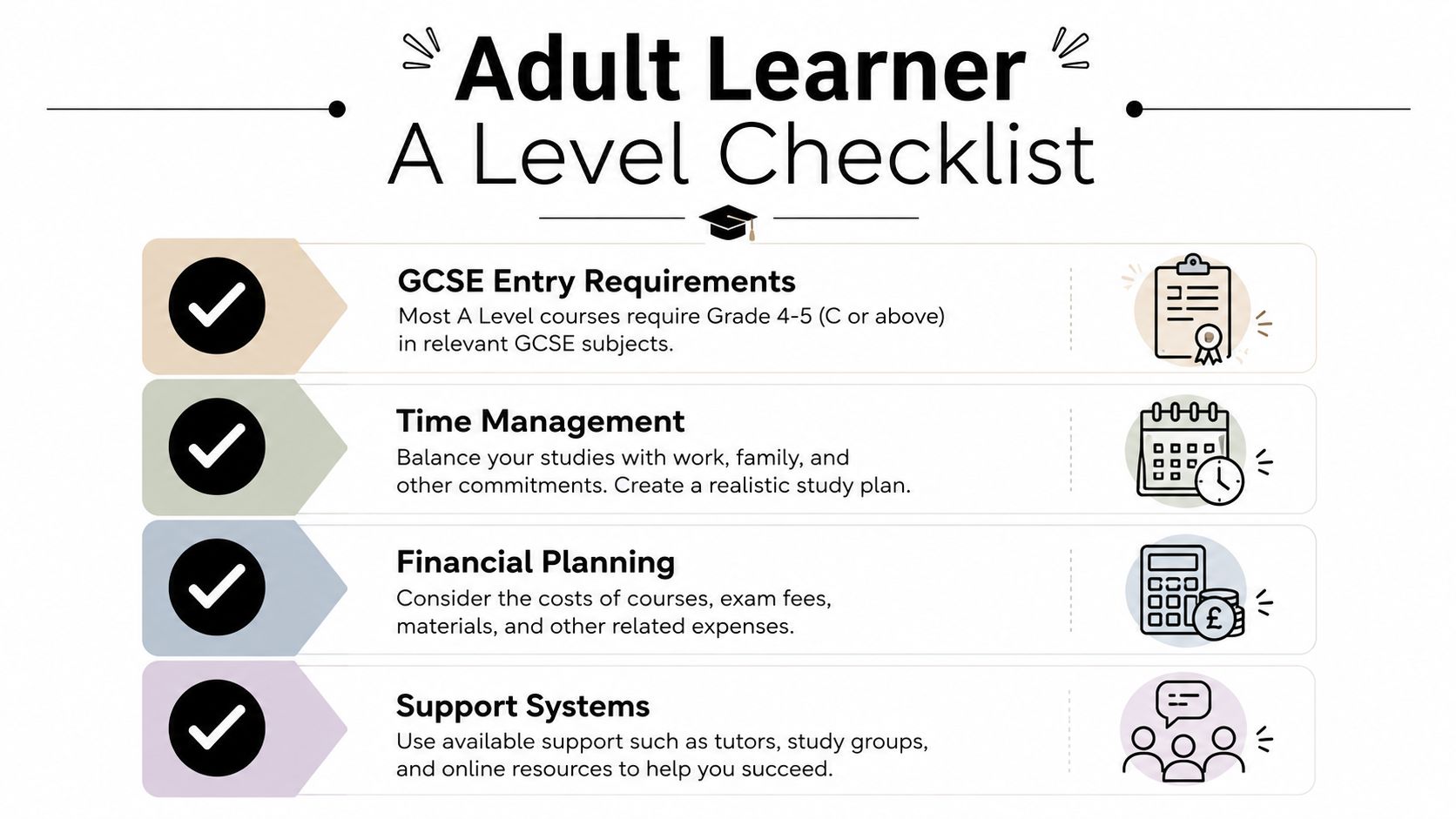
Many A levels need related GCSEs, and Maths and English are often required. If you're missing one of those, it's better to find that out early than halfway through enrolment. A good provider should explain what you need before you commit.
Online study can work very well for adults because it lets you learn from home and fit lessons around work and family. Distance learning for A levels is often built around tutor support, structured content, and flexible access, which matters when your timetable isn't your own.
Time and confidence
Part-time adult learners often need longer than full-time students, and that's completely normal. The key is pacing yourself so you can keep going without burning out. Short, regular study sessions are usually more realistic than trying to do everything at once.
Many adults worry they've forgotten how to learn, or that they're too old to start again. That fear is common, but it doesn't mean anything is wrong with you. Motivation, purpose, and life experience can make adult learners very strong students because they tend to know why they're there.
Support and money
Look for a college that offers clear tutor access, sensible feedback, and pastoral support, not just course materials. Ask about the total cost, exam fees, and whether there are finance options available. If a provider is vague about support or pricing, treat that as a warning sign.
- Check GCSE entry rules early: make sure the subjects you want match your current level.
- Plan around your week: school runs, shifts, and family time all matter.
- Ask about support: good tutors make a huge difference when confidence is low.
- Budget for the full journey: courses, exams, and any extra study resources should be clear from the start.
Strategic Alternatives Beyond the Obvious Choices
A student who returns to education after work, parenting, or a long break often worries that their subject mix will look too unusual. That worry is understandable. The useful question is whether the combination builds a clear academic story and supports the next step you want to take.
Some strong combinations do exactly that without following the usual science-heavy route. English Literature, a language, and History create a strong humanities base. This mix suits Law, English, international study, and many writing-heavy degrees because it develops evidence use, interpretation, and clear argument. It also gives universities a coherent profile they can understand quickly.
Maths paired with Economics and a language is another sensible route. It can work well for Economics, Business, and some Law applicants. The balance matters here. Maths shows numerical confidence, Economics adds analysis of systems and choices, and a language can strengthen communication and show flexibility. Cambridge's subject guidance reflects the broader point that universities tend to prefer combinations with purpose rather than a random pile of subjects.
Less obvious, still strong
Biology, Psychology, and Sociology can also form a thoughtful combination. It does not fit every medical course, but it can support social science, public health, healthcare management, and people-focused degree routes. The strength here comes from how the subjects sit together around behaviour, society, and human wellbeing.
For adult learners, that can be reassuring. You may already have workplace experience, family responsibilities, or a clearer view of the job you want. A combination like this can fit those priorities better than copying a path chosen by someone who is still exploring. It can also fit the way you study now, because it connects ideas across subjects rather than asking you to rely on memory alone.
What matters is the story your subjects tell. If they connect clearly to the degree you want, they do not need to be the most stereotypical set of choices in the room. A less crowded combination can even look more deliberate, because it shows you have thought carefully about your strengths and your destination.
A lot of adults feel relieved when they see this. You do not have to copy the path of a 17-year-old who is still deciding. You can choose subjects that match your experience, your goals, and the course you want to study.
Your Journey to Transforming Your Future
There's a quiet moment that matters a lot, the day your results arrive and you realise you've done it. The certificate is only paper, but it carries something bigger. It says you kept going while life was busy, tiring, and sometimes unfair.
That moment often changes how people see themselves. Your children see it too. They see that learning isn't only for schoolchildren, and that sticking with something hard can lead somewhere real. That example can stay with them for years.
The payoff goes beyond pride at home. A stronger qualification can open the door to better training, better interviews, and more confidence when you speak about your skills. It can also support the kind of career move that gives your family more stability and more choice.
Real progress starts when you stop asking whether you're capable and start choosing the path that fits your goal.
Choosing good A level combinations is part of that change. You're not just signing up for subjects, you're deciding what kind of future you're building. If the right mix leads you towards university, a fulfilling job, and a better life for your family, then the choice is worth taking seriously.
You don't need to know everything today. You only need a clear next step, the right combination, the right support, and the courage to begin.
If you're ready to take that step, Next Level Online College can help you choose a flexible A level route that fits around work, family, and real life. Their fully supported online learning is built for adult learners who want a confident, practical way back into education, with guidance from enrolment through to results.