
Somewhere in your day, this thought keeps coming back. You want more. More choices, more security, more pride, and a future that feels bigger than getting through the week.
You might be working, raising children, caring for family, or all three at once. You might also be carrying an old story about yourself: that you left education too early, that you're not academic, or that university is for other people. I don't agree. If you're looking at A Levels now, you're already proving something important. You haven't given up on yourself.
Your Time to Shine Is Now
It's 9:30 pm. The house is finally quiet, you open your laptop, and the same question lands again. Could I do this now?
Yes. You can.
An online fast-track A Level is a practical route for adults who want a recognised qualification without stopping work or putting family life on pause. The point is not to race blindly. The point is to choose a route that fits a real goal and a real deadline, especially if university is part of the plan.
That matters more than many guides admit. Fast track only helps if your subjects, exam board, and exam dates line up with the UCAS cycle you want to apply through. If you are a mature applicant, that timing can make the difference between starting university next year and losing another year.
You are not too old
Age is not the problem. Planning is.
Guidance for mature students explains that there is no upper age limit for A Levels, and that adults can study them over different timeframes, including accelerated options. That should take some weight off your shoulders. The question is not whether you still have a chance. The question is whether you will give yourself a clear structure and stick to it.

If you have been telling yourself that you missed your moment, stop saying that. Adults return to study every year and get the grades they need. The difference is rarely raw talent. It is usually consistency, a clear reason for doing it, and a study setup that works in ordinary life. If you want to see what that kind of online study process looks like in practice, review how online A Level study typically works for adult learners.
Practical rule: You do not need to feel fearless. You need a strong reason and a workable plan.
Why this matters for your family
This choice reaches further than exam results.
A Levels can lead to university, training, career change, and better long-term earning power. For many adults, that means more stability at home and more control over what the next ten years look like. That is not selfish. It is responsible.
If you have children, they are watching more than you think. They see what it looks like to return to something hard, keep your word to yourself, and build a better future step by step. That example stays with them.
A recognised route with a real payoff
A Levels remain one of the main qualifications used for university entry in the UK. Ofqual's official 2024 A level results data shows how established and widely used this route still is. That is one reason I recommend it so strongly to adults who want a qualification universities already understand.
You are not chasing a vague promise. You are working towards a standard qualification with a clear place in the UK admissions system.
That is a smart move. It is achievable, respected, and worth the effort.
Choosing Your Subjects and a Provider Who Cares
A common mistake at the start is choosing subjects based on what sounds good, instead of what gets them where they want to go.
If your goal is university, don't start with “What A Levels can I squeeze in?” Start with “What does my course ask for?” That one change can save you time, stress, and a painful delay later.
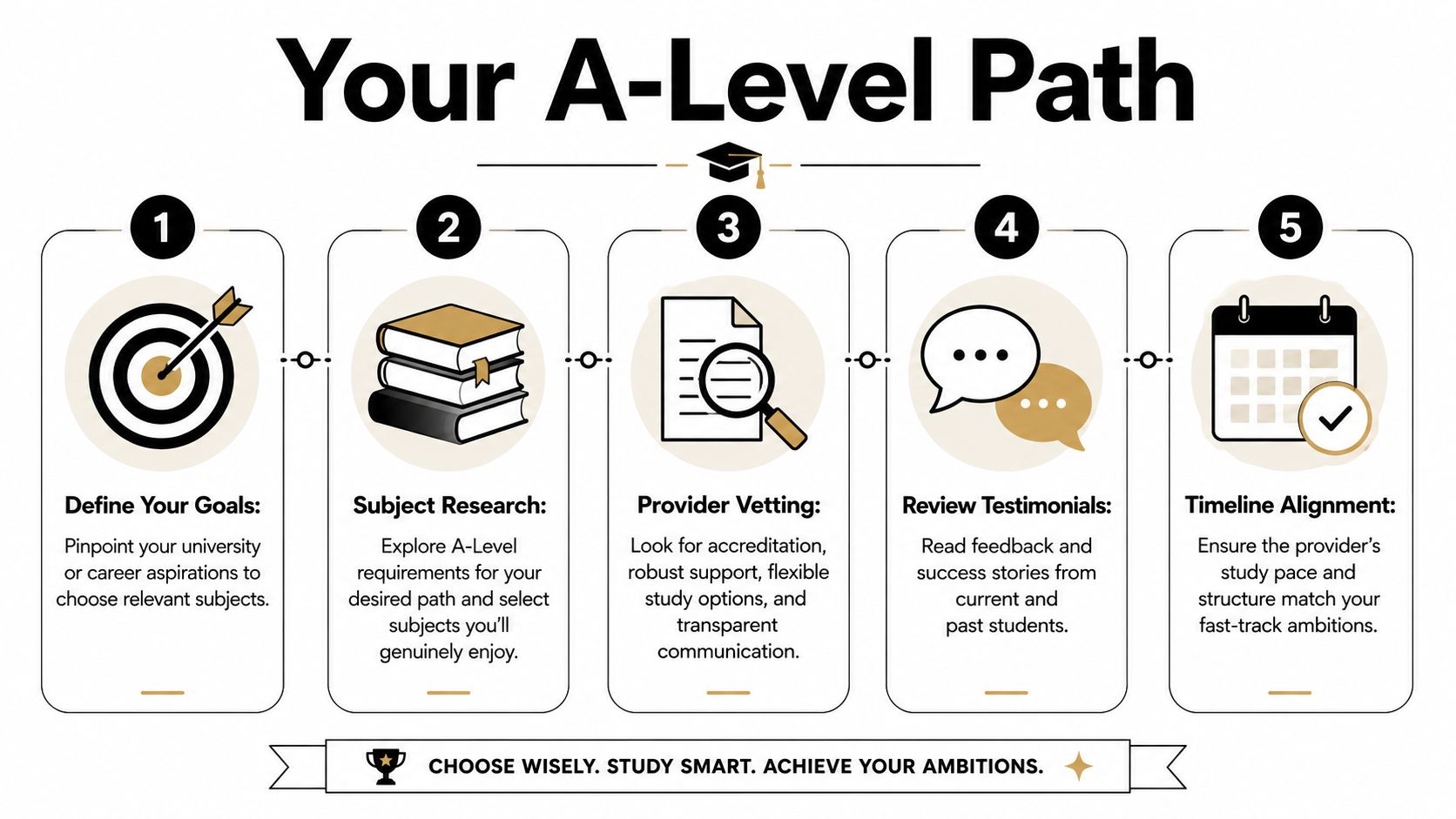
Choose backwards from your goal
The question isn't just whether you can study fast. The key question is which subject combination can be completed, examined, and certificated in time for your specific university admissions cycle. That's especially important if you're aiming for a career change into areas with clear entry expectations.
Use this order:
- Pick the destination first. Look at the university course or training route you want.
- Check the entry requirements carefully. Some courses want specific A Level subjects.
- Check timing. Make sure those subjects can be studied, sat, and certificated in time for the admissions cycle you want.
- Only then choose the provider. A fast-track promise means little if the dates don't line up.
If you're looking at nursing, teaching, psychology, business, or a science route, be especially strict with yourself here. Don't assume any three subjects will do the job. Universities often care about subject choice and when your results will be ready.
What to look for in an online provider
A good provider doesn't just sell course access. They help you finish.
Use this checklist when comparing colleges:
- Clear structure: You need a study plan that shows what to cover each month. Fast-track A Levels fall apart when the course is vague.
- Tutor support: When you get stuck, someone should answer your academic questions properly.
- Exam guidance: You need help understanding private candidate entry, exam boards, and deadlines.
- Adult-friendly delivery: The course should fit around work shifts, school runs, and real life.
- Transparent communication: If something has a deadline or extra step, the provider should say so clearly.
- Payment options: Cost matters. You're far more likely to continue if the course is financially manageable.
One option to review is how Next Level Online College structures its learning process. What matters most is not the brand name. It's whether the provider gives adult learners a clear path from enrolment to exam entry.
Avoid the wrong kind of fast track
Some “fast-track” offers are really just self-study with a sales label. Be careful if a provider is weak on the basics.
Watch for red flags:
- No clear exam information: If they can't explain how exams work, that's a problem.
- No mention of support: Adult learners usually need guidance, not just files to download.
- No timeline planning: If they don't ask about your target university start date, they're missing the point.
Fast track should mean organised and purposeful. It should not mean rushed and confusing.
Understanding the Fast Track Timeline and Exams
You need a realistic picture of what fast track looks like. It usually means compressing the standard two-year A Level into about one year. You still cover the same syllabus and sit the same external exams. You just do it at a faster pace, which usually calls for an immediate start, a firm revision plan, and private candidate exam registration with awarding bodies such as AQA or Pearson Edexcel, as explained in Oxford College's guide to how fast-track A Levels work.
That's the truth of A Levels online fast track. Same finish line. Faster journey.
Fast track compared with the standard route
| Aspect | Fast Track A Level (1 Year) | Standard A Level (2 Years) |
|---|---|---|
| Study length | About one year | About two years |
| Pace | Much faster | More spread out |
| Syllabus | Same syllabus | Same syllabus |
| Exams | Same external exams | Same external exams |
| Study rhythm | Needs a fixed weekly plan and early revision | More room to recover from slow periods |
| Best for | Adults with a clear goal and steady routine | Learners who need more time and flexibility |
This comparison matters because many adults assume a fast-track course must be a lesser version. It isn't. The challenge is not quality. The challenge is managing the pace.
How the exam side works
You cannot sit A Level exams at home. You study online, but the exams are sat in person through an exam centre as a private candidate. That's one of the parts people find intimidating, but it's manageable when you break it down.
Follow this sequence:
- Enrol early. Give yourself enough time to study properly.
- Confirm the exam board. Your course materials should match the board you'll be entered for.
- Find an exam centre. Do this sooner than you think you need to.
- Register as a private candidate. Don't leave it until the last minute.
- Build revision into your calendar. Fast track only works if revision starts before panic does.
Some providers allow enrolment all year, while others set deadlines such as mid-August for entry to the following summer exams. Pembrokeshire College's overview notes that fast-track A Levels are typically built around a one-year timeline and that some providers use cut-off points like mid-August for the next summer exam series.
Don't leave timing to chance
If you want a university place, your course, exam entry, and certification need to line up. That's why I'd urge you to read about distance learning for A Levels with one question in mind: does this fit my target admissions cycle?
Leave enough time for the boring admin. Adult learners often fear the academic side, but the real damage usually comes from missed deadlines.
Your Study Plan for Success Around a Busy Life
The hardest part for many adults isn't understanding the subject. It's protecting study time when life keeps barging in.
You might have a job, dinner to cook, children who need help, and messages arriving all evening. That's why your plan must be simple enough to survive a normal week.

Use short wins, not heroic sessions
Forget the fantasy version of studying. You probably won't sit in silence for half a day with colour-coded notes and endless energy. That's fine.
A better approach is a repeatable one:
- Forty-five minute blocks: One focused session often beats a tired three-hour slog.
- A weekly family plan: Tell people when you're studying so the time feels real.
- Small task lists: “Complete one topic” works better than “study biology”.
- Visible progress: Tick things off. Your brain needs proof that you're moving.
One adult learner might study before the children wake up. Another might use two evenings a week and part of Sunday. Someone on shifts might study in changing slots. The best plan is the one you'll keep.
Study truth: Consistency beats intensity. You do not need a perfect week. You need enough good weeks.
Build study into the life you already have
Don't wait for spare time to appear. It rarely does. Use what already exists.
Think practically:
- Lunch break for reading or flashcards
- Commute time for audio revision
- Early morning for written tasks
- Weekend block for essays or timed practice
This video gives a helpful look at staying motivated while learning from home.
Let your family be part of the plan
You don't have to do this alone. In fact, you shouldn't.
Tell your children what you're doing and why. Let them see your books on the table. Let them hear you say, “I'm studying because I want a better future for us.” That turns your learning into a family story, not a private struggle.
Some evenings will go wrong. A child gets ill. Work runs late. You're exhausted. Missing one session does not mean you're failing. Start again the next day.
You are not behind because life is busy. You are brave because you're still trying inside a busy life.
How Your Hard Work Gets You to University
You finish work, sort dinner, clear a corner of the table, and open your notes. It may not look like a traditional route to university. It still counts.
Universities care about the qualification you achieve, the subjects you chose, and whether your grades arrive in time for the admissions cycle you want. That is why a fast-track A Level can be such a smart move for an adult learner. You are not taking a lesser path. You are taking a practical one.
Why universities still take A Levels seriously
A Levels are a standard UK entry qualification for higher education. If you sit the required exams and meet the course requirements, your application is judged on that basis.
The part many guides miss is timing.
For mature applicants, a primary challenge is not only getting the grade. It is matching your subject choices, exam board availability, predicted grades, and final results to a real UCAS deadline. If you want to start university in a specific year, work backwards from that start date. Check exactly when your exams will be sat, when results are released, and whether your chosen universities will accept your application with pending grades or expect achieved grades.
That planning gives you options. Poor planning closes them.
How to think about grades and UCAS points
You do not need to learn every UCAS rule tonight. You do need a clear target.
Ask yourself:
- Are these A Levels accepted for the degree I want?
- Do I need two subjects or three?
- Will this university accept mature applicants with recent A Levels and older qualifications?
- Am I applying with predicted grades, or after results day?
If you need a clear explanation of the points system, read how A Level grades convert to UCAS points. It helps you translate your hard work into something universities utilise.
What matters most in your application
Grades open the door, but they are not the whole application. Universities also look at whether your subject mix makes sense for the course and whether your personal statement shows a serious reason for returning to study.
As an adult learner, you have an advantage here. You can explain your decision with honesty and purpose. You are not applying because it seems like the next default step. You are applying because you know why this matters.
That carries weight.
Do not rule yourself out because you took a different route or because education has been on hold for years. Mature applicants are a normal part of UK admissions. If your plan is realistic and your application is well timed, your fast-track A Levels can take you exactly where you want to go.
Answering Your Top Questions
What if I don't have the GCSEs I need
Check the entry requirements for both the A Level course and your future university course. Some adults need to sort English, maths, or a specific subject first. That isn't failure. It's just the correct order. Getting the foundations right often makes the next step much easier.
Can I really study science A Levels online
Yes, many adults do. The key is checking how the provider handles the theory, practical understanding, and any requirements linked to your future university course. If you want to move into a science-related degree, ask direct questions before you enrol. Don't rely on assumptions.
What if I've been out of education for years
That's common. You may feel rusty at first, but rusty is not incapable. Most adult learners need a short adjustment period to rebuild reading, writing, note-taking, and exam confidence. Once the routine clicks, things usually feel much less frightening.
How many subjects should I take on a fast-track route
Be sensible. Ambition is good. Overloading yourself is not. The right number depends on your goal, your deadlines, and the time you can protect each week. A smaller, well-executed plan is far better than a big plan you can't sustain.
Can I start at any time
Sometimes yes, but not always in the way people assume. Courses may allow year-round enrolment, while exam timing still follows a fixed pattern. That's why your personal deadline matters more than the word “flexible”.
What about payment plans
Many adult learners need a manageable way to spread the cost. Ask before enrolling. A provider should explain fees and options clearly. If the money side feels confusing or hidden, step back and ask more questions.
What if I'm scared I'll fail
Then you're human. Fear doesn't mean you shouldn't do it. It usually means the goal matters to you. Start with a clear plan, the right subjects, proper support, and honest expectations. That's how confidence grows. Not before action, but through it.
If you're ready to turn hope into a proper plan, Next Level Online College offers flexible online study for adults who want recognised qualifications around work and family life. If you're unsure which A Levels fit your university goal, speak to an adviser and get clear on your next step before you enrol.