

You may be reading this after the children are in bed, with work waiting for tomorrow and a quiet worry that university belongs to younger people. Perhaps you left school years ago, or your grades no longer show what you can do. You may want a more fulfilling career, better pay, or just the chance to make your family proud.
An Access course in business can give you a recognised route forward. It won't ask you to pretend that life is simple. It gives you a structured way to rebuild your study skills, gain a Level 3 qualification and prepare for a business-related degree. This guide explains what you'll study, how grading works, who can apply, how online learning compares with college and what really affects your move into university.
A New Beginning for Adult Learners
You might be working shifts, caring for children or supporting a household while thinking about a future that feels just out of reach. You may remember school as a place where you didn't feel confident, or you may have left before you had the chance to show your ability. Those memories can feel powerful, but they don't decide what happens next.
You aren't too old to start again. Access courses in business are made for adult learners who want a practical route back into education. The Access to Higher Education Diploma (Business) is a nationally recognised Level 3 qualification in the UK, commonly offered as an intensive one-year route for adults aged 19 and over who want to progress to university study in business-related subjects, as described by Learn Direct's overview of Access to Higher Education Business.
Confidence grows through action
Imagine explaining to your child that you have an assignment due, then sitting down to work after dinner. They see you keep going when the work feels difficult. They see you ask for help instead of giving up. Your course becomes more than a qualification. It becomes a living example of perseverance, patience and self-belief.
You don't need to feel confident before you begin. Many adult learners gain confidence by completing one small task, receiving useful feedback and trying again. A tutor can help you understand what a good paragraph looks like, how to plan an assignment and how to improve your work without feeling judged.
Returning to education isn't proof that you fell behind. It's proof that you're ready to choose a new direction.
The pages ahead answer the question that often sits underneath every other question: will this really get me into university? You'll see how credits and UCAS points work, why English and maths matter, what conditional offers mean and why completing the diploma is only one part of a successful progression plan.
What Is an Access Course in Business
An Access course can give you a supported route into university study, even if you have been away from education for years. It prepares you for the reading, deadlines, business concepts and written assignments that a degree will involve, so the move feels manageable rather than like one sudden leap.
The Access to Higher Education Diploma (Business) is a nationally recognised Level 3 qualification. It is commonly presented as an intensive programme for adults aged 19 and over, offering an alternative to traditional A Levels for mature learners. Courses can support progression into business, management, accountancy, economics, marketing and business administration.
In practical terms, the diploma combines subject knowledge with the habits university expects. You learn how to find information, organise your ideas and complete assessed work while building your understanding of business. That combination matters for adults who may remember the subject but feel less sure about studying again.
A qualification universities understand
You may wonder whether an online diploma will be taken seriously. Access to Higher Education Diplomas in England, Wales and Northern Ireland sit within the QAA Recognition Scheme. The Quality Assurance Agency licenses Access Validating Agencies, known as AVAs, to develop, quality assure and award the diplomas. The qualification therefore follows a formal quality structure rather than being created and approved only by an individual provider. The QAA explanation of its Access to Higher Education role describes this process.
Recognised courses link their units, assessments and moderation to required standards. This gives universities a clear way to understand the diploma and its level. It also means your course is organised around progression rather than a collection of separate lessons.
That structure can steady you when study feels unfamiliar. A tutor may help you turn a question into an assignment plan, improve a paragraph and use feedback on your next draft. You develop the skills gradually, alongside the business topics.
The qualification can support a genuine route into higher education, but it does not guarantee a university place. Your result, the degree's entry requirements, your subject choice and any offer conditions all matter. Universities may make conditional offers, so completing the diploma is one part of the plan. Check how the course's credits and UCAS points match the degree you want before enrolling.
For broader background, this discussion of how open access boosts graduation considers how open-access education can support learners. Online study with tutor guidance can also make the route more workable around employment, children and family responsibilities.
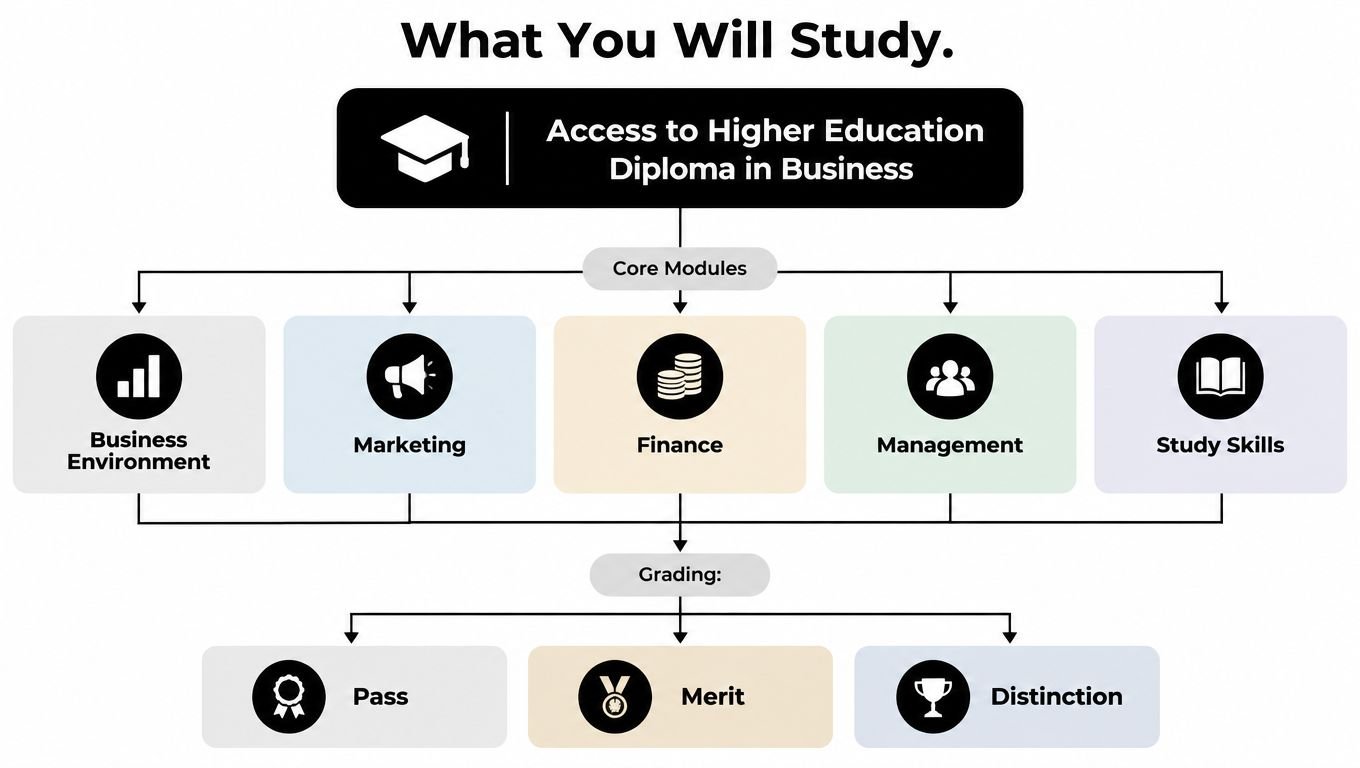
What You Will Study and How You Are Graded
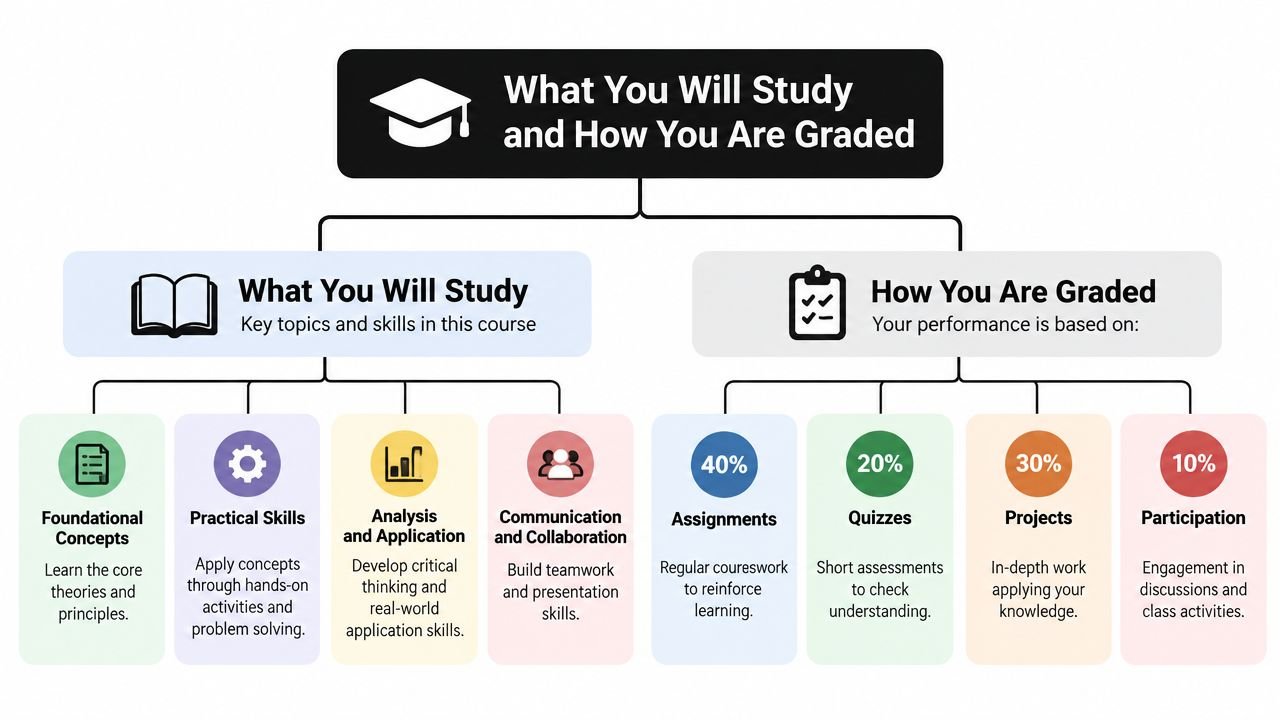
Starting an Access course can feel like opening a business textbook in a language you have not used for years. The course breaks that language into manageable parts, then gives you practice using it. You learn how organisations operate while developing the study habits needed for a degree.
The main areas of learning
You may examine the business environment, including customers, competitors, laws and wider changes that affect organisations. Marketing introduces customer needs, campaigns and the way businesses communicate value. Finance covers income, costs, budgets and financial decisions.
Management looks at teamwork, leadership, decision-making and organisational goals. Alongside these subjects, study skills help you find reliable information, take useful notes, plan assignments, reference sources and test whether your argument is clear.
The topics often meet in one task. A marketing proposal may need a budget. A manager may need to understand customer behaviour before making a decision. A business may need to change its plans because its market or legal responsibilities have shifted. By working through examples like these, you begin thinking like a business student rather than memorising isolated definitions.
How the credit system works
Access to Higher Education Diplomas in Business are structured around 45 graded credits, built from units and assessed through coursework and portfolios rather than one final examination. CWA's explanation of the Access to HE Diploma grading structure explains how these grades contribute to the overall diploma result.
Your result develops throughout the course. A portfolio might include written work, research, practical tasks or reflections, depending on the unit. One assignment can feel difficult, but your final outcome is formed from work completed across the programme.
The graded credits use Pass, Merit and Distinction. Your combination of grades creates a UCAS tariff between 48 and 144 points, with 45 distinctions producing 144 points. Some providers describe 144 points as equivalent to three A grades at A Level, although universities set their own requirements and may attach conditions to an offer. A course can therefore provide a route into university, but your chosen degree, final grades and offer conditions still matter.
| Grade pattern | What it means |
|---|---|
| Pass | You meet the required standard for the unit |
| Merit | Your work shows a stronger level of understanding |
| Distinction | Your work shows an especially high level of understanding |
| UCAS tariff | Pass 48 points, Merit 96 points, Distinction 144 points, based on 45 credits at distinction |
Ask the provider how feedback works, how many assignments you will complete and how tutors monitor progress. Good answers let you plan around work and family commitments, while regular feedback shows what to improve before the next submission. An infographic titled What You Will Study and How You Are Graded explaining course curriculum and grading structure.
Who Can Apply and What You Need
You may be returning to education after work, caring responsibilities or a long break from the classroom. Access courses in business are generally designed for adults aged 19 or over. Providers often expect you to have been away from full-time education for at least a year, but each course sets its own conditions. Activate Learning's business professions course information outlines the adult focus, one-year structure and usual entry expectations.
You will usually need GCSE English and maths at grade 4/C, or Functional Skills Level 2. These qualifications support the reading, writing, calculations and clear communication used on a business degree. They are starting-point requirements, not a test of whether you belong at university.
University entry has two parts. The Access diploma builds business knowledge and academic study skills. English and maths provide the tools for understanding information, writing clearly and working with numbers.
A business degree can include budgets, charts, reports, written arguments and research. You do not need to be a maths expert, but you do need a sound foundation. Activate Learning's course guidance confirms that GCSE English and maths or Functional Skills Level 2 can form part of the progression benchmark alongside the Access diploma.
If you do not yet have the required English or maths qualification, your university plan can still continue. You may be able to complete Functional Skills before the diploma or, if the provider permits, alongside it. Ask which order suits your current qualifications and available study time.
Funding questions to ask
Funding can feel like the largest barrier, so contact providers early and ask for a written answer. In England, learners aged 19 to 23 taking their first eligible full Level 3 course may qualify for fee remission or free study under ESFA funding rules. Eligibility depends on your circumstances and the course, so check your position rather than relying on a general statement.
Take these questions to an adviser:
- Your qualifications: Do your English and maths results meet the entry conditions?
- Your study history: Does your time away from full-time education affect eligibility?
- Your funding position: What fees, remission or finance options apply to you?
- Your target degree: Will the diploma, credits and expected grades meet the requirements for your chosen universities?
That final check matters because an Access diploma can support a university application, but it does not guarantee an offer. Universities may set specific grades, subjects or other conditions. Ask whether the provider helps learners match their diploma and predicted results with degree requirements before applying.
A supportive adviser should make the next step clear, including any missing qualification, funding form or university requirement. You should leave the conversation knowing what to do first, not feeling embarrassed about your starting point.
Online or College-Based Access Courses
The best study mode is the one you can keep doing when life becomes busy. A college may give you a regular classroom routine and face-to-face contact. Online study may fit more easily around school runs, shifts, childcare and travel.
Neither option makes you more or less capable. The important question is whether the course gives you a clear timetable, useful feedback and people to contact when you need help.
| Feature | Online Study | College-Based Study |
|---|---|---|
| Flexibility | You can often study from home at times that fit work and family life | Sessions follow a set timetable |
| Structure | A strong provider gives you planned units, deadlines and progress checks | The college timetable creates a regular routine |
| Travel | No daily journey to a campus, which can reduce disruption | Travel brings you into a learning centre |
| Pace | You may organise study around shifts and family responsibilities | The group usually moves through lessons together |
| Support | Support may include tutors, mentors, feedback and wellbeing guidance online | You can speak with staff and classmates in person |
| Confidence | Home study can feel gentler if a classroom seems intimidating | Regular attendance can help you build confidence with others |
What supported online learning looks like
Online learning isn't the same as being left alone with a PDF. A properly organised course should give you a curriculum, assessment dates, subject specialists and a way to ask questions. Some providers also offer mentors and wellbeing advisers, which can matter when study stress meets family pressure.
Before enrolling, ask to see the learning platform or a sample timetable. Find out how quickly tutors usually respond, whether live sessions are recorded and how feedback is delivered. Check what happens if illness, work or caring duties interrupt your planned study time.
If you want to explore the practical details of a flexible route, read the Access to HE Diploma online course information and compare it with local college options.
Choose around your real week
Write down your actual commitments, not the ideal week you wish you had. Include work, travel, meals, bedtime routines, appointments and time when you can think clearly. Then ask which course format can survive that week.
A classroom may suit you if you learn best through conversation and need a fixed routine. Online study may suit you if travel is difficult, your shifts change or you need to work in shorter blocks. The right decision should make regular study more possible, not add unnecessary strain.
Getting Into University and Building Your Career
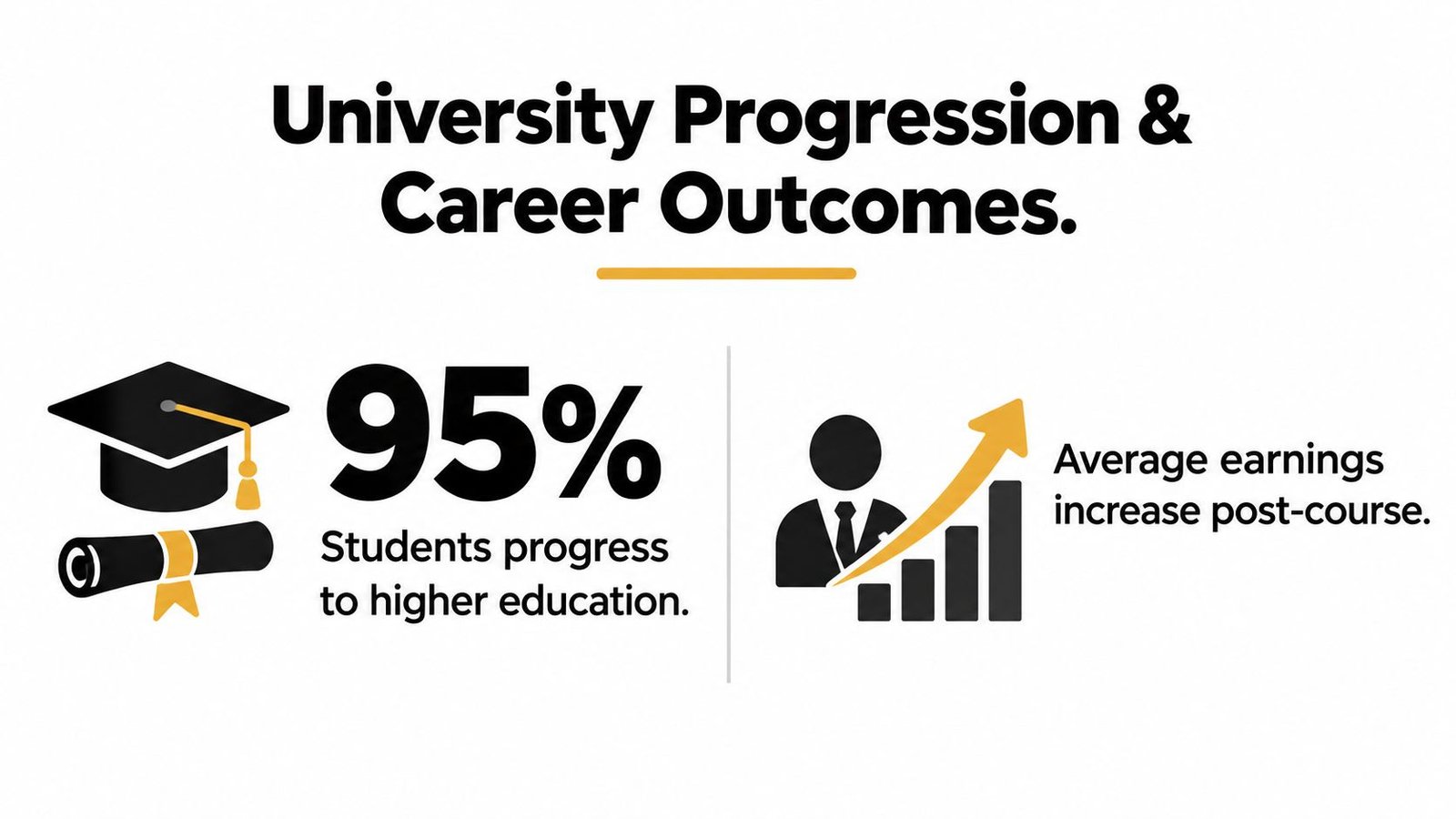
You finish an Access course, submit your university application and receive a conditional offer. The offer is encouraging, but it is not yet a confirmed place. You still need to complete the diploma, achieve the required grades, meet any English and maths conditions and choose a degree that accepts your qualification.
A college may report that around 95% of its Access to HE students progress to university, as stated in its Access to Higher Education Business and Law information. Treat this as one provider's result, not a promise for every learner. It shows what progression can look like when students complete their course and satisfy the next-stage requirements.
What the wider figures tell you
National data gives a broader view. 43,420 students entered Access courses in 2020/21, while 23,290 students with Access diplomas entered higher education the following year, according to national Access to Higher Education figures. The difference does not mean the diploma has failed. Some learners defer, change direction, miss a condition, choose employment or do not complete the application process.
University entry works best as a planned route, rather than an automatic final step.
Practical rule: choose your target degree before you finish the diploma, then check its exact grade, subject and English and maths conditions.
Universities often make conditional offers. This means they are prepared to offer you a place if you achieve the requirements they list. Those conditions may include a particular Access grade profile, the right UCAS points or separate GCSE and Functional Skills requirements.
UCAS points can make an unfamiliar offer easier to understand. For a clearer explanation of how diploma grades become tariff points, read this guide to Access to Higher Education Diploma UCAS points.
Some providers have direct progression arrangements. One UK provider states that learners who achieve 56 UCAS points or more from its Access to HE Business qualification are automatically guaranteed a place on a degree course at that institution. Certain degrees still have extra entry rules, as explained by University College Birmingham's Access to Higher Education Diploma information.
Where the route can lead
A business degree can support progression into business management, accountancy, economics, marketing and business administration. Your next role may not appear immediately, and no qualification guarantees a particular salary. A degree can still help you compete for roles that ask for higher-level knowledge and give you greater confidence at work.
The change may also be personal. You could move towards work that suits your strengths, contribute more confidently in meetings and show your children that a new chapter can begin after a long break.
This video offers another way to consider progression and preparation:
How to Choose the Right Course for You
Choosing a provider is your first practical act of self-belief. You don't need to pick the course with the loudest promise. You need one that is recognised, realistic for your life and honest about the work required for university progression.
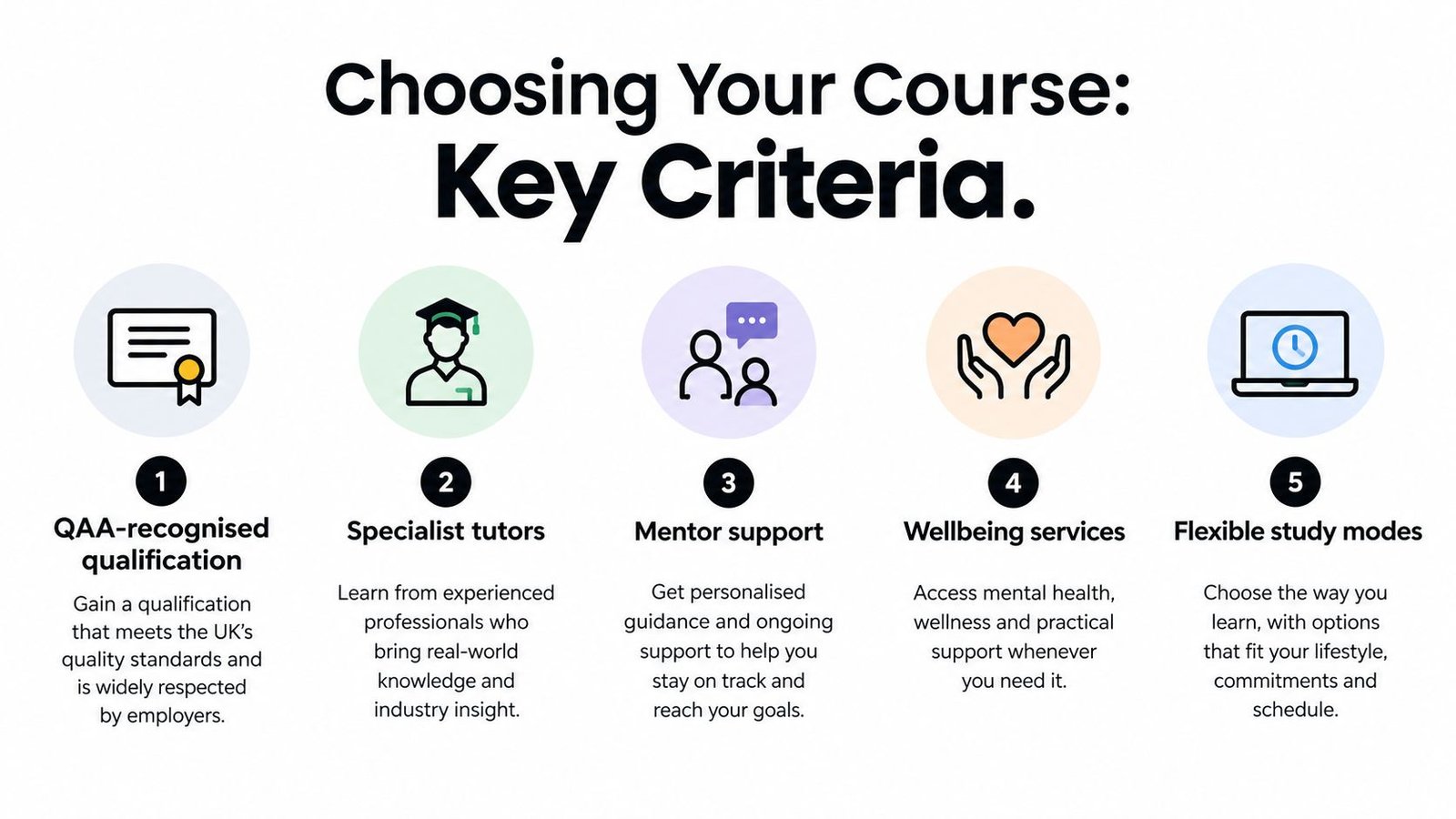
Start with the qualification. Ask which awarding and validating arrangements apply, whether the diploma is within the QAA Recognition Scheme and how the provider checks assessment quality. A clear answer should be easy to understand, not hidden behind vague language.
A useful provider checklist
Use these questions when comparing courses:
- Qualification: Is the Access diploma recognised, and can the provider explain how quality assurance works?
- Tutors: Are subject specialists available to teach business ideas and give feedback on assignments?
- Mentoring: Will someone help you plan deadlines, build study habits and stay connected when motivation drops?
- Wellbeing: Is there practical pastoral support if anxiety, family pressure or confidence problems affect your study?
- Flexibility: Can the timetable work around your job, children, travel and other responsibilities?
- Progression: Will staff help you check university requirements before you apply?
- Finance: Are fees, funding routes and payment options explained clearly before enrolment?
A provider should also explain what happens after you submit work. Ask whether feedback tells you how to improve, rather than only giving a grade. Good support helps you become more independent over time.
A worked example
Next Level Online College offers an online Access to Higher Education Diploma in Business and Management as a route towards university. It is part of the Cambridge Online Education Ltd group, which has over 25 years of experience supporting adult returners, according to the publisher's information. Its model combines structured online learning with subject specialists, mentors and wellbeing advisers, while also offering other qualifications such as Functional Skills, GCSEs and A Levels.
That doesn't mean it will suit every learner. You should still check the awarding arrangements, course timetable, assessment process, university progression advice and total cost before making a decision. You can also compare whether you need an Access diploma or another route, such as the A Levels or equivalent options.
Choose the course that helps you keep promises to yourself in ordinary weeks. A course that fits your family life is more useful than one that looks impressive but becomes impossible to attend.
Your Family Is Watching You Rise
University may still feel like a place meant for other people. Old school experiences, missed opportunities and the demands of adult life can make that feeling seem convincing. They do not measure your ability to learn now.
An Access course in business gives you a structured route, commonly completed in one year, with support for adults returning to education, as described by Learn Direct's Access to Higher Education Business course information. You study business, practise academic writing, complete assignments and build credits that can support a university application.
Those credits do not guarantee an offer. Universities set their own entry requirements, and you may need the right UCAS points, subject results or a conditional offer before your place is confirmed. Check how your chosen degree accepts the qualification. Conversion from an Access course to university is a genuine route, but it depends on meeting the conditions and completing the work.
The course will not remove every difficult week. You may balance deadlines with work, caring responsibilities and tiredness. A clear timetable, tutor feedback and regular study time can make the workload manageable, even when confidence arrives later than commitment.
You do not need to decide your whole career tonight. Check the entry requirements, ask a provider how support works and look at the degree you want. A real plan, steady feedback and completed work can turn a hope into a route you can follow.
Next Level Online College offers a flexible, fully supported online Access to Higher Education Diploma in Business and Management for adults fitting study around work and family life. Visit Next Level Online College to explore the course and ask about entry requirements.