
You may be sitting at the kitchen table after the children are in bed, wondering whether university is still possible. Perhaps you're working, caring for family, and trying to rebuild confidence after years away from lessons. The phrase “A levels or equivalent” can sound like a locked door, but it usually means there's more than one recognised way in.
The right route depends on your goal, your previous qualifications, your available time, and how you learn best. Traditional A levels may suit one person, while an Access to Higher Education Diploma, T Level, BTEC, apprenticeship or Scottish Higher may suit another. This guide explains the choices in simple language, including workload, flexibility, university entry and UCAS points.
You Can Get to University and Make Your Family Proud
Aisha had a full-time job, two children and a long break from education. She wanted to work in healthcare, but every university course seemed to ask for qualifications she didn't have. At first, she assumed she'd need to return to school, study several subjects at once and somehow fit homework around packed lunches, shifts and bedtime routines.
Her worry was understandable. Adult learners often fear they've forgotten how to revise, write assignments or sit exams. Some feel embarrassed about asking basic questions. Others think they're too old, too busy or not clever enough.
Those thoughts aren't proof that you can't succeed. They're signs that this matters to you.
Aisha started by asking a more useful question than “Am I clever enough?” She asked, “Which qualification gives me the clearest route to my goal and fits my life?” That change helped her compare realistic options instead of judging herself against school leavers.
Your past doesn't decide your next qualification. Your destination and circumstances should guide it.
University courses often ask for A levels or equivalent qualifications because they need evidence that applicants are ready for advanced study. That evidence can come through different Level 3 routes. You may not need to copy the path someone else took at sixteen.

Your qualification can help you move towards university, a new career, better earnings or work that feels meaningful. It can also show your children that learning doesn't stop when school ends. They'll see you keep going when work is tiring and family life is demanding.
You might study in the evening, use online materials during a lunch break or complete an assignment while the rest of the house is quiet. Progress may feel slow on some weeks, but steady progress still counts. With the right support, a return to education can become a practical part of family life rather than a dream you keep postponing.
What A Levels or Equivalent Really Means in the UK
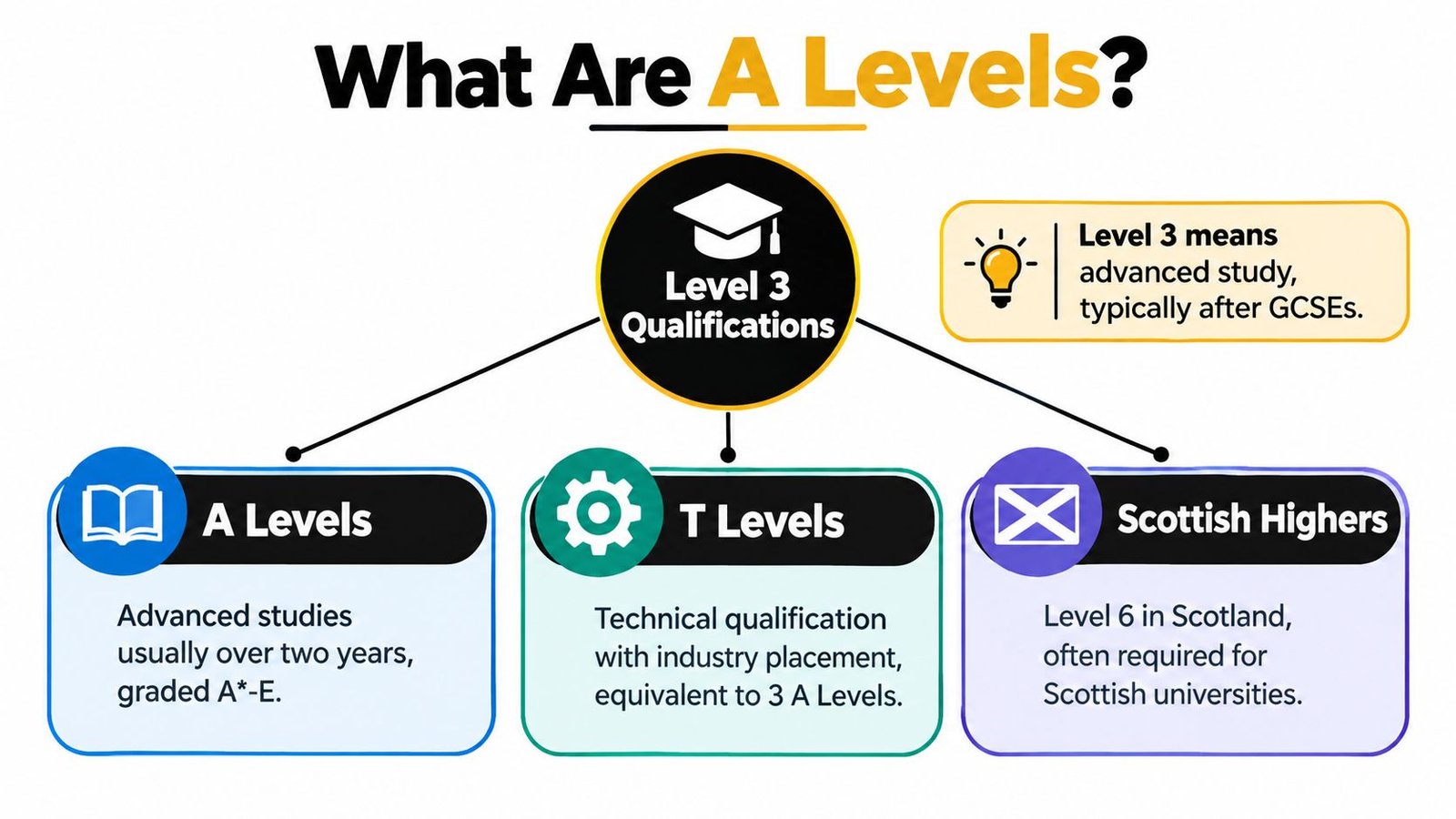
Start with the qualification level. A levels are Level 3 qualifications in the UK framework. In simple terms, Level 3 means advanced study that usually comes after GCSE-level learning.
Think of the levels as steps on a ladder. GCSEs generally sit at Level 2. A levels and other recognised advanced qualifications sit at Level 3. University study comes later, at higher levels. You don't always need A levels specifically, but you usually need the right evidence that you're ready for the course you want to join.
Government education information explains that a full Level 3 can be achieved through two A levels, four AS levels, a QAA Access to Higher Education Diploma at Level 3, or certain technical routes. The important point is that “equivalent” refers to a recognised qualification at a comparable level, not an informal course or a certificate with a similar-sounding name. You can read about presenting qualifications clearly in the resume education section rules.
England's A level system remains large. In summer 2026, 835,950 A level results were issued to 320,505 students across 2,835 schools and colleges in 57 subjects, with around two-thirds of students taking three subjects, as recorded in the government education statistics. Those figures describe the scale of the traditional route, but they don't mean it's automatically the right route for every adult.
Equivalent doesn't mean identical
An Access to Higher Education Diploma isn't the same course as three A levels. A T Level isn't delivered in the same way as an A level either. Each route has its own content, assessments and timetable.
What matters is whether your chosen university and course accepts it. Universities may list specific qualifications, ask for grades, or use UCAS Tariff points. Always check the exact course page before enrolling.
For adults, this creates useful choice. You might need a broad preparation for university, a technical qualification linked to employment, or specific subjects such as Biology and Chemistry. The phrase A levels or equivalent gives you a starting point for research, not a command to choose A levels.
If an Access route sounds closer to your circumstances, explore the Access to Higher Education options and compare the entry requirements for your intended degree.
Your Main Pathways Compared Side by Side
There isn't one perfect qualification for every adult learner. A levels usually offer academic depth and subject choice, while other routes may provide applied learning, workplace experience or a concentrated university preparation programme.
| Pathway | Typical Duration | Assessment Style | Flexibility for Adults |
|---|---|---|---|
| A levels | Often studied over an extended programme | Examinations, with subject-specific assessment arrangements | Can be demanding alongside work, but online and part-time options may help |
| Access to Higher Education Diploma | Often designed as a concentrated university preparation route | Assignments, projects and other course assessments | Often attractive to adults who need a focused route into higher education |
| BTEC | Varies by qualification and study pattern | Coursework, practical work and some examinations | May suit learners who prefer applied assessment |
| T Levels | A substantial technical programme with an industry placement | Classroom assessment and practical or occupational assessment | Strong option for learners able to manage structured study and placement commitments |
| Apprenticeship | Varies by occupational standard | Workplace evidence and formal assessment | Combines employment with learning, but requires a suitable job and employer |
| Scottish Highers | Varies by programme and learner plan | Examinations and course assessment | Particularly relevant for Scottish study and university applications |
A levels
A levels suit learners who want to study academic subjects in depth. They can be useful when a university asks for particular subjects, such as Chemistry for a science-related degree. They're also familiar to admissions teams and employers.
The challenge is subject coverage. Many learners take three subjects, and the work can include regular study, revision and final examinations. Ofqual's 2026 figures recorded 835,950 A levels awarded to 320,505 students across 57 subjects, with about two-thirds of students taking three subjects in its results overview. Maths had A or A* outcomes rise from 41.6% to 42.1% in that release, a reminder that subjects can differ in competitiveness and grade patterns.
Access to Higher Education Diplomas
An Access Diploma is designed for learners who want to progress to university but may not have recent Level 3 qualifications. It normally focuses on a subject area and develops academic skills alongside subject knowledge.
For a parent or full-time worker, a concentrated route may feel more manageable than studying several separate A levels. You'll still need to meet deadlines and complete serious work, so “flexible” doesn't mean effortless.
Choose the assessment style you're most likely to complete consistently, not the route that sounds impressive to other people.
BTECs, T Levels and apprenticeships
BTECs often suit practical learners who prefer assignments, projects and applied tasks. If you learn best by connecting ideas to real situations, this style may feel more natural than relying mainly on final exams. Information about how BTEC qualifications can relate to university applications is available in this guide to BTEC Level 3 UCAS points.
T Levels are technical qualifications with an industry placement. They may suit someone who wants clear occupational direction and can commit to a structured college and workplace pattern.
Apprenticeships combine paid employment with learning. They can be powerful for career changers, but you need to find a suitable vacancy and employer. They aren't a general replacement for every university entry route.
Scottish Highers are important in Scotland and may be named by Scottish universities. If you're applying across the UK, check how the university compares them with the offer for your course.
How UCAS Points and University Entry Requirements Work
You may find a course that asks for AAB, while your qualification uses a different grading system. UCAS Tariff points help you compare these routes, rather like using one measuring scale for different-sized ingredients. They do not replace the full entry requirement. A university may still ask for a named subject, a particular grade, or a specific qualification type.
The UCAS Tariff covers Level 3 and SCQF Level 6 qualifications, not Level 2 qualifications such as GCSEs, according to the UCAS Tariff guidance. GCSEs can support progression, but they usually do not add tariff points to an undergraduate offer.
Reading A level offers
The published points for A level grades are:
| A level grade | UCAS Tariff points |
|---|---|
| A* | 56 |
| A | 48 |
| B | 40 |
| C | 32 |
| D | 24 |
| E | 16 |
These figures are also explained in the UCAS Tariff explanation provided by GRB. Adding three grades gives you a useful guide. AAA equals 144 points, while BBB equals 120 points. You can find more detail about UCAS Tariff points for A level grades before comparing routes.
A points total is only part of the picture. A course might ask for AAB, rather than a general total. Someone could have enough overall points but still miss the offer because they did not study the required subject or reach the named grade. The course page sets the conditions, so read it carefully before paying for a qualification.
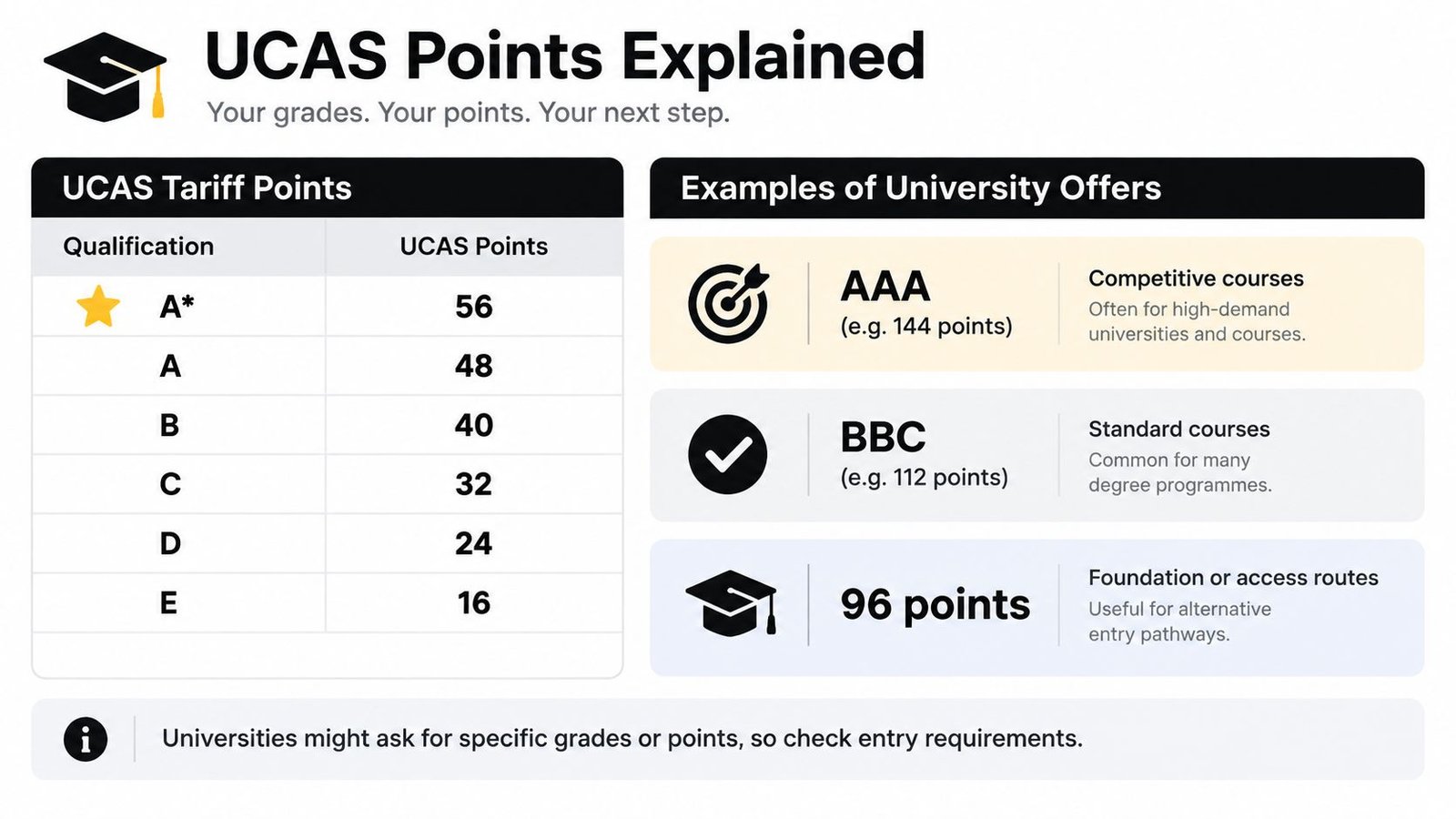
Universities may list A levels, T Levels, Scottish Highers or Tariff points. Many undergraduate courses ask for three A levels or equivalent qualifications at the same level, but each university and course sets its own terms. This matters when choosing a route around work and family life. A qualification with a suitable points value may still be the wrong choice if it does not meet your course's subject rules.
Your education record will also matter when you apply for jobs alongside study. Keep your CV clear, and use this guide to optimize your resume for ATS if you need help presenting it for screening systems.
Which Route Fits Your Life and Goals Best
The best route is the one that connects your target course, your available time and your preferred way of learning. Start with the destination, then work backwards.
If university is your goal within a short timeframe
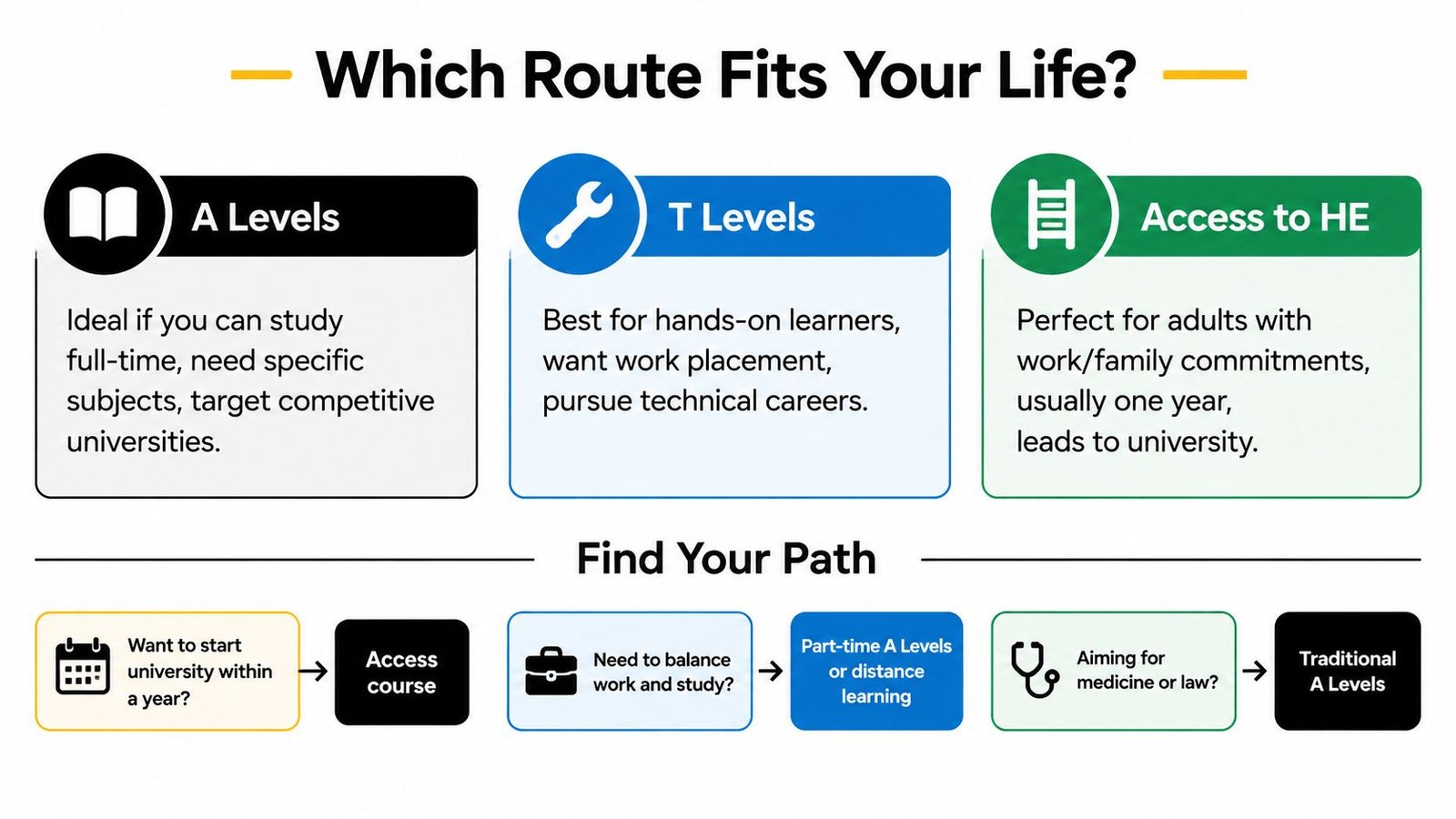
An Access to Higher Education Diploma may be worth investigating first. It's designed around progression to university and can give adults a focused academic route. Check that the specific degree accepts the Diploma and whether it expects particular units or grades.
Traditional A levels may still be the safer choice for highly subject-specific degrees. Medicine, for example, can require particular science subjects and strong grades. Law may offer more flexibility, but competitive universities can still set demanding academic conditions. Don't choose based on a general internet list. Read the admissions page for the exact university.
If work and childcare fill your week
A part-time or online A level programme may help if you need to spread study over a longer period. It can give you control over when you read and revise, but you'll need a weekly routine and a quiet place to work.
An Access course may provide a more concentrated route, which can be useful if you want to reach university sooner. Its deadlines can feel intense, so ask about lesson times, tutor contact and assignment support before committing.
The qualification should fit your real week, including school runs, shifts, illness and rest.
If you want practical career preparation
T Levels, BTECs and apprenticeships may suit learners who want to connect study with work. A T Level includes an industry placement, while an apprenticeship places employment at the centre of the programme. A BTEC may be a middle ground for someone who wants applied projects without entering an apprenticeship.
A technical route can also support university progression, but the course must match your intended degree. Ask admissions staff how they treat the exact qualification, not just the general pathway name.
If your GCSEs are no longer recent
You may need to rebuild English, maths or subject knowledge before starting Level 3. That isn't failure. It's preparation, and it can make later study less frightening.
Functional Skills or GCSE study may be the sensible first step. An adviser can help you decide whether you need a full qualification, a specific grade, or evidence of recent learning. Adults often succeed more confidently when they stop trying to skip the foundation they need.
How to Choose Your Next Step With Confidence
Begin with the course or career you want, not with a qualification catalogue. Write down the university degree, apprenticeship or job that interests you, then copy its entry requirements into a notebook. Circle every requirement that says subject, grade, Level 3, UCAS points or equivalent.
Use these questions to narrow the choice:
- What must I study? Check whether the destination requires Biology, Chemistry, Maths, English or another named subject.
- How much time can I protect? Count the hours you can realistically use after work, family care and sleep.
- How do I learn best? Decide whether exams, assignments, practical work or workplace learning bring out your strengths.
- What support keeps me moving? Look for tutor feedback, assessment guidance, study planning and pastoral support.
- What happens if life changes? Ask about online access, breaks, extensions and contact arrangements.
Skills for Careers says learners normally need at least five GCSEs at grades 9 to 4, including grade 6 in the subjects they want to study, to take A levels according to its A level guidance. Providers may set their own entry checks, especially for adult learners with older qualifications. If you don't meet the usual starting point, ask about GCSEs, Functional Skills or an access route rather than assuming education is closed to you.
A provider should also explain how it supports working adults. Next Level Online College offers online Functional Skills, GCSEs, A levels and Access to Higher Education Diplomas, with academic and pastoral support designed around work and family responsibilities. Compare its course details with other providers, check the awarding arrangements, and confirm that the qualification meets your university's requirements.
Before enrolling, contact the university admissions team. Send them the exact qualification name, subject and awarding body. Keep their reply with your application notes, because clear evidence will help you choose with much less worry.
Your Inspiring Next Chapter Starts Now
You don't need to become a different person before you begin. You need a route that respects the person you are now, including your responsibilities, experience and reasons for wanting change.
The phrase A levels or equivalent means your opportunity may come through more than one door. A levels can offer subject depth. Access courses can prepare adults for university in a focused way. BTECs, T Levels, apprenticeships and Scottish Highers can connect learning with practical or regional needs.
Keep these reminders close:
- Check the destination first: Read the exact university or employer requirements.
- Match the workload: Choose a timetable you can sustain around work and family.
- Build the foundation: GCSEs or Functional Skills may be a strong first step.
- Ask direct questions: Admissions teams and course providers expect learners to need clarification.
- Use your experience: Work, parenting and life responsibilities have already taught you discipline, patience and problem-solving.
A qualification can open a path to university and a fulfilling career, but your example may matter just as much at home. Your children can see that a difficult beginning doesn't have to become a permanent limit. Your neighbours, colleagues and future patients, pupils or clients may benefit from the skills you develop.
You're not too late. You're making a considered choice, and that's a strong way to start.
Next Level Online College offers flexible online GCSEs, Functional Skills, A levels and Access to Higher Education courses with academic and pastoral support for adult learners. Visit Next Level Online College to compare routes, check entry requirements and take the next practical step towards university or a new career.