
You might be reading this after the school run, on a lunch break, or late at night when everyone else is asleep. You may have had the same thought more than once. You'd love to teach, help children grow, and build a future your family can feel proud of, but you don't have the usual qualifications and you're not sure where to begin.
That feeling is more common than you think. Many adults carry old worries from school into later life. They tell themselves they're not academic, they've left it too late, or university is for other people. None of that has to be true.
An Access to Higher Education course in teaching can be the turning point. It isn't about going backwards. It's about moving forward with a route built for adults who are ready to change their lives.
Your Dream of Teaching Is Closer Than You Think
You may already be practising parts of teaching in everyday life. You explain homework. You calm worries. You listen, encourage, organise, and help children keep going when something feels hard. Those things matter. They say a lot about the kind of teacher you could become.
For many adults, the hardest part isn't ability. It's confidence. It's that quiet voice saying, “People like me don't go to university.” But adult learners do return to study, and more of them are doing so. The number of students aged 30 and over starting a first degree rose from 11% to 15% of all first-degree learners in five years, according to UK higher education statistics.
That matters because it means you wouldn't be the odd one out. You'd be joining other adults who have jobs, bills, children, caring duties, and a strong reason for coming back.
The feeling behind the goal
Wanting to teach is often about more than a job title. It can be about proving something to yourself. It can be about showing your children that setbacks don't get the final word. It can be about building a steadier income and doing work that means something.
You don't need a perfect school history to become a serious adult learner.
Some readers worry that dreaming about teaching is unrealistic. It isn't. What usually helps is breaking the journey into the next small step, not trying to solve the whole future in one evening.
Why this route fits adult life
An Access to Higher Education teaching pathway exists for people who didn't take the standard route. It gives you a realistic way into university study without asking you to become a teenager again.
That difference matters. Adult education works best when it respects the life you already have. You're not starting from nothing. You're bringing real experience, patience, resilience, and purpose. Those are powerful things to bring into education.
What Is an Access to HE Diploma for Teaching
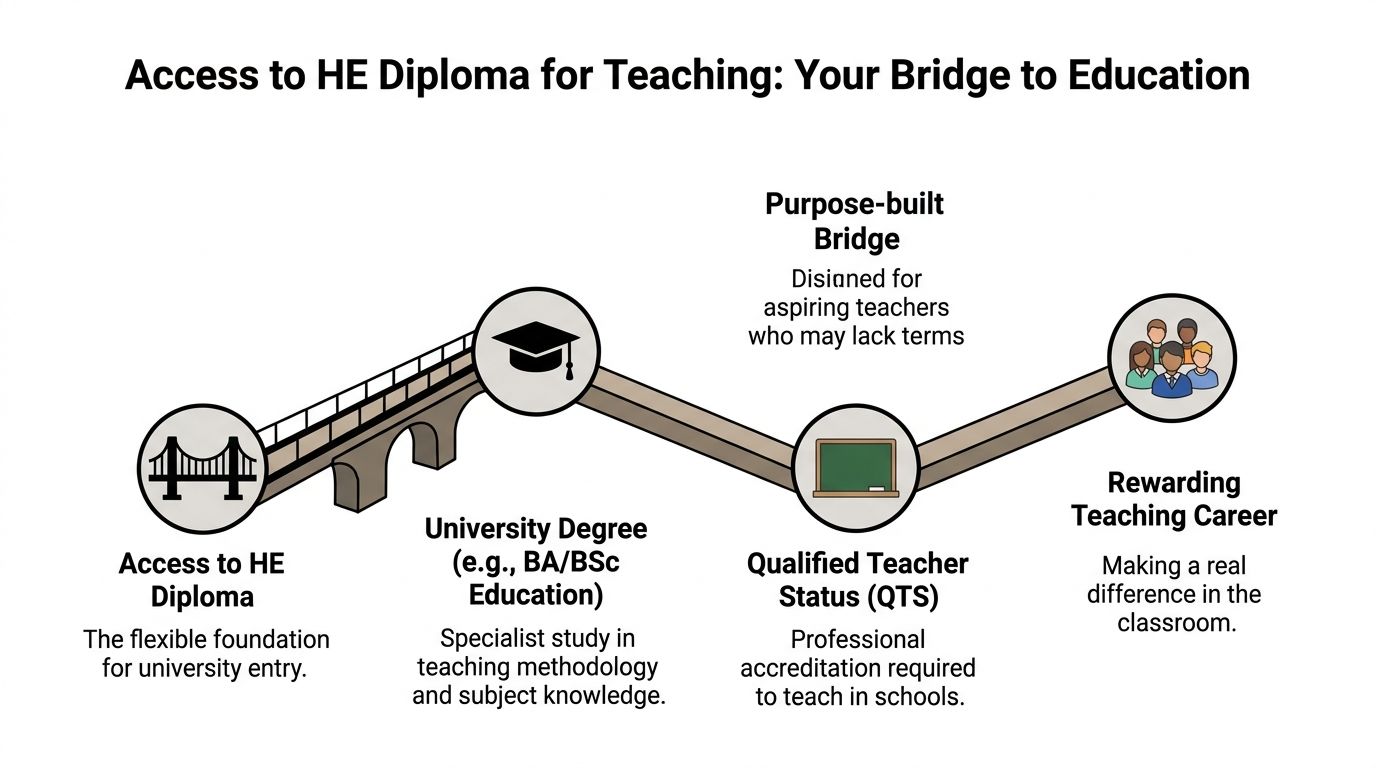
Think of an Access to HE Diploma as a purpose-built bridge. It helps adults cross from “I want to go to university” to “I'm ready to apply”.
It's designed for people who usually don't have traditional qualifications such as A Levels but do have the motivation to move into higher education. In a teaching pathway, the course prepares you for university study linked to education, childhood, learning, and teacher training routes.
Why adults choose this route
This isn't a second-best option. It's a recognised route made for adult returners. In one year, over 23,600 students took an Access to Higher Education Diploma, and 87% were mature students, according to the Office for Students mature students briefing.
That tells you something important. This route is normal for adults. It's trusted. It's established. It's not a strange detour.
How it feels different from school
Many people hear the word diploma and worry they'll be thrown into a classroom that feels like school all over again. That usually isn't what adult study feels like.
Adult learners tend to ask direct questions, speak from real experience, and study with a strong reason. The atmosphere is often more focused because people are there on purpose. They know what's at stake.
Here's the simple version of what this diploma does:
- Builds academic skills so you can cope with university reading, writing, and thinking
- Introduces education-related subjects that connect with teaching and child development
- Creates a university entry route for adults without the usual school-based qualifications
- Raises confidence step by step so the next stage feels possible, not frightening
Practical rule: Don't think of an Access diploma as “catching up”. Think of it as training for the next level.
If your goal is access to higher education teaching, this course is often the clearest starting point because it joins your ambition to a route universities understand.
What You Will Learn on Your Course
Most adults feel calmer once they know what they'll study. The course isn't a pile of random subjects. It's a structured way to help you understand how learning works and how to succeed in higher education.
Subjects that connect to real classrooms
On an Access to HE teaching course, you may study topics linked to education, children, and society. The titles vary by provider, but the ideas are familiar and useful.
You might explore questions like these:
- How do children learn? You may look at how memory, attention, and development shape learning.
- Why does play matter? Early learning often grows through play, routine, language, and relationships.
- What affects a child's progress? Family life, community, confidence, support, and school systems all play a part.
- How does education shape society? You may consider fairness, opportunity, and why some learners face more barriers than others.
These aren't just theory questions. They help you start thinking like someone who wants to work in education.
The skills you build along the way
The course also teaches you how to study well. That matters because many adults haven't written an assignment for years.
You'll usually practise things such as:
| Skill | Why it matters |
|---|---|
| Essay writing | Helps you explain ideas clearly and support your points |
| Reading academic material | Builds confidence with university-level texts |
| Research | Teaches you how to find and use useful information |
| Referencing | Shows where your ideas came from in a proper academic way |
| Presenting arguments | Helps you speak and write with confidence |
What about exams
Many adult learners find relief as access courses are commonly assessed through coursework, such as essays, reports, and presentations, rather than relying only on high-pressure final exams.
That matters if your confidence took a knock at school. Coursework gives you a chance to improve, reflect, and build skill over time. You're not expected to become perfect overnight.
When adults realise they can grow through steady coursework, the course often feels possible for the first time.
A good course doesn't just teach content. It teaches you how to believe, “I can do this,” and then gives you the proof.
Your Clear Pathway to a Teaching Career
When the route looks confusing, the dream can feel far away. Once the steps are clear, it becomes much easier to trust the process.
There are different ways to move from an Access diploma into teaching. The right route depends on the age group you want to teach and the university course you choose.
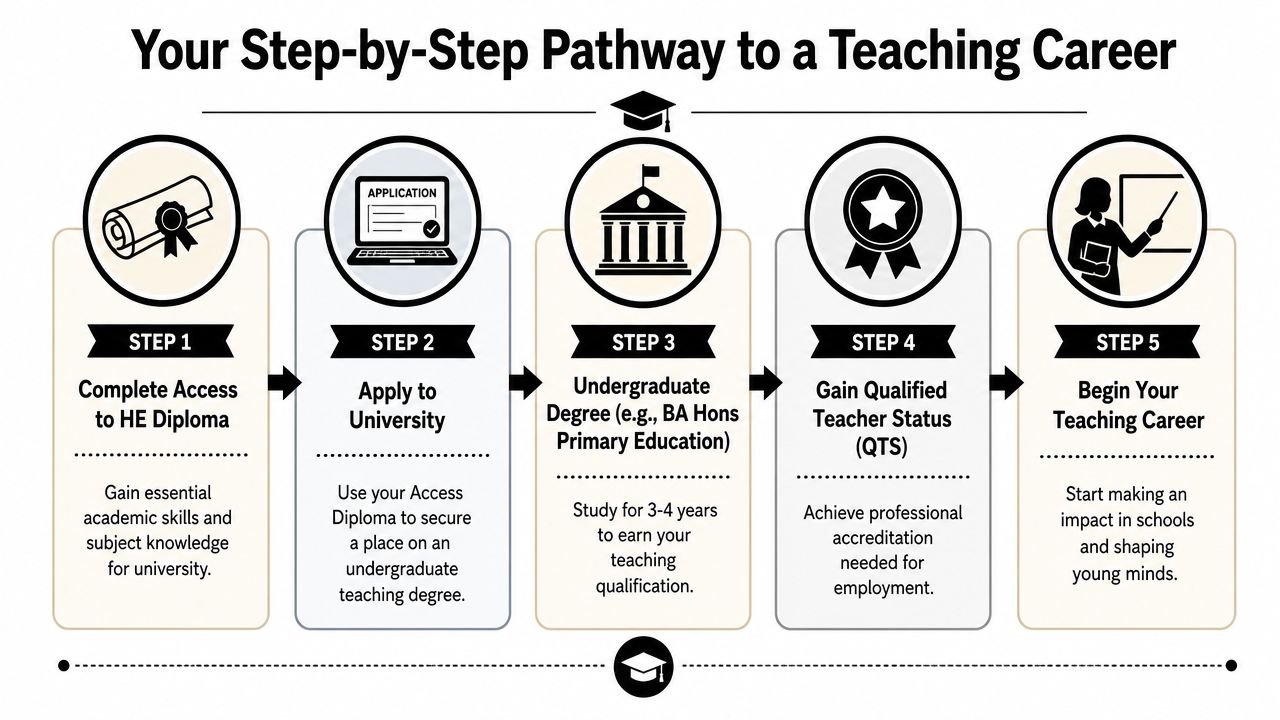
Route one through an undergraduate teaching degree
Some learners use the Access diploma to apply for a degree focused directly on education or teacher training, such as a Bachelor of Education or a primary education degree.
That route usually works like this:
- Complete your Access to HE Diploma
- Apply to university
- Study an undergraduate teaching-related degree
- Gain Qualified Teacher Status if your route includes it
- Apply for teaching roles
This route suits people who want a clear line from adult study into teacher training.
Route two through a subject degree and then teacher training
Other learners choose a subject they love first. That might be English, history, maths, science, or another area. After that, they move into teacher training through a PGCE or another teacher training route.
This path can be a good fit if you already know the subject you'd like to teach later on.
Why this route matters for adults
Background still affects university access. The gap remains wide. Young people from the most advantaged areas are about twice as likely to apply to higher education as those from disadvantaged areas, based on the Sutton Trust report on university access. An Access to HE Diploma matters because it gives motivated adults a direct route built around merit and readiness.
If you want a fuller breakdown of application routes, this guide on how to get into university without A Levels can help.
A simple way to think about your next decision
Ask yourself these questions:
- Do I want to teach younger children or older students?
- Do I want a degree focused on education, or a subject degree first?
- Would I feel more confident with a direct route, or do I want more subject choice?
You don't need every answer today. You only need enough clarity to take the next step.
How to Fit Your Studies and Finances Around Your Life
Time and money stop many adults before they start. That's understandable. You can't ignore work, children, rent, travel, food, and all the small daily jobs that make up family life.
Still, practical barriers don't always mean “no”. Often they mean “find a route that fits real life”.
Finding study time in an already full week
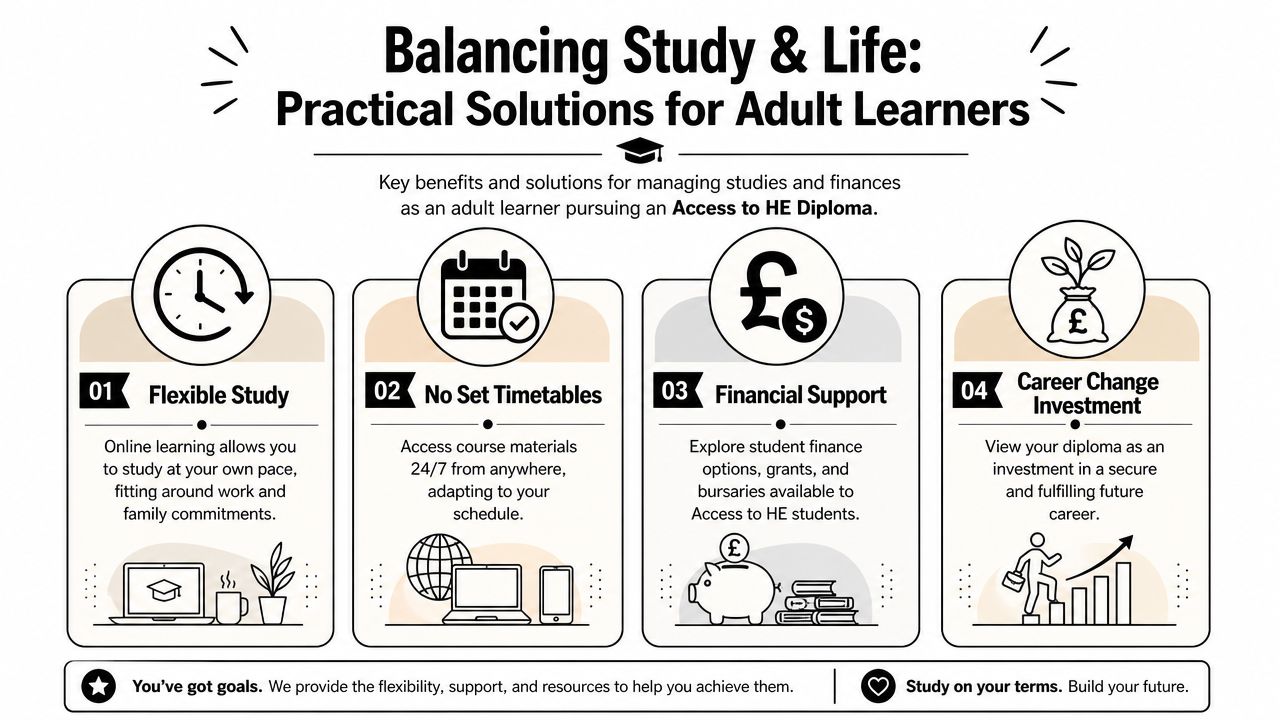
Flexible online learning can make a big difference for adult learners. Instead of trying to shape your life around a rigid timetable, you shape study around the life you already have.
That might mean:
- Early mornings before the house wakes up
- Lunch breaks with headphones and a notebook
- Evenings after the children are in bed
- Weekends in smaller blocks instead of one long session
The goal isn't to study all day. The goal is to study steadily.
One provider in this space is Next Level Online College, which offers online adult learning routes designed to fit around work and family responsibilities. The format matters because many adults need structure and support without having to travel to a campus.
Small, regular study sessions usually work better than waiting for a perfect free day that never comes.
Thinking about money without panic
Funding worries are real. Adult learners often fear they'll start a course and put the whole household under pressure.
There is movement in this area. The UK government's Lifelong Loan Entitlement is designed to give adults loan funding for four years of post-18 education that can be used flexibly for courses such as the Access to HE diploma, as outlined by the Institute for Fiscal Studies on adult education policy.
That matters because it shows a clear policy direction. Adults are being recognised as learners who may need to retrain later in life, not just once at 18.
If you're also exploring current support options, this page on Advanced Learner Loans is a useful place to start.
What makes study sustainable
A plan doesn't need to be fancy. It needs to be honest.
Try this simple checklist:
- Be realistic about hours. Choose a weekly study pattern you can keep.
- Protect one regular slot. A fixed routine reduces decision fatigue.
- Tell your family why this matters. People support what they understand.
- Expect wobbles. A hard week doesn't mean you've failed.
Access to higher education teaching is possible when your study plan respects your life, rather than pretending your life isn't there.
How to Apply and Get Ready for Success
The application stage can feel bigger than it really is. Most adults build it up in their minds because they care so much. In practice, it's a series of manageable steps.
What you usually need
The key reassurance is this. You don't need A Levels to start an Access to HE course.
Providers may have their own entry rules, but adult learners are often asked about these areas:
- Your interest in teaching and why you want this route
- Your readiness to study and commit time each week
- English and maths requirements for later university or teacher training progression
Many adults worry when they hear about GCSE English and maths. If you don't already have them, that doesn't always end the journey. In many cases, adults can study these qualifications online alongside or before moving on, depending on the route and provider.
Your story matters in the application
A strong application isn't about sounding posh or academic. It's about being honest and clear.
You can write about things like:
- Why teaching matters to you
- What changed in your life that made now the right time
- What you've learned from work, parenting, caring, or volunteering
- Why you're ready to keep going even when study feels challenging
Parenting experience often gives people more relevant skills than they realise. Patience, communication, routine, empathy, and persistence all belong in education.
If you're unsure how to put that into words, this guide on how to write a university personal statement can help you shape your ideas.
A helpful look at the online learning experience
Seeing how online study works can make the process feel more real and less intimidating.
A simple preparation list
Before you apply, try doing these four things:
- Write down your reason for wanting to teach
- Check your current qualifications
- Look at your weekly routine and find study time
- Ask questions early if you're unsure about entry requirements
You don't need to impress anyone with perfection. You need to show commitment, honesty, and a willingness to learn.
Your Questions Answered With Confidence
Am I too old to start
This is a really common worry, and the simple answer is no. Adult learners come back to education at many different ages. Teaching benefits from maturity, patience, and life experience. Those qualities can become strengths, not disadvantages.
What if I wasn't good at school
This is another well-known fear. Being unhappy or underconfident at school doesn't mean you can't succeed now. Adult study feels different because your reason is different. You're not learning because someone told you to. You're learning because your future matters to you.
What if people like me don't usually get to university
Barriers are real, and some groups face them more sharply. Pupils eligible for free school meals are 1.69 times less likely to progress to higher education, according to the EPI report on access and participation in higher education. That's exactly why targeted routes and proper support matter so much for adult learners.
Some people start with confidence and others build it. Building it still counts.
What if I have children and a busy home
Many adult learners study while raising families. You don't need a silent house and endless free time. You need a workable pattern, a clear reason, and support when life gets messy. Children also notice more than we think. Seeing you study can show them what determination looks like.
What if I'm scared to begin
You can be scared and ready at the same time. Most big life changes begin with doubt. The first step doesn't need to feel comfortable. It just needs to be taken.
A course in access to higher education teaching isn't only about university entry. For many adults, it becomes proof that they can finish what they started, create a better future, and become the role model they've always wanted to be.
If you're ready to turn a private dream into a real plan, Next Level Online College offers flexible online routes for adults who want recognised qualifications and a clear path towards university. If teaching has been on your heart for a long time, this could be the moment you start building that future.