
You're sitting at the kitchen table after the children have gone to bed, looking at a course page on your phone. Part of you wants a fresh start in healthcare, fitness, beauty or further education. Another part is asking, “What if I'm too old? What if I can't remember how to study?”
Those worries are common, but they don't decide what you're capable of. Anatomy and physiology level 3 can give you a structured way back into education, with clear learning goals, recognised qualification routes and knowledge that connects directly to how the human body works. It can also become a stepping stone towards further study, including an Access to HE Diploma and, for some learners, university.
Why This Qualification Could Change Everything
Maya had spent years putting everyone else first. She worked during the day, helped with schoolwork in the evening and told her children that education mattered. Yet when she began looking at health-related courses, she felt embarrassed by the gap in her own education. She remembered finding science difficult at school and worried that the chance to change direction had passed.
She nearly closed the course page. Then she noticed that a Level 3 anatomy and physiology qualification wasn't an informal collection of online lessons. In the UK, regulated Level 3 qualifications appear in government qualification records, with a recognised awarding structure, a Qualification Accreditation Number and defined study requirements. The Gatehouse Awards Level 3 Certificate in Anatomy, Physiology and Pathology, for example, is recorded with QAN 603/5679/0, 150 Guided Learning Hours and 190 Total Qualification Time.
That distinction matters. A regulated qualification gives you something more solid to investigate than a course advertisement that only promises a certificate. It helps you ask better questions about the awarding organisation, assessment method, funding and progression before you enrol.
Knowledge with a purpose
Anatomy is the study of the body's structures. Physiology is the study of how those structures work. You aren't learning medical words to pass a test. You're learning how bones support movement, how the heart moves blood, how nerves carry messages and how different systems work together to keep the body stable.
That understanding can support future learning in health, complementary therapy, beauty and fitness. It can also help you decide whether a wider health pathway is right for you before you commit to a more advanced programme.
A qualification can be a personal milestone as well as an academic one. Your children may remember the evenings when you studied, asked questions and kept going. They'll see that learning doesn't belong only to young people.
For an adult learner, success may mean more than gaining a certificate. It may mean building the confidence to apply for a new role, creating a better financial future, or proving to your family that a difficult beginning doesn't have to define the ending. If nursing is your long-term goal, a course such as this online access to nursing pathway can help you explore the wider route and the preparation involved.
What Level 3 Actually Means and What You'll Learn
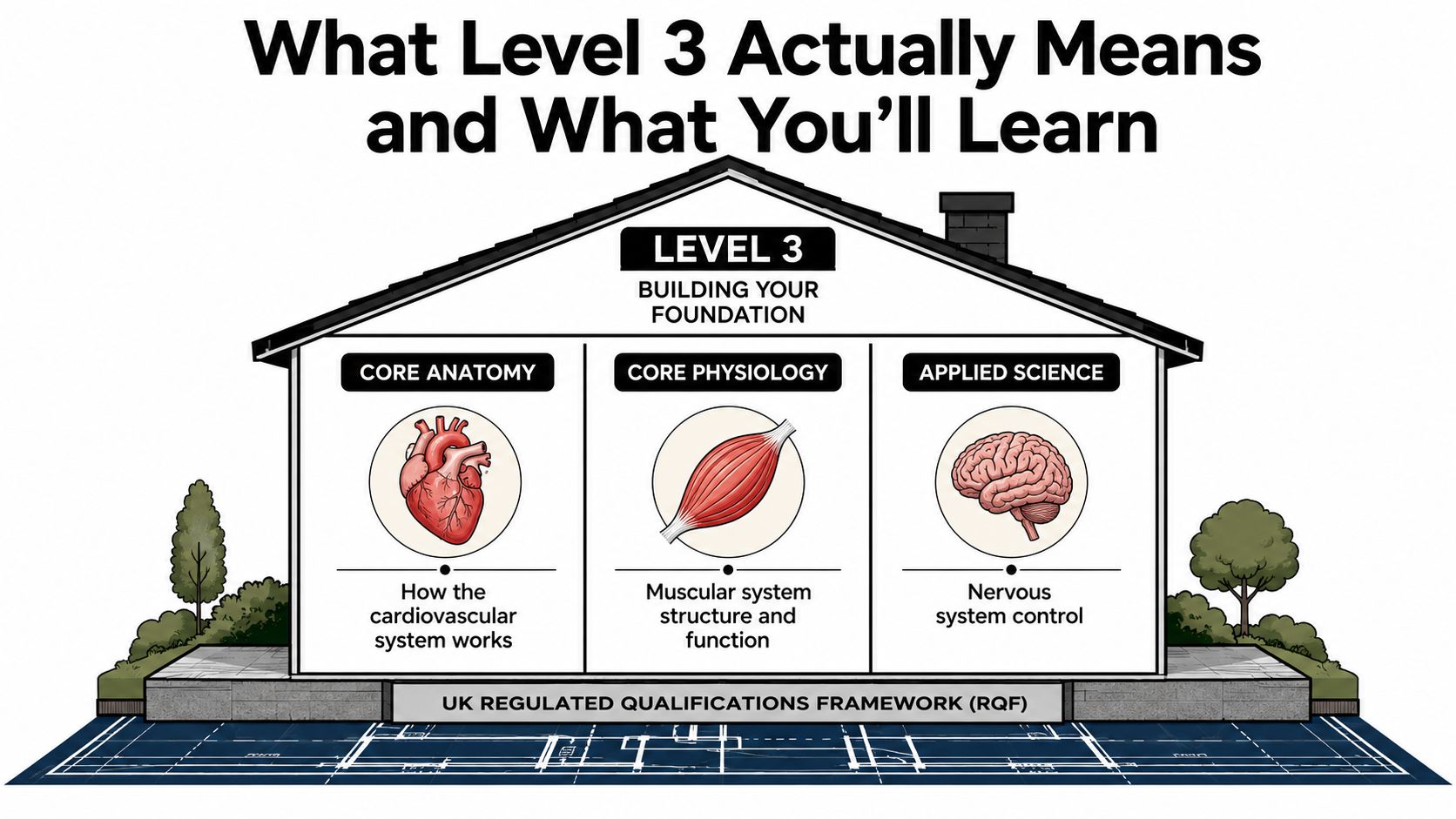
Think of a qualification as a house. Before you choose paint colours or furniture, you need a reliable foundation. In education, Level 3 is part of the UK Regulated Qualifications Framework, but the words “Level 3” alone don't tell you everything about the building. You still need to check the awarding body, qualification title, units, assessment method and progression opportunities.
The government record for a separate VTCT Skills Level 3 qualification lists QAN 60341002 and an age 16 to 19 funding approval window from 1 September 2019 to 31 July 2026. Its presence alongside other regulated routes shows that anatomy and physiology qualifications can sit inside a formal national framework rather than existing only as unregulated short courses. You can compare progression-related qualifications through guidance on BTEC Level 3 UCAS points, but always check the exact entry rules for your intended university or course.
The foundation and the rooms
Most courses introduce the body in connected layers. You may begin with cells, tissues and organs, then move into the systems that make up the whole person.
- The skeletal system is the body's frame. It gives support and protects important organs.
- The muscular system provides movement, much like a set of pulling cables attached to the frame.
- The cardiovascular system includes the heart and blood vessels. It transports oxygen and other substances around the body.
- The respiratory system brings oxygen into the body and removes carbon dioxide.
- The nervous system acts like a communication network, carrying messages between the brain, spinal cord and the rest of the body.
- The endocrine system uses hormones as chemical messages that influence processes such as growth, energy use and reproduction.
- The digestive system breaks food down so the body can absorb and use nutrients.
- The urinary, lymphatic and reproductive systems each have their own functions, while also working with other systems to maintain health.
Physiology often returns to homeostasis, which means keeping internal conditions within a suitable balance. You can think of it as a home's heating system adjusting when the room becomes too cold or too warm. The body constantly responds to change.
Three useful course terms
QAN means Qualification Accreditation Number. It identifies a regulated qualification in official records. GLH, or Guided Learning Hours, refers to planned learning with guidance, while TQT, or Total Qualification Time, includes guided study and other work such as reading, revision and assessment preparation.
The figures can vary between qualifications. The Focus Awards Level 3 Award in Understanding Human Anatomy and Physiology is listed with 70 Guided Learning Hours, 80 Total Qualification Time and 8 credits in its qualification information published by the training provider. Those details help you understand the size and structure of the award before you start.
How You'll Be Assessed and What to Expect
Assessment can feel frightening because the word often brings back memories of school exams. The useful question isn't “Am I good at exams?” It's “What evidence will this qualification ask me to provide?” Different Level 3 routes can assess similar knowledge in very different ways.
Multiple-choice exams
Some provider examples use 40 multiple-choice questions with a pass mark of 28 out of 40. That format checks broad recall under timed conditions. You'll need to recognise terms, distinguish between similar functions and apply basic knowledge to short scenarios.
Other routes use 90 multiple-choice questions plus labelling tasks, so you may need to identify structures as well as select answers. The Level 3 anatomy and physiology diploma information illustrates why you should never assume that every course uses the same exam pattern.
Written papers and coursework
Written assessments ask you to explain ideas in your own words. A question might ask you to describe how a body system functions, compare two structures or explain how systems work together. Short answers reward accuracy, while extended answers also require a clear order and relevant detail.
Coursework-only diplomas take a different route. One provider describes a programme with about 200 hours of study and no formal exit exam, with learners completing written tasks instead. That can suit someone who prefers steady work and tutor feedback, but it doesn't mean the course is automatically easier. You still need to understand the content and meet the assessment criteria.
Match revision to the assessment
Read the assessment rules before you create a study plan. For a multiple-choice exam, use flashcards, labelled diagrams and practice questions. For written work, practise explaining a process without copying the course notes. For a portfolio, keep your evidence organised and check each task against the marking criteria.
The assessment method should influence your revision from the first week. Waiting until the end to discover that you need written explanations, not just memorised terms, makes the course harder than it needs to be.
Entry Requirements and a Realistic Study Plan
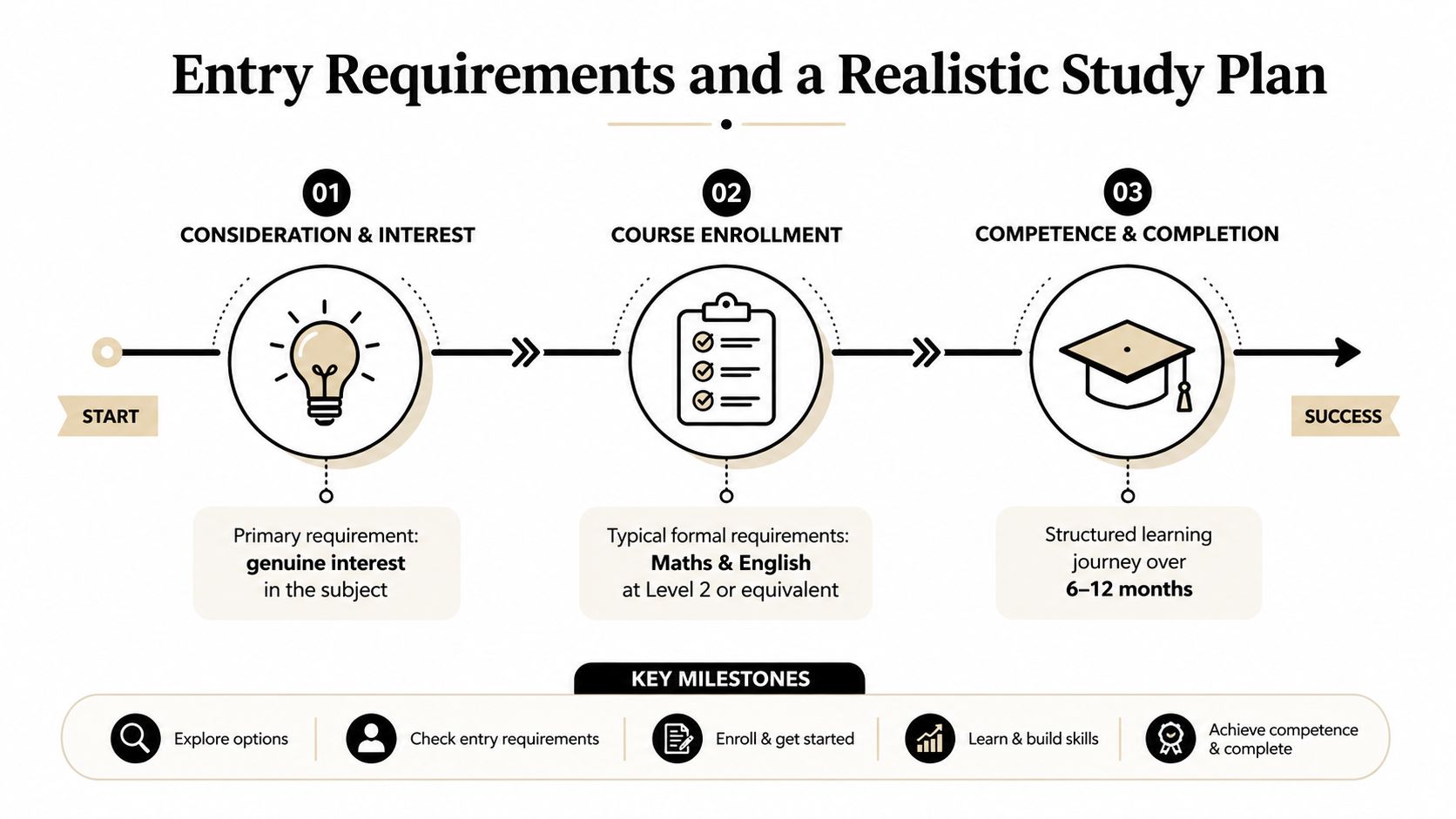
Many adult learners expect a science qualification to demand a long list of previous certificates. In practice, entry rules vary by provider, but courses may focus on your interest in the subject, your ability to read course material and your readiness to complete independent study. Ask for the exact requirements rather than guessing that your past grades rule you out.
English and maths can matter when you want to progress further. An Access to HE Health Professions provider describes these diplomas as nationally recognised, intensive Level 3 courses designed for adults aged 19 or over who want degree-level study. The same provider says university entry typically requires GCSE grade 4 or above in English and maths, or Functional Skills Level 2. You can read the Access to HE health professions course information before planning your next stage.
Turn a large course into small sessions
A course with 150 Guided Learning Hours can sound enormous, but the total becomes easier to manage when you divide it into regular blocks. The figure comes from the Gatehouse qualification record, and your own course may have a different GLH or TQT, so use your provider's specification when planning.
Here's an example for someone working full-time and managing family responsibilities:
- Monday evening: Read one short topic and write down five key terms.
- Wednesday evening: Draw or label a diagram of the system you studied.
- Saturday morning: Complete a longer learning session while the family is occupied.
- Sunday evening: Use active recall to test yourself without looking at the notes.
You might study in short sessions during the week and reserve a longer block for assignments. The important part is not creating a perfect timetable. It's choosing times you can repeat, then protecting them as appointments. A study planner template collection can help you see your work, family time and revision in one place.
Where This Qualification Can Take You
A Level 3 anatomy and physiology qualification can give an adult returner a practical starting point for a new direction. It is not a guaranteed job offer or a substitute for professional registration. Its usefulness depends on the exact award, your intended role and what the next organisation accepts.
The subject can support several vocational and educational routes:
- Beauty therapy: Knowledge of skin, muscles and body structures can support safer, more informed practice.
- Complementary therapy: Body-system knowledge provides scientific grounding for further learning.
- Fitness instruction: Understanding muscles, joints, movement and energy systems helps you support clients responsibly.
- Health-support pathways: Anatomy and physiology can prepare you for additional training.
- Access to HE study: The qualification may strengthen your confidence before an intensive route towards university.
That final route matters for adults who want to prove to themselves, and perhaps to their children, that returning to education is possible. Learning how the body works can become more than course content. It can be evidence that steady effort opens another door.
Regulatory details should be checked against the qualification you are considering. As noted earlier, this qualification carries QAN 603/5679/0 and was eligible for funding through 31 July 2026. The Gatehouse qualification record confirms the relevant qualification information, including eligibility for Advanced Learner Loans and Level 3 Free Courses for Jobs during that period.
Choose the route, not just the label
“Level 3” describes a level of study, not one universal course. One award may focus heavily on theory, while another may include pathology, a portfolio or a different examination structure. Employers, colleges and universities may therefore treat them differently.
Before enrolling, ask:
- What is the full qualification title?
- Who awards it?
- Does it have a QAN?
- What are the GLH and TQT?
- Is funding available for your circumstances?
- What progression route does the provider document?
- Will your intended college, employer or university accept it?
These checks protect your time and money. They also help you choose a course that matches your goal, whether you want a vocational role, greater confidence in science or preparation for higher education. Next Level Online College can make that plan feel manageable by helping you study around work and family responsibilities, one clear stage at a time.
Common Fears and the Truth About Returning to Study
Returning to education can bring up old memories. You may remember a teacher saying science wasn't your strength, or a previous course that became impossible when work and family demands grew. Those experiences deserve respect, but they aren't proof that you'll fail now.
Fear and reality
- “I'm too old to learn.” Adult learners bring patience, work experience and a strong reason for studying. Those qualities can help you keep going when a topic feels unfamiliar.
- “I failed science at school.” A Level 3 course can introduce ideas step by step. School results describe one period of your life, not your present ability.
- “I can't balance study with parenting.” Online learning can make it easier to study around shifts, school runs and caring responsibilities, although you'll still need an honest plan.
- “I'll start but never finish.” Small weekly targets create visible progress. Support from tutors, mentors or family members can make it easier to recover after a difficult week.
Check what the label hides
A common mistake is treating “Level 3 Anatomy and Physiology” as one universal qualification. The available UK routes show meaningful differences in units, study load and assessment. Some programmes use multiple-choice examinations, some use written work and others use coursework portfolios.
That difference is helpful once you know about it. If exams make you anxious, look for a route whose assessment style suits your strengths. If you want a clear deadline and formal test experience, an examined qualification may provide that structure. If you learn best through drafting and improving written work, coursework may feel more natural.
You don't need to feel confident before you begin. Confidence often arrives after you keep a promise to yourself, such as completing one topic or submitting one assignment.
Funding can also feel confusing. The qualification details above show that some routes have specific loan or funding eligibility, but approval doesn't mean every learner qualifies automatically. Check your own situation with the provider and confirm all costs before making a decision.
Study Tips That Actually Work for Busy Adults
Long reading sessions aren't the only way to learn anatomy and physiology. A short, focused routine can work well when your day is already full.
Start with a weekly rhythm. Choose one main topic, such as the cardiovascular system, and study it in three ways. Read the structure, explain the function in simple words and then test yourself without looking at the page. This moves you from recognition to recall, which is a stronger test of what you know.
Make the body easier to remember
Use a blank sheet to draw a rough diagram. It doesn't need to look artistic. Add labels from memory, then use your notes to correct it in another colour. The corrections show you exactly what to practise next.
Try these habits:
- Use plain-language explanations: Describe the heart as a pump, blood vessels as routes and valves as one-way doors before learning formal terms.
- Teach someone else: Explain a body system to your child or partner. If you can make it understandable to them, you're strengthening your own understanding.
- Build a term bank: Write the word, a simple definition and a sentence showing how it is used.
- Keep a wins list: Record completed topics, practice questions and submitted work. Your progress becomes visible on days when motivation is low.
- Ask for help early: Contact a tutor when confusion begins, not after several weeks of avoiding the topic.
A supportive online course should reduce the loneliness of studying at home. Look for structured lessons, clear assessment guidance and access to academic or wellbeing support. You're allowed to need help. Seeking it is a study skill, not a weakness.
Your Next Step With Next Level Online College
The right course can help you move from uncertainty to action, but choosing well still matters. Look for a recognised UK qualification, a clear awarding partner, a transparent assessment method and a progression route that matches your ambition. If you're considering university, check entry requirements with the target institution rather than relying on a general promise that any Level 3 certificate will be accepted.
Next Level Online College is designed for adult learners who need education to fit around real responsibilities. Its wider programme includes Functional Skills, GCSEs, A Levels and Access to Higher Education diplomas, creating possible routes from foundational study towards university and career development. The college is part of the Cambridge Online Education Ltd group and draws on over 25 years of experience supporting adults returning to education.
Support that recognises real life
Flexible online delivery can help you study around work and family commitments, while structured curricula can stop self-study from becoming aimless. Academic guidance, assessment preparation and pastoral support give you people to contact when a topic, deadline or confidence problem starts to feel too large.
Finance options and competitive pricing may also help you plan responsibly, but you should review the current terms and your eligibility before enrolling. A sensible decision includes checking the qualification, total cost, study expectations and progression plan.
Your children don't need to see you have everything figured out. They need to see you make a thoughtful choice, keep learning and continue after a setback. Starting anatomy and physiology level 3 could become the first visible step towards a more fulfilling role, further study or a future your family can share with pride.
Next Level Online College offers flexible, supported online learning for adults who want to study anatomy and physiology level 3 and build towards further qualifications. Visit Next Level Online College to explore recognised courses, study support and progression options, then take the first practical step towards your new direction.