
Yes, UK universities accept online A Levels when they're awarded by a recognised exam board and carry UCAS Tariff points. The important detail is the qualification and awarding body, not whether you studied in a classroom or online.
Perhaps you're sitting at the kitchen table after the children have gone to bed, wondering whether an online course will look “real enough” on a university application. You may have left school years ago, built a career, cared for your family, or lost confidence in your academic ability. Now you're ready to move forward, but you don't want to spend time and money on a qualification universities might question.
That worry is understandable. The good news is that the UK admissions system focuses on the formal qualification, awarding body, grade and subject requirements. Pearson says its Edexcel GCSEs, UK A Levels and International AS Levels are widely recognised by UK universities, with International AS Levels accepted by all Russell Group universities, including Oxford and Cambridge. You can read the relevant guidance on online A Level recognition and university entry for further context.
What This Question Really Means for Adult Learners
Let's start with a learner called Sam. Sam left school without the grades needed for university, then spent years working and raising a family. Later, Sam found a degree course that could lead to a more fulfilling career. The course required A Levels, but attending a sixth-form college during the day wasn't possible.
Sam's first question was, “Will a university accept A Levels if I study online?” The answer is yes, provided the A Levels come from a recognised awarding body and carry the appropriate UCAS Tariff points. The online lessons are the teaching method. The exam board awards the qualification.
The worry behind the question
Most adult learners aren't really asking whether online education is legal. They're asking whether admissions staff will see them as serious applicants. They're also asking whether their certificate will have the same value as one earned by a school student.
That concern makes sense, especially if you've been away from education for a long time. But universities don't award academic value based on whether you sat at a school desk, studied in a college or learned from home. They check whether the qualification is recognised and whether it meets the course's entry requirements.
The UK online A Level admissions guidance from CambriLearn highlights the central caveat. Acceptance depends on the awarding body and exact qualification, not just the word “online”.
The useful question isn't “Was it online?” It's “Who awarded it, where did I sit the exam, and does it meet this course's requirements?”
Those checks give you a clear path. You can identify the exam board, confirm the assessment arrangements, check the UCAS information and ask the university for written confirmation. You don't need to guess, and you don't need to feel embarrassed about asking sensible questions.
What Online A Levels Are and How They Differ From Other Options
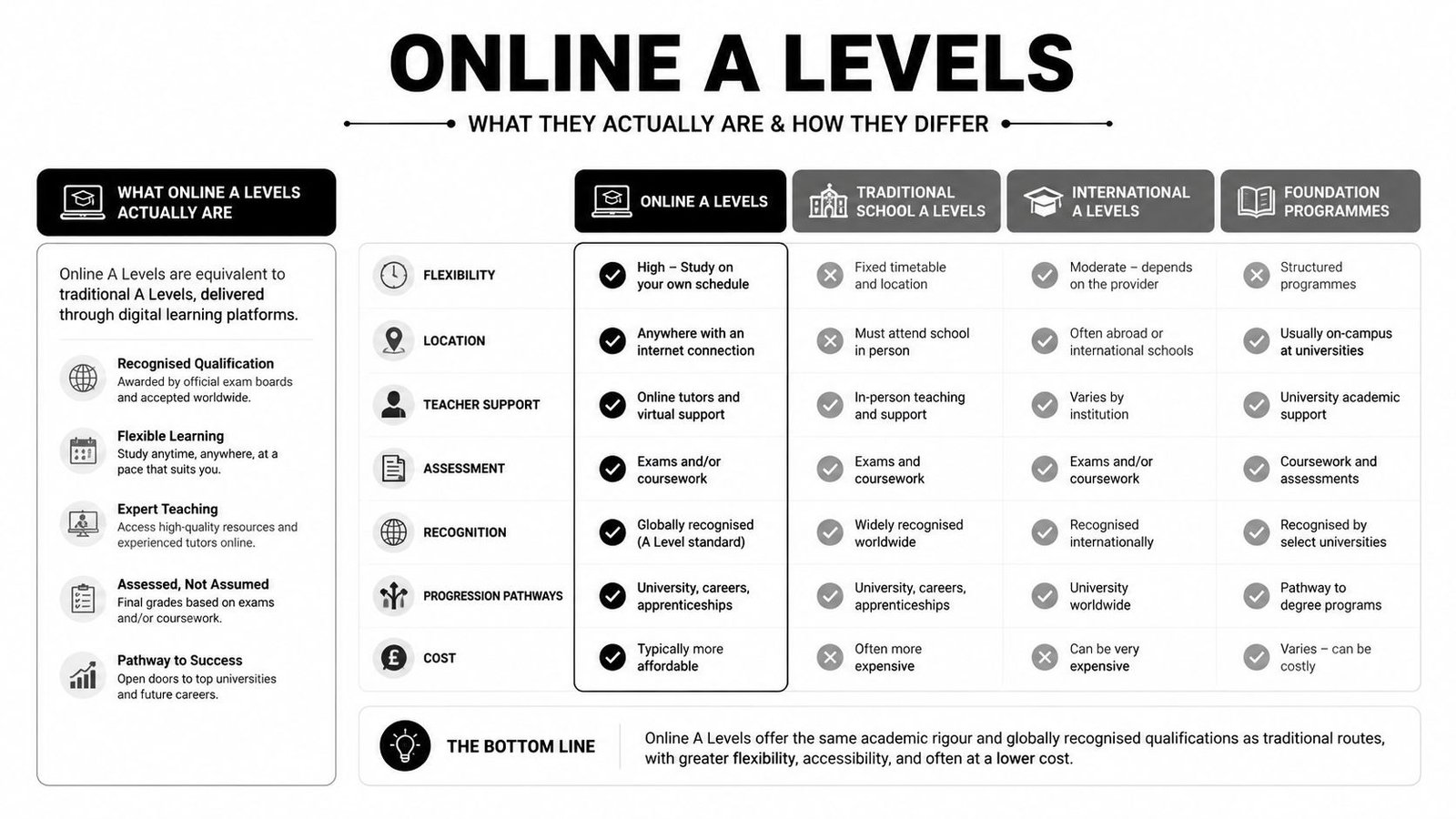
An online A Level follows the same assessment pathway as any other A Level. The difference is where and how the teaching happens. You study through digital lessons, tutor support, study materials and practice work, then complete assessment through the relevant examination board.
The qualification and the teaching service are separate. A learning provider supplies lessons and support. An awarding body sets or approves the assessment and awards the result. Pearson Edexcel and Cambridge are examples of recognised awarding bodies. The provider may also help you arrange assessment through an approved examination centre.
That distinction gives you a practical way to check a course. Ask which organisation will award the A Level, which specification you will follow and where you will sit the exams. A certificate issued only by an unregulated organisation may not carry the same recognition as an A Level awarded by an established examination board.
A simple way to compare routes
The qualification route matters more than the room where you study.
- Online UK A Level: Teaching is delivered online, while assessment follows the awarding body's requirements.
- Traditional sixth-form A Level: Teaching takes place in a school or college, with assessment through the relevant exam board.
- International A Level: This qualification is designed for international use and may be widely recognised. You still need to check the exact awarding body and the university's requirements.
- Foundation programme: This is a different preparation route. Some universities accept it, but its value depends on the institution and the specific programme.
The study method affects your timetable, contact with tutors and daily support. It does not, by itself, change the academic status of the qualification. Before enrolling, check the provider's accreditation for online courses and request the awarding body, specification and exam-centre details in writing. These documents help you show a university exactly what you studied and how it was assessed.
How Universities Decide Whether to Accept Your A Levels
An admissions decision works like a checklist, not a judgement about where you studied. Once the qualification is recognised, the university looks at whether your subjects and grades fit the degree you want.
Start with subject compatibility. A course may ask for particular A Levels, such as Mathematics for some science or economics degrees. Other courses may accept a wider subject combination but still set grade requirements. UCAS points can help compare results, yet they do not replace a named subject requirement. An online A Level in an unrelated subject may therefore count towards your overall profile without meeting every condition.
Read the course entry requirements carefully. Separate the offer into three parts:
- Grades: the result you must achieve.
- Subjects: any A Level the university specifically names.
- Combination: rules about how many qualifications must be taken together or which subjects cannot be counted together.
Offer letters use the same logic. A conditional offer might require certain grades in particular subjects, while a contextual offer may use different conditions. Check the wording rather than relying on a general entry grade shown elsewhere. If a requirement is unclear, ask the university's admissions team before choosing your subjects.
Your qualification also needs to be identifiable. Keep your certificate, candidate number and exam details available. UCAS, the awarding body or the exam centre may need information that confirms what you studied and how the assessment was completed. Clear records make it easier for admissions staff to match your result to the requirement.
The teaching format is usually a separate question. Studying from home may change your timetable and support, but it does not automatically change the qualification's academic value. The deciding evidence is the recognised A Level, the subjects and grades achieved, and the university's published requirements.
Pearson provides university progression information for learners checking how its qualifications support progression. You can use that guidance alongside the course page and direct advice from your chosen university. That gives you three useful checks: what the awarding body confirms, what UCAS records, and what the university asks for.
Understanding UCAS Tariff Points and How Grades Translate
UCAS Tariff points give universities a common way to compare certain qualifications. For A Levels, the points are linked to the grade. Studying online doesn't reduce the points attached to a recognised qualification.
The fixed A Level scale is:
| A Level Grade | UCAS Tariff Points | Typical Offer Range |
|---|---|---|
| A* | 56 | Course-specific |
| A | 48 | Course-specific |
| B | 40 | Course-specific |
| C | 32 | Course-specific |
| D | 24 | Course-specific |
| E | 16 | Course-specific |
These figures are listed in the A Level to UCAS points reference. The final column says “course-specific” because universities don't all use the same offer style. Some courses state grades directly, while others include a Tariff requirement or use both types of information.
Turning your target into a study plan
Suppose your chosen course asks for three B grades. Each B is worth 40 points, giving a total of 120 points. That example shows why checking the current course requirements matters. You should never rely on a general idea of what a university “usually” asks for.
Another learner might aim for AAB. That combination is worth 136 points, because an A is 48 points and a B is 40 points. These examples aren't promises about admission. They're a way to understand the value of each grade and set a practical target.
Use the UCAS course search and the individual university's entry profile to check:
- Required subjects: Some degrees need particular A Levels.
- Required grades: The university may list a combination such as ABB or AAB.
- Tariff wording: Check whether the course uses points, grades or both.
- Qualification conditions: Look for notes about awarding bodies or accepted equivalents.
For a clearer explanation of the calculation, use this guide to A Level grades and UCAS points. Remember that UCAS generally counts the highest level of achievement in the same subject. If you hold both an AS Level and an A Level in that subject, the A Level is usually the one that counts, as explained in UCAS advice for advisers.
How to Check That Your Online A Levels Will Be Accepted
You can protect yourself from confusion by checking your course before you enrol. Treat this as a calm evidence-gathering exercise, not a test of your intelligence. Each step answers one practical question.
Start with the awarding body
Ask the provider to name the awarding body and the exact qualification. Check whether the qualification appears on the Register of Regulated Qualifications and whether the awarding body is recognised for the route you're considering. Pearson Edexcel is one example named in UK-facing guidance.
Confirm the assessment route
Online lessons still need a valid examination arrangement. Ask whether you'll sit through an approved examination centre, whether remote invigilation is permitted for that qualification and who handles registration. Request the centre details and key dates before you pay or commit.
Match the A Level to your degree
Look at the entry requirements for each target course. Write down the subjects, grades and any qualification conditions. A recognised A Level may be accepted generally, but your chosen degree can still require a particular subject.
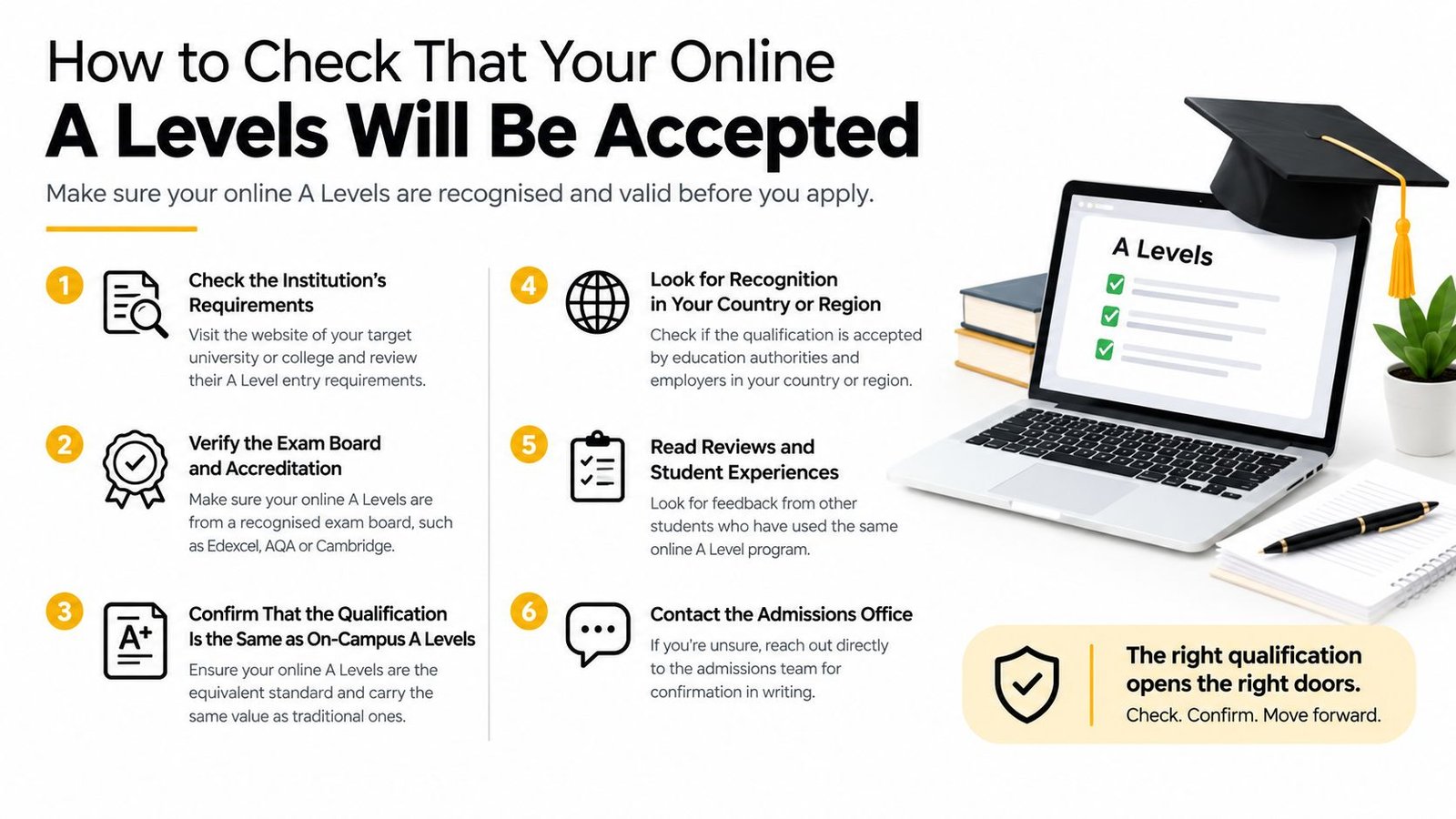
Ask the university directly
Contact the admissions office if anything remains unclear. Include the awarding body, qualification title, specification code and proposed assessment route. Ask for confirmation in writing, then keep the reply with your course records.
Keep your evidence together
Store your certificate, statement of results and any awarding body confirmation. You may also need details from the exam centre. Having these documents ready makes it easier to answer questions during your UCAS application.
Practical rule: Don't enrol based on a provider's general promise that “universities accept online A Levels”. Ask which awarding body, which qualification and which assessment route apply to you.
This process gives you control. It also helps you spot a provider that answers clearly and one that avoids precise details.
Why Universities Do Not Treat Online A Levels as a Second-Class Qualification
You have studied at home, perhaps around work or caring responsibilities, and now you are looking at a university application. It is understandable to wonder whether admissions staff will see your qualification differently. They usually focus on the qualification you hold and the evidence behind it, rather than the room where you studied.
A recognised A Level provides the academic information a university needs: the subject, awarding body, grade and assessment record. Online teaching changes how you prepare. It does not automatically change the qualification itself. The same principle can apply when you later consider postgraduate study, although each programme may set its own subject, grade and degree requirements.
Your route can show useful strengths
Adult learners often bring experience that school leavers have not yet developed. You may have planned study around employment, family life, health or distance from a college. Completing an A Level in those circumstances can demonstrate organisation, persistence and independent learning.
Those qualities do not replace entry requirements. They sit alongside them. A competitive course may still ask for specific subjects and grades, so read the requirements for every course you are considering.
What universities may still ask
An admissions team might request clearer information if your application does not explain the qualification or assessment arrangement. It may ask about the awarding body, exam centre, subject combination or results document. Treat this as checking the facts, not judging your decision to study online.
Keep your certificate, statement of results and centre details together. If a university asks a question, you can answer quickly and clearly. UCAS records and awarding-body evidence also help show that your result is genuine.
The Pearson progression guidance offers general information about progression from recognised qualifications. The practical message is simple: Legitimacy matters. Delivery mode alone isn't a barrier.
Building a Brighter Future for You and Your Family
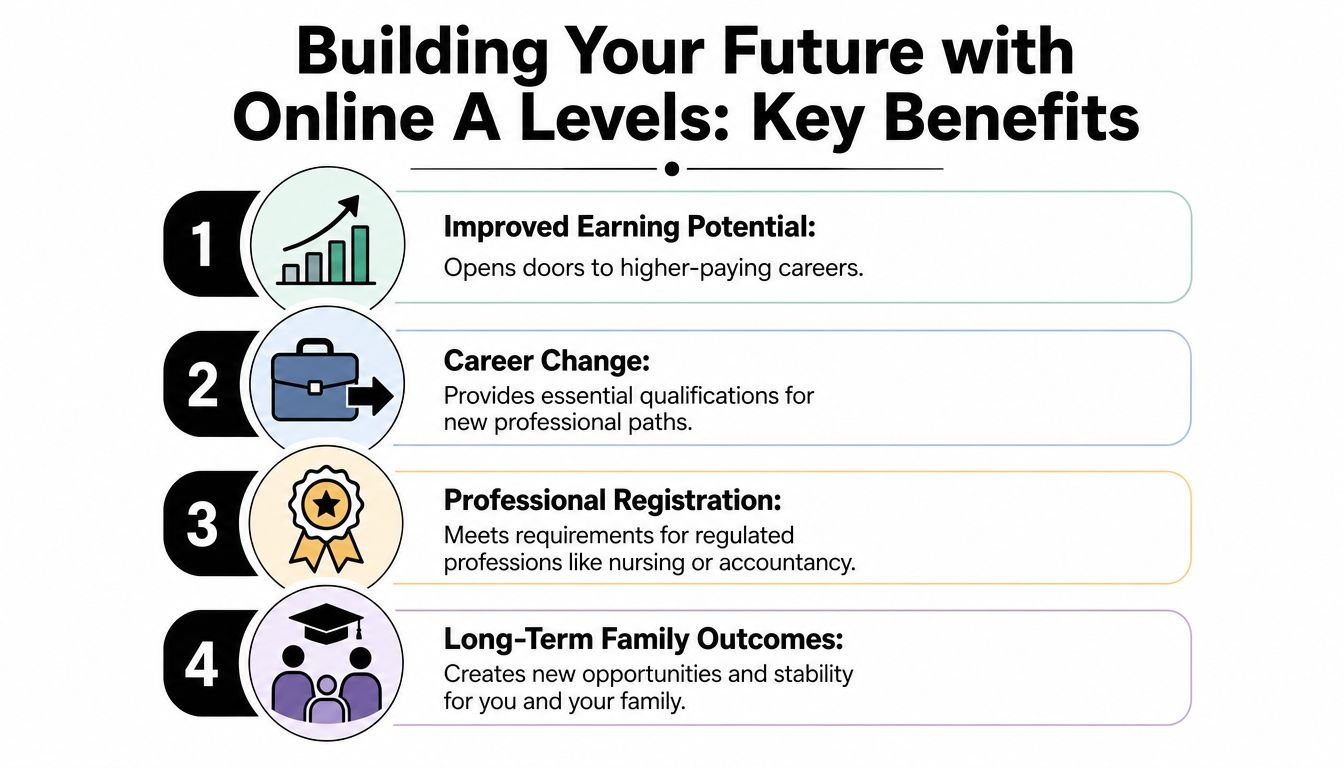
An A Level can be more than a line on an application. For an adult learner, it can be the first formal step towards a degree, a career change or a professional route that once felt out of reach. It can also restore confidence after years of believing that education belonged to somebody else.
Your reasons may be practical. You may want access to a career with stronger earning potential, or you may need the right subjects before applying for higher education. You may want to move into work that feels meaningful and allows you to contribute more to your community. The qualification won't do all the work for you, but it can open a door that was previously closed.
Your children notice your courage
Children often learn from what adults do, not only from what they say. When you study after work, revise around family life or keep going after a difficult result, you show them that progress can begin at any age.
You don't need to pretend that studying is easy. Let them see that you ask for help, plan your time and try again. Your achievement can become a shared family moment, and it may change how your children see their own education.
Flexible support makes the route more realistic
Next Level Online College is one option for adults looking at Pearson Edexcel A Levels taught online. Its courses combine structured study with tutor and pastoral support, flexible pacing and guidance towards UCAS applications. You should still verify the exact awarding body, qualification and assessment route for the course you choose.
A supportive provider can help you turn a large ambition into manageable tasks. You might begin with one subject, build a weekly routine and review your progress with a tutor. That steady approach can work around employment and caring responsibilities without asking you to abandon the rest of your life.
Your Next Step Toward University
You don't need to solve your whole future today. Begin with two or three degree courses that interest you. Read their entry requirements and write down the A Level subjects and grades they ask for.
Then check the qualification route. Confirm the awarding body, ask where exams will be taken and save the answers. If you're unsure, contact each university's admissions office before enrolling. Clear information now can prevent stress later.
It can help to make a simple page with four headings:
- Degree course: Record the university and course name.
- Subjects: Note every required A Level subject.
- Grades: Write the stated grade offer or Tariff requirement.
- Questions: List anything you need the provider or admissions team to confirm.
You can also use this guide to getting into university to organise your next actions. Your first step might be a conversation with a course adviser, followed by a realistic study plan that fits your work and family responsibilities.
You're not behind. You're building from where you are now, with a clearer purpose and more life experience than you had before. Small, repeated actions can take you towards a qualification, a university application and a future your family can feel proud of.
Next Level Online College offers supported online A Levels for adult learners who need a recognised route towards university and career progression. Visit Next Level Online College to explore suitable subjects and discuss a study plan that fits around your life.