
You've spent the day working, caring for your family and trying to keep everything moving. Then an email, form or college application asks for English skills, and an old worry returns: “What if I'm not good enough?” Many adults feel this way after time away from education. Feeling nervous doesn't mean you can't succeed. It means the opportunity matters to you.
Functional Skills English City and Guilds offers a practical route back into learning. It focuses on the English people use at work, in further study and in everyday life, so you can build useful skills while growing in confidence. With the right support, you can become a proud example for your children, prepare for a better career and take steps towards university.
Your Fresh Start with Functional Skills English
Meet Aisha. She works shifts, helps her children with homework and has wanted to return to education for years. She understands conversations well, but writing a formal email makes her nervous. At school, she felt that English was something other people were naturally good at.
Aisha doesn't need to become a different person to succeed. She needs patient teaching, clear practice and a course that connects learning with real life. Functional Skills English City and Guilds can give her that starting point. The qualification helps learners practise reading information, writing clearly, speaking with confidence, listening carefully and communicating with other people.

Your reason for starting matters
Perhaps you want to help your children see that learning doesn't stop when you become an adult. Perhaps you need English for an apprenticeship, a new role or a college application. You may want to feel more comfortable writing messages, filling in forms and sharing your ideas.
Those goals are important. A recognised English qualification can support progression, but the confidence you build during study can affect many parts of life. You may speak up more at work, help your family with school tasks or feel ready to apply for opportunities you once avoided.
A fresh start doesn't require perfect English. It requires a first step and support that meets you where you are.
City & Guilds qualifications are built for practical use, not for making learners feel judged. The course journey can be broken into manageable tasks, such as understanding a notice, planning a letter or taking part in a discussion. Each completed task gives you evidence that your ability is growing.
Your children may notice that effort before they notice the certificate. They'll see you study after work, ask questions and keep going when something feels difficult. That example can stay with them for years. Your progress can also lead towards further qualifications, fulfilling employment and, for some learners, a future university application.
What City and Guilds Functional Skills English Covers
Think of the qualification as a set of building blocks. Each block supports a different part of communication, and together they help you manage real situations with greater independence.
City & Guilds Functional Skills English is available across five levels, from Entry 1 to Level 2, and develops reading, writing, speaking, listening and communication skills for work, study and everyday life in England. The current 4748 English suite includes handbooks for Entry Level 1, Entry Level 2, Entry Level 3, Level 1 and Level 2. The government qualification record confirms that there are no formal age restrictions and no entry requirements for the qualification suite. You can check the official qualification record for City & Guilds Functional Skills English.
The five levels as building blocks
- Entry Level 1 supports the earliest steps in functional communication. You might work on recognising information, writing simple messages and taking part in short conversations.
- Entry Level 2 adds more independence. Learners practise understanding everyday texts and sharing information in clearer ways.
- Entry Level 3 strengthens the foundation before Level 1. You'll handle a wider range of reading, writing and communication tasks.
- Level 1 is useful for many work and further study goals. It expects you to understand information, organise writing and communicate appropriately for different situations.
- Level 2 develops a stronger level of independence and accuracy. It can support progression where a provider, employer or course asks for Level 2 English.
Your starting point should be based on your current skills, not on embarrassment about past experiences. An initial assessment can show which building blocks are secure and which need more practice. Starting at the right level protects your confidence and helps you make steady progress.
What you practise
Reading means more than saying words aloud. You may need to find a key detail in an email, understand a public notice or work out the main point of an article. Writing includes choosing suitable language, organising ideas and checking spelling, punctuation and grammar.
Speaking, listening and communicating help you take part in discussions, explain a view and respond to another person. These skills matter when you speak to a manager, attend an interview, discuss a child's needs with a school or present an idea at work.
City & Guilds describes the qualification as a way to show that a learner can read, write, speak, listen and communicate at an appropriate level while applying those skills to real-life situations. The City & Guilds overview of Functional Skills explains this practical purpose.
Functional Skills English and GCSEs Compared Simply
Functional Skills English and GCSE English can both support progression, but they aren't the same qualification. The right choice depends on your goal, the requirement set by your next course or job and the way you learn best.
Functional Skills English concentrates on practical communication. You use English for everyday situations, workplace tasks and further learning. GCSE English follows a broader academic route and may include literary study alongside language skills. Some university pathways specifically ask for GCSE English, so you should check the exact entry requirements before enrolling.
| Feature | Functional Skills English | GCSE English |
|---|---|---|
| Main purpose | Practical reading, writing, speaking, listening and communication | Academic English language and, where required, literature study |
| Learning style | Real-life tasks and communication situations | Wider academic study with set texts and examination preparation |
| Assessment | Assessment is linked to the qualification components and may suit learners seeking a practical route | Assessment follows the GCSE specification and examination arrangements |
| Typical progression | Work, apprenticeships, further study and routes that accept Functional Skills | Courses and pathways that specifically require GCSE English |
| Best starting question | Does my employer or next provider accept Functional Skills at the level I need? | Does my chosen pathway ask for GCSE English Language or Literature? |
Neither route is a measure of your worth
Some adult learners worry that choosing Functional Skills means they've taken an easier or less valuable option. That isn't a helpful way to view it. Functional Skills English is designed to show that you can apply English in real situations, which is exactly what many adults need for work and daily responsibilities.
A GCSE may be the better route if a university, college or employer names it as a specific requirement. Functional Skills may suit you if you need a practical qualification, want to rebuild confidence or need to meet an English condition through another recognised pathway. Always ask your intended provider what it accepts.
For a closer look at the relationship between the two routes, read this guide to Functional Skills qualifications equivalent to GCSE.
Choose with your destination in mind
Write down the next step you want to take. If you're applying for a course, look at its published English requirement. If you're changing jobs, ask the employer or training provider which qualifications they accept. This small check can prevent you from spending time on a route that doesn't match your plan.
If you're unsure, speak with a tutor or admissions adviser. A good adviser will ask about your current skills, your confidence and your destination, rather than pushing you into a level that feels unsuitable.
How City and Guilds Assessment Works
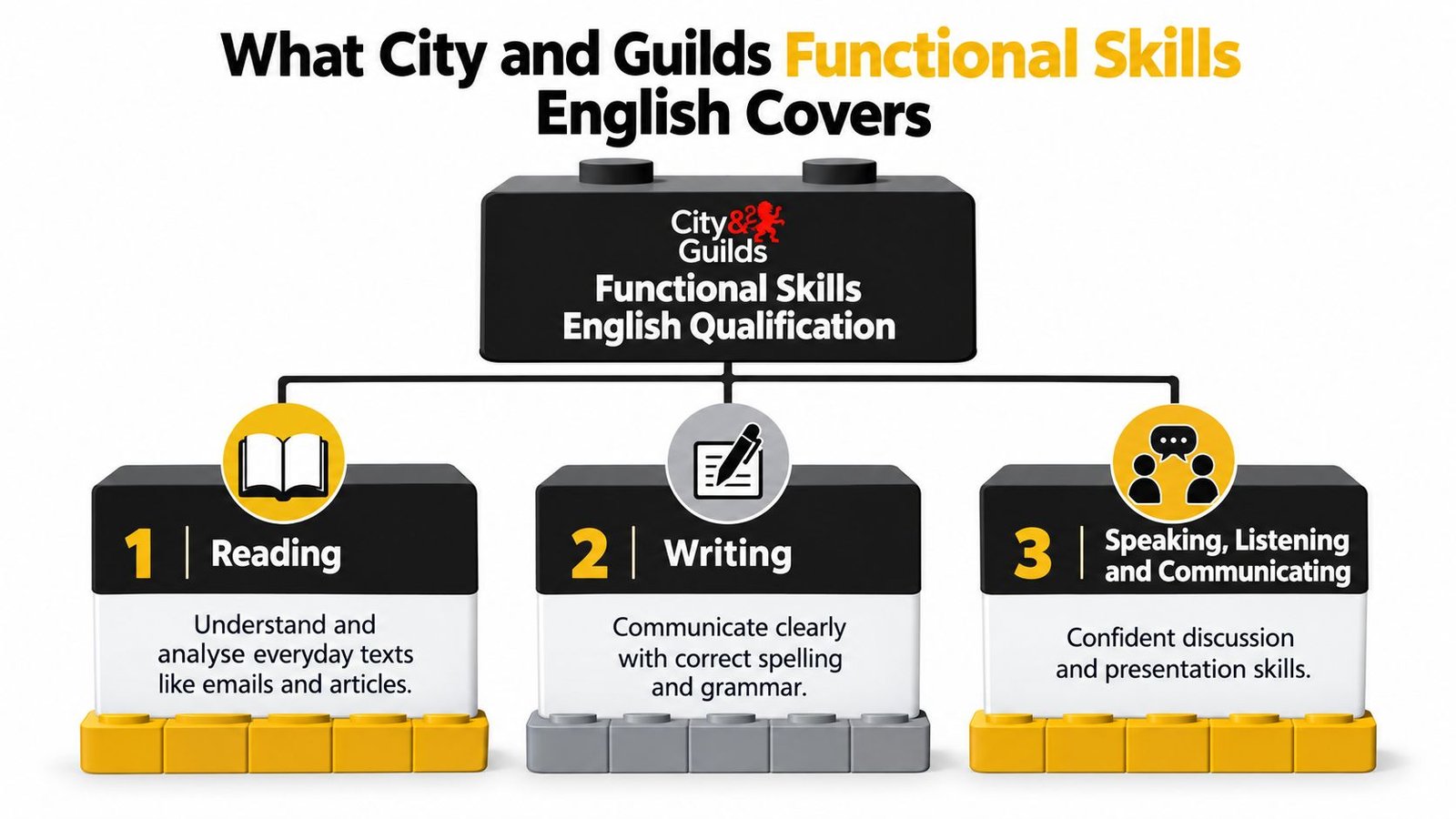
The assessment becomes easier to understand when you separate it into its parts. At Entry Level 1, Entry Level 2 and Entry Level 3, City & Guilds Functional Skills English is built from Reading, Writing, and Speaking, Listening and Communicating. The qualification is based on real-life application, so preparation should include practical tasks as well as written exercises.
Three parts, one complete qualification
Reading checks how well you understand information. You may need to identify facts, interpret meaning or decide which details matter. Writing checks whether you can communicate a clear message for a purpose, while paying attention to structure and technical accuracy.
Speaking, Listening and Communicating looks at how you take part in communication with other people. This may involve listening to information, responding appropriately, sharing ideas and presenting your thoughts clearly.
You can't rely on one strong area to carry the whole qualification. The City & Guilds Entry Level qualification handbook states that learners must pass each component at the same level to achieve the qualification.
The must-pass rule: You need to pass Reading, Writing, and Speaking, Listening and Communicating at the same level. A weakness in one component can prevent certification, even when the other areas are strong.
This is why a diagnostic assessment is so useful before you book an exam. It can reveal that your reading is secure but your writing needs support with paragraph order, punctuation or planning. You can then spend time where it will make the greatest difference.
Indicative pass marks
At Level 1 and Level 2, the reading test is marked out of 30, with a current indicative pass mark range of 17 to 19. The writing test is marked out of 54, with an indicative pass mark range of 30 to 31 for Level 1 and 31 to 32 for Level 2. These figures come from the current City & Guilds indicative pass marks information.
Indicative marks aren't a reason to guess your result before you study. They show why careful preparation matters. Read every question, plan your writing and leave time to check your answers. Your tutor or centre should also explain the current assessment arrangements for your level.
Understanding Pass Marks and First Attempt Success
Functional English is practical, but practical doesn't mean effortless. City & Guilds' published data show that some components are more difficult for first-time candidates, particularly writing and some Level 2 reading assessments.
In the 2024/2025 data, first-time pass rates were 63% for Level 1 writing, 67% for Level 2 reading and 77% for Level 2 writing. The same City & Guilds data show that earlier 2022/2023 figures included 69% for Level 1 writing and 75% for Level 2 reading. These figures are reported in the City & Guilds Functional Skills pass-rate document.
Why writing causes problems
Writing asks you to manage several jobs at once. You need to understand the purpose, consider the reader, choose suitable information, organise your ideas and check spelling, punctuation and grammar. A learner may have good ideas but lose marks because the message is unclear or the response doesn't match the task.
Reading can also be challenging when a text contains unfamiliar words, implied meaning or several details that appear important. Learners sometimes rush because the passage looks familiar, then answer from memory rather than using evidence from the text.
A retake isn't proof that you can't do English. It's information about the skill that needs more focused practice.
Turn the gap into a study plan
Generic revision can leave you practising what you already know. Targeted support is more useful. For writing, ask a tutor to mark a formal email, explain which criteria you missed and help you rewrite one paragraph. For reading, practise locating evidence, identifying the writer's purpose and explaining how you reached an answer.
A sensible plan might include:
- Writing practice: Plan before drafting, use paragraphs for separate ideas and check the final response against the task.
- Reading practice: Underline key words in the question, search the text carefully and answer with the information requested.
- Review after feedback: Keep a short list of repeated errors, such as missing full stops or unclear paragraph order.
- Retake preparation: Practise the specific component rather than repeating every lesson from the beginning.
City & Guilds activity continues to include assessment support, such as webinars on Level 1 and Level 2 English and updated indicative pass marks published in 2026, so learners and centres need guidance that reflects current expectations. You can use a Functional Skills test preparation service to support practice, but your centre should remain your main source for assessment decisions.
Your Step by Step Path to Registration and Preparation
Starting feels less frightening when you turn it into a short list. You don't need to solve everything today. You need to identify your goal, check your starting point and choose support that fits your life.
Begin with the right level
First, decide why you need English. You might need it for work, an apprenticeship, a college course or personal development. Next, complete an initial assessment through a suitable centre. This helps identify whether Entry Level 1, Entry Level 2, Entry Level 3, Level 1 or Level 2 is the sensible place to begin.
City & Guilds states that adult learners in England can be fully funded for their first Level 1 or Level 2 maths and/or English qualification through the Adult Skills Fund, subject to the relevant funding rules and eligibility checks. Its Functional Skills English and maths qualifications are available from Entry Level 1 to Level 2, as explained on the City & Guilds Functional Skills qualification page. Ask your chosen provider to confirm whether funding applies to you.
Build study around real responsibilities
Online learning can help adults fit study around work, childcare and family life. Choose regular study times that you can protect, even if they're short. Tell the people at home why your learning matters, and let them see your progress. Your study routine can become a positive family habit rather than something you have to hide.
Use this preparation pattern:
- Reading: Work with emails, notices, instructions and articles. Find the main point, identify details and explain meaning in your own words.
- Writing: Practise messages for different readers. Plan, draft and check rather than trying to write perfectly in one go.
- Speaking and listening: Discuss everyday topics, listen without interrupting and practise giving a clear answer with a reason.
- Feedback: Ask someone qualified to explain the exact reason an answer needs improvement.
- Mock assessment: Complete practice under realistic conditions, then review your mistakes calmly.
Past papers can help you become familiar with question styles, but they shouldn't replace teaching and feedback. Use Functional Skills English past papers as part of a wider plan, and check that your materials match your City & Guilds level and current assessment arrangements.
Protect your wellbeing, too. Take breaks, sleep when you can and speak up if anxiety is affecting your work. A calm, organised learner can show more ability than a tired learner who has rushed into an assessment.
Achieve More for You and Your Family with Next Level Online College
Returning to education takes courage. You're not only studying spelling, reading or writing. You're proving to yourself and to your family that your future can still grow.
A Functional Skills English qualification can support practical progress towards work and further study. It may help you approach applications with more confidence, communicate more clearly at work and meet an English condition for a progression route that accepts the qualification. The exact requirement always belongs to the employer, college or university, so check before you enrol.
Support that fits adult life
Next Level Online College offers online Functional Skills English study for adult learners who need a flexible way to prepare. Its wider provision combines structured learning with subject specialists, mentors and wellbeing support, allowing learners to ask questions and receive guidance while managing everyday responsibilities.
A supportive course should help you understand what to practise, not give you pages of work. That might mean reviewing a writing task, preparing for a speaking activity or using a mock assessment to identify a gap. It should also help you connect English with your next goal, whether that's a new role, further study or a university pathway.
Your certificate matters, but the confidence to use your voice matters just as much.
At Level 1 and Level 2, the reading test is marked out of 30, and the indicative pass mark range is 17 to 19. The writing test is marked out of 54, with indicative pass mark ranges of 30 to 31 for Level 1 and 31 to 32 for Level 2, according to the City & Guilds pass mark guidance. Knowing the assessment shape can make preparation feel more manageable, especially when a tutor helps you focus on the component that needs attention.
Your children may remember the day you passed, but they'll also remember the days you kept studying. That persistence can show them that education belongs to the whole family. With steady support, your next achievement may open the door to a more fulfilling career, further qualifications and a future you once thought was out of reach.
Next Level Online College offers flexible online Functional Skills English study with structured lessons, assessment preparation and support from experienced subject specialists, mentors and wellbeing advisers. Visit Next Level Online College to explore your options and take the first practical step towards stronger English, greater confidence and your next goal.