
Some evenings feel heavier than others. You finish work, sort the house, answer messages, help with dinner, and still carry that quiet thought in the back of your mind. You know you're capable of more, but getting back into learning feels scary.
If that sounds like you, you're not behind. You're not “bad at English”. And you're not the only adult who wants a better future but feels nervous about taking the first step.
Functional Skills English Level 1 can be that first step. Not just towards a qualification, but towards confidence, pride, and new choices. It can help you speak up more clearly, write with more confidence, and prove to yourself that you can do hard things. That matters at work, at home, and in the example you set for your children.
Your First Step to a Brighter Future
You might be reading this because you want more from life. Maybe you want a better job. Maybe you want to stop feeling embarrassed when filling in forms or writing emails. Maybe you want to show your children that learning doesn't stop when school ends.
That feeling is powerful. It means you still believe your future can change.

When life gets busy, dreams often get pushed aside
Many adult learners put themselves last for years. Family comes first. Bills come first. Work comes first. After a while, it's easy to believe education belongs to other people.
But that isn't true.
You can return to learning at any age. You can build skills step by step. You can feel proud of your progress, even if school was hard the first time around.
You don't need to have it all figured out. You only need to decide that your future matters too.
A qualification like Functional Skills English Level 1 isn't about pretending to be someone else. It's about strengthening the skills you already use in daily life, then turning them into something recognised and respected.
This is about more than a certificate
Think about the small moments that could change. Reading a school letter without worry. Writing a message to a manager with confidence. Joining a conversation and trusting your own words.
Those moments build something bigger:
- More self-belief when you speak, write, and apply for opportunities
- More pride at home because your children see you trying, learning, and growing
- More options for the future because you're building a path instead of standing still
For many adults, the biggest change happens inside first. You stop saying, “I can't.” You start saying, “I'm getting there.”
That shift can affect every part of your life.
Understanding Functional Skills English Level 1
You might already use more English skills than you give yourself credit for.
If you read a text from school, fill in a form, reply to an email, or explain a problem at work, you are already using the kind of skills this qualification builds. Functional Skills English Level 1 takes those everyday skills and turns them into something recognised. It gives you a clear way to strengthen what you can do and prove it on paper.
A good way to see it is this. Level 1 works like building a strong middle step on a staircase. It is above the earliest stages of learning, but it does not expect advanced academic English. It focuses on practical communication in familiar situations, which is why many adults find it a realistic place to begin. If you want a fuller picture of what Functional Skills English includes, that guide can help.
A qualification based on real life
Functional Skills English Level 1 is a nationally regulated qualification. In simple terms, that means it is recognised and built around useful English for daily life, work, and study.
You are not being asked to become a literary expert. You are learning how to understand information, get your point across clearly, and take part in conversations with more confidence. That can make ordinary tasks feel less stressful and help you trust yourself more.
At this level, you build skills such as:
- Reading information clearly, including letters, notices, instructions, and short articles
- Writing for a purpose, such as emails, messages, forms, and short pieces of writing
- Speaking and listening with confidence in discussions, conversations, and practical situations
Where Level 1 fits
Some adult learners worry that Level 1 will be too hard. Others worry it will not count for much. In reality, it sits in a useful middle ground.
It is a recognised step within the Functional Skills pathway, below Level 2 and above Entry Level. That makes it a solid choice if you want progress you can manage without feeling thrown in at the deep end. For many people, it is the point where things start to click. You begin to see that learning is not about being perfect. It is about becoming steadier, clearer, and more confident in situations that matter to you.
A course that respects adult learners
This qualification is often a good fit for adults returning to education because it is structured and practical. The NCFE qualification page for Level 1 Functional Skills English shows guided learning hours, total qualification time, and that there are no pre-entry requirements.
This is helpful if you have been out of education for a long time.
You do not need to sound academic on day one. You do not need a perfect school record. You need a starting point, a bit of patience with yourself, and support that helps you keep going.
A simple way to judge it: if you use English in everyday life but want more confidence, more structure, and a recognised qualification, Level 1 is often a sensible place to start.
What You Will Learn and Why It Matters
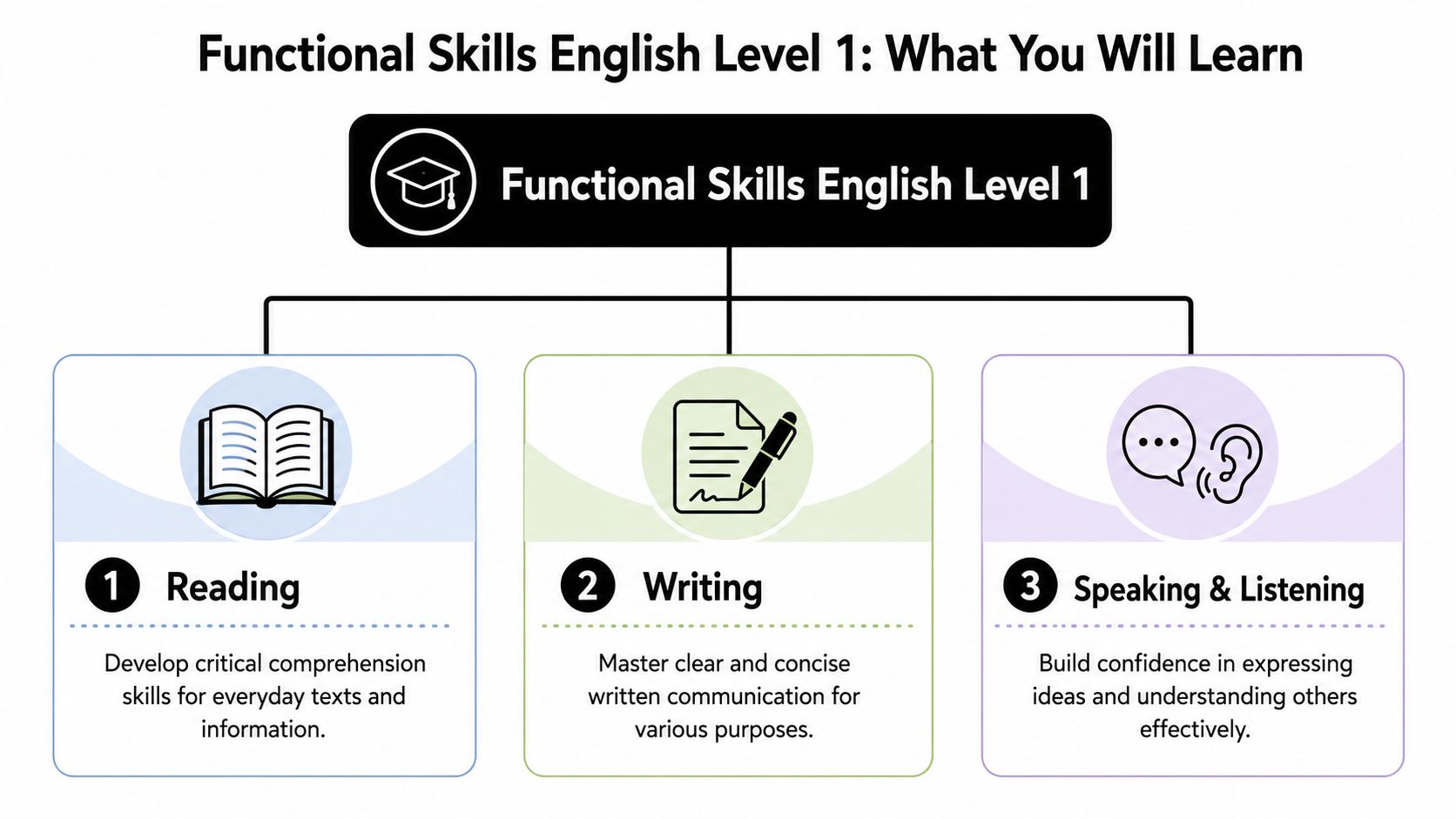
The heart of Functional Skills English Level 1 is simple. You build your skills in reading, writing, and speaking and listening. These aren't separate from real life. They are real life.
Reading with more confidence
Reading at this level isn't about trying to sound clever. It's about understanding meaning clearly.
You may work with everyday texts such as instructions, articles, letters, or short discussions. You learn how to spot main points, follow information, and understand what a writer is trying to say.
That helps in ordinary moments that matter a lot. You can read a message from school and know exactly what action is needed. You can look at workplace guidance and feel less unsure. You can help your child with homework instructions without feeling lost.
A stronger reader usually becomes a calmer person too. You spend less time second-guessing yourself.
Writing that gets your point across
Writing is one of the biggest confidence barriers for adult learners. Many people worry about spelling, punctuation, or sounding “wrong”. Functional Skills English Level 1 helps you write in a way that is clear, useful, and appropriate for the situation.
That might mean:
- Work messages that sound professional and polite
- Forms and applications that are easier to complete accurately
- Personal writing such as letters, notes, or messages that say what you really mean
Good writing isn't about using fancy words. It's about helping the reader understand you.
Here's a simple way to look at it:
| Skill | Everyday example | Why it helps |
|---|---|---|
| Reading | Understanding a letter from school | You can respond with confidence |
| Writing | Sending an email to a manager | You sound clear and capable |
| Speaking and listening | Joining a meeting or parents' evening | You share your views more confidently |
Speaking up and listening well
This part can surprise learners. It often becomes one of the most rewarding areas because it helps you trust your own voice.
You may be asked to take part in discussion, listen carefully, and present ideas in a familiar setting. That's useful far beyond the course. It helps when talking to teachers, employers, colleagues, customers, or family members.
When you start speaking with more confidence, people often respond to you differently. They listen more closely because you're presenting yourself with more belief.
For adults who've spent years doubting themselves, that can feel like a major change. Not because you've turned into someone else, but because your confidence has finally caught up with your ability.
Passing Your Exams A Simple Guide
The word “exam” can make your stomach drop. That's normal, especially if school didn't leave you with happy memories. But the assessment for Functional Skills English Level 1 is designed to be practical, not trick you.
The qualification has three parts: a Reading test, a Writing test, and a Speaking, Listening and Communicating assessment, according to the official Functional Skills criteria for English.
What each part feels like
The reading and writing parts are usually formal exams. The speaking part is usually more relaxed and assessed internally in a familiar context, as described in the guide to Functional Skills tests.
That means the course checks different kinds of skill in different ways.
Reading test
You read texts and show that you understand them. The focus is on meaning, purpose, and useful information.Writing test
You produce your own written responses. The goal is to communicate clearly and appropriately.Speaking, Listening and Communicating
You take part in a discussion or presentation in a familiar setting. This often feels closer to everyday communication than a traditional exam.
It's a chance to show what you can do
Many adult learners think exams are there to expose weakness. A better way to see them is this. They are your chance to show the progress you've made.
You won't be asked to become perfect overnight. You'll be asked to demonstrate practical English skills that connect to daily life.
Remember this: the assessment is there to measure useful communication, not to catch you out.
How to calm exam nerves
If you feel anxious, keep your preparation simple and steady.
- Practise little and often so the work feels familiar
- Read the question carefully before rushing into an answer
- Leave time to check your writing at the end
- Treat the speaking task like a real conversation rather than a performance
Confidence often grows after the first few practice tasks. Once you see the style of assessment, it usually feels less mysterious and more manageable.
Your Path to University and a Better Career
One of the best things about Functional Skills English Level 1 is what it can lead to next. It doesn't trap you in one lane. It opens doors.
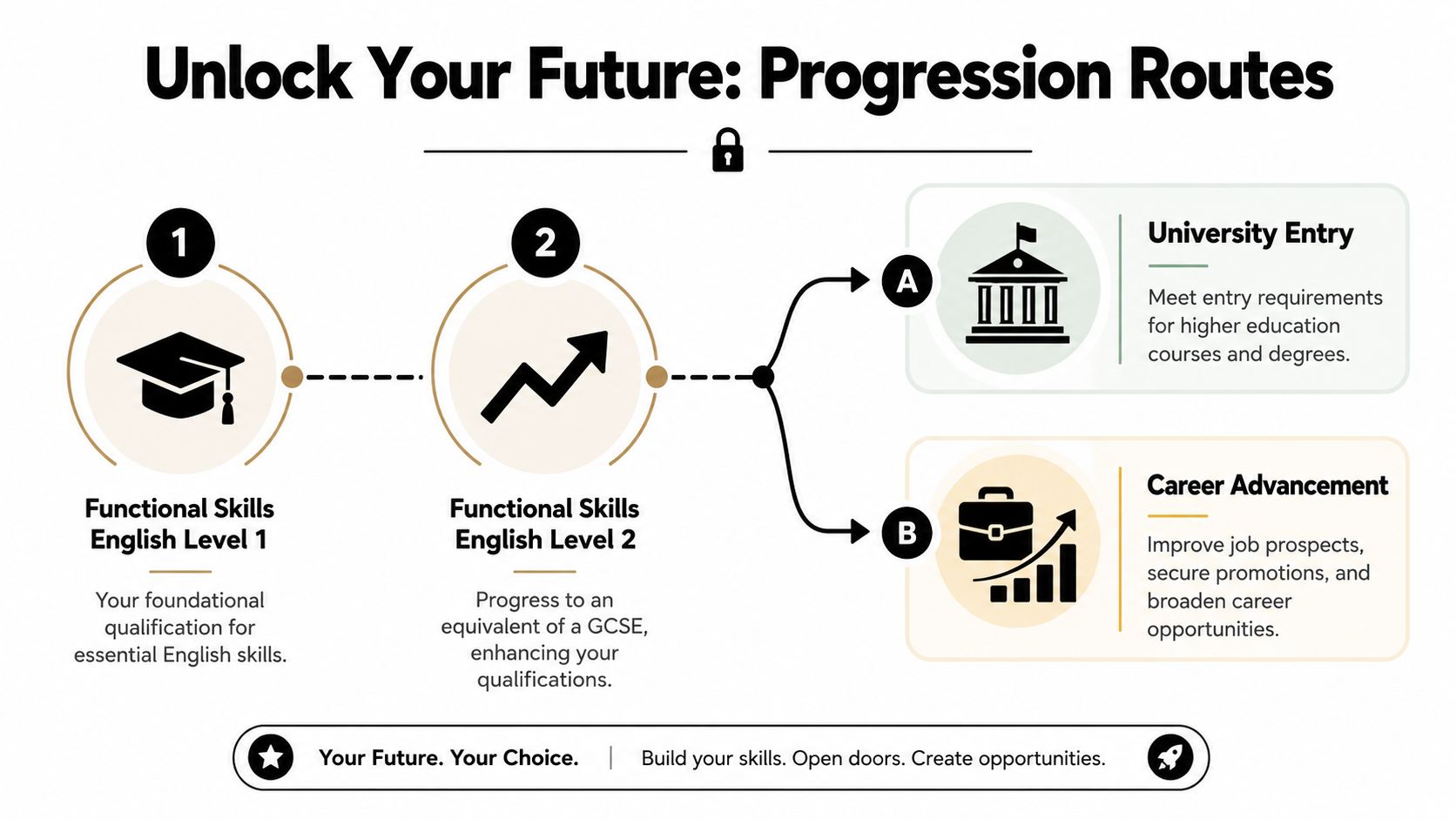
Functional Skills English Level 1 is widely recognised as being roughly equivalent to GCSE grades 1 to 3, according to City & Guilds guidance on Functional Skills. That helps learners and employers understand where it sits.
A stepping stone that counts
For many adults, Level 1 is the point where things begin to move again. You gain a recognised qualification, prove your ability, and create momentum.
From there, people often aim for:
- Functional Skills English Level 2
- GCSE pathways
- Apprenticeships
- Jobs that ask for formal English skills
If university feels like a distant dream, it may help to stop looking at the whole staircase. Just focus on the next step. For some learners, that's Level 1. After that, the path becomes easier to see.
A useful starting point is learning more about routes into higher education for adult learners.
The story changes when you keep going
Think about an adult learner who starts with low confidence. They enrol because they want to improve their English for work. While studying, they realise they enjoy learning more than they expected. Passing Level 1 gives them proof that they can succeed. That success gives them the courage to move on to Level 2, then to bigger goals.
That's how life changes. Not always with one giant leap, but with one brave decision followed by another.
Here's what Level 1 can support:
| Next goal | How Level 1 helps |
|---|---|
| Better work opportunities | Shows practical communication skills |
| Further study | Builds confidence for Level 2 or GCSE |
| Apprenticeships | Supports recognised entry requirements |
| Long-term university plans | Starts a clear progression route |
Why this matters for your family too
When adults return to education, the result is never just personal. Your children notice. Your partner notices. Your family sees you setting a goal and sticking with it.
That example is powerful.
You show that setbacks don't define a person. You show that learning can happen later in life. You show that effort, courage, and patience matter.
A parent who studies sends a strong message without saying a word. Growth is possible. Change is possible. A new chapter is possible.
You Are Not Alone How We Help You Succeed
Returning to learning can feel lonely at first. You may wonder if everyone else will be more confident, more organised, or better prepared. Most adult learners feel that way in the beginning.
What helps is having support around you. Not just lessons, but real people who understand adult life and the pressure that comes with balancing study, work, and family.
The right support makes study feel possible
Adult learners usually don't need pressure. They need structure, kindness, and clear guidance.
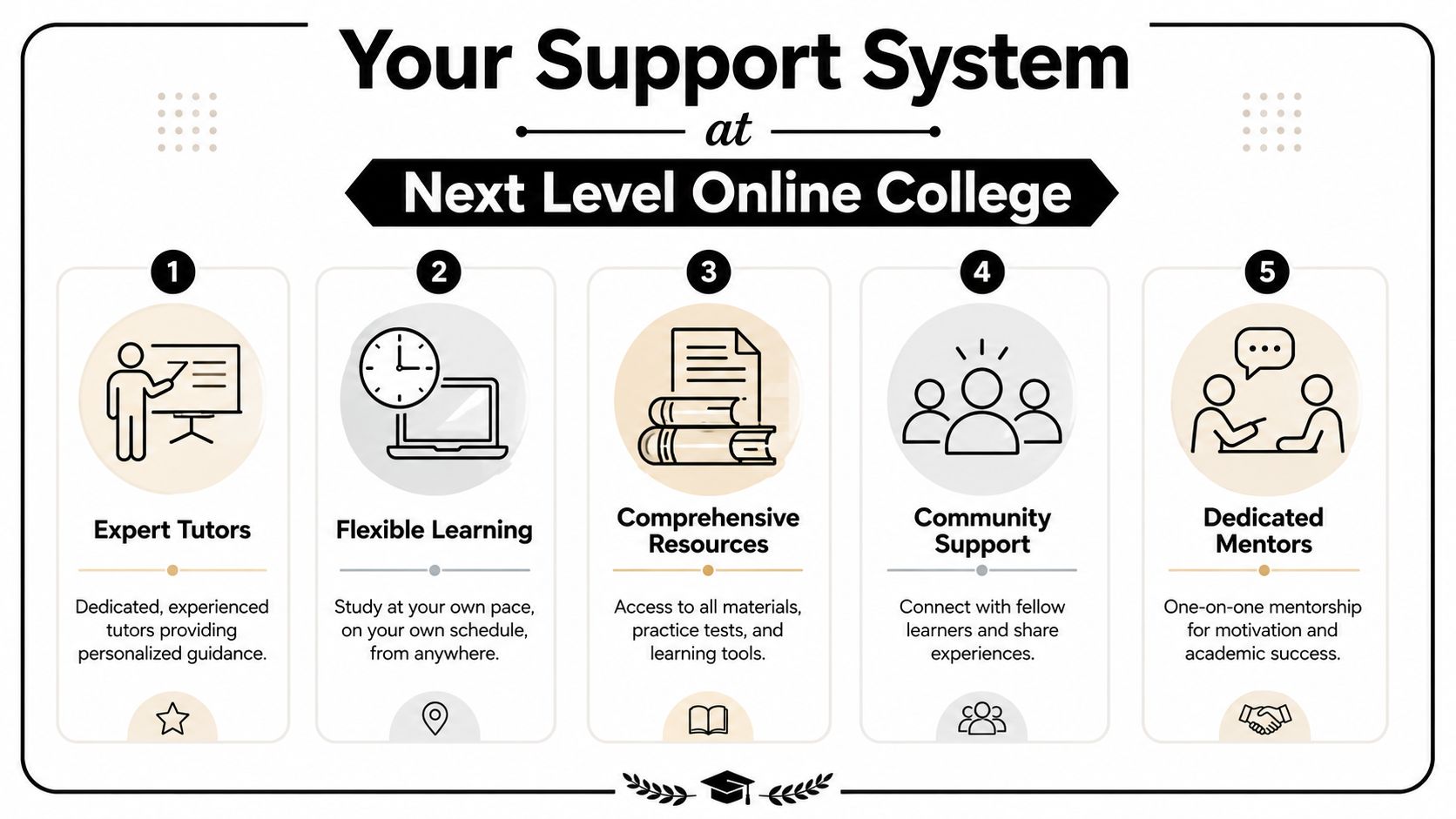
Strong support often includes:
- Expert tutors who explain things clearly and answer questions without judgement
- Flexible learning so study can fit around shifts, school runs, and busy weeks
- Useful resources such as practice materials and revision help
- Encouragement from mentors or advisors when motivation dips
- A learning community where you don't feel like you're doing everything on your own
That human side matters more than many people expect. When someone believes in you, it becomes easier to believe in yourself.
Online learning can work around real life
Adult life rarely leaves neat spaces for education. That's why flexibility matters so much.
Online learning can help you study in ways that suit your reality. Early mornings before work. Evenings after the children are asleep. Weekends when the house is quieter. You don't need to fit your life around learning in the same way a school timetable demands.
That flexibility can reduce one of the biggest barriers adults face. The feeling that education is a good idea, but impossible to fit in.
Progress grows from consistency, not perfection
Many learners think they must feel confident before they begin. Usually, confidence comes after they begin.
You don't need a perfect routine. You need a workable one.
Some weeks will go smoothly. Some won't. Success usually comes from coming back to your goal, even after a difficult week.
If you've been carrying self-doubt for years, support isn't a bonus. It's part of how progress happens.
Ready to Make Your Family Proud?
You don't need to become a different person to succeed in Functional Skills English Level 1. You just need to give yourself permission to start.
This qualification can help you build practical English skills, prepare for the next stage of study, and grow in confidence in everyday life. But the deeper value goes beyond lessons and assessments. It's about proving to yourself that your goals still matter.
The first step can change more than you think
When you study as an adult, you're doing something brave. You're choosing growth over fear. You're choosing possibility over old labels. You're choosing to believe that your future can be bigger than your past.
That choice can ripple through your life.
- At home, you become a stronger role model
- At work, you may feel more ready to apply, speak up, and move forward
- In yourself, you build the kind of pride nobody can take away
If you've spent years doubting your ability, let this be the moment you stop waiting to feel ready. Readiness often comes after action, not before it.
You can start from where you are
You don't need perfect spelling. You don't need school confidence. You don't need to have all the answers today.
You only need a beginning.
And if your reason is your children, your future, your confidence, or the quiet dream of doing more with your life, that reason is enough.
If you're ready to take that first step, Next Level Online College offers flexible support for adult learners who want recognised qualifications and a realistic path forward. Speak to a friendly advisor, ask your questions, and find out how you could start building a brighter future with Functional Skills English Level 1.