
Some evenings look the same. The children are in bed, the washing is still waiting, and you're sitting at the kitchen table wondering whether life can be bigger than this. You want better options. You want steadier work, more confidence, and the feeling that you're moving forward instead of standing still.
You might also feel nervous. Lots of adults do when they think about studying again. Maybe school never felt like your place. Maybe you've been telling yourself for years that you're “not academic”. But choosing to try again is brave, and it can change far more than your own future. It can change what your children see is possible.
Your First Step Towards a New Future
Think about a parent who spends the day working, sorting the house, answering messages from school, and still feels a quiet ache inside. They want to apply for a better job but worry about the form. They want to help more with homework but freeze when numbers come up. They want their children to feel proud, yet they don't always feel proud of themselves.
If that sounds familiar, you're not failing. You're standing at the start of something new.

Functional Skills Entry Level 3 is often the right starting point for adults who want a fresh chance without jumping straight into something that feels too hard. It gives you a manageable place to begin. You don't need to be perfect. You just need to be willing to take one step.
Why this step matters
This kind of learning isn't only about passing a qualification. It's about rebuilding trust in yourself. Every worksheet you finish and every skill you understand sends a new message to your mind: I can learn. I can improve. I can do hard things.
That matters in daily life.
- For your family: You may feel more confident reading letters, filling in forms, and helping with school routines.
- For your children: They see an adult who keeps going, even when it's scary.
- For your future: You begin opening doors that may have felt shut for years.
You do not need to have everything sorted before you begin. Starting is what helps things become clearer.
It's okay to start small
Many adult learners think they must leap straight to a big qualification. They don't. A strong future is usually built in smaller steps. Entry Level 3 can be that first solid win.
And that win matters more than people realise. When you prove to yourself that you can return to learning, keep going, and achieve something, it doesn't stay inside the classroom. It changes how you speak, how you apply for opportunities, and how you see your own potential.
If you've been waiting for the “right time”, this may be it. Not because life is suddenly easy, but because you're ready to stop putting yourself last.
What Exactly Is Functional Skills Entry Level 3
You may have seen the words Entry Level 3 and felt unsure straight away. That reaction is completely normal. Qualification names can sound formal, but the idea behind this one is simple. It is a starting point that helps you build secure skills in English or maths, so everyday tasks feel clearer and further study feels possible.
Functional Skills focuses on the skills people use in real life. Reading instructions. Writing messages and forms. Working out numbers. Understanding information and using it sensibly. The goal is not to fill your head with facts you will never use. The goal is to help you feel more capable in ordinary situations that matter to you and your family.
A good way to understand Entry Level 3 is to see it as the stage where the basics begin to settle into place. If learning has felt broken, rushed, or confusing before, this level gives you room to practise without being pushed too far too soon. That matters more than many adults realise, because confidence grows best when the work feels challenging but manageable.
What Entry Level 3 means in simple terms
Entry Level 3 sits below Level 1 in the national system. It is designed for learners who need a firm base before moving up to more advanced work. That does not make it a small achievement. It makes it the right starting point for many adults who want to return to learning and do it properly this time.
Here is the bigger picture:
| Stage | What it means |
|---|---|
| Entry Level 3 | Build confidence with core English or maths skills |
| Level 1 | Move into more advanced everyday and workplace tasks |
| Level 2 | Reach a higher recognised standard often compared with GCSE-level study |
If you want a clearer picture of where these levels lead, this guide to Functional Skills and GCSE equivalence explains it in a straightforward way.
One important point often helps nervous learners breathe a little easier. Entry Level 3 is not a label that says you have failed. It is a course level that says, "start here, get stronger here, then keep going."
A recognised qualification, not an informal course
Entry Level 3 sits within a national framework used in England. That means it is a recognised part of adult and post-16 education, not something made up by one local provider. The Department for Education includes Functional Skills in its published attainment data, which shows that these qualifications are part of the wider education system, as shown in the Department for Education data catalogue for attainment statistics.
That recognition matters.
It means the step you take now counts. For many adults, that is very important. You are not "just having a go." You are beginning a real pathway that can lead to further study, better work options, and a stronger example for the people who look up to you at home.
A better fit for adult learners
Many adults worry that going back to study will feel like being dropped into the school experiences that hurt their confidence in the first place. Functional Skills Entry Level 3 is different in its purpose. It is built around practical learning and clear progress.
That can feel like a relief.
Instead of asking you to memorise lots of disconnected content, it helps you strengthen the skills that support daily life. Bit by bit, that can change more than your coursework. It can change how you speak to employers, how you handle forms and letters, and how you see yourself.
For many learners, this is the point where education starts to feel possible again. And when that happens, the change often reaches beyond one person. Children notice. Partners notice. Families notice. One qualification can become the first proof that a new future has already begun.
Real-World Skills You Will Gain Confidence With
The best part of Functional Skills Entry Level 3 is that the learning connects to ordinary life. You can feel the difference quite quickly. What once felt awkward can start to feel normal.
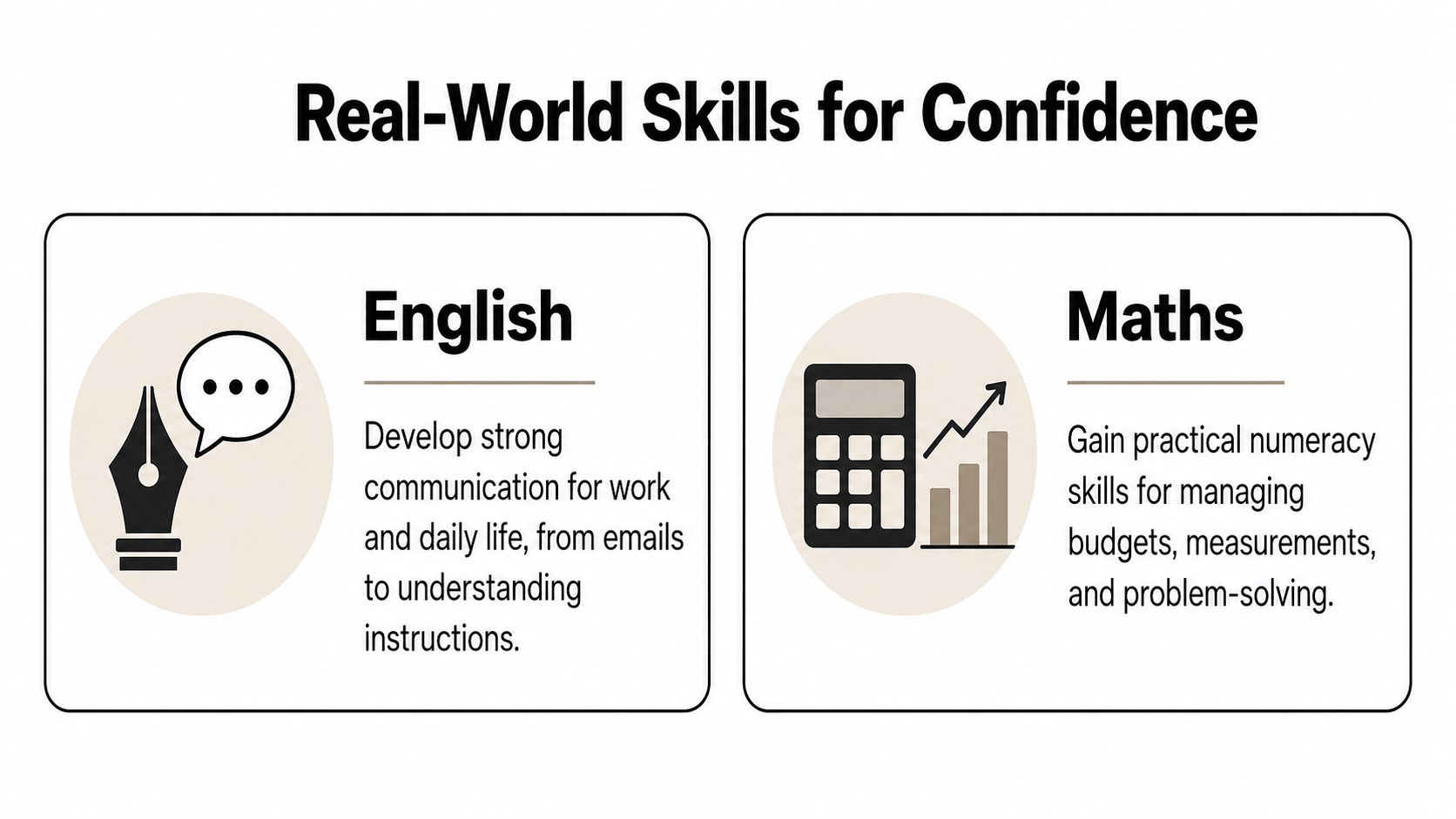
English that helps in everyday situations
In English, confidence often grows in quiet ways first. You may notice that you understand letters more easily. You may read instructions once instead of three times. You may write a message or email and feel happier pressing send.
That matters at home and at work.
A parent might read a school letter and understand exactly what action is needed. Someone at work might write a clearer message to a manager or customer. Another learner may finally feel able to explain their thoughts without worrying they'll “get it wrong”.
Here are some everyday wins English can support:
- Reading with less stress: understanding forms, appointment letters, rotas, and notices.
- Writing more clearly: filling in applications, sending emails, or replying to messages with confidence.
- Speaking up: sharing ideas, asking questions, and feeling more comfortable in conversations.
Maths that feels useful straight away
Maths worries many adults, especially if they had a hard time with it before. But Entry Level 3 maths is built around practical skills. The curriculum covers clear milestones such as counting, reading, writing, ordering and comparing numbers up to 1,000, and adding or subtracting three-digit whole numbers, as shown in this Entry Level 3 maths skill plan.
Those skills connect directly to daily tasks.
You might use them when checking a shopping total, working out if your change is right, reading a payslip, or planning a household budget. You may also notice a difference when helping your child with homework because numbers no longer feel like an instant wall.
A few examples make it clearer:
| Everyday moment | Skill you may use |
|---|---|
| Checking the weekly shop | adding totals and comparing prices |
| Looking at your wages | reading figures and spotting if something looks wrong |
| Planning bills | subtracting amounts and keeping track of money |
| Helping at home | reading numbers and explaining simple maths steps |
If you want to explore a wider route into this subject, these online Functional Skills maths options show how adults often build confidence step by step.
Many adults don't need “more maths”. They need maths taught in a way that feels useful and calm.
Confidence grows outside the lesson too
The change becomes emotional as well as practical.
You stop feeling like the person who always has to ask for help. You start becoming the person who understands the bill, reads the instructions, and checks the numbers. That shift can be powerful in a family home.
Children notice these things. They notice when you keep going. They notice when you study. They notice when you believe in yourself a little more. Functional Skills Entry Level 3 can be the beginning of that change.
A New Way to Show What You Know
For many adults, the word exam brings back old fear. Sweaty hands. Blank minds. The feeling that one bad day defines everything. That's why it helps to see Functional Skills assessments differently.
These assessments are there to let you show what you can do. They are not there to catch you out.
Practical, not packed with tricks
At Entry Level 3, assessment focuses on practical ability. In English, that means areas such as reading and writing, and there is no coursework to keep chasing in the background. According to the NCFE qualification page for Entry Level 3 English, Functional Skills Entry Level 3 is assessed through controlled external tests, with no coursework component, and qualifications can often be completed in around two months.
That structure can feel far less overwhelming than a course with endless assignments.
Why that helps busy adults
Coursework can be hard when you're balancing work, children, caring duties, or an unpredictable routine. It can pile up and make you feel as if you're always behind. A controlled assessment gives you a clearer target.
Instead of thinking, “I've got loads hanging over me,” you can focus on learning the skill, practising it, and then showing it.
Some learners find reassurance in these points:
- Clear focus: you know what skills you are working towards.
- No coursework backlog: you're not carrying unfinished written tasks for months.
- Real-life relevance: the emphasis stays on what you can do.
The assessment is not asking whether you were good at school years ago. It is asking what you can do now.
You are allowed to prepare calmly
You don't need to become a different person to pass. You don't need to be naturally brilliant. You need practice, support, and time to settle into the material.
That's a healthier way to think about assessment. It becomes a checkpoint, not a judgment on your worth. For many adults, that mindset change is just as important as the qualification itself.
Your Pathway to Making Your Dreams Happen
A qualification like this may look small from the outside. In real life, it can be the first move in a much bigger story.
Many adults return to learning because they want more from life. Some want a better job. Some want to move into training, healthcare, business, education, or another field that asks for stronger English and maths. Some want to prove to themselves, and to their children, that their future isn't fixed.
The government's adult education information states that 62% of UK adult learners say career advancement is their main reason for returning to education, which shows why a foundation like Entry Level 3 matters so much on a longer journey into higher-level skills and work opportunities, as outlined in the government collection on adult education.
One step often leads to the next
Entry Level 3 can help you move forward to Level 1 and then onwards again. That pathway matters because progress becomes easier when each stage builds your confidence.
You don't have to see the whole staircase on day one. You only need to stand on the first step and keep moving.
What that pathway can look like
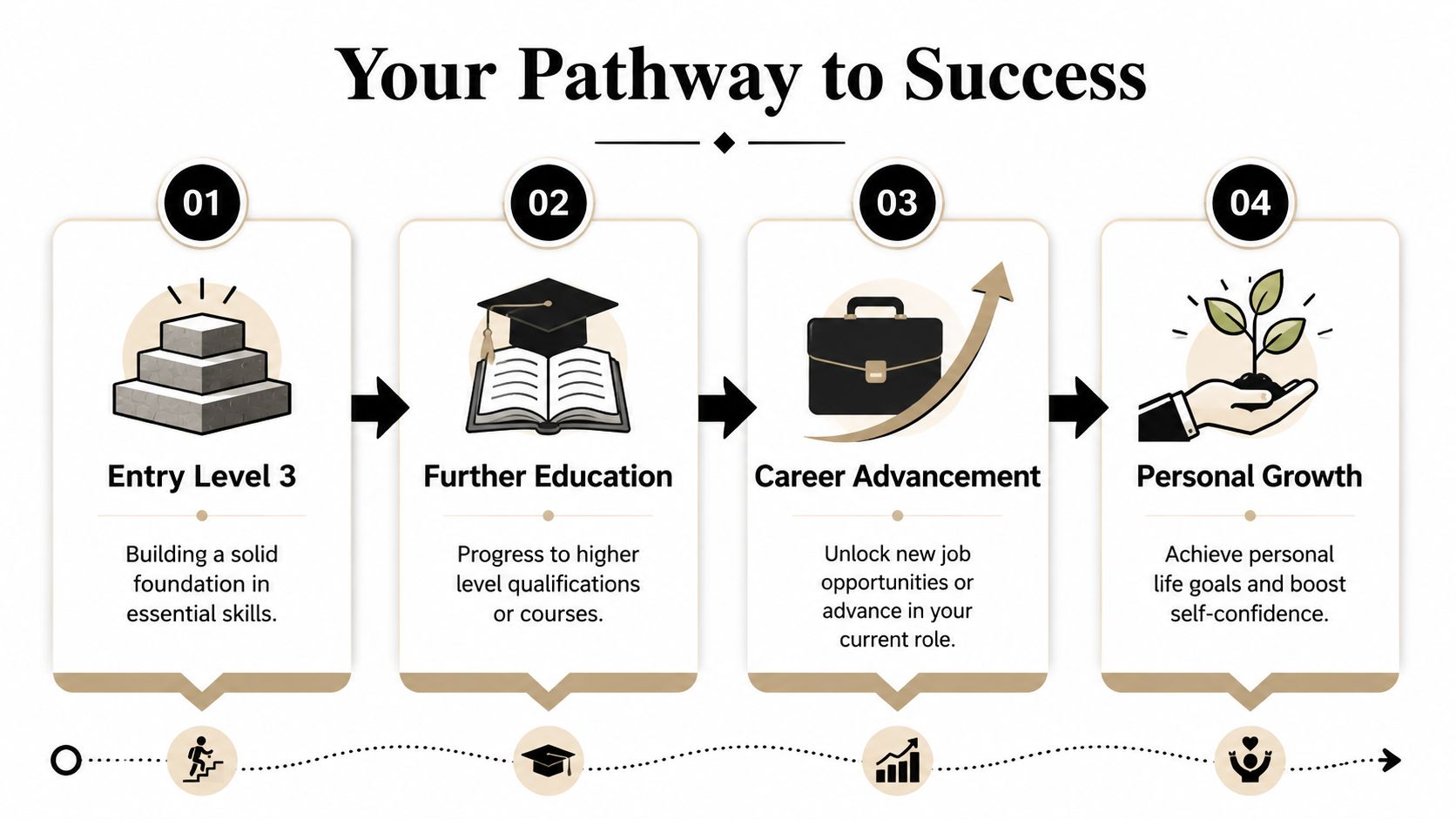
Here is a simple picture of how progress can build:
Start with Entry Level 3
You strengthen core skills and begin to feel more capable.Move into higher study
You may progress to the next level when you are ready.Open career options
Better skills can support applications, training, and workplace confidence.Grow personally
You carry that confidence into family life, goals, and future plans.
The deeper reward
There is also a kind of success that doesn't fit neatly on a certificate.
It's the moment your child sees you studying and realises learning doesn't stop at school. It's the moment you stop saying “I can't” so quickly. It's the moment you start making decisions from hope instead of fear.
Education can begin as a practical choice and become a personal turning point.
Functional Skills Entry Level 3 won't do everything by itself. But it can start a chain reaction. One completed lesson leads to one passed assessment. One passed assessment leads to one new option. Over time, your world can get larger.
That's how dreams often happen. Not in one giant leap, but in steady steps taken by ordinary people who decide not to give up.
A Simple Plan to Get You Started
Starting feels easier when you don't try to solve everything at once. You don't need the perfect study room, a free diary, or endless confidence. You need a simple plan you can stick with.
Step one, choose your reason
Pick the reason that matters most to you. Keep it personal. Maybe you want to qualify for better work. Maybe you want to help your children more confidently. Maybe you want to stop feeling embarrassed by forms, numbers, or spelling.
Write that reason down in a notebook or on your phone. Keep it where you can see it on hard days.
A strong reason helps when motivation dips. It reminds you that this isn't “just a course”. It's part of the life you're building.
Step two, make study small enough to fit real life
Busy adults often think study has to happen in long, perfect blocks. It doesn't. Short, regular sessions can work well.
Try this:
- Use small pockets of time: a quiet half hour in the evening can be enough to keep moving.
- Create one study spot: it can be one corner of the table, not a whole office.
- Tell someone you trust: support is easier to receive when people know what you're aiming for.
If you want to understand how the assessment side works, this guide to the Functional Skills test can help make the process feel more familiar.
Step three, count every small win
Adults with low confidence often wait until they've done something big before they allow themselves to feel proud. Try not to do that. Small wins matter.
Keep track of moments like these:
| Small win | Why it matters |
|---|---|
| You studied even when tired | that shows commitment |
| You understood a topic that once confused you | that shows progress |
| You asked for help | that shows strength, not weakness |
| You kept going after a bad day | that shows resilience |
Progress is not only passing. Progress is showing up again.
A calm routine beats a dramatic burst of effort. If you keep taking small actions, confidence usually follows. Not all at once, but bit by bit. And bit by bit is how real change lasts.
Study With Confidence at Next Level Online College
Choosing where to study matters, especially if you're returning to education after a long break. The right support can make the difference between feeling alone and feeling guided.
Next Level Online College is built for adult learners with real responsibilities. That means learning that fits around family life, work, and the ups and downs of ordinary weeks. It also means support from people who understand that confidence can be fragile when you first come back to study.
Support that feels human
Many adults worry they'll sign up and then be left to manage on their own. A strong online college should do the opposite. It should give you structure, help, and encouragement so that you know what to do next.
That support matters even more if learning has felt difficult in the past. Around 15% of UK adults have dyslexia, and many others face learning challenges, which is why personalized support can make such a difference, as explained by the British Dyslexia Association overview of dyslexia.
Good support can include things like:
- Clear explanations: lessons broken into manageable pieces.
- Flexible pacing: time to learn without feeling rushed.
- Helpful guidance: tutors who answer questions without making you feel silly.
- Practical strategies: approaches that suit different learning needs.
Learning around your life
One of the hardest parts of adult education is not the work itself. It's fitting study into everything else. Online learning can help because it gives you more control over when and how you learn.
That can be useful if you're:
- Working shifts
- Parenting young children
- Caring for someone
- Building confidence after years away from study
For some learners, seeing how online study works in practice helps it feel more real.
A future worth investing in
Paying for education can feel like a big decision. But many adults find it helps to think of study as an investment in the next version of their life. You are not only paying for course materials. You are backing your own future.
You are saying that your goals matter. Your confidence matters. Your family's future matters.
And if you've been putting yourself at the bottom of the list for a long time, that decision can be powerful all by itself.
If you're ready to take that first brave step, Next Level Online College offers flexible, fully supported study designed for adult learners who want a real chance to move forward. You don't need to have all the answers before you begin. You just need a starting point, and this could be yours.