
You may be looking at a maths course page with a nervous feeling in your stomach. Perhaps you left school years ago, struggled with numbers, or worry that studying will take time away from your children and work. You might also be thinking about a better job, a new career, or eventually reaching university, but feel that maths is standing in the way.
Functional Skills Maths Entry Level 3 gives you a practical place to begin. It isn't a judgement on your ability. It's a nationally regulated qualification that helps you rebuild everyday numeracy, grow your confidence, and prepare for the next step. With patient support and regular practice, you can prove to yourself and your family that returning to education is possible.
What Functional Skills Maths Entry Level 3 Really Means for You
You're not starting from behind. You're beginning at a point calibrated for where you are now, with practical maths that can lead towards Level 1, GCSE study, work, or further education. Functional Skills Maths Entry Level 3 belongs to England's nationally regulated Functional Skills framework, so it follows defined standards rather than functioning as an informal revision class. The government subject content sets out skills including whole numbers, fractions, decimals, calculations, rounding, data, and probability. You can read the official Functional Skills maths subject content for the full standard.
A household bill, supermarket comparison, recipe measurement, or weekly budget can become a useful maths exercise. These familiar tasks use the number sense the qualification develops. You may already be practising some of these skills without recognising their value.
A genuine starting point, not a label
You do not need a perfect school record to begin. A regulated provider records Entry Level 3 Functional Skills maths as an open-entry qualification with no prior-entry requirements and no minimum age requirement for registration. The NCFE Entry Level 3 Functional Skills mathematics qualification record confirms this accessible starting point.
That flexibility matters when you are returning after a long break from education. Shifts, caring responsibilities, health needs, and home life can all affect when and how you study. An open-entry course lets you begin with the knowledge you have, instead of expecting you to arrive already confident.

Your next step can change how you see yourself
Entry Level 3 is the highest of the entry levels, before Level 1. It works as a bridge between everyday numeracy and more advanced study or workplace maths. Reaching it gives you a clear achievement to build on, whether your next goal is Level 1, a vocational course, or training for a role such as a teaching assistant.
Children often notice when a parent returns to learning. They see an adult ask questions, make mistakes, practise, and keep going. That example can make education feel possible in everyday family life, even if maths has caused anxiety in the past.
Remember: needing help with maths does not mean you lack ability. It may mean you have not yet found a learning approach that makes sense to you.
The qualification also appears within government-funded routes for different learner groups. The NCFE qualification record shows approval for age 14–16, age 16–19, and legal entitlement English and maths funding routes from 1 September 2019 to 31 July 2026. This helps explain its presence across school, college, adult learning, and employment pathways.
The Topics You Will Cover and Why They Matter
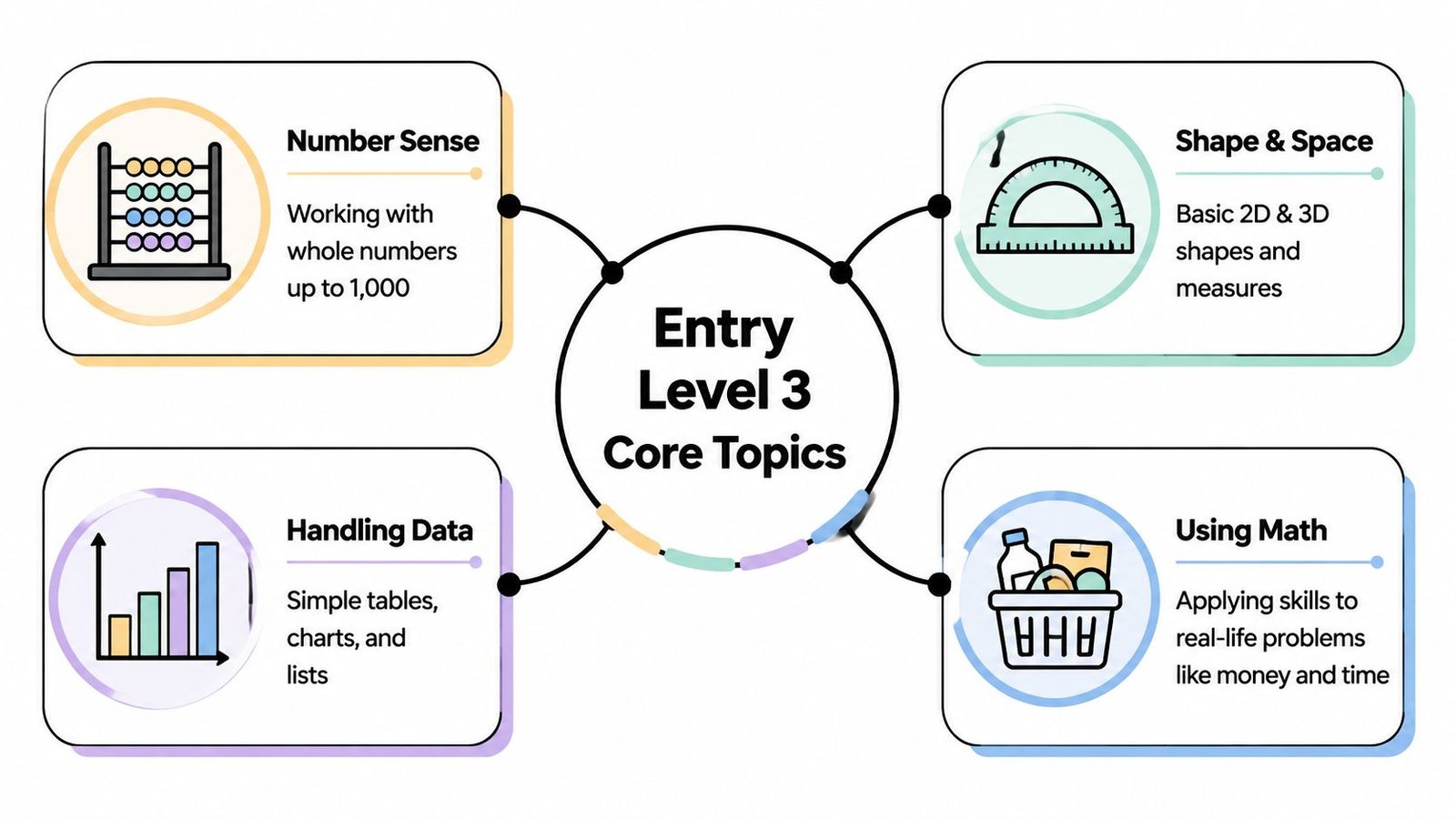
The maths content becomes less frightening when you connect each topic to something you already do. The official standard expects Entry Level 3 learners to use numbers and data in practical situations, rather than repeat rules without understanding their purpose.
Number skills for everyday decisions
You'll work with whole numbers, fractions, and decimals up to 1,000. This includes counting, reading, writing, ordering, and comparing numbers. For example, you might decide whether £185 is enough for a set of planned costs, compare two prices, or identify which amount is larger.
The standard also includes:
- Addition and subtraction: You'll add and subtract three-digit whole numbers, useful for combining bills or checking how much money remains.
- Multiplication: You'll multiply two-digit numbers, which can help when calculating the cost of several identical items.
- Division: You'll divide three-digit whole numbers by single-digit and double-digit numbers, including expressing remainders. This can support tasks such as sharing quantities or working out how many complete groups you can make.
- Fractions and decimals: You'll handle common forms of numbers that appear in recipes, measurements, prices, and workplace instructions.
- Rounding: You'll use rounding to check whether an answer is sensible. If your total looks very different from a rough estimate, rounding can help you spot an error.
Information and data you can understand
You'll learn to extract information from tables and charts. A bus timetable, payslip, rota, or household spending record can all present information in a structured form. The skill is not only reading a number, but finding the detail you need and using it correctly.
You'll also make comparisons, record changes, and find the mean and range. The mean is an average, while the range shows the difference between the smallest and largest values. These ideas can help you understand working hours, spending patterns, or results in a simple workplace record.
Probability and sensible thinking
Entry Level 3 includes understanding probability on a 0-to-1 scale. You'll consider how likely an event is, from impossible through to certain. You don't need complicated theory to use this idea. Checking whether something is likely, unlikely, or certain is part of making everyday decisions.
The most helpful habit is to ask, “What is this number telling me?” Maths becomes more useful when you connect the calculation to a decision. A correct answer is important, but understanding what it means is what makes the skill practical.
How the Assessment Works and What You Need to Pass
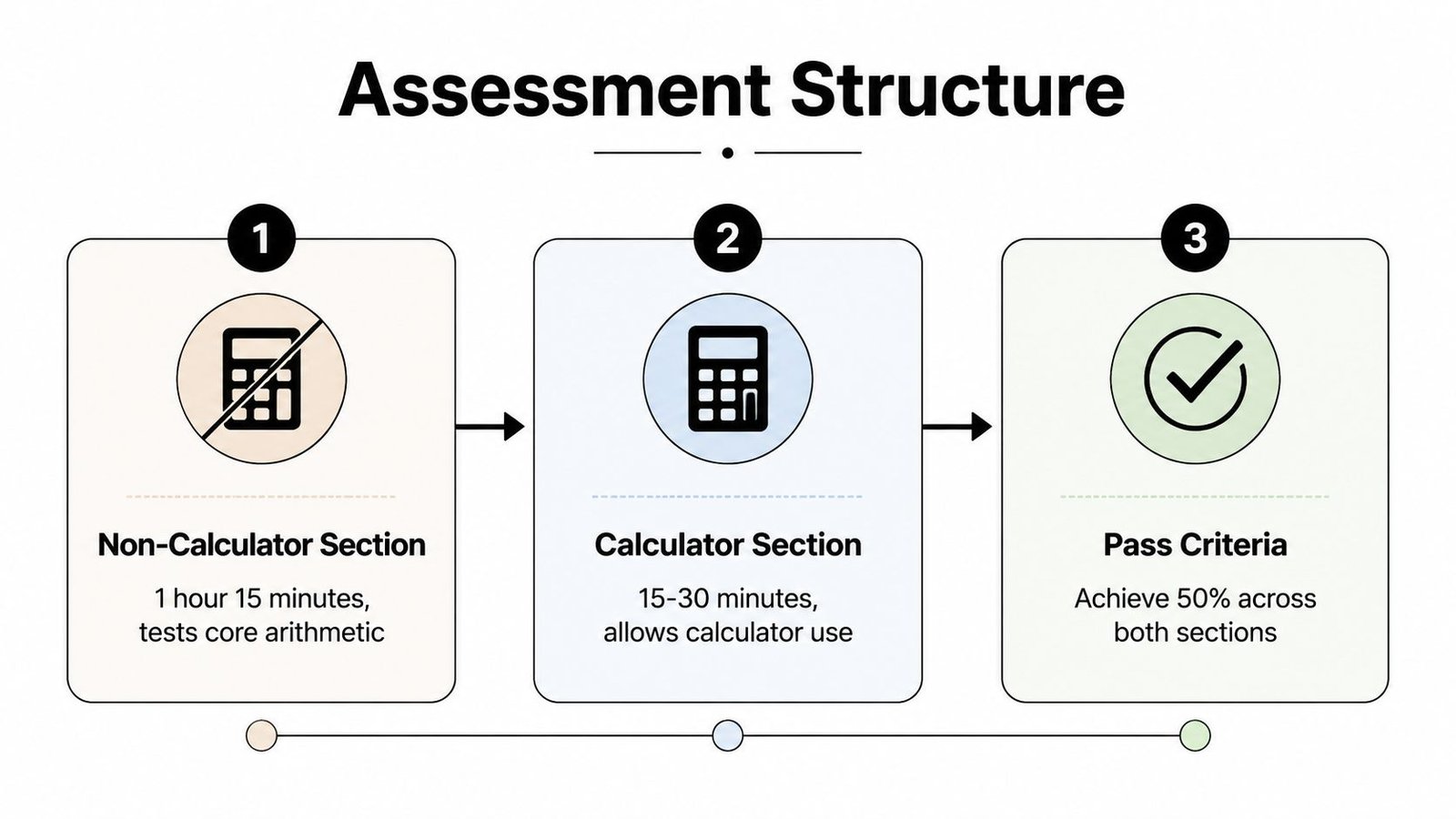
Walking into an assessment feels easier when you know what will happen first. At Entry Level 3, the total assessment time must be no less than 1 hour 15 minutes and no more than 1 hour 45 minutes, according to the government Functional Skills mathematics conditions and requirements. This nationally regulated structure gives you a clear target as you build confidence for Level 1, further study, and work.
The assessment includes calculator and non-calculator work. Some awarding organisation specifications show an entry-level split of 25% non-calculator and 75% calculator, followed by one pass or fail result for the whole qualification. Check the specification used by your awarding organisation, since arrangements can vary.
What the two parts test
The non-calculator section checks whether you can handle core arithmetic without a device. You may need to show that you understand the numbers and can complete straightforward calculations carefully.
The calculator section provides support for questions where the harder step is selecting the correct operation, reading information, and applying your answer to a situation. A calculator cannot decide whether you should add, subtract, multiply, or divide, so practise the calculation and the decision behind it.
Practical rule: Read the whole question before touching the calculator. Underline the information you need, identify what the question asks, and then choose the operation.
What pass or fail means
Entry Level 3 awards a single pass or fail result for the whole qualification, removing the pressure of chasing letter or number grades. Your preparation should focus on using the required skills accurately across the assessment.
Practise in calm conditions before assessment day. Try timed questions, check each answer, and record the type of mistake you made. A Functional Skills maths test resource can help you recognise question styles and choose preparation that supports steady progress. Each practice session gives you another chance to replace numeracy anxiety with evidence that you can manage the task. That growing confidence can support your next qualification and show your family that progress remains possible at any stage.
Entry Level 3 Compared to Level 1 and GCSE Maths
A parent returning to study after years away from the classroom may need a qualification that restores confidence before a larger exam becomes realistic. Entry Level 3, Level 1, and GCSE maths serve different points in that journey. Entry Level 3 develops nationally regulated foundation skills, Level 1 extends practical competence, and GCSE follows a broader academic programme.
| Feature | Entry Level 3 | Level 1 | GCSE |
|---|---|---|---|
| Place in the pathway | Highest entry level and a bridge towards Level 1 | A step above entry level, with greater depth | A wider academic qualification with formal GCSE assessment |
| Main focus | Practical number work, fractions, decimals, calculations, data, and probability | More demanding application of maths in practical contexts | Broader mathematical knowledge, including academic concepts and exam methods |
| Typical learner need | Rebuilding confidence or strengthening essential numeracy | Developing work-ready skills after entry-level study | Preparing for GCSE outcomes, further study, or requirements that specifically name GCSE |
| Assessment feel | Practical tasks with one pass or fail result | More complex practical questions | Formal GCSE papers and a wider course of study |
| Progression purpose | Prepare for Level 1, further training, and stronger everyday numeracy | Support progression towards Level 2 or other study | Meet requirements for courses, training, employment, or higher education where GCSE is requested |
Rather than competing with GCSE maths, Entry Level 3 fills a distinct role. It gives learners practice with practical numeracy before they face a wider curriculum, while providing a nationally defined target instead of an informal “basic maths” class.
The qualification includes clearly specified skills, such as working with three-digit operations and numbers up to 1,000. These boundaries help tutors plan lessons and help learners recognise what progress looks like. For an adult who has avoided maths because of difficult school memories, that clarity can make study feel manageable.
Level 1 is often the next suitable target for learners who can apply those skills with greater independence. Someone preparing for an apprenticeship may need to check whether the provider asks for Functional Skills at a particular level. Another learner may need Level 2 or GCSE for a college course, job, or university plan. Requirements vary, so check the exact entry conditions before enrolling. The guide to Functional Skills qualifications and their relationship to GCSE can help you compare the qualifications and prepare useful questions for a provider.
The route should match your starting point and your goal. Progressing through Entry Level 3 can help you approach Level 1 with stronger habits, clearer understanding, and less fear of making mistakes. It can also give families a visible example of persistence, showing children that learning remains possible at any stage.
Study Strategies That Build Confidence and Beat Maths Anxiety
Maths anxiety can make a simple question look impossible. Your mind may go blank, your hands may feel tense, or an old memory from school may tell you that you “aren't a maths person”. That feeling is real, but it isn't proof of your ability.
Begin with short study periods that fit your life. You might study after the school run, during a quiet break at work, or while your family is settling for the evening. A small, regular routine is easier to protect than a large plan that leaves you exhausted.
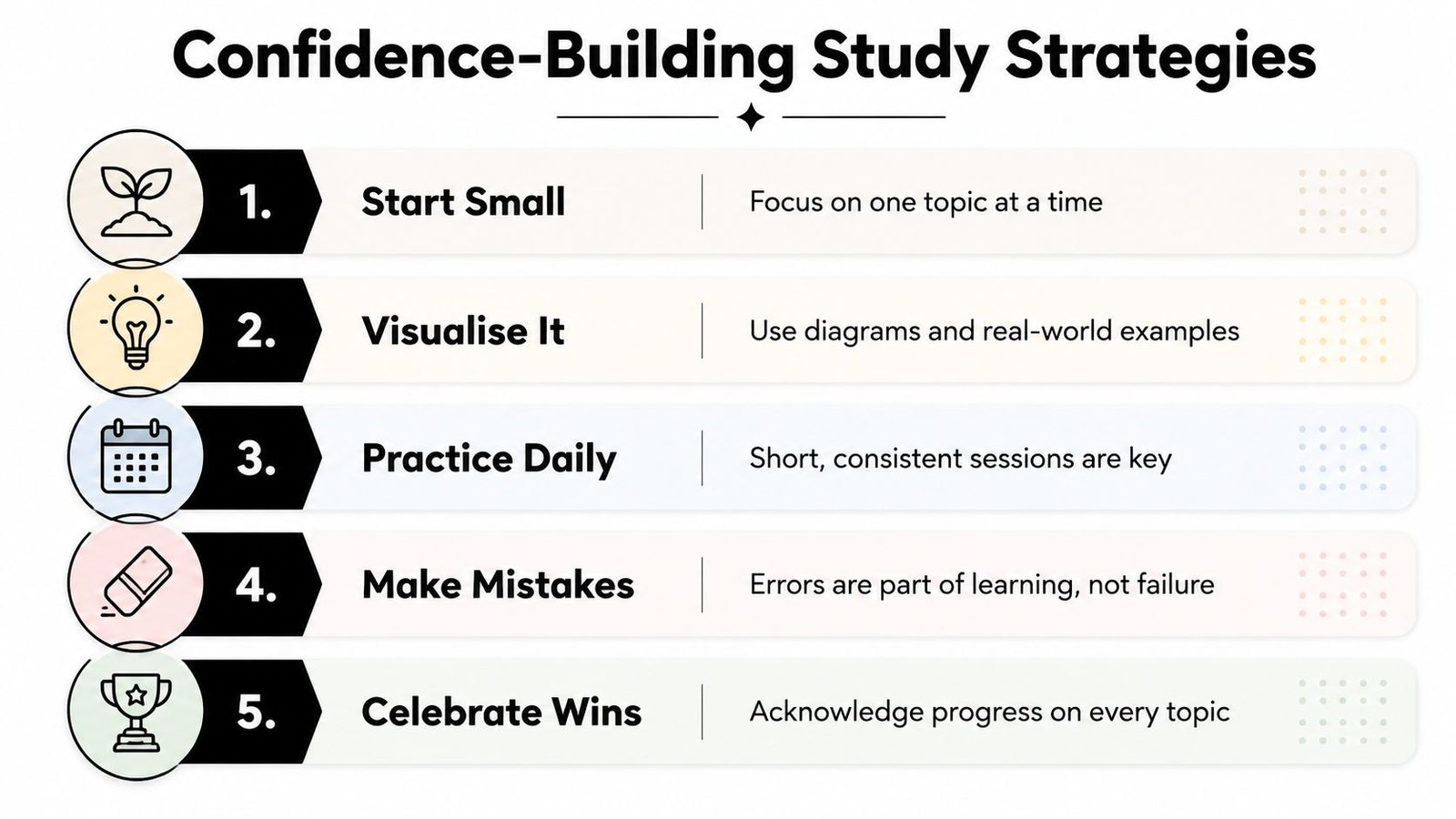
Five habits that make learning feel safer
- Start with one small target. Work on comparing numbers, then move to addition, rather than trying to revise the whole syllabus in one sitting.
- Use objects and pictures. Draw a number line, group coins, sketch a table, or use household items to make the question visible.
- Practise a little and often. Repeating a skill helps you recognise familiar patterns without forcing you to memorise everything at once.
- Keep an error notebook. Write the question, your answer, the correct method, and what confused you. This turns a mistake into a useful instruction.
- Celebrate evidence of progress. Completing a question you once avoided is an achievement. Tell your children what you learned, and let them see you keep going.
Replace fear with a repeatable method
For a money question, circle the prices, underline the question, estimate the answer, calculate it, and then check whether the result makes sense. Use the same sequence each time. A reliable method reduces the pressure of deciding what to do next.
Active learning can also help you remember more effectively. Active learning strategies for adult students include approaches that ask you to do something with the information, rather than only reading it. Explain a calculation aloud, create your own example, or teach the method to a family member.
This short video may also give you another way to think about building confidence while learning:
You don't need to feel confident before you start. Confidence often arrives after you collect several small successes.
Ask for help early. A tutor can show you a different method, slow down the explanation, or help you identify whether the difficulty is with the calculation, the wording, or exam nerves. That support can protect your motivation while you build independence.
How Next Level Online College Supports Your Journey
Returning to study is easier when the course fits your real life. Next Level Online College is a UK-based online provider offering flexible, supported study for adult learners. It is part of the Cambridge Online Education Ltd group, which has over 25 years of experience supporting adult returners to education.
The provider offers recognised and regulated qualifications, including Functional Skills maths and English, GCSEs, A Levels, and Access to Higher Education diplomas. Its online format is intended for people managing work, family, and other responsibilities, so you can access learning without travelling to a college campus for every session.
Support that covers learning and wellbeing
A useful course should give you more than a list of modules. Adult learners may need help understanding a maths method, planning study time, preparing for assessment, or staying motivated after a difficult week.
Available support includes:
- Academic guidance: Subject specialists can help you understand course content and practise the skills required for assessment.
- Pastoral support: Mentors and wellbeing advisers can support the wider challenges that affect your study routine.
- Flexible access: Online materials allow you to organise learning around your existing responsibilities.
- Progression planning: You can explore routes towards Level 1, GCSE, Access to Higher Education, university, or career development.
- Financial planning: Finance options and competitive pricing may help you consider study within your circumstances.
The important question isn't whether online learning is automatically right for everyone. Ask whether the provider explains the qualification clearly, offers suitable assessment preparation, and gives you a way to ask for help when you're stuck. You should also confirm the awarding partner, entry conditions, course inclusions, and assessment arrangements before enrolment.
A clear route from enrolment to achievement
Begin by assessing your current skill level and your intended goal. If Entry Level 3 is the appropriate starting point, select a course that aligns with the national content, provides structured practice, and outlines the assessment process. Establish a regular weekly schedule, apply feedback from your tutor, and revisit challenging topics rather than avoiding them.
For a parent, this journey can carry a special meaning. Each completed activity says, “I can learn something new.” Each revision session shows your children that education doesn't belong only to the young. It belongs to anyone ready to take the next step.
Answers to Your Most Common Questions
Is Entry Level 3 recognised?
It is part of the regulated Functional Skills framework in England, with nationally defined subject content. Funding records also show approved routes for different age groups and legal entitlement English and maths funding. Employers and training providers may set their own requirements, so check whether they ask for Entry Level 3, Level 1, Level 2, GCSE maths, or another specific qualification.
Can it help me reach university?
Entry Level 3 is a foundation rather than a general university entry qualification. It can help you prepare for further study, but you may need to progress to a higher qualification, such as Level 1, Level 2, GCSE maths, or an Access to Higher Education route. Always check the exact entry conditions for the course and university you have in mind.
How long does it take?
There isn't one completion time that suits every learner. One major regulated provider lists 55 Guided Learning Hours for a combined Entry Level 1, 2, and 3 mathematics qualification family, but your personal schedule, starting point, support needs, and course structure will affect how long study takes. Treat the figure as guided learning information, not a promise about your total calendar time.
Can I study online?
Online study can suit adults who need to learn around work and family. Before joining, check how lessons, tutor support, practice activities, and assessment are delivered. You should know whether the final assessment is online, centre-based, or arranged through a particular awarding organisation.
What happens if I don't pass?
A first result doesn't define your ability. Ask the provider how feedback works, whether you can review the topics that caused difficulty, and what the arrangements are for another assessment attempt. Use the experience to adjust your preparation, especially if anxiety, question wording, or one particular skill caused problems.
Does Entry Level 3 remain useful for apprenticeships?
Apprenticeship rules changed for adults aged 19 and over starting apprenticeships. They are no longer required to pass English and maths qualifications, although funding can still support those studies. Entry Level 3 may still be strategically useful if you want to strengthen your numeracy, prepare for progression, meet an employer's expectations, or continue towards a higher qualification. Check the current requirements for your apprenticeship and employer.
You aren't choosing a number on a page. You're choosing a chance to rebuild a skill, open a route forward, and show your family what determined learning looks like. Start with the support you need, take each topic in order, and let steady progress replace the fear you carried from the past.
Next Level Online College offers flexible online Functional Skills maths support covering Entry Level 3 content, with academic and pastoral guidance for adult learners. Visit Next Level Online College to explore the course pathway and take the first practical step towards stronger numeracy and future study.