
You're folding laundry after a long shift when a job advert catches your eye. The role sounds right, the pay would help, and then you see the quiet requirement: GCSE maths. For a moment, an old school memory returns. Perhaps you left with a U or F, misplaced your certificate, or never sat the exam at all.
That memory doesn't decide what you can do now. Adult learners return to maths for work, university, apprenticeships, family goals and personal pride. You may be studying between school runs, after bedtime, or on a bus with your phone balanced on your knee. The route needs to fit your life, not pretend you've got unlimited time.
GCSE maths courses can help you choose the right qualification, understand the exam, arrange funding and build confidence one skill at a time. By the end of this guide, you'll know what to look for and what you can do next.
A New Beginning With GCSE Maths
Maya had avoided maths for years. She could manage household bills, compare supermarket prices and work out how long it would take to get to work, but the word “algebra” still made her feel twelve again. When a nursing application asked for GCSE maths, she nearly closed the page.
She also had a reason to keep reading. Her children were beginning to ask for help with homework, and she wanted them to see that learning doesn't stop when school ends. A qualification could support her application, improve her confidence and show her family that a difficult subject can be faced rather than feared.
That's a common starting point. Adults often know more practical maths than they give themselves credit for. You've already used estimation, percentages, measurements, time and money in real situations. A course helps you organise that knowledge and learn the exam methods that awarding bodies expect.
The qualification can open doors
GCSE maths remains an important progression qualification in England. In 2026, nearly 700,000 16-year-olds sat GCSEs in England, and 57.2% of all students achieved grade 4 or above in maths. Among 16-year-olds, the grade 4-or-above figure was 71.8%, while 22.3% achieved grade 7 or above, with boys at 24% and girls at 20.5% for the top grades. (BBC coverage of the 2026 GCSE results)
Those figures describe a national exam, not your ability. They also show why the qualification matters to people returning later. GCSE English and maths by age 19 remains a national education indicator, tracked across academic years from 2016/17 to 2024/25. (UK government GCSE statistics)
You might need the qualification for a university application, a nursing route, teaching, policing, an apprenticeship or a promotion. You might want to earn more, move into a fulfilling career or become the person your children see making a brave new start.
Small steps count
You don't need to feel ready before you enrol. You need a clear route, realistic support and enough time to practise. The right provider will help you understand the course, exam entry, tier choice and study expectations before you commit.
A useful starting point: don't ask, “Am I naturally good at maths?” Ask, “What do I need to practise next?”
The pages ahead deal with the practical questions that often cause worry. You'll see how the course works, how Foundation and Higher differ, which study format may suit your week, what funding to check and how to revise without giving up your evenings or your family time.
What a GCSE Maths Course Really Is
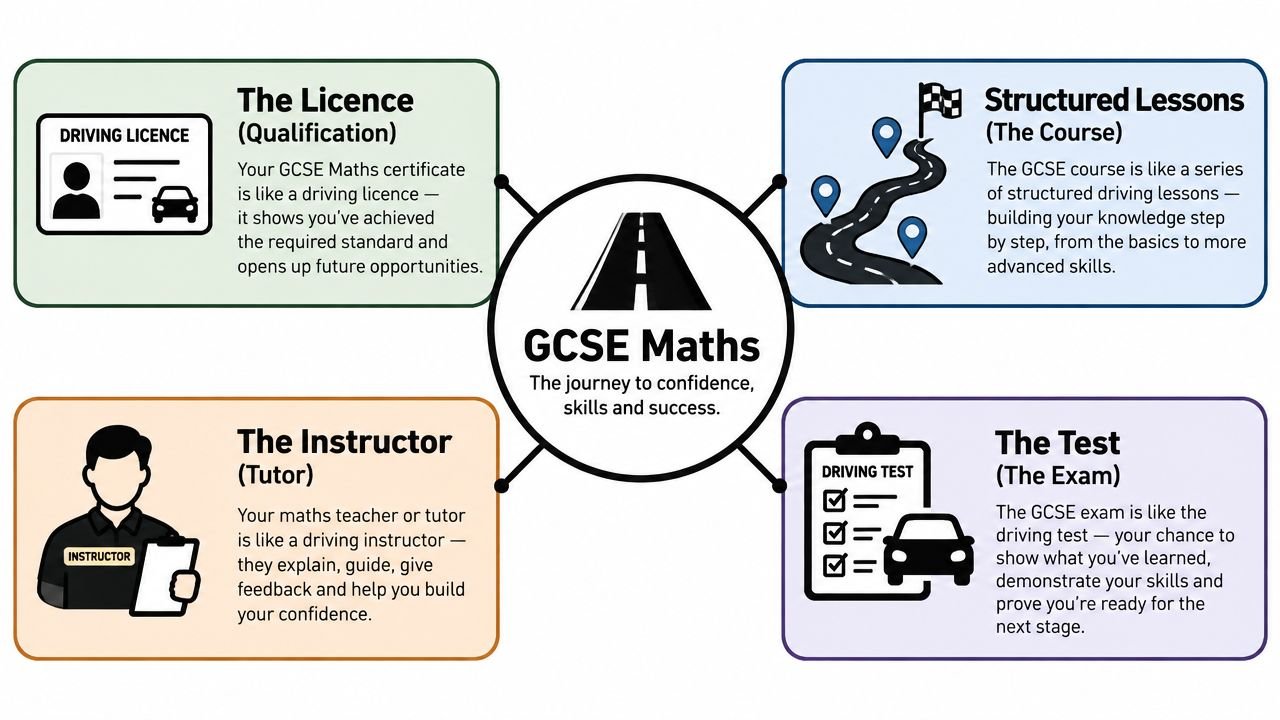
Think about learning to drive. The qualification is the licence. The course is the set of lessons that takes you from uncertainty to control. Your tutor is the instructor, showing you safe methods and correcting mistakes. The exam is the test that checks whether you can use those skills independently.
A GCSE maths course follows the same pattern. You study number, algebra, ratio, geometry, probability and statistics. You practise questions, learn how marks are awarded and prepare for formal papers. The result proves that you've reached a recognised standard of maths for employment, apprenticeships, further study and everyday decisions.
The two tiers
GCSE Mathematics in England has two tiers:
- Foundation tier: grades 1 to 5.
- Higher tier: grades 4 to 9.
The tier you enter affects the questions you'll see and the grades available to you. Foundation gives you a clear route towards grade 4 or 5, while Higher allows access to the full grade range but includes more demanding algebra, reasoning and problem-solving.
Grade 4 is commonly treated as the standard pass. Grade 5 is often called a strong pass and may be preferred by some employers, sixth forms or course providers. Always check the exact requirement for the next step you want, because an entry rule may ask for a particular grade or tier.
What adult teaching feels like
Adult GCSE maths courses usually focus on the content you need, rather than recreating every part of school life. Teaching is often direct and practical. A tutor might explain percentages through wages and discounts, ratio through recipes or construction measurements, and graphs through travel, energy use or household spending.
The qualification is one subject, even though it covers many areas. Adult providers may organise it over an academic year, with an autumn or summer examination route. Some centres also support a November sitting, depending on their arrangements and the awarding body.
You're allowed to ask why a method works. You can say that a step doesn't make sense. You can bring a real example from work or home and use it to make the maths clearer. That adult experience is useful. You aren't starting with nothing, and you don't have to hide the gaps you've carried for years.
Course Types and Which One Suits You
The best route depends on the door you're trying to open. A university course may insist on GCSE maths, while an employer or apprenticeship may accept Functional Skills Level 2. An Access to Higher Education course can provide a broader bridge when you're aiming for university without the usual collection of school qualifications.
Before you enrol, write down the exact job, apprenticeship or degree you want. Then check its entry requirements directly. A shorter qualification isn't automatically the wrong choice, but it may not meet a particular university or teacher-training requirement.
A clear comparison
| Route | Typical Study Hours | Typical Duration | Employer & University Acceptance | Best For |
|---|---|---|---|---|
| GCSE maths | Varies by provider and starting point | Often one academic year for adults | Broadly recognised by employers, universities and apprenticeship providers, subject to individual entry rules | Learners who need the traditional qualification for work, higher education or progression |
| Functional Skills Level 2 maths | Varies by provider and existing skills | Often shorter than a GCSE route | Accepted by many employers and apprenticeship schemes, but not every university or PGCE course | Learners who need practical maths or want a confidence-building route |
| Access to Higher Education | Varies by diploma and subject | Usually longer than a short standalone maths course | Designed as a progression route to university, with requirements set by the chosen institution | Adults without traditional qualifications who want a structured university pathway |
GCSE maths is the broadest option when you're unsure what future applications may require. It's also the route most likely to help if a course specifically says “GCSE maths at grade 4 or above”.
Functional Skills Level 2 can suit someone who needs a practical qualification for work or an apprenticeship. It may also help you rebuild study habits before taking GCSE maths later. That two-stage route can feel less frightening if school maths left you anxious.
Access courses are different. They usually combine preparation for higher education with a subject area such as health, social care or humanities. The maths requirement may be built into the course, but you must check whether the university you want accepts that route for your chosen degree.
Before paying for a course: ask the admissions team, “Will this exact qualification and grade meet the requirement for my intended destination?”
For a closer look at the options available to adult learners, explore these adult maths courses. Make a note of the awarding body, exam route, support included and whether the provider enters you for the exam. Those details matter when you're balancing study with work and childcare.
How the Exam and Tiers Actually Work
The exam becomes less mysterious once you can see its shape. GCSE Mathematics in England has three externally assessed papers. Each paper is worth 80 marks, and each contributes one third of the qualification. One paper is non-calculator, while two papers allow a calculator. The combined scaled total is based on 240 marks. (AQA GCSE Mathematics specification)
For the standard tier structure, each paper lasts 1 hour 30 minutes, so the assessment takes 4 hours 30 minutes in total. You take all three papers at the same tier, either Foundation or Higher. (LearnDirect explanation of GCSE university entry requirements)
The papers at a glance
| Paper | Duration | Calculator | Tier Coverage |
|---|---|---|---|
| Paper 1 | 1 hour 30 minutes | No | Foundation or Higher |
| Paper 2 | 1 hour 30 minutes | Yes | Foundation or Higher |
| Paper 3 | 1 hour 30 minutes | Yes | Foundation or Higher |
The non-calculator paper doesn't mean you need to do everything in your head. You'll still have working space, and clear written steps can earn method marks. The calculator papers test whether you can choose sensible operations, enter them correctly and interpret the answer.
Choosing Foundation or Higher
Foundation covers grades 1 to 5. Higher covers grades 4 to 9. That means Foundation has a maximum grade of 5, while Higher can lead to grade 9, but Higher questions are more challenging and a grade 4 is not guaranteed because you enter that tier.
Your tutor should use a starting assessment, your target course requirements and your practice performance to guide the decision. Don't choose Higher because it sounds more impressive. Don't choose Foundation because you're embarrassed about your past. Choose the tier that gives you a realistic route to the grade you need.
The specification also gives different topic weightings to each tier. On Foundation, the balance is roughly 25% Number, 20% Algebra, 25% Ratio, 15% Geometry, and 15% Probability and Statistics. On Higher, Algebra carries roughly 30% and Geometry 20%, with the remaining content balanced across the other areas. (AQA GCSE Mathematics specification)
Marks and grades
Awarding bodies set grade boundaries after examining the papers. A raw mark is the number of marks you earn, while the grade boundary is the mark needed for a particular grade in that exam series.
For example, if you earned 120 marks across the three papers, that would be your raw total. You wouldn't know the grade from that number alone, because the boundary depends on the tier, awarding body and difficulty of the papers. Your results statement gives the final grade, and your provider can explain how the boundary worked for your series.
You can read a plain-language guide to what GCSE grades mean if the grading language feels unfamiliar. Results day can feel tense, but it's also a clear point of progress. Whatever the result, your tutor can help you understand the next step rather than leaving you to decode it alone.
Study Formats, Timelines and a Weekly Rhythm
A course can be excellent on paper and still be wrong for your week. If you work shifts, care for children or share a busy home, the important question isn't only how the lessons are taught. It's whether you can attend, catch up and ask for help when Tuesday goes wrong.
Four ways to study
In-person college classes give you a fixed routine and face-to-face contact. They suit learners who concentrate best outside the home, though travel and set timetables can make attendance difficult.
Online live lessons provide scheduled teaching through video. You can ask questions in real time and study from home, which helps when the school run or a late shift makes travel hard. Check whether recordings are available if you miss a session.
Fully self-paced platforms let you choose when to watch lessons and complete tasks. This flexibility can work well around irregular hours, but you'll need a plan and a way to contact a tutor. A long list of unwatched lessons can become stressful if nobody helps you reset.
Blended learning combines live teaching, recorded material, independent practice and tutor feedback. It can offer structure without making every study moment depend on a classroom timetable.
A complete beginner may need 6 to 12 months, while a confident resitter may manage 3 to 6 months, depending on starting knowledge, course intensity and exam timing. Those are planning ranges, not promises. A provider should assess your skills before telling you what pace is sensible.
A week that leaves room to breathe
Suppose you work around 30 hours a week and have children at home. Your plan might look like this:
- Tuesday evening: 45 to 60 minutes of a lesson and guided questions.
- Thursday evening: 45 to 60 minutes revisiting the difficult examples.
- Saturday morning: a longer block for a topic exercise or part of a past paper.
- Commute moments: ten minutes reviewing formulae, vocabulary or mistake notes.
- One protected rest day: no guilt, no catching up, just recovery.
You don't need to copy this timetable. The principle is to create regular contact with maths while protecting your energy. Two short sessions are often easier to keep than one large promise that never survives a busy week.
Ask about attendance rules, recordings, tutor messaging, marking times and wellbeing support before enrolling. If your child is ill or your shift changes, tell the provider early. A good study plan includes a recovery route, not just an ideal week.
For more guidance on balancing flexibility with recognised assessment, read whether you can do GCSE maths online. Choose the format that helps you return after interruption, because consistency matters more than perfection.
Costs, Funding and Your Next Steps
The price of GCSE maths courses can vary widely. Some college places may be free for eligible learners, while self-funded online packages may cost between £400 and £900. (LearnDirect course and entry guidance)
The figure on the course page isn't the whole decision. Ask whether it includes teaching, tutor support, assessment, exam entry, books and resit advice. A cheaper course may leave you paying separate exam fees, while a higher upfront price may include more of the support you need.
Funding may be possible
Fully funded study is often linked to your existing qualifications and personal circumstances. You may have a stronger chance if you don't already hold a grade C or 4, receive certain benefits, or are aged 19 to 23 without a full Level 2 qualification. Rules vary, so a local college or provider must confirm your eligibility.
This is especially important for adults who are unsure about enrolling at all. Official further-education data recorded adult maths participation falling 27.0% year on year, from 200,620 to 146,390, while adult essential-skills participation fell 14.8%. (Further Education and Skills statistics for 2025/26) The figures don't tell us why every person delayed study, but they underline the value of turning interest into a direct funding conversation.
A practical enrolment checklist
- Write down your target. Name the job, apprenticeship, university course or personal reason.
- Check the entry rule. Confirm the qualification, grade and awarding body accepted.
- Contact a local college. Ask about funding, start dates and exam entry.
- Compare two or three providers. Look at lesson access, tutor contact, recordings and total costs.
- Book a taster or assessment. Find out whether Foundation or Higher is realistic.
- Ask about deadlines. Exam entries and course intakes may close before you expect.
- Plan your first study week. Put sessions in your calendar before motivation fades.
You're not being difficult by asking questions about money. You're protecting your family budget and making sure the route is manageable. If one provider says no, that's information, not a judgement on your ability.
Revision Tips That Build Confidence
Revision isn't a punishment you save for the final week. It's rehearsal. Each short practice session gives your brain another chance to recognise a method, spot a pattern and stay calm when a question looks unfamiliar.
Adult resit learners often face a threshold problem. In summer 2026, 15.3% of candidates aged 17 and over achieved grade 4 or above in GCSE maths, down from 17.1% in 2025, across 219,135 entries. (Sector analysis of GCSE and A level outcomes in 2026) A Royal Society briefing has also stated that 18% of all resit entrants nationally attain a grade 4. (Royal Society briefing referenced in the same sector analysis)
Those results show that adult returners need purposeful support, not a vague instruction to “revise harder”. You can improve your chances by finding the specific topics blocking your next mark and practising them repeatedly.
A simple revision toolkit
- Begin with 20 minutes. Use a short past-paper warm-up, then stop and mark it carefully.
- Keep a worked-solutions journal. For every error, write the question, the mistaken step and the correct method in your own words.
- Return to formulae often. Use spaced repetition for area, volume, speed, distance, time and other core relationships.
- Teach one topic aloud each week. Explain percentages or equations to a family member, or speak through the steps when you're alone.
- Add timed mini-mocks from week three. Short timed sets help you practise decisions without waiting until the final exam.
A wrong answer is useful evidence. It tells you whether the problem was a forgotten rule, a reading mistake, weak calculator use or a gap in understanding. Write that diagnosis down, ask your tutor about it and try a similar question later.
A better measure of progress: count the mistakes you now understand, not only the questions you got right first time.
A consistent course should revisit difficult ideas over time rather than teach them once and abandon them. Algebra, ratio and problem-solving deserve patient practice because they can affect your ability to reach the pass threshold. Your tutor can help you decide which topics deserve attention first, rather than sending you through every page at random.
If you want extra support while checking a calculation or exploring a method, a balanced Writingmate math tool review can help you think about how digital tools may fit into study. Use any tool to support understanding, not to replace your own working, because the exam asks you to show the method.
This video may also give you another way to approach practice:
Your tutor, course provider and family can all be part of your support team. Asking for help isn't weakness. It's what serious learners do when they want to keep moving.
Next Level Online College offers flexible online GCSE and International GCSE options, with structured teaching and academic support for adult learners fitting study around work and family. Visit Next Level Online College to check the available GCSE maths route, support options and next steps towards your qualification.