
Some evenings, after work and after everyone else has settled down, you might find yourself thinking the same quiet thought. You know you're capable of more, but one missing qualification keeps getting in the way.
Maybe you've looked at job adverts and seen GCSE maths listed again and again. Maybe you want to go to university, start an Access course, change careers, or prove to yourself and your children that you can do this. If school maths knocked your confidence years ago, coming back to it can feel frightening. That's normal.
It's also not the end of your story.
GCSE Maths Foundation can be a fresh start. Not a trip back to the classroom you remember, but a practical step towards a better future. A future where you apply for the course you want, go for the promotion you deserve, and show your family what persistence looks like. For many adult learners, this qualification is about far more than numbers. It's about self-respect, stability, and becoming the kind of role model children never forget.
Your Time to Shine with GCSE Maths
Sarah is the kind of learner I meet all the time. She works hard, puts everyone else first, and has spent years telling herself that maths “just isn't for me”. She wants a better job. She wants to study further. Most of all, she wants her children to see that it's never too late to grow.
But each time she thinks about GCSE maths, old memories come back. Fast lessons. Confusing methods. The feeling that everyone else understood while she was left behind.
If that sounds familiar, you're not alone.
Starting again is brave
Coming back to education as an adult takes courage. You're often balancing work, family, bills, tiredness, and the voice in your head that says you've missed your chance. You haven't.
You're not the same person you were at school. You've handled responsibilities, solved real-life problems, managed money, organised a home, and kept going through hard times. Those things matter. They build patience and determination, and those qualities help far more in adult study than people realise.
You don't need to be naturally “good at maths” to pass GCSE Maths Foundation. You need support, a clear plan, and enough time to practise.
This qualification can change more than your CV
A maths pass can open doors. It can help with entry requirements for further study. It can strengthen job applications. It can give you confidence with everyday tasks like budgeting, understanding bills, and helping your children with homework.
It can also change how you see yourself.
Many adult learners carry shame about qualifications. They feel embarrassed, even when they've built a life through sheer hard work. Passing GCSE maths doesn't just give you a certificate. It can replace years of self-doubt with proof that you can learn, improve, and finish what you start.
That matters at home too. When your children see you studying, trying, and refusing to give up, they learn something powerful. They learn that education isn't only for the young. They learn that effort counts. They learn that setbacks don't get the final word.
A better future starts with one step
You don't have to master everything at once. You just need to begin.
GCSE Maths Foundation is designed to help learners build a solid base, and for many adults it's the route that makes the most sense. If your aim is to gain a recognised qualification, move forward in work or study, and rebuild confidence along the way, this can be a strong place to start.
What Is GCSE Maths Foundation?
You sit down after work, open a maths book, and one question looks fine while the next seems to come from a different world. That feeling is common for adults returning to study. GCSE Maths Foundation is designed to steady that experience. It gives you a clear route through the subject, with questions aimed at grades 1 to 5 and a stronger focus on methods you can build step by step.
GCSE maths has two tiers, Foundation and Higher. Foundation is the tier where you can achieve up to a Grade 5. For many adult learners, that makes it a practical choice if your goal is a recognised pass for work, further study, or personal progress.
A course built to strengthen the basics
Foundation covers the main areas of maths you are most likely to use and revisit often. You learn number, algebra, ratio, proportion, geometry, measures, probability, and statistics. The difference is in the level of difficulty and the style of question.
A helpful way to see it is this. Foundation builds the ground floor first. You need secure skills with fractions, percentages, averages, graphs, and simple equations before harder topics start to make sense. If those basics have been shaky for years, Foundation gives you space to repair them properly.
That matters more than many adults realise.
The part many learners miss, the crossover topic gap
Foundation is not only about the easiest questions on the paper. Some of the most important marks sit in crossover topics. These are topics that appear in both Foundation and Higher, but at a level that can still stretch learners who have revised only the basics.
This is one reason adults can feel caught out in the exam. You may feel prepared for straightforward number work, then lose marks on multi-step percentage problems, compound measures, algebra with substitution, or interpreting graphs in context. These questions often make the difference between a Grade 4 and a Grade 5.
If your target is a strong pass, this gap deserves attention. Standard revision plans do not always focus on it clearly enough.
Who Foundation is for
Foundation often suits adults who are returning to education after a long break, rebuilding confidence after a difficult experience at school, or working towards a pass for a course or career goal. It is also a sensible route if you need GCSE-level maths but want to compare it with other pathways, such as qualifications equivalent to GCSE maths, before deciding what fits your situation best.
Choosing Foundation does not mean choosing the easy option. You still need regular practice, careful revision, and exam technique. What it does mean is that your effort is directed towards the level and grade range that match your goal.
What makes it feel more manageable
Many adults worry that GCSE maths will be full of abstract ideas with no link to everyday life. Foundation usually feels more grounded because so much of it connects to real situations and repeatable methods.
You are likely to spend time on:
- Number skills such as fractions, decimals, percentages, and place value
- Basic algebra such as simple equations, formulas, and patterns
- Statistics including averages and reading charts or tables
- Measures and ratio used in money, recipes, distance, time, and scale drawings
- Crossover questions that combine two or three skills in one problem
That last point is easy to overlook.
A learner may know how to find a percentage and also know how to read a graph, but freeze when both appear in the same question. Foundation helps you practise joining the steps together. That is often where confidence starts to grow, because maths stops feeling like random rules and starts feeling like a method you can follow.
Is the Foundation Tier the Right Choice for You?
You may be sitting at the kitchen table after work, looking at course options and asking one simple question. Which route gives me the best chance of passing, without wasting time on topics I do not need?
For many adult learners, Foundation Tier is the right answer.
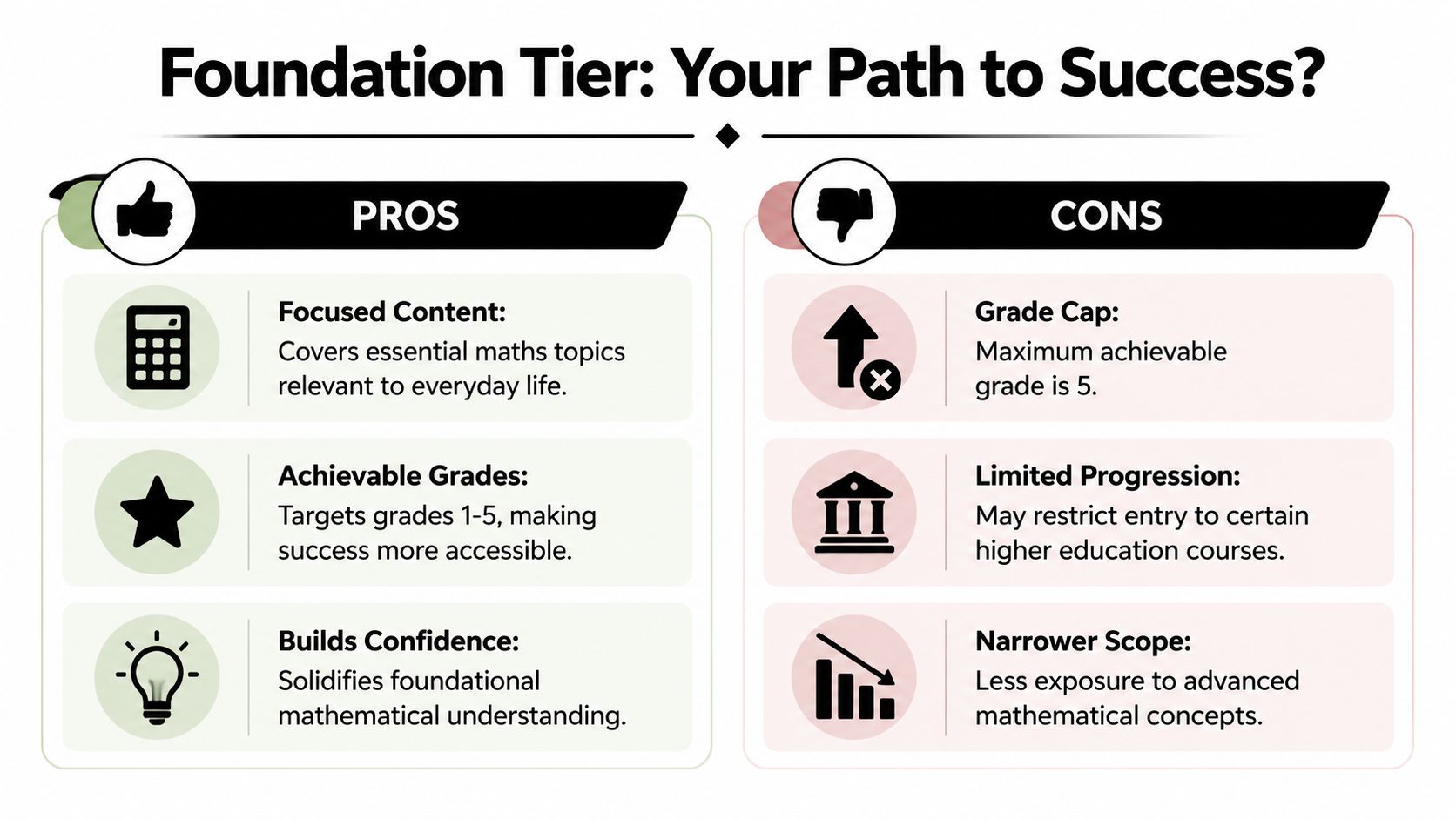
If your goal is to get the maths qualification needed for work, college, university access, or personal progress, Foundation gives you a clear and realistic target. The highest grade available on Foundation is 5, so it suits learners aiming for a Grade 4 standard pass or a Grade 5 strong pass.
That Grade 5 point matters more than many people realise.
Foundation is often described as the lower tier, but some of the questions near the top of the paper sit in the crossover area between Foundation and Higher. These are the marks that can lift a learner from a basic pass towards a strong pass. Adult learners are often not shown this clearly. They revise the basics, skip the mixed questions, and then wonder why they stall.
Focus on your real goal
Some learners feel pushed towards Higher because it sounds better on paper. A better choice is the tier that matches your current level and gives you the strongest chance of success.
If you need GCSE maths as an entry requirement, Foundation can remove a lot of pressure while still giving you room to achieve well. You are not choosing less. You are choosing a route that lets you build secure methods, collect steady marks, and prepare properly for the crossover questions that often decide whether you reach a Grade 5.
That is a smart decision.
The pass mark is often more reachable than adults expect
A lot of adults come back to maths believing they must get almost everything right to pass. That belief can knock confidence before revision even begins.
The grade boundaries for GCSE maths change from year to year and differ by exam board, so it is best to check the official papers and boundaries directly through Pearson Edexcel GCSE grade boundaries. The main point is reassuring. You do not need perfection to pass. You need consistent marks across the paper, good exam habits, and a plan for the topics that appear again and again.
This is good news for adult learners. A pass is built from many sensible steps, not from getting every question right.
Foundation can be a strategic choice
Foundation often suits adults who want a clear route to success and are willing to build confidence step by step. It is especially helpful if you:
- Need GCSE maths for progression into work or further study
- Want a strong chance of a Grade 4 or 5
- Benefit from steady practice rather than rushing into advanced topics
- Need to close the crossover topic gap, so mixed questions stop feeling like a surprise in the exam
If you are also weighing up GCSE against other routes, this guide to Functional Skills qualifications that are equivalent to GCSE maths can help you compare your options clearly.
A good tier choice is not about pride. It is about results.
Passing GCSE maths as an adult can change much more than one line on a CV. It can open the door to a new course, a better job, more security at home, and a powerful example for your children or family. If Foundation is the route that gets you there, it is a wise choice and a strong one.
Key Topics You Will Master on the Foundation Course
You sit down to revise after work, open a maths book, and see fractions, graphs, percentages, and angles all on the same page. It can feel like too much at first. The good news is that Foundation maths is built in layers, so each topic supports the next, and that makes steady progress possible.
A lot of adult learners return to maths expecting random rules to memorise. What they usually find instead is a set of practical skills that connect. Fractions help with percentages. Percentages help with money. Algebra helps you spot patterns. The course starts to feel less like a pile of separate topics and more like a toolkit you can use.
The main topics you will build step by step
Foundation covers the areas that come up again and again in everyday life, work, and the exam paper. You are learning the maths that helps you calculate, compare, estimate, measure, and check whether an answer makes sense.
| Subject Area | Key Topics You'll Learn |
|---|---|
| Number | Fractions, decimals, percentages, place value, negative numbers, times tables, estimation |
| Algebra | Simple expressions, equations, sequences, patterns, basic graphs |
| Ratio and proportion | Sharing amounts, scaling recipes, unit pricing, proportion problems |
| Geometry and measure | Perimeter, area, volume, angles, shapes, units of measure |
| Statistics | Charts, tables, averages such as mean, median, mode, and range |
| Probability | Simple chance, outcomes, and interpreting likelihood |
If you have been away from education for a long time, Number is often the best place to rebuild confidence. It works like the foundation of a house. If fractions, decimals, percentages, and negative numbers become secure, many other topics become easier because they rely on the same habits of careful calculation and checking.
Algebra often worries adults more than it needs to. At Foundation level, it usually begins with simple ideas such as finding missing values, following patterns, and understanding what a letter stands for. You are not expected to jump straight into advanced methods. You build up to them.
How these topics connect to real life
Maths becomes clearer when you attach it to a real task.
- Money uses percentages, fractions, decimals, and ratio. You might compare deals in a supermarket, work out a pay rise, or check interest and bills.
- Home projects use measure and geometry. You may need area for flooring, perimeter for skirting boards, or volume for paint, concrete, or storage.
- Family decisions use statistics. Reading a chart, comparing costs, or working out an average helps you judge information with more confidence.
That matters beyond the exam room. Passing maths can help you apply for courses, meet job requirements, and show your children that going back to learning is possible at any stage of life.
The crossover topic gap most revision misses
This is the part many adult learners are not warned about clearly enough.
Some Foundation questions sit near the top end of the tier and draw on skills that also appear on Higher papers. Exam boards describe some content as common to both tiers in the specification, which means there is real overlap in what learners are expected to know. You can see that shared content in the Pearson specification and in support materials linked from exam boards, where topics such as percentages, ratio, algebra basics, graphs, area, volume, probability, and statistics appear across both tiers.
That crossover topic gap catches people out. A learner may revise only the easiest Foundation questions, then lose marks on mixed or less familiar problems that still sit within reach of a Grade 5. These are often not "hard" because they need advanced maths. They feel hard because they combine two or three basic skills at once.
For example, a question might ask you to:
- calculate with fractions, then convert the result to a percentage
- use ratio in a worded problem about money or recipes
- read a graph and then solve a simple equation
- find area or volume after converting units first
These questions are like carrying shopping bags in both hands while trying to find your keys. Each task on its own is manageable. Doing them together is what creates pressure.
That is why smart revision for Foundation is not only about covering the syllabus once. It is about practising the crossover topics that sit between secure Grade 4 work and stronger Grade 5 answers. If your goal is a solid pass, this is one of the best places to spend your effort.
A helpful way to revise is to group topics into pairs. Study fractions with percentages. Study ratio with proportion. Study graphs with algebra. Study area with unit conversion. That approach trains your brain for the mixed questions that often make the difference between scraping through and getting the stronger pass you want.
If you are unsure what a strong pass means in practical terms, this guide to what GCSE grades mean and how they are viewed can make the target clearer.
You do not need to master everything at once. You need to build the topics that appear often, then practise combining them calmly and regularly. That is how confidence grows, and it is often how adult learners close the gap to Grade 5.
Understanding the Exam and Grading System
Exams feel less threatening when you know exactly what they look like. GCSE Maths Foundation follows a set structure, and once you understand it, revision becomes far easier to organise.
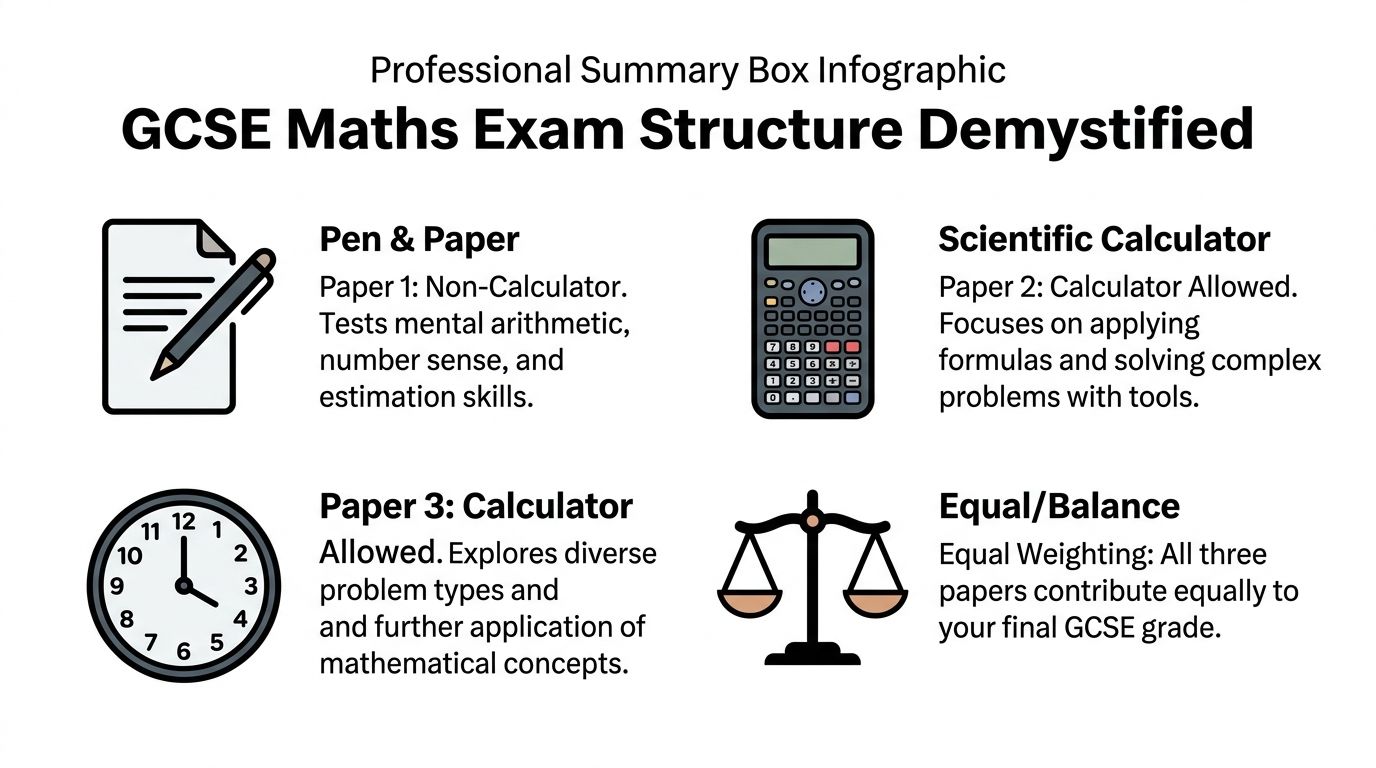
Here's the exam layout at a glance.
How the papers work
The qualification requires three written papers, each lasting 90 minutes and each worth 80 marks, as set out in the Pearson GCSE Mathematics specification. That gives a total of 240 marks across the qualification.
Paper 1 is non-calculator. Papers 2 and 3 allow a calculator.
A lot of adults find this reassuring once they know what it means. Paper 1 checks skills like number sense, mental methods, and careful written working. Papers 2 and 3 let you use a calculator for longer calculations, but they still test understanding, not just button pressing.
Any topic can appear on any paper
This part catches some learners out. The topics are not kept neatly separate. The Pearson specification explains that all content can appear in any paper, which means questions often mix skills from different areas.
That's why revision works best when you don't treat topics in isolation forever. It helps to practise switching between number, algebra, shape, and data, because that's what happens in the exam.
For many learners, understanding the grade system also makes everything feel more achievable. If you'd like a simple explanation, this guide to what GCSE grades mean can help.
A helpful video can make the exam format feel even more familiar.
What the grades mean for you
Foundation Tier is graded on the same 9 to 1 scale as the rest of GCSE maths, but because it is Foundation, the highest available grade is 5. For many adult learners, the key grades are:
- Grade 4, which is the standard pass
- Grade 5, which is the strong pass
The final grade comes from your total marks across all three papers, not from one paper on its own. That can calm a lot of worry. A weaker paper doesn't ruin everything. What matters is your overall performance.
Your exam is not designed to trick you. It is designed to test how well you can apply the maths you've practised.
Once you know the structure, the exam stops feeling like a mystery. It becomes a plan.
Your Study Plan for Success as an Adult Learner
You get home after work, sort dinner, answer a message from school, and finally sit down with your maths book when the house is quiet. That moment is where many adult learners begin. Not with perfect conditions, but with determination.
A good study plan needs to fit real life. If it asks too much, too soon, it usually falls apart. If it fits your week, it can carry you all the way to exam day.
Build a routine you can keep
Start with small wins. Three focused sessions a week is far better than one long session you keep postponing. Even 25 to 30 minutes can be enough if you use it well.
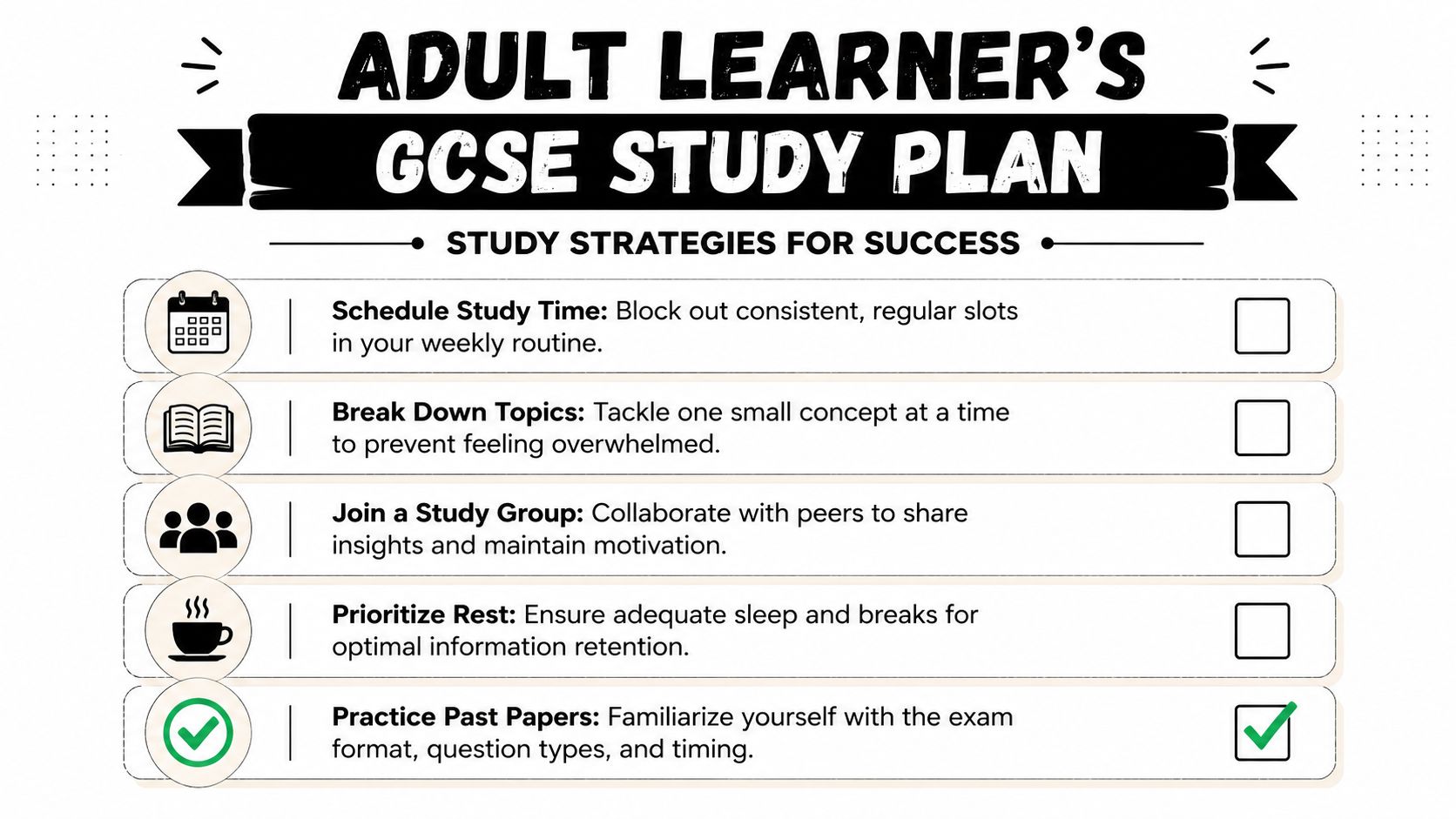
A simple routine often works best:
- Choose fixed study times so maths becomes part of your normal week
- Focus on one skill at a time before mixing topics together
- Keep a notebook of mistakes and write the correct method beside each one
- Practise exam questions often so the wording feels more familiar
Treat your revision like training for a walk up a steep hill. You do not sprint the whole way. You build stamina, one steady step at a time.
Close the crossover topic gap
This is the part many adult learners are not warned about clearly enough. Some Foundation questions sit right on the border between Foundation and Higher content. They are still fair game on a Foundation paper, and they often appear later in the exam when confidence is already being tested.
These crossover questions matter because they can lift a Grade 4 towards a Grade 5.
Many learners revise the obvious Foundation topics, then feel caught out by questions that combine skills or ask for a little more reasoning. The gap is often not a lack of ability. It is a lack of preparation for that middle ground between secure basics and early Higher-style thinking.
Give extra attention to:
Fractions, decimals, and percentages
These appear everywhere. If you can move confidently between them, many harder questions become more manageable.Negative numbers and order of operations
These are small building blocks, but weak building blocks make bigger questions wobble.Multi-step worded problems
Read once for the story, then again for the maths. Underline what you know, circle what you need to find, and decide the steps before you calculate.Area, ratio, and algebra in the same question
The crossover gap often shows up in such questions. The topic is not always harder. The challenge is that it mixes more than one idea.Checking whether your answer makes sense
An estimate can save marks. If your answer for a length is 400 metres in a small triangle, your common sense can catch that before the examiner does.
Late Foundation questions often reward calm thinking and strong basics used together.
That is why isolated topic revision is only the first stage. Once you know the methods, start mixing them. One session on percentages. The next on ratio. Then a short set of questions that blends both. That is how you prepare for the questions that help you reach a strong pass.
Use the support built into the exam
You may also be given a formula sheet, depending on the exam year and the latest rules set by the exam system. Policies can change, so check the current guidance from your exam board before the exam rather than relying on older advice.
What matters most is this. A formula sheet does not replace understanding. It helps with memory, but you still need to know which formula to choose and how to use it. It works like a map. The map helps, but you still need to know where you are going.
If you want a clear next step, this guide on how to pass GCSE maths as an adult learner gives practical revision advice you can use straight away.
Keep your plan simple. Keep showing up. Each study session is evidence that you are building something better for yourself and for the people who rely on you.
Your Next Steps After Passing Your GCSE
Passing GCSE Maths Foundation can change the direction of your life.
It can help you move into further study, apply for new roles, or meet entry requirements that once felt out of reach. It can also give you something less visible, but just as important. Confidence. The kind that helps you raise your hand, fill in the application, and stop talking yourself out of opportunities.
For many adults, this qualification becomes a turning point. You might go on to university through an Access course. You might move into a better paid job. You might finally feel able to help your children with schoolwork and show them, through your own example, what commitment looks like.
Here is a look at an online learning option built for adult returners.

You don't need to have it all worked out today. You only need to decide that your future matters enough to take the first step. A maths qualification won't solve every problem overnight, but it can open a door that has stayed closed for too long.
And once that door opens, a lot can change.
If you're ready to turn low confidence into real progress, Next Level Online College offers flexible online study designed for adult learners across the UK. With recognised courses, expert support, and a structure that fits around work and family life, it can help you take that next step towards university, a better career, and a future your family will be proud of.