
You might be reading this after a long shift, with the washing still waiting, your phone buzzing, and that old thought creeping back in: “Maybe I'm just not a maths person.”
I want to tell you something important. That thought isn't the truth.
Many adults return to mathematics carrying painful school memories. A teacher moved too fast, a class laughed, or you froze during exams. After experiencing that enough, it is easy to believe you were the problem. It was not you. Very often, the actual problem was timing, pressure, or a lack of support.
Passing GCSE maths as an adult isn't about going backwards. It's about moving forward with more life experience, more purpose, and a much stronger reason to succeed. This time, you're not doing it because a school told you to. You're doing it for your future, your children, your confidence, and the choices you want to have.
It's Your Time to Conquer GCSE Maths
A lot of adult learners harbor this goal for months, sometimes years. They want a better job. They want to apply for university. They want to stop feeling embarrassed when a form asks for GCSE maths. They want to show their children that it's never too late to learn.
That's a powerful reason to begin.

Most advice on how to pass gcse maths is written for teenagers, but adult learners face different pressures. Work, childcare, money worries, and tiredness all affect study. That's why adult-focused support matters, and why many learners look for flexible options such as GCSE maths for adults. As noted in Tutorful's adult-focused guide to passing GCSE maths, government skills policy continues to highlight essential maths as a barrier to employment for adults.
This journey means more than a grade
For an adult, a maths pass often stands for much more than an exam result.
It can mean finally applying for a course you once ruled out. It can mean walking into an interview without that fear of being “found out”. It can mean helping your child with homework and saying, with honesty, “I struggled too, but I kept going.”
You are not starting from behind. You are starting with purpose.
That purpose matters on difficult days. When you're tired, purpose gets you to open the notebook. When one topic feels confusing, purpose helps you come back the next day instead of giving up.
Adults often learn better than they expect
You've already built skills that help with maths, even if you don't realise it yet. You budget. You compare prices. You work out time. You solve problems at work and at home all the time.
Maths in an exam may look different on the page, but the brain skills are already there:
- You already reason: You make decisions every day using evidence.
- You already estimate: You judge costs, timings, and quantities without thinking much about it.
- You already persist: Adult life trains you to keep going when things aren't easy.
That's why so many adults surprise themselves once they begin properly. They don't need magic. They need structure, support, and a plan that fits real life.
Find Your Starting Line Not Your Limit
Before you revise, you need a calm and honest picture of where you are now. Not where you “should” be. Not where you were at school. Just where you are today.
That's your starting line.
A quick diagnostic check helps you spot which topics feel secure, which topics are rusty, and which ones need careful rebuilding. It isn't a judgement. It's a map. If you skip this step, you can waste weeks revising topics you already know while avoiding the ones that really need attention.
What a diagnostic check should tell you
A useful first check should answer simple questions like these:
- Which topics feel familiar: Fractions, percentages, ratio, algebra, graphs, shape, probability.
- What kind of mistakes you make: Is it a knowledge gap, a reading mistake, or panic under pressure?
- How confident you are with calculator and non-calculator work: Some adults know the method but get stuck with arithmetic.
- Whether you're ready for your exam tier: You need a realistic match between your current level and your goal.
Keep your first check private if that helps. Nobody needs to see it except you and, if you choose, a tutor or teacher.
Understanding the grade you actually need
For most adult learners, the main target is grade 4. That is widely treated as the standard pass, and it's the grade many employers, apprenticeships, and colleges ask for. Official England-only GCSE results show that 67.4% of GCSE entries across all subjects were at grade 4/C or above in 2024, compared with 67.8% in 2023 and 67.0% in 2019, according to the government's GCSE results 2024 infographic.
That matters because it shows two helpful things. First, grade 4 is a clear and recognised benchmark. Second, results have settled back near pre-2020 patterns rather than staying at the unusually high levels seen during the exam-grade inflation period.
Practical rule: Don't aim vaguely to “do better at maths”. Aim clearly to reach the standard pass that opens doors.
Foundation or Higher
Many adults get worried about this choice. Keep it simple.
Here's a plain guide:
| Tier | Best for | Main mindset |
|---|---|---|
| Foundation | Learners focused on securing a pass | Build confidence, accuracy, and steady marks |
| Higher | Learners aiming for higher grades and comfortable with more demanding questions | Stronger algebra, reasoning, and problem-solving |
If your main goal is to pass and move on to the next stage of life, there is nothing small about that. A smart target is better than an impressive target you can't yet support.
Create a Study Plan That Works For You
Adults often say, “I don't have time.” What they usually mean is, “I don't have big empty blocks of time.”
That's true for many people. But big empty blocks aren't the only way to study well.
The better question is this: where are your study pockets?
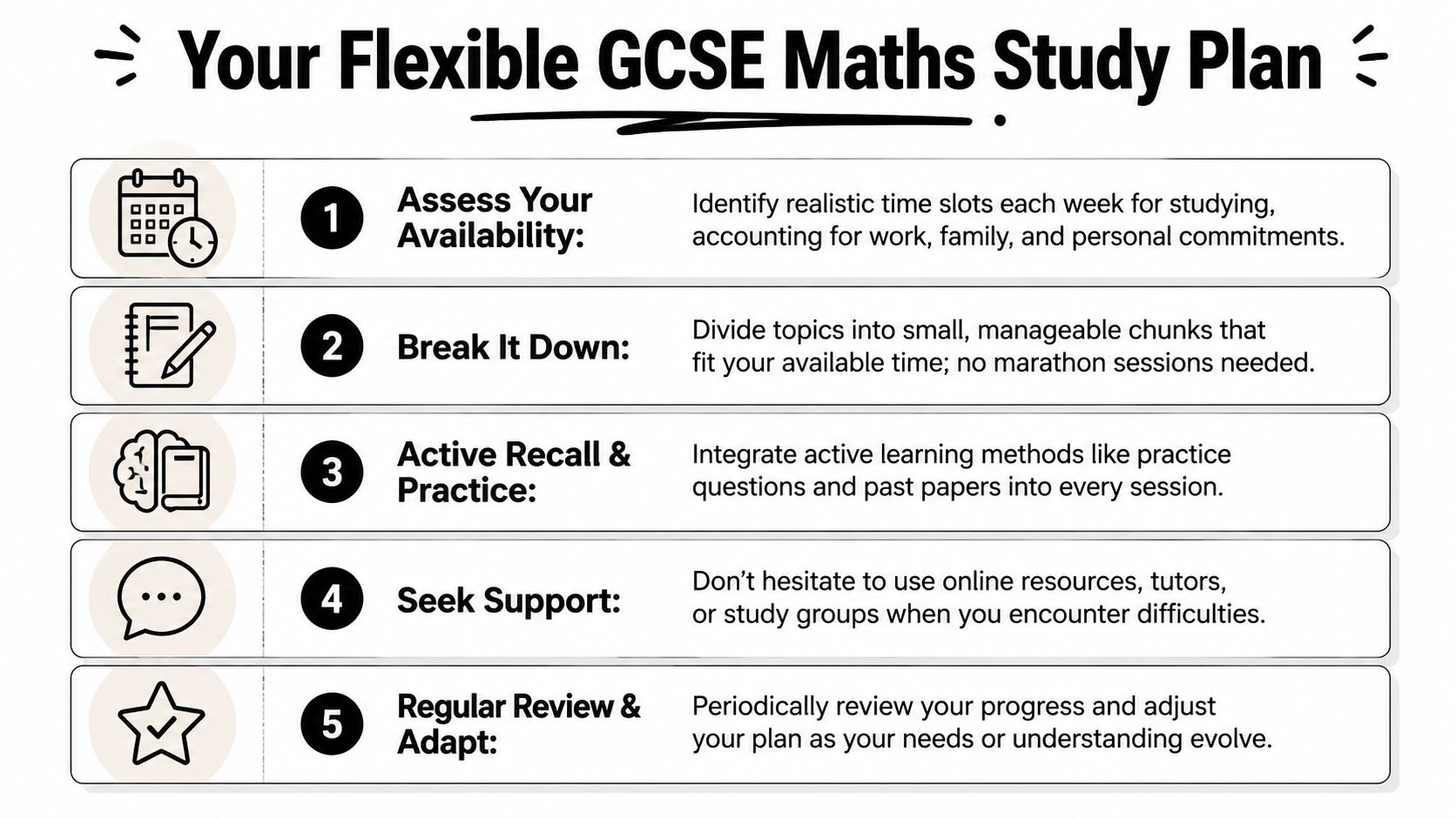
For adults, progress often comes from short, regular sessions. A focused burst before work. Ten minutes of flashcards at lunch. Practice questions after the children are asleep. If you need help building that routine, practical ideas for studying for maths can make the whole week feel more manageable.
Look for hidden time, not perfect time
Finding a quiet two-hour block for revision every evening is unrealistic for many students. That doesn't mean success is out of reach. It means your plan must fit the life you live.
Try this simple weekly approach:
Mark your fixed commitments
Work shifts, school runs, caring duties, food shopping, appointments.Circle your possible study pockets
Early mornings, lunch breaks, travel time, evenings, weekends.Match the task to the time
Short slot equals one skill or a few questions. Longer slot equals a mixed practice set or part of a paper.Keep one catch-up slot
Life happens. A missed session doesn't have to ruin the week.
What to study first
Don't begin with the hardest topic unless it's stopping all your progress. Start by winning marks and building belief.
A sensible order often looks like this:
- Secure what you almost know: These topics improve quickly and boost confidence.
- Fix repeated weak spots: If the same type of question keeps going wrong, deal with it directly.
- Leave a little time for challenge: You still need to stretch your thinking, but not at the cost of confidence.
- Mix topics regularly: Real exams don't group every question neatly by comfort level.
Small sessions done consistently beat a perfect timetable that never gets used.
A weekly planner for a busy adult
Here's a model that feels realistic for many adults:
| Day | Time pocket | Task |
|---|---|---|
| Monday | 20 minutes | Review one weak topic and do 5 practice questions |
| Tuesday | 15 minutes | Flashcards, formulas, or arithmetic accuracy |
| Wednesday | 25 minutes | Mixed questions from two familiar topics |
| Thursday | 20 minutes | Correct mistakes from earlier in the week |
| Saturday | 45 minutes | Timed practice set |
| Sunday | 15 minutes | Quick review and plan next week |
This kind of plan works because it's honest. It respects your life instead of pretending you have endless energy.
Build confidence into the plan
A good study plan isn't only about content. It should also protect your confidence.
Try these rules:
- End most sessions with one thing you can do well: Don't always stop on the hardest question.
- Keep a wins list: Write down topics you've improved.
- Track effort as well as marks: Showing up counts.
- Study even when motivation is low: Routine is stronger than mood.
When adults pass GCSE maths, it's rarely because they found a secret shortcut. It's because they built a plan they could stick to.
Master Smart Revision That Builds Confidence
Many adults revise by reading notes again and again. It feels safe, but it doesn't always build exam strength. Maths improves faster when you do, check, correct, and do again.
That's where smart revision changes everything.

A stronger approach is to test yourself often and learn from the exact places where marks slip away. If you want to sharpen that method, these GCSE revision techniques can help you turn practice into progress.
Know what the exam is really testing
GCSE Maths doesn't only reward correct methods. It tests different kinds of thinking. According to Suited Tutor's guide on passing GCSE maths, the exam is built around three assessment objectives:
- AO1 means using and applying standard techniques
- AO2 means reasoning, interpreting, and communicating mathematically
- AO3 means solving problems in mathematical and other contexts
A lot of adult learners spend nearly all their time on AO1 because it feels more familiar. They practise methods, but then feel shocked when the paper asks them to explain, interpret, or solve a problem set in context.
Use a QLA grid
A Question-Level Analysis grid, often called a QLA, sounds technical but is very simple.
After a practice paper, make a small table with these headings:
| Question | Topic | AO skill | What went wrong | What I'll do next |
|---|---|---|---|---|
| Q1 | Fractions | AO1 | Forgot common denominator | Practise 5 fraction additions |
| Q7 | Graphs | AO2 | Misread the scale | Slow down and check axes |
| Q15 | Ratio problem | AO3 | Didn't know where to start | Practise multi-step worded questions |
This changes revision from “I'm bad at maths” to “I lost marks on ratio problems that need AO3 thinking.” That is much easier to fix.
A better question: Don't ask, “How many marks did I lose?” Ask, “Why did I lose them?”
Active recall beats passive reading
Active recall means pulling the answer from your brain instead of just looking at it. That effort strengthens memory.
Try methods like these:
- Cover and solve: Read an example, cover it, then do it from memory.
- Teach it aloud: Explain a method as if you're teaching your child or a friend.
- Mini whiteboard practice: Write steps quickly, wipe, repeat.
- Error redo: Leave wrong questions for a day, then try them again without notes.
A short video can also help when you need a fresh explanation or a calmer voice than the one in your own head.
Confidence grows when revision gets precise
Confidence doesn't come from telling yourself positive things while hoping for the best. It comes from evidence. You couldn't do a question last week. Now you can. You kept missing ratio. Now you understand the steps. You used to panic at worded problems. Now you know how to underline key information and break them down.
That's real confidence. It's earned.
Turn Practice Papers into Your Secret Weapon
Past papers are not just for checking whether you're ready. They train you how to behave under pressure.
That makes them one of the best tools you have.
A lot of adults use practice papers too late. They wait until they “know everything”. In reality, practice papers help you learn how the exam feels, how questions are worded, and where your timing starts to wobble.
Train for the room, not just the topic
Real exam success depends on more than topic knowledge. You also need calm, pacing, and decision-making.
Try doing practice papers under timed conditions so your brain gets used to the pace. Sit at a table. Put your phone away. Use the equipment you'll use in the exam. Even that small bit of realism can make the actual day feel more familiar.
Use the three-pass method
When your mind goes blank in an exam, structure helps. One of the best simple systems is the three-pass method.
First pass
Answer the questions you know how to do straight away. These are your confidence marks.Second pass
Return to questions that look possible but need a bit more thought.Third pass
Attempt the hardest questions. Look for small parts you can still do, such as reading a graph, writing a formula, or showing one correct step.
This stops you from getting trapped too early on one difficult question while easier marks sit elsewhere on the paper.
Hard questions often contain easier marks hidden inside them. Take those marks.
Show your working
Many adults do mental maths, especially in everyday life. In GCSE maths, that can cost marks if the final answer is wrong and there's no evidence of method.
Write down your steps, even if they seem obvious to you. This helps in three ways:
- It slows you down enough to reduce careless mistakes.
- It gives you a path back if you get stuck halfway.
- It can earn marks for method, even when the final answer isn't right.
What to do when you freeze
Freezing happens. It doesn't mean you're unprepared.
Use a reset routine:
- Read the question again slowly
- Underline the important numbers or words
- Write what the question is asking in simpler words
- Do one small step
- Move on if needed and return later
You do not need to feel confident every minute of the exam. You only need to keep collecting marks.
After each paper, review it properly
The learning doesn't end when time is up. Mark the paper and look for patterns.
Ask yourself:
| Question type | What happened | Next move |
|---|---|---|
| I knew it but got it wrong | Careless mistake | Practise checking steps |
| I didn't understand the wording | Reading issue | Do more worded questions |
| I had no idea how to start | Knowledge gap | Relearn topic basics |
| I ran out of time | Pacing problem | Practise timed sections |
That review turns each paper into training. Without review, it's just a score.
You Are Not Alone Support For Your New Future
It is 9:30 at night. The children are finally asleep, the washing-up is still waiting, and you are staring at a maths question that seems written for somebody else. In that moment, it is easy to believe you are behind, too old, or meant to work it all out alone.
You are not behind. You are an adult doing something brave.
Support changes far more than your answers on a page. It gives structure to weeks that already feel full. It gives you a calm voice when panic starts to rise. It gives you someone to remind you that one bad session does not erase the progress you made last Tuesday after work, or on Sunday morning at the kitchen table.
You're in good company
Adults return to GCSE maths every year. This is not an unusual path or a last chance. It is a common route back into study, training, and better job options.
Ofqual reported in its 2024 GCSE results overview that entries from students aged 17 and over increased, largely because more learners were taking English and maths again, while grade standards remained broadly stable, as explained in Ofqual's 2024 GCSE results overview.
That matters for a simple reason. You are stepping onto a road many adults have already walked. People with jobs, childcare, bills, and long gaps since school do come back. They do pass. You can too.
The right support helps you keep going
Good support works like a handrail on a staircase. It does not climb the stairs for you, but it makes each step steadier.
The best kind of help does more than explain fractions or algebra. It can help you:
- Stay consistent: Someone notices when life has knocked you off track and helps you start again.
- Calm the fear: A clear explanation can stop one difficult topic from turning into a week of avoidance.
- See progress properly: A poor mock score is feedback, not a verdict on your future.
- Build belief: Small wins count more when someone points them out and shows you what caused them.
Asking for support is a practical decision. It saves time, protects confidence, and makes it easier to keep studying around work and family life.
This pass can change more than one result
Passing GCSE maths can open doors to courses, apprenticeships, promotions, and jobs that used to feel out of reach. For many adults, that is the starting reason. The deeper reward comes later.
You begin to trust yourself again.
That change reaches beyond you. A child who sees a parent return to learning and keep going after setbacks learns a powerful lesson. Courage is not about finding things easy. Courage is doing the hard thing anyway.
You may begin this journey because a college, employer, or training course asked for GCSE maths. You may finish with something even bigger. Proof that an old fear does not get the final word.
If you're ready to take that step, Next Level Online College offers flexible online learning for adults who need study to fit around work, family, and real life. With recognised courses, structured support, and a focus on confidence as well as results, it's a strong place to begin your next chapter.