
You can study for a GCSE maths resit online from home, but the final exam must still be taken in person at an approved exam centre. In England, 219,135 learners aged 17 and over sat GCSE maths resits in summer 2026, and 33,598 achieved grade 4 or above, so getting the right support and a clear plan really matters.
You might be reading this after the kids have gone to bed. The house is finally quiet. You've opened your laptop, typed “GCSE maths resit online”, and felt that familiar knot in your stomach. Part of you wants a fresh start. Another part is thinking, “I was never good at maths. What if I fail again?”
If that sounds like you, take a breath. You are not behind. You are not too old. And you are definitely not the only adult trying to rebuild confidence through education.
Many adults come back to maths because they want more for themselves and their family. Sometimes it's about university. Sometimes it's about getting into a better job. Sometimes it's about showing your children that it's possible to keep going, even after setbacks. That matters. Children notice when a parent keeps a promise to themselves.
Starting Your GCSE Maths Resit Journey
Sarah is the kind of learner I've met many times. She works hard, looks after everyone else first, and keeps putting her own goals on hold. She left school years ago with a low maths grade and told herself she just “wasn't a maths person”. Then one day she found a course she wanted to apply for, and maths was in the way.
That moment is often where this journey begins. Not with confidence. With courage.
The first thing to clear up is simple but important. A GCSE maths resit online means your learning can happen online. Your lessons, revision, tutor support, practice questions, and mock preparation can all be done from home. But the actual GCSE maths exam is not taken online. It must be sat in a physical exam centre under formal exam conditions, as explained in this overview of how GCSE exams work for online learners.

What online really means
This catches many adults out. They hope the whole process will be digital because that feels less frightening and easier to fit around family life. The truth is a little different, but still manageable.
Online study usually gives you:
- Flexible lessons: You can study in the morning, on your lunch break, or after the children are asleep.
- Tutor help: When a topic like fractions or algebra knocks your confidence, you can ask for support instead of sitting in silence.
- Practice from home: You can build skill slowly, without the pressure of a classroom.
- Mock exam prep: You can rehearse timed papers before the day arrives.
What stays in person is the final exam itself.
Practical rule: Study online, sit the exam in person.
That one sentence removes a lot of confusion.
Why this matters emotionally
For adults, online learning is often about more than convenience. It gives you privacy. You can make mistakes without anyone watching. You can rewind a lesson. You can go over percentages five times if you need to. There's no shame in that. In fact, that's often how confidence grows.
If you're exploring your options as an adult learner, this guide to GCSE resits for adults can help you picture what the route looks like in real life.
In England, GCSE maths resits are not rare or unusual. Department for Education-related reporting described around 160,000 students retaking GCSE maths annually, and in 2019 over 180,000 learners aged 17+ were re-entered for GCSE Mathematics. The pass rate in that 2019 cohort was 22.3%, compared with 43% among 64,494 entrants in 2012, which shows how large and challenging this pathway has been for years, especially for post-16 learners returning after disappointment (Royal Society background paper on GCSE resits).
That isn't there to scare you. It's there to remind you that struggling before doesn't mean you're the problem. Many people need a different setting, better preparation, and steadier support.
Checking Your Eligibility and Current Grade
Before you enrol anywhere, check where you stand. This part is more straightforward than expected.
Start with your age and subject
For the November resit route, guidance says the series is restricted to GCSE English Language and GCSE Maths, and candidates normally need to be at least 16 years old by 31 August of the exam year, according to this 2026 resit guidance summary.
So if you're an adult hoping to retake maths, you're usually looking at a valid route. The key point is that November is not a catch-all retake window for every GCSE subject. It is focused on the two subjects adults most often need for work, college, apprenticeships, and university access.
Check your old result
Find your original maths result if you can. If you still have your certificate or results slip, look for GCSE Mathematics and the grade beside it.
You're usually resitting because:
- You got below grade 4
- You need a better grade for progression
- You never completed the qualification in the first place
If you've lost your paperwork, don't panic. Start by contacting your old school or the exam centre where you sat the exam. If that isn't possible, ask the relevant exam board about replacing documents or confirming results. It can take a bit of admin, but it's fixable.
A missing certificate is a problem to solve, not a reason to give up.
If you never sat GCSE maths before
Some adults assume they can only “resit” if they sat the exam at school. In everyday language, people use “resit” for both retaking and taking GCSE maths later as an adult. If you never completed it when you were younger, an online GCSE maths course may still be suitable. What matters most is choosing the right level of support and making sure you book the formal exam correctly.
Know the difference between November and summer
Adults often get muddled here. The November sitting is a specific option for maths and English. The summer series is the main exam season.
The bigger confusion is often not dates, but the route itself. Many search results mix up traditional GCSE resits, online study, and alternatives such as Functional Skills. Official careers guidance makes clear that GCSE English and maths can be resat in the autumn or summer, but traditional GCSEs are not sat online, as explained by the National Careers Service resits guidance.
That matters because once you understand your route, the whole process feels less foggy. You stop guessing. You start planning.
Choosing the Right Online Course and Provider
Once you know you're eligible, the next job is picking a course that fits your life. This decision matters because adult learners don't just need content. They need a course they can stick with when work gets busy, children get ill, or confidence drops for a few days.
What to compare first
Don't choose a course just because the website looks polished. Look at how the course works in real life.
| Feature | Why It Matters |
|---|---|
| Flexible study access | You need to fit learning around work, school runs, and everyday life |
| Tutor support | Maths feels less overwhelming when you can ask questions and get clear answers |
| Structured materials | A logical order helps when you haven't studied for years |
| Mock exams | Timed practice helps you get used to exam pressure |
| Exam guidance | Many adults need help understanding how private exam entry works |
| Pastoral support | Confidence and motivation often matter as much as the maths itself |
Signs a course may suit you
A good provider usually makes things feel clear, not complicated. You should be able to tell:
- How the lessons are organised: Random worksheets can leave you lost. A proper route from basics to exam questions is much better.
- What support you'll get: Some adults want independence. Others need regular check-ins.
- Whether it suits resit learners: Resitters often need focused repair work, not just a standard school-style course.
If you're comparing formats, this explanation of whether you can do a GCSE online helps sort out what can be done remotely and what still has to happen in person.
GCSE or Functional Skills
This is one of the most important decisions for adults. Some learners need a full GCSE because of funding rules, study plans, or entry requirements. Others mainly need a recognised maths qualification for work or progression and may find Functional Skills a better fit.
A recent guide notes that Functional Skills Level 2 can be accepted as a GCSE-equivalent by many universities, employers and training providers, but also explains that some Department for Education funding rules can require full-time students with a grade 3 to study towards GCSE rather than Functional Skills. It also notes that autumn GCSE resits remain the standard route for many learners, while online providers build support around that exam calendar (comparison of GCSE resits and Functional Skills routes).
That means there isn't one right answer for everyone.
One example of a provider checklist
You might look at a provider such as Next Level Online College if you want an online course with adult-focused study support, but compare it alongside other options using the same checklist. Ask yourself whether the provider offers clear teaching, tutor access, emotional support, and practical exam guidance.
Pick the course you're most likely to complete, not the one that sounds the most impressive.
The right course should make you feel steady. Not rushed. Not ashamed. Steady learners often go further than anxious learners.
Enrolment, Support, and Booking Your Exam
Many adults hesitate. They're ready to study, but the paperwork and exam booking feel intimidating. Break it into small steps and it becomes much easier.
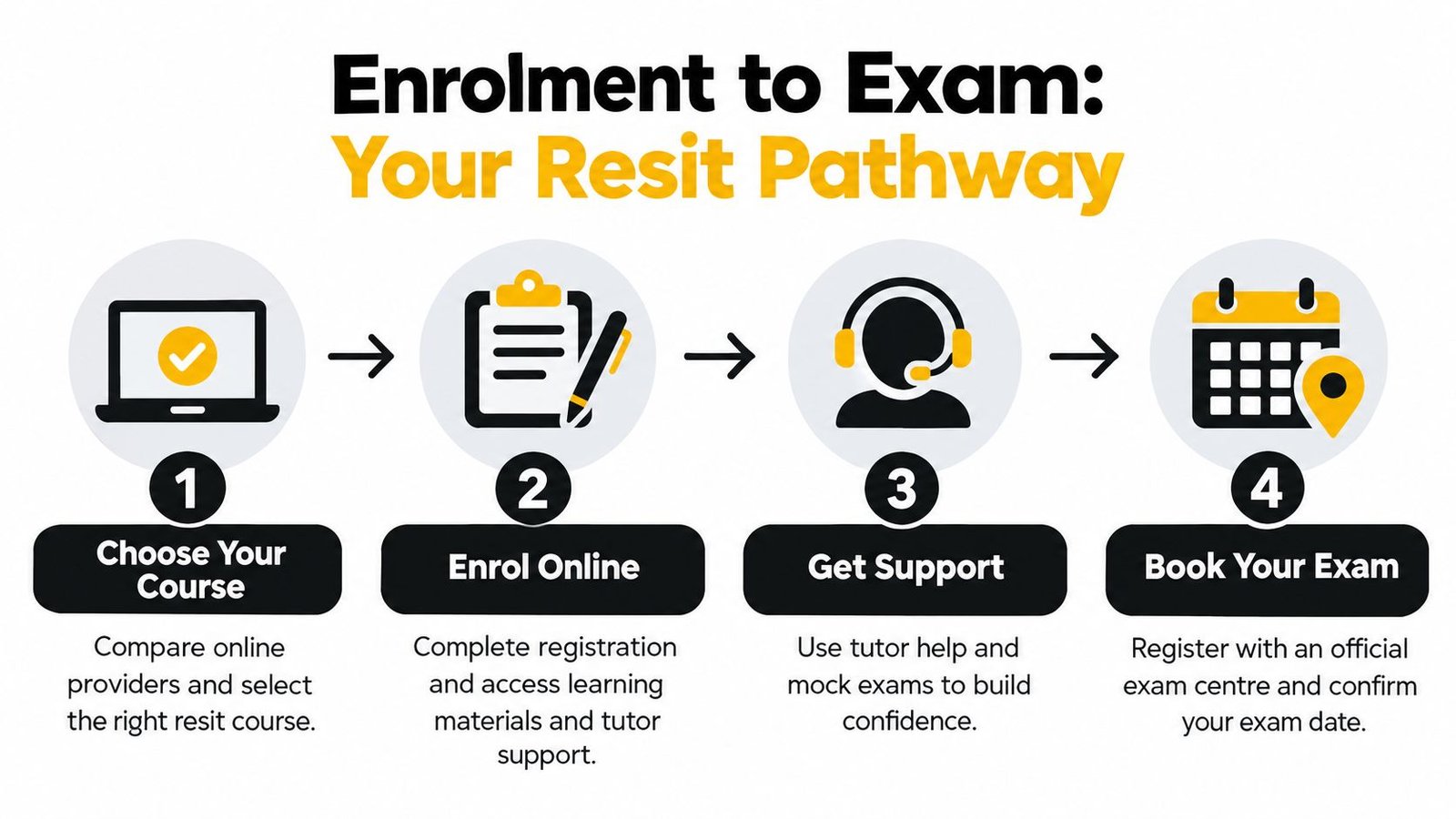
The four jobs you need to do
Choose your course
Enrol with the provider you've decided on so you can start learning.Start studying
Log in, find your materials, and begin with a diagnostic check or the first unit.Get support early
Use tutor help as soon as a topic starts to wobble. Don't wait until revision week.Book your exam centre
This is separate from your course unless your provider handles it for you.
That last step matters a lot. Many adults assume enrolling on a course automatically books the exam. Often, it doesn't.
The November timetable and deadline
If you're aiming for the November 2026 resit series, the timetable listed by major exam information sources places Paper 1 on 4 November, Paper 2 on 6 November, and Paper 3 on 9 November 2026, as shown in this November 2026 GCSE resit dates guide.
You also need to act early. Several 2026 guidance sources say the entry deadline for the November GCSE resit series is 4 October 2026, with exam centres often setting an earlier internal deadline, according to this GCSE resits 2026 deadline guide.
So don't leave exam booking until you “feel ready”. Exam places are practical matters, not confidence matters.
What support should be in place
Good support isn't just about answering maths questions. It should help you keep going when life gets noisy.
Look for:
- Tutor contact: Someone who can explain methods in plain English.
- Mock papers: You need practice answering full papers, not only topic questions.
- Feedback: It's much easier to improve when someone points out patterns in your mistakes.
- Reminders and planning help: Adults juggle a lot. Structure reduces stress.
Book the exam first enough that your revision has a real target.
That target can be surprisingly powerful. Once a date is fixed, your study stops feeling like a vague dream and starts becoming a plan.
Creating a Study Plan and Managing Costs
A strong plan doesn't need to be perfect. It needs to be realistic. Adults often fail not because they aren't capable, but because they set a timetable that doesn't fit their real life.

Build a week you can actually keep
If you work full time or care for children, don't try to study like a teenager with whole afternoons free. A better plan is often shorter and steadier.
Try this shape:
- Two focused weekday sessions: Short, quiet, and specific.
- One longer weekend session: Good for a full topic or timed paper.
- One catch-up slot: This protects you when life interrupts the plan.
Use each session for one clear job. Don't sit down and vaguely “do maths”. Decide in advance. Fractions. Ratio. Algebra basics. A timed non-calculator paper. Clear tasks lower resistance.
Use revision methods that build confidence
Adults often reread notes and mistake that for progress. GCSE maths usually improves faster when you practise actively.
This guide to GCSE revision techniques can help you build a routine, but the key idea is simple. Learn a method, try questions, mark them, then fix the gaps straight away.
A useful pattern is:
- Learn one topic.
- Do a few questions slowly.
- Try similar questions without notes.
- Return later and test it again.
Small wins count. Getting six questions right today can be the start of passing later.
Thinking about cost without panic
Costs matter. Adult learners have rent, childcare, travel, food, and bills. It's sensible to think carefully before paying for a course or exam.
What you're usually paying for may include:
- Course access: Lessons, materials, and online platform use
- Tutor support: Feedback and help when you get stuck
- Exam fees: Often separate if you book with a centre
- Extra services: Mock marking, pastoral support, or payment plans
Because prices vary a lot between providers and centres, it's better to compare what is included rather than chasing the cheapest figure. A low-cost course that leaves you confused can become expensive if it leads to another resit.
Why planning matters so much
The latest England resit figures show how demanding this route can be. In summer 2026, 219,135 learners aged 17+ sat GCSE maths resits and 33,598 achieved grade 4 or above, a 15.3% pass rate. That was down from 17.1% in 2025, while the post-16 share of all GCSE maths entries rose to 27.1%, according to FE Week's report on 2026 GCSE resit results.
That tells me something important. This isn't an exam to drift into casually. It rewards routine, repeated practice, and proper support.
And yet, it's still worth it. This qualification can help you gain university access, training routes, stronger job options, and the quiet pride of proving to yourself that your past doesn't get the final say.
Exam Day Success and Next Steps
By the time exam day arrives, your job is no longer to become perfect at maths. Your job is to show what you know calmly and clearly across all three papers.
The night before and the morning itself
Keep the final evening simple. Check your exam time, your travel plan, and the items your centre has told you to bring. Then stop studying at a sensible time. Tired panic rarely helps anyone answer maths questions well.
On the day, arrive early enough that you're not rushing through the door flustered. Sit down, breathe, and remind yourself that nerves are normal. They don't mean you're unprepared. They mean this matters to you.
During the paper
Use your time carefully. If one question freezes you, move on and come back later. Many adults lose marks because they get stuck proving something to themselves on one difficult question.
Try to remember:
- Read each question slowly: Maths mistakes often come from rushing words, not numbers.
- Show your working: Even if your final answer isn't right, method marks can still matter.
- Keep moving: Protect your time for easier marks elsewhere on the paper.
The national picture also suggests that mature learners can improve with structure, but age alone doesn't solve the problem. In summer 2026, learners aged 17+ had a 15.3% pass rate overall, and even the age 20+ group, though strongest, fell to 32.51% from 33.99%, which is why structured preparation and exam practice still matter so much, as discussed in this review of what the national GCSE maths resit data shows.
If you pass, and if you don't
If you get the grade you need, celebrate it properly. Don't brush it off. You earned it. Tell your children. Tell the people who supported you. Use it as proof that you can do hard things.
If the result isn't what you hoped for, be disappointed if you need to be. Then look at the next step with a clear head. Some learners need another attempt. Some decide a different route suits their goals better. One result does not define your intelligence, your worth, or your future.
What matters most is this. Every hour you put into this journey shows your family something powerful. It shows that grown-ups can learn. It shows that setbacks can be answered with action. It shows that education isn't only for other people.
And sometimes that lesson changes a whole household.
Next Level Online College offers flexible online courses for adults who need recognised maths qualifications, including routes that fit around work and family life, with academic and pastoral support built in. If you want help turning a GCSE maths resit online into a real, manageable plan, visit Next Level Online College.