

Some days you carry on because you have to. You go to work, come home tired, sort dinner, answer messages, pay bills, and do it all again the next day. You know you can do more than this, but the gap between where you are and where you want to be can feel huge.
If you've been wondering how to become a consultant in the UK, you might also be thinking, “People like me don't do that.” Maybe you left school early. Maybe life got in the way. Maybe you've had a career break and your confidence has taken a knock. That does not mean your future is small. It means your route may look different, and that's perfectly fine.
Consulting is, at heart, simple. A consultant helps people solve problems. That could be in business, admin, customer service, budgeting, marketing, project support, training, operations, data, or something more specialised over time. You do not need to start as the finished article. You need to start as someone willing to learn, build proof, and keep going.
A better career can mean more than a better payslip. It can mean showing your children what persistence looks like. It can mean becoming the person in your family who went back to learning, got qualified, and changed the story for everyone after them.
Your Dream of a New Career Is Closer Than You Think
Martin had spent years being the reliable one at work. He fixed problems, trained new starters, calmed unhappy customers, and kept things moving when managers were stressed. Yet nobody called him an expert. Nobody sat him down and said, “You could build a career from this.”
At home, he felt that quiet ache many adults feel. He wanted more security. He wanted work that used his brain. Most of all, he wanted his children to see that it's never too late to aim higher.

That's where many future consultants begin. Not with a fancy title. With a feeling that their experience matters more than their current job allows.
Consulting is helping, not showing off
A lot of people hear the word consultant and think of city offices, expensive suits, and jobs meant for someone else. But consulting is really about taking knowledge you already have, improving it, and using it in a structured way to help others.
You might already do this in everyday life:
- At work: You spot problems before other people do and suggest better ways to do things.
- In your community: You help organise events, solve admin issues, or keep projects on track.
- At home: You budget carefully, plan around chaos, and make good decisions under pressure.
Those are not small things. They are signs that you can think clearly, organise information, and support other people.
You don't need to begin as an expert with all the answers. You need to begin as a learner who is ready to become useful.
Why this career can change more than your job
Consulting can offer flexibility, purpose, and a stronger sense of control over your future. For some people, that means joining a firm. For others, it means building slowly on the side while they study or work.
If your confidence is low right now, hold onto this thought. Your current position is not your final position.
The road into consulting may start with basic qualifications, short projects, and small wins. That's not a weakness. That's how many solid careers are built. Step by step, you become more credible, more skilled, and more confident. Your family sees it too.
Find Your Spark What Could You Be a Consultant In
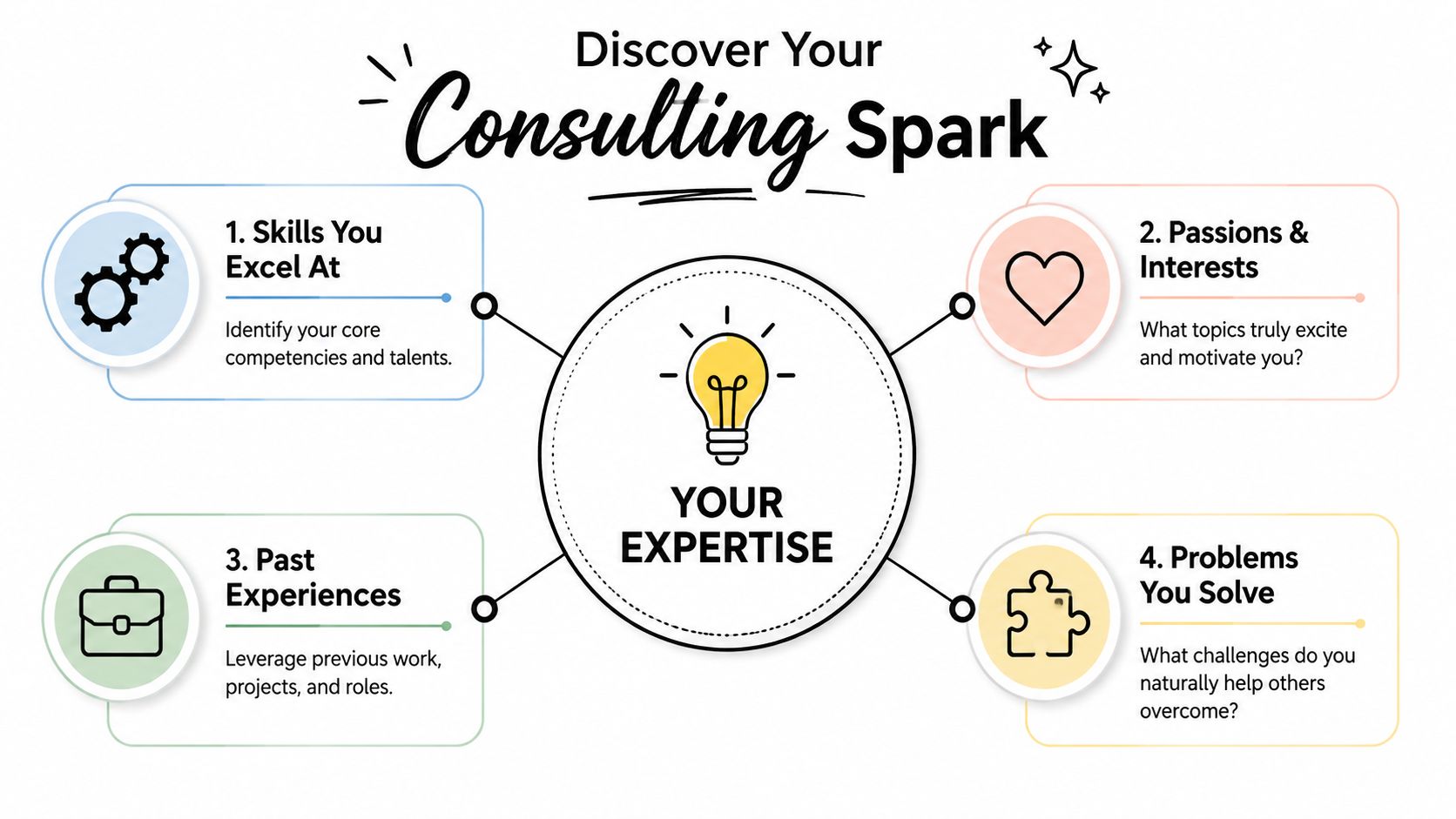
Many adults get stuck on one question. “What could I possibly consult on?” They think they need to be famous, senior, or brilliant at one narrow thing from day one. You don't.
The better question is this. What problems do people already trust you to help solve?
Look for clues in real life
Start with a notebook or the notes app on your phone. Write down where people come to you for help. Don't judge your answers. Just list them.
You may notice patterns such as:
- Sorting mess into order: Maybe you're great at schedules, rotas, filing systems, or event planning.
- Explaining things clearly: Perhaps new staff understand tasks better after you've shown them.
- Keeping spending under control: You might be strong at budgeting, cost tracking, or practical planning.
- Handling customers well: You may know how to solve complaints or improve service calmly.
These skills can become the base of a consulting niche.
Turn a general skill into a clear niche
“Niche” means your specific area of focus. It helps people understand what you do and why they should trust you.
Here's the difference:
| Too broad | Clearer niche |
|---|---|
| Business consultant | Customer service process consultant for small local businesses |
| Marketing consultant | Social media support consultant for charities and community groups |
| Admin consultant | Admin systems consultant for solo business owners |
| Finance consultant | Budgeting and cashflow support consultant for small organisations |
A niche doesn't trap you forever. It gives you a starting point.
According to Wise's guide on becoming a consultant, a practical method for new consultants is to choose one sector or function, build 2–3 documented case studies from work or volunteer experience, and turn them into a portfolio. The same guidance notes that early clients often come from personal networks, and that trying to stay too broad makes it harder to win that first assignment.
Practical rule: If people can't quickly understand what you help with, they won't remember to recommend you.
A simple confidence exercise
Try these prompts and answer them in plain language:
- What tasks do I do well without much panic?
- What do people thank me for?
- What problem have I solved more than once?
- Which kind of people do I understand best?
- What work would I be happy to learn more about?
Now turn your answers into one sentence.
For example:
“I help small clubs and local groups organise admin and communication so things run smoothly.”
Or:
“I help small businesses improve customer replies and simple office systems.”
That sentence is not your final brand. It's your starting spark. Once you can name the value you bring, learning how to become a consultant feels far less mysterious.
Build Your Foundation With Skills and Qualifications
Natural ability matters. Experience matters too. But qualifications can give you something many adult learners badly need, which is evidence. Evidence that you can study, finish what you start, and meet a recognised standard.
That matters in consulting because clients need reasons to trust you. In specialist areas, qualifications carry real weight. The Royal Statistical Society explains the route into statistical consultancy and notes that many roles require an MSc in statistics or an equivalent qualification, with some consultants also holding a PhD. It also points to specialist job routes such as Allstat, jobs.ac.uk, and the RSS job board. That tells you something important. In professional consulting fields, formal study is often part of credibility.
Education is not “starting over”
If you left school years ago, study can sound frightening. But adult learning works best when you stop seeing it as going backwards. You're building a ladder from where you are now.
That ladder might look like this:
- First step: Improve core skills in English and maths if those areas have held you back.
- Next step: Gain GCSEs or equivalent qualifications if you need a stronger base.
- Then: Move on to A Levels or an Access to HE Diploma if university or higher-level professional study is your goal.
- Later: Choose a degree or specialist training that fits your consulting direction.
Each stage gives you more confidence and more options.
Why A Levels and Access courses can be life-changing
For readers without a degree, or for those returning after a career break, this is often the turning point. A Levels and Access to HE courses can help you prove academic ability, open the door to university, and show future employers or clients that you take development seriously.
If you're exploring business-focused study, a Business A Level course can help you strengthen your understanding of organisations, decision-making, and commercial thinking. Those skills are useful if you want to support businesses later.
What to build alongside qualifications
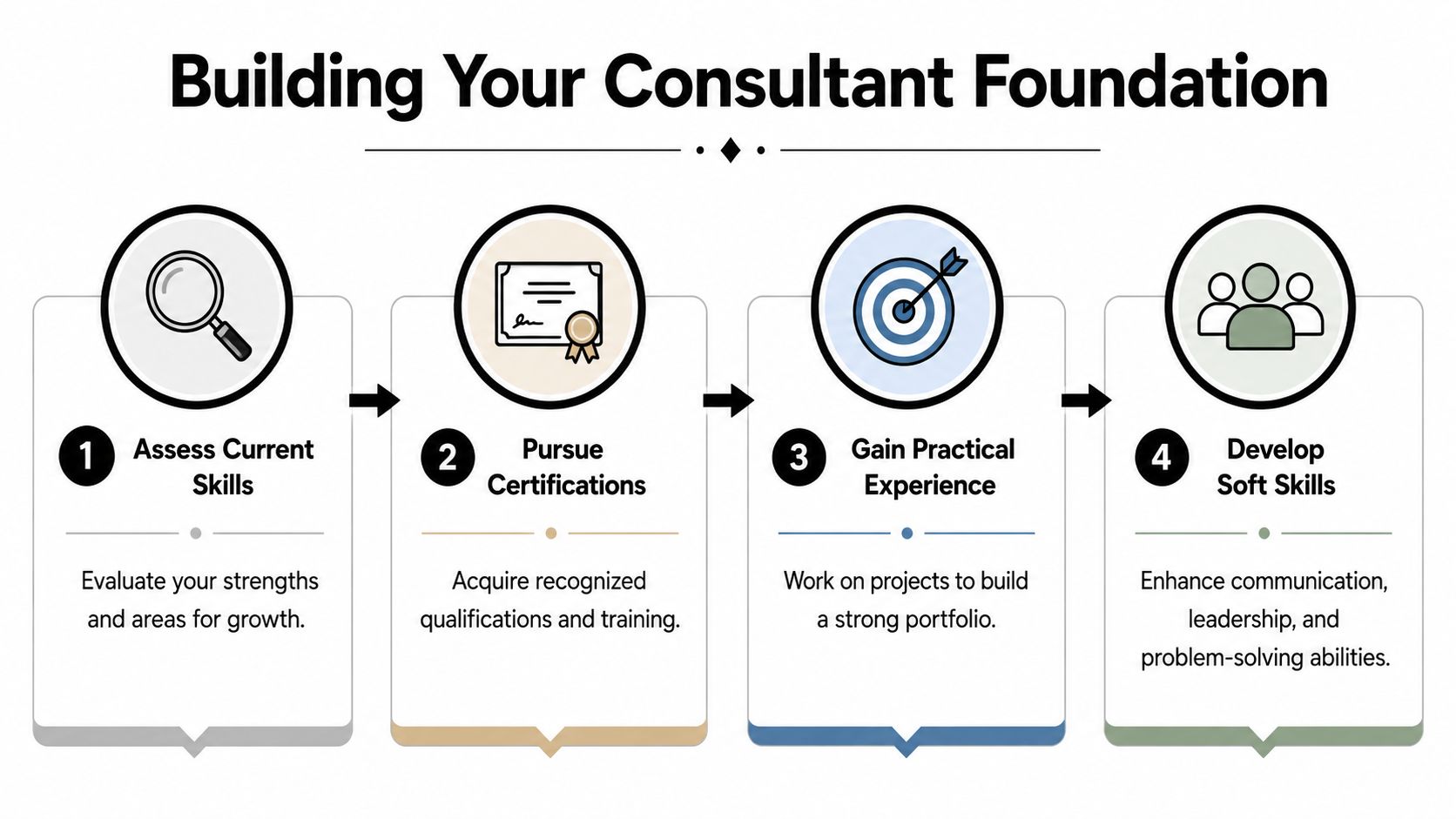
Study alone isn't enough. Strong consultants combine learning with practical habits.
Focus on these areas:
- Communication: Can you explain an idea clearly, without confusing people?
- Problem-solving: Can you break a messy issue into smaller parts?
- Organisation: Can you plan tasks, keep notes, and follow through?
- Professional confidence: Can you speak about your work calmly and clearly?
You don't need perfect confidence before you start. Confidence usually grows after repeated action.
Qualifications are not magic. They won't replace effort. But they can give structure to your progress and proof of your commitment.
If you feel embarrassed about where you're starting
Please don't be. Plenty of capable adults need to rebuild their education after time away. Family responsibilities, poor school experiences, money worries, health issues, and self-doubt interrupt many people's plans.
What matters now is direction.
If your long-term dream is consulting, then your short-term goal might be much simpler. Pass English. Improve maths. Complete an A Level. Finish an Access to HE diploma. Apply to university. Get your first role with more responsibility. Each step counts. Each step changes how you see yourself.
That's how a consulting career becomes realistic. Not through one giant leap, but through steady proof that you can learn, adapt, and grow.
Gain Real Experience and Unshakeable Credibility
The biggest fear for beginners is simple. “No one will hire me because I don't have experience.” But experience doesn't only come from paid consulting work. It can come from work you've already done, projects you've supported, and problems you've solved in other settings.
What matters is how you present that experience.
Treat your work like evidence
The American Statistical Association's guidance on what clients should expect in a consulting session describes the first session as a formal scoping stage, where the consultant clarifies the problem, reviews what already exists, and estimates the effort before work begins. That's a useful lesson for any new consultant. Professional consulting is not casual advice. It is a structured way of understanding and solving a problem.
So instead of saying, “I helped out with admin at a charity,” say something more structured:
- What was the problem?
- What did you review first?
- What did you change?
- What happened as a result?
That becomes a case study.
Low-risk ways to build proof
You can build credibility before you ever call yourself fully established.
Try options like these:
- Volunteer carefully: Help a local charity, club, school group, or community project with one clearly defined problem.
- Use your current job: If you've improved a process, trained staff, or organised a project, write it up as a simple case study.
- Support a small business you know: Offer a limited piece of work, such as reviewing admin systems or customer communications.
- Start tiny: One project done well is worth more than lots of vague claims.
Make each project clear and bounded. Avoid saying yes to everything.
A simple case study template
Use this structure for your portfolio:
| Part | What to write |
|---|---|
| Situation | What was going wrong or needed improvement |
| Task | What you were asked to help with |
| Action | The steps you took |
| Result | What changed afterwards, described honestly and clearly |
If you don't have hard numbers, that's fine. Stay truthful. You can write about smoother processes, clearer communication, better organisation, or reduced confusion without inventing data.
A small, well-documented project often builds more trust than a big claim with no proof.
Why this works
Clients want to feel safe. They want to know you can listen, organise information, and handle a problem in a sensible order. A short portfolio of real examples shows that far better than a long list of buzzwords.
This also helps your confidence. When self-doubt kicks in, your case studies remind you that you have already solved real problems for real people. That's the beginning of professional credibility.
Set Up Your Consulting Business The Smart Way
A lot of beginner guides talk about websites, logos, and social media first. But many adults need a more basic answer before any of that. What kind of setup should I use?
That question matters, especially if you're starting part-time, testing the waters after a career break, or keeping your day job while you learn. A common weakness in consultant advice is that it skips this early business decision. As noted in this guide discussing how beginners become consultants, many guides fail to address the practical UK choice between salaried work, sole trader status, or a limited company.
Sole trader or limited company
For many beginners in the UK, these are the two common self-employed routes to compare.
| Feature | Sole Trader | Limited Company |
|---|---|---|
| Setup | Usually simpler to start | Usually involves more setup |
| Admin | Often lighter | Often more formal |
| Identity | You and the business are closely linked | The business is a separate legal structure |
| Best fit for many beginners | Often suits part-time testing | May suit people ready for a more formal structure |
| Decision style | Good for keeping things simple early on | Good when you want a separate company identity |
This table is not legal or tax advice. It's a simple starting view so you can ask better questions when you're ready.
A sensible beginner approach
If you're not sure yet whether consulting will become your full-time path, keeping things simple can help. You want enough structure to act professionally, but not so much that you get paralysed by admin.
A useful early checklist looks like this:
- Open a separate bank account: It helps you keep business money apart from household spending.
- Track income and costs: A spreadsheet is enough when you begin, as long as you keep it tidy.
- Write down your offer: Be clear about what problem you help solve.
- Create a simple service outline: State what is included, what is not, and how work begins.
If the whole business side feels intimidating, learning the basics of study, work, and progression through flexible online learning can help you build confidence first. These accredited online courses in the UK show the kind of stepping-stone approach many adult learners need.
How to think about pricing
New consultants often freeze on pricing because they think they need the perfect answer. You don't. You need a fair, clear starting point.
Keep it simple:
- price a small piece of work
- define the outcome
- explain the scope
- avoid vague open-ended promises
For example, instead of charging for “general support”, offer a simple review, a short audit, or a focused improvement project. People buy clarity more easily than complexity.
The smart setup is the one you can understand, manage, and grow from. Not the one that sounds most impressive.
Find Your First Clients and Build Your Network
Your first clients probably won't appear because of a clever slogan. They usually come because someone already knows you, trusts you, or hears about you through someone else.
That's good news if the idea of selling makes you cringe.

Start with warm people, not strangers
Make a short list of:
- former colleagues
- old managers
- friends with small businesses
- local contacts from clubs, schools, or charities
- people who've seen your work first-hand
Then tell them calmly what you're doing.
You might say:
“I'm building a small consulting service to help local businesses improve their admin systems.”
Or:
“I'm starting to support small organisations with customer communication and process problems.”
That's enough. You don't need a speech.
Show, don't push
When someone seems interested, share a case study or short example. That's much easier than trying to “sell yourself”.
Try this flow:
- Start with their problem: Ask what's frustrating them.
- Listen properly: Don't rush in with advice.
- Mention similar work: Briefly explain a relevant project you've done.
- Offer a next step: Suggest a short call or review.
This feels natural because it is natural. Networking works best when you stay curious and useful.
People are more likely to remember a clear problem-solver than a person who says they can do everything.
Build confidence through conversations
Join groups linked to your niche. That could be local business meet-ups, professional online communities, industry forums, or community networks. Go there to listen, learn, and understand common problems.
If confidence is your biggest hurdle, focused self-development can help. Many adults benefit from practical support like these courses to improve confidence while they rebuild their career direction.
For readers who want the large-firm route later, consulting interviews are a very different challenge. A UK strategy consulting guide recommends starting case interview prep 3–6 months before interviews and completing at least 30 timed case practices as preparation, as described in this consulting interview guide on YouTube. That tells you how analytical the profession can become at higher levels. You don't need to master that today, but it's a useful long-term standard to aim towards.
Your first client isn't won by pretending to be bigger than you are. It's won by being clear, prepared, and trustworthy.
Your Action Plan for a New Future
Keep this simple. You don't need a perfect five-year masterplan. You need a repeatable week.
A practical routine could look like this:
- One study session: Work on your qualification or core subject knowledge.
- One portfolio session: Write up a past project into a case study.
- One outreach session: Message one former colleague or local contact.
- One reflection session: Review what you learned and what to do next.
If family life is busy, keep sessions short and regular. A steady rhythm beats a burst of effort followed by exhaustion.
Write down three immediate actions for this week:
- choose one consulting niche
- list two past projects you could turn into case studies
- research the qualification that would move you forward most
You are not too late. You are not too old. You are not disqualified because your path has been messy.
Your children do not need to see a perfect parent. They need to see a brave one. Every lesson you complete, every skill you build, and every step you take towards a new career shows them what resilience looks like. That is powerful. That is how lives change.
If you're ready to turn ambition into action, Next Level Online College can help you build the qualifications, confidence, and study routine that make a consulting future feel real. Whether you need Functional Skills, GCSEs, A Levels, or an Access to HE Diploma, flexible online learning can help you take the first step towards a career you and your family can be proud of.