
Some people reading this are doing it after a long shift, with the kettle on, bills on the table, and a quiet worry in the back of their mind. You may be wondering whether it's too late to go back to learning, whether your school results from years ago still matter, or whether a respected career in healthcare is only for people who took a straight path the first time.
It isn't.
If you want to learn how to become a Nurse Practitioner in the UK, the path is real, clear, and possible. It is also bigger than one course or one application. For many adults, it starts with rebuilding confidence, getting the right qualifications step by step, and choosing a route that fits around real life.
This goal can mean more than a job title. It can mean stable work, better pay, a career your children can be proud of, and the feeling that your effort matters every day.
Imagine a Career That Truly Matters
You might be in a job that pays the bills but leaves you flat. You get through the day, come home tired, and still feel like you were meant for something more useful, more respected, more meaningful.
That feeling matters.

A Nurse Practitioner is someone people turn to when they're worried, unwell, confused, or frightened. They listen, assess, explain, and help patients move forward. In everyday life, that can look like supporting a parent with a long-term condition, helping a child with urgent symptoms, or guiding an older patient through treatment choices with calm and kindness.
Why this role feels different
This career has weight to it. People trust you. Families remember your care. Your children see you studying, growing, and building a future with purpose.
For many adults, that's the main reason to begin.
A nursing career can also open the door to stronger earning potential over time. If you want a simple look at what nursing pay can look like across roles, this guide to average nursing salary can help you understand the bigger picture.
You don't need to have everything worked out today. You only need to believe that your next step can lead somewhere better.
The pride is personal
Think about what changes when you stop saying “maybe one day” and start saying “I'm working towards it”.
- At home: Your family sees commitment, not just intention.
- For yourself: You prove that a difficult start doesn't decide your finish.
- For your future: You move towards a career built on care, skill, and responsibility.
Many adults worry that wanting more is selfish. It isn't. Building a better life for yourself often lifts the people around you too. When your children watch you revise after dinner, ask for help, and keep going, they learn what courage looks like.
That's one of the quiet powers of adult education. It changes more than your timetable. It changes what feels possible in your home.
Your First Steps If You Are Starting Fresh
The part that confuses most career changers isn't the final job. It's the beginning. People often think they need perfect school grades, recent A Levels, or a healthcare background before they can even think about nursing.
That's one of the biggest myths.
Start with what you already have
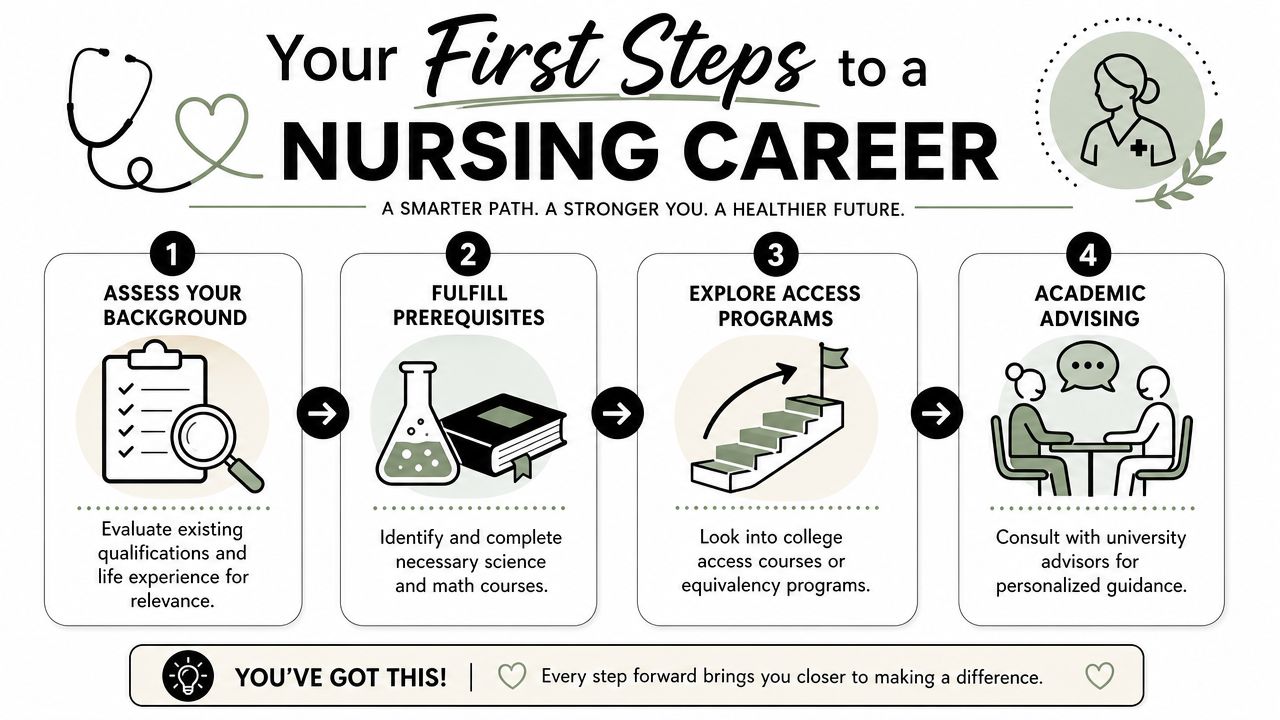
Before you enrol on anything, check your current qualifications. You may already have some of what you need. Old GCSEs, work experience, caring responsibilities, and previous study can all help you understand your starting point.
If you're missing key subjects, the usual first building blocks are:
- Functional Skills in English and maths: Useful if you need to strengthen core skills first.
- GCSEs: Often needed for university entry, especially English, maths, and sometimes science.
- Access to Higher Education Diploma: A common route for adults who want to progress to university without traditional school qualifications.
Many adults use this route successfully. Data from the UK Department for Education shows that 42% of new adult nursing students in the UK do not have a prior healthcare degree, and many use Access to Higher Education diplomas before applying for a nursing degree, as noted in this overview of nurse practitioner pathways.
What each step is really for
A lot of learners think these early courses are just hoops to jump through. They're not. They prepare you for the pace and style of university study.
Here's what they do in practice:
Functional Skills rebuild confidence
If you've been out of education for years, starting here can make study feel manageable again.GCSE-level study fills in gaps
Nursing degrees expect you to read carefully, write clearly, and handle number-based tasks.An Access course bridges you to university
This is often the turning point. You begin studying at a higher level and start seeing yourself as someone who belongs in higher education.
If you want to explore that route in more detail, these nursing access courses show the kind of bridge many adult learners use to move towards university entry.
Practical rule: Don't choose your first course by pride. Choose it by what gives you the strongest chance of success.
The hidden bottleneck adults often miss
One reason people feel lost is that many guides skip over the groundwork. They jump straight to university and leave out the part where an adult learner may need time to gain GCSEs or complete an Access diploma first.
That missing stage matters. It isn't a setback. It's part of the route.
A simple way to think about it is this:
| Starting point | Helpful next move | Why it matters |
|---|---|---|
| You left school with few qualifications | Functional Skills or GCSEs | Builds the basics you'll rely on later |
| You have some qualifications but not enough for nursing | Access to HE Diploma | Creates a recognised route to university |
| You've been away from study for years | Begin with a confidence-building course | Helps you settle into learning again |
You don't need to pretend this part is easy. Returning to education can feel exposing. But every worksheet, every assignment, and every pass builds proof that you can do hard things.
The University Journey to Become a Registered Nurse
You submit your university application after years away from the classroom. A few weeks later, you are reading a module list, looking at placement hours, and wondering whether you can really do this.
You can.
Once you have the entry qualifications you need, university becomes the stage where you train as a registered nurse. For many UK career changers, this is the first time the plan feels real. The Access to Higher Education route got you to the door. The nursing degree is what takes you through it.

University can sound bigger and harder than it really is. The course is demanding, but it is also structured. You are not dropped into a hospital and expected to somehow know what to do. You learn in layers, much like building a house. First the foundation, then the frame, then the parts that make everything work safely together.
What your nursing degree involves
A nursing degree usually combines academic study with supervised placements in real healthcare settings. You learn the science behind care, then practise that care with support.
Across the course, you will usually spend time on:
- Classroom learning: anatomy, communication, ethics, health conditions, and patient care
- Clinical placements: supervised practice in settings such as hospitals, community services, or care environments
- Written assignments: essays, reflections, and work based on evidence
- Practical skills: safe, professional care for real patients
For adult learners, that mix often helps. If sitting in a classroom all week sounds intimidating, placements can make the learning feel more concrete. If placements feel nerve-racking, the academic side gives you time to understand the why behind what you are doing.
If the application process still feels unclear, this guide on how to get into universities explains the admissions side in plain English.
Why this stage matters so much
Becoming a registered nurse comes before advanced practice. It is the part of the journey where you gain your professional grounding, learn how healthcare teams work, and start carrying real responsibility in a supported way.
That matters because Nurse Practitioners are not trained in a rush. The path builds step by step. First, you become a nurse who can assess, communicate, document, and care for people safely. Later, with experience and postgraduate study, you build on that base.
A short video can help make the bigger path feel more real:
What adult learners often bring to university
Many adult students arrive worrying they are behind. In practice, they often bring strengths that younger students are still developing.
If you have worked, raised children, cared for relatives, handled bills, or kept a household running during stressful times, you already know something about pressure, responsibility, and showing up when people need you. Nursing uses those qualities every day.
Common strengths adult learners bring include:
- Reliability
- Empathy
- Clear communication
- Time awareness
- Resilience
University does not expect you to arrive fully formed. It expects you to learn, practise, ask for help, and improve over time.
That is a different standard, and it is a much more human one.
A realistic way to look at the challenge
The degree is serious. There will be deadlines, long days, and moments when you feel stretched. But there is also a quiet shift that happens for many career changers. You stop seeing higher education as something meant for other people.
You start seeing proof that your earlier steps mattered. The GCSEs. The Access course. The evenings spent studying after work. None of that was wasted effort. It was training your mind, your habits, and your confidence for this stage.
And for many people, the reason goes deeper than a job title. It is about building a future your family can be proud of, creating more security, and showing yourself that your life can still change direction. One term, one placement, and one passed assignment at a time.
Gaining Experience and Studying for Your Masters
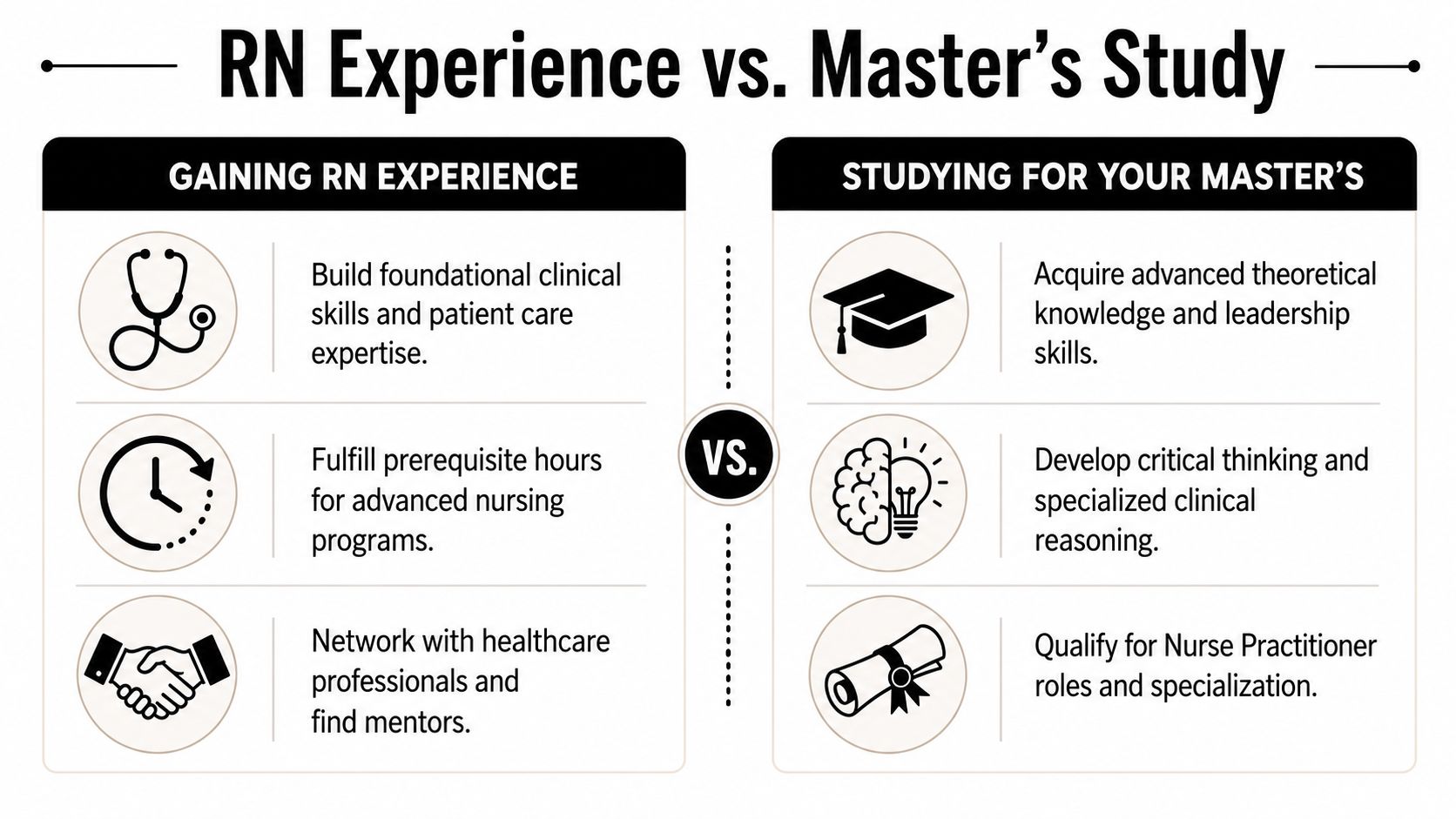
After qualifying as a registered nurse, you won't usually move straight into full Nurse Practitioner status. You'll first need time working in practice, building judgement, confidence, and clinical experience. Then comes postgraduate study, usually a Master's in Advanced Practice or an equivalent route.
This stage is where adult learners often hit the hardest question. How do you keep moving forward when you also have work, family, bills, and people depending on you?
Why RN experience matters first
Working as a registered nurse gives you more than a job title. It gives you the everyday understanding that advanced practice depends on. You learn how patients present in real life, how teams work under pressure, and how to make safe decisions when things aren't simple.
That experience also helps you choose where you may want to specialise later. Some nurses feel drawn to primary care. Others find their place in mental health, older adult care, or work with children and families.
Full-time and part-time routes compared
The challenge is that study doesn't happen in a vacuum. Many adults need a course structure that bends around life, not one that ignores it.
Recent 2025 NMC data shows only 15% of UK Nurse Practitioner programmes offer flexible clinical placements, while 68% of nurses work part-time, as discussed in this article on becoming a nurse practitioner. That's why flexibility isn't just a preference. For many people, it decides whether the path is workable at all.
Here's a simple comparison:
| Study route | Often suits | Main pressure point | Main advantage |
|---|---|---|---|
| Full-time Master's | Learners with fewer outside commitments | Less room for work and family changes | Faster progress |
| Part-time Master's | Working adults and parents | Can take longer and needs planning | More manageable alongside real life |
A smart question to ask a course provider: “How are clinical placements arranged for adults with work and caring responsibilities?”
How to make this stage more manageable
You don't need a perfect life setup before starting. But you do need a plan.
Try focusing on these areas:
- Work pattern: Evaluate your shifts and whether they can fit around study.
- Family support: Tell the people close to you what this goal means and where you'll need help.
- Course structure: Look for modular learning, clear timetables, and realistic placement support.
- Energy, not just time: A free evening isn't helpful if you're too exhausted to learn.
Some adults rush into the first postgraduate option they find. It's often wiser to pause and choose carefully. A slightly slower route that you can sustain is better than a faster route that collapses under pressure.
Choosing with your future in mind
This part of learning how to become a nurse practitioner is less about ambition and more about design. You're building a route that has to survive school runs, shift changes, tired weeks, and unexpected life events.
That doesn't make the dream smaller. It makes your planning stronger.
Your Final Steps Registration and Specialisation
By the time you reach this stage, you're no longer someone wondering whether higher education is possible. You're someone who has built skills, completed serious study, worked in healthcare, and earned the right to move into advanced practice.
The final stretch includes completing your postgraduate training, meeting the professional standards for advanced practice, passing the required board certification, and registering properly so you can work as a Nurse Practitioner.
The credential that makes it official
To become a fully qualified Nurse Practitioner, you must pass a national board certification and register with the NMC, as explained in this guide to Nurse Practitioner career paths. This formal credential is what allows you to practise and move into better-paid roles.
That matters for practical reasons, but it also matters emotionally. After years of effort, this is the point where your training becomes recognised professional status.
Choosing your special area
One of the most exciting parts of the final stage is specialisation. The career begins to feel more personal. You aren't only becoming a Nurse Practitioner. You're becoming the kind of Nurse Practitioner that fits your strengths and interests.
You might be drawn to:
- Primary care: Supporting patients with everyday health concerns and long-term conditions
- Mental health: Helping people through complex emotional and psychological needs
- Older adult care: Working with patients who need careful, joined-up support
- Children and families: Supporting younger patients and the adults who care for them
Different programmes and employers may use slightly different titles and pathways, so it's worth reading course details carefully and checking exactly how registration requirements are met.
The final exam and registration process aren't there to catch you out. They're there to confirm that you can practise safely and well.
Challenges at the finish line
The end of a long course can be strangely emotional. People expect you to feel only excitement, but many learners also feel tired, nervous, and unsure of themselves. That's normal.
At this point, keep your focus narrow:
- Finish the coursework well
- Prepare properly for certification
- Keep your documents organised
- Ask questions early if anything is unclear
Don't let paperwork or self-doubt steal the moment. You've already done the hard part by staying in the journey.
What this moment represents
Registration is more than an administrative step. It says something bigger. It says you kept going when life was crowded, when confidence dipped, and when the path looked longer than you hoped.
It says your new professional identity is earned.
You Can Do This Your New Future Awaits
Late at night, after work is finished and the house is quieter, this goal can feel very big. You might be looking at GCSEs, then an Access to Higher Education course, then university, then years of training after that, and wondering whether you have started too late.
You have not.
For many UK career changers, the path to becoming a Nurse Practitioner does not begin with A Levels already in place. It begins with the foundations. That might mean Functional Skills or GCSEs first. Then it may lead to an Access to Higher Education diploma, a nursing degree, registered practice, and postgraduate study. It is a long route, but long does not mean out of reach. It means you build it one layer at a time, like laying bricks for a house your future can stand on.
Steady progress still gets you there
Adult learners often carry two jobs at once. The work everyone can see, and the quiet work of rebuilding confidence.
If your journey takes longer than someone else's, that does not make it weaker. In fact, many mature students bring something powerful into nurse training: life experience, patience, and a clear reason for doing the work. When a course feels hard, that reason matters. It helps you stay at the desk for one more hour, ask one more question, and try again after a setback.
Some parts of the Nurse Practitioner route are known for stretching people, especially advanced study and prescribing. As noted earlier in the article, hard modules are part of the journey for many learners. Struggling with one part does not mean you are not suited to the role. It usually means you need time, support, and a better study plan.
What success can mean for your family
Your family may never fully understand every stage of the process. They may not know what an Access course includes, or why registration and postgraduate training take time.
But they will understand what your effort means.
They will see you choosing a better future.
They will see you keeping promises to yourself.
They will see that change is possible, even after years away from education.
That matters. Children, partners, and relatives often remember the example more than the details. They remember courage in ordinary clothes. They remember the person who decided that "this is how things have always been" was not good enough anymore.
Start small and make the path visible
When the full route feels foggy, shorten your view. The next step is the one that matters most.
- List the qualifications you already have
- Check whether you need GCSEs or Functional Skills first
- Look at Access to Higher Education diploma entry requirements
- Read a few nursing degree entry pages from UK universities
- Write down your reason for starting, especially the reason that matters on hard days
- Pick one date for one action, even if it is only making an enquiry
This process works like a staircase. You do not need to see the whole building to climb the first step.
A better future is usually built gradually. One lesson. One application. One placement. One passed module at a time. If becoming a Nurse Practitioner keeps returning to your mind, pay attention to that. Your starting point does not decide your finish line. Being nervous does not mean you cannot do it.
You can do this, and you do not have to do it all at once.
If you're ready to take that first step, Next Level Online College offers flexible online courses for adults across the UK, including Functional Skills, GCSEs, A Levels, and Access to Higher Education diplomas. If you've been out of education for years or you're trying to fit study around work and family, their support-led approach can help you build confidence and move towards university with a clear plan.