

The children are finally asleep. You're sitting at the kitchen table with your laptop open, looking at a course fee that seems much larger than expected. One question keeps returning: can I really afford this without falling behind on the bills?
That worry is sensible. Paying for online college can feel confusing, especially when you're balancing work, childcare and household costs. But adult learners in the UK have several legitimate routes, including loans, payment plans, employer help, bursaries, benefits and apprenticeship funding.
This guide will help you match each option to your situation. You'll also find realistic course price ranges, a simple budget plan and a timeline for making applications. You don't need to solve everything tonight. You just need to take the next clear step.
The Money Question Every Adult Learner Asks First
Aisha works part-time and has two children. She wants to improve her English qualification so she can apply for a better-paid role later. The course is online, which means she can study after work, but the fee still makes her nervous. She worries about school trips, food bills and an unexpected repair arriving in the same month.
Her first mistake was looking only at the total fee. Her second was assuming she had to pay it all at once. Once she asked the college for a full breakdown, she found several possible routes. She could compare self-funded instalments, ask whether a bursary was available and check whether a public loan applied to her chosen qualification.
A useful starting point: Don't ask only, “Can I afford the course?” Ask, “Which part of the cost could another funding route cover?”
Your answer will depend on your real-life position.
- Working parent: An employer contribution, a payment plan or part-time study may protect your monthly cash flow.
- Career changer: An Advanced Learner Loan could help with an eligible further education course, while part-time work covers living costs.
- GCSE returner: A college bursary, local support and a carefully chosen course may be more relevant than a university loan.
- Employee seeking promotion: Employer sponsorship or an apprenticeship may reduce the amount you need to pay yourself.
Online study can fit around family life, but the finance still needs planning. Write down the course fee, exam charges, equipment, travel to any exam centre and the date each payment is due. Then compare that list with your income and available support.
You're not failing because the money feels difficult. You're doing the responsible thing by checking before you enrol. A clear plan can turn a frightening fee into a series of manageable decisions.
What Online College Actually Costs in the UK
Start with the qualification, not the provider's headline offer. Different levels need different amounts of teaching, assessment and examination support, so the price can change widely.
Use the figures below as a rough shopping guide, not a promise of what every college charges. Prices vary according to the provider, awarding organisation, level and whether exams are included.
| Qualification | Typical Price Range |
|---|---|
| GCSE subject | £250 to £500 per course |
| Functional Skills Maths or English | £150 to £400 |
| Access to HE Diploma | £1,200 to £3,200 |
| A Level subject | £300 to £600 per subject |
| Short vocational certificate | £400 to £1,500 |
Providers such as Oxford Home Schooling and ICS Learn may appear when you compare GCSE options, but you should still request a complete fee breakdown. An advertised price may cover tuition while leaving assessment, examination or administration charges separate.
Exam-centre and administration fees may add £50 to £150, depending on the course and arrangements. If you're studying from home, ask whether you'll need to attend an approved centre for an examination and whether the provider helps arrange it.
How to compare two course quotes
Take two quotes and place them side by side. Check these points before you focus on the cheapest total:
- Tuition: What teaching, marking and tutor support are included?
- Assessment: Are assignments, practical assessments or examination entries included?
- Materials: Will you need books, specialist equipment or software?
- Time limit: How long can you remain enrolled?
- Refund rules: What happens if work or family circumstances force you to pause?
A very low quote may exclude important costs. A higher quote may include more support, but that doesn't automatically make it good value. Ask the provider to explain every fee in plain English.
The most useful figure for your budget is the amount you must pay, followed by the payment dates. That number gives you a firm starting point for comparing loans, instalments and support.
Using Advanced Learner Loans and Tuition Fee Loans
An Advanced Learner Loan is designed for eligible adults taking further education courses. Official guidance says adults in England can use it for approved courses and that grants or bursaries may also be available through the government money and learning support guidance.
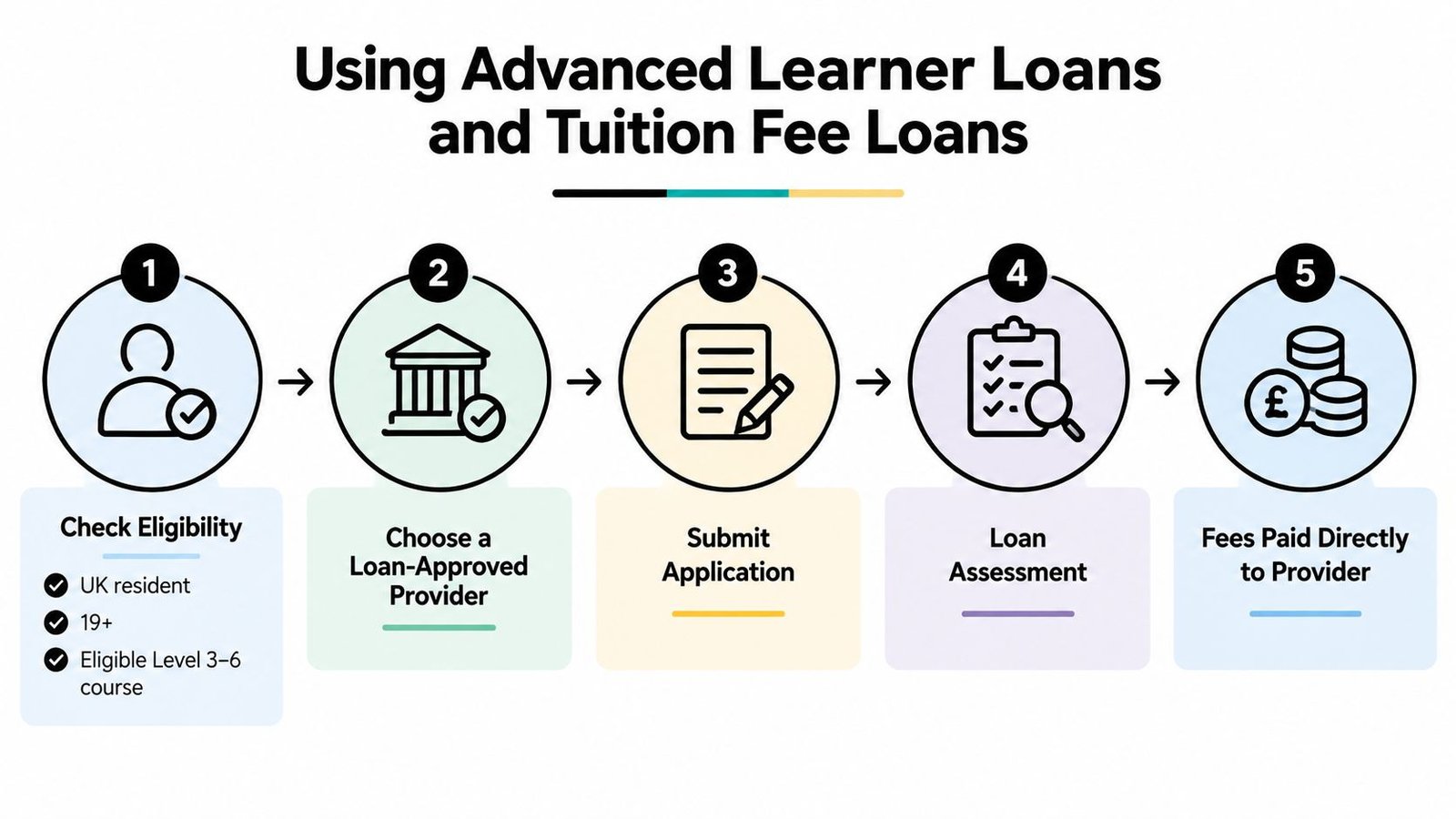
A typical application follows this order:
- Check your course level and provider. Advanced Learner Loans can apply to eligible Level 3 to Level 6 courses, including many Access to HE Diplomas. The provider must be approved for loan funding.
- Ask the college for its learning and funding details. Don't rely on the word “online”. The qualification, provider and course must meet the rules.
- Apply through Student Finance England. You'll need to provide the requested identity and course information.
- Wait for the assessment. If approved, the loan pays eligible course fees to the provider rather than giving you a cash payment for household bills.
- Check repayment conditions. Repayment begins only when your income passes the relevant threshold. The remaining balance is cleared after 30 years under the stated rules.
Access to HE students should ask about the special progression rule. If you complete an eligible Access to HE Diploma and then progress to university, the Advanced Learner Loan may be written off entirely, subject to the applicable conditions. Confirm the details with Student Finance England before making decisions.
Tuition Fee Loans for online degrees
Higher education funding works differently. In England, a full-time distance-learning course started on or after 1 September 2012 can qualify for a Tuition Fee Loan, while part-time study generally needs at least 25% intensity of an equivalent full-time course to qualify for support. For 2025–26, the maximum part-time fee loan is £7,145, rising to £7,335 in 2026–27, according to Student Finance England's part-time student guidance.
Full-time distance learning has a higher tuition fee loan cap, up to £9,535 in 2025–26 and £9,790 in 2026–27, in eligible cases. Maintenance support can differ from campus study, so don't assume a distance-learning course gives you the same living-cost help.
Use the guide to Advanced Learner Loans for further course-specific information. You can also watch this short explanation:
The common trap is assuming every online course qualifies. Before paying a deposit, confirm the provider's approved status, the qualification type, the course intensity and the exact funding cap.
Payment Plans, Employer Sponsorship and Apprenticeships
Loans aren't the only way to manage study costs. Many working adults compare a direct payment plan, help from their employer and an apprenticeship route.
A payment plan lets you spread fees into regular instalments paid to the college. It can suit a career changer who wants control and doesn't want to apply for formal borrowing. Ask whether the plan is interest-free, whether a deposit is required and what happens if you need to pause.
Employer sponsorship may work well when your course supports your current job. Speak to HR before enrolling and ask whether the employer pays the provider directly, reimburses you after each assessment or covers only part of the fee. Read any study agreement carefully. A clawback clause may require you to repay some employer funding if you leave within the agreed period.
An apprenticeship is different again. The employer pays a 0.5% levy on its annual pay bill, offset by a £15,000 allowance, where the levy rules apply. Where levy funds are available, the government pays providers 80% of the negotiated price in equal monthly instalments, up to the funding band maximum. If funds aren't sufficient, co-investment still covers 80% of training, with the employer contributing the balance. These rules come from the apprenticeship funding rules for 2025 to 2026.
| Feature | Payment Plan | Employer Sponsorship | Apprenticeship |
|---|---|---|---|
| Main payer | You | Your employer, fully or partly | Employer and government funding |
| Best fit | Self-funded study | Upskilling in your current role | Paid work with structured training |
| Key question | What are the instalment dates? | Is there a clawback clause? | Is the employer and programme eligible? |
| Cash flow | Regular payments to the college | Depends on reimbursement terms | Provider payments follow funding rules |
| Main risk | Missing a payment | Owing money if you leave early | Confusing it with student finance |
Small employers may still offer apprenticeship opportunities, but you'll need to check their eligibility and the proposed standard with the training provider. Apprentices can't use a student loan to pay for their apprenticeship, and an existing loan must be terminated if it's in place.
Ask your employer about tax treatment too. A workplace contribution may have tax implications depending on how it's arranged. For apprenticeship routes, review the apprenticeship entry requirements and confirm every responsibility in writing.
Bursaries, Grants and Benefits That Can Help
Bursaries can fill the gap left after you've checked loans and payment plans. Colleges and universities may offer hardship help, childcare support or course-material assistance, but each provider sets its own rules and budget.
If you're using an Advanced Learner Loan, ask about the 19+ Advanced Learner Loan Bursary Fund. Colleges may use it to support eligible learners with childcare, travel and study materials. You may also find subject-specific help through professional bodies, such as the Royal Society of Chemistry or construction training boards.
Benefits need careful checking. Part-time online study will often be easier to combine with Universal Credit than full-time study, but your work, income, caring responsibilities and course status all matter. Full-time study can trigger tighter rules. Tell your benefits adviser about the course before you enrol, rather than assuming online learning won't count as study.
Why local support can be hard to find
Adult education funding is under pressure. The Association of Colleges reports that 2025–26 spending was £1.31 billion, 3% lower than 2024–25 and below 2016–17 levels, while the Institute for Fiscal Studies puts the 2025–26 adult education budget at about £1.5 billion, down from £1.8 billion in 2019–20. You can read the IFS discussion in its analysis of schools and colleges funding.
That doesn't mean support has disappeared. It means availability can vary sharply by region, provider and eligibility category. Ring the bursary officer early and ask about college funds, local authority discretionary support and household-related assistance.
Keep a record of every application. Some grants can be combined, while others reduce the amount available from another fund. Ask the college to check whether support overlaps before you accept awards. The online bursary application guidance can help you prepare the questions you need to ask.
Budgeting and Application Timelines That Work
A funding application is easier when you treat it like a small household project. Put one folder on your phone or computer for course quotes, identity documents, application references, receipts and decision letters.
Six months before enrolment
Research courses and ask each provider for a full fee breakdown. Build a simple spreadsheet with three columns: household essentials, study costs and a small contingency. Include tuition, exam fees, books, internet use, travel to an exam centre and childcare if live sessions require it.
Three months before
Check Advanced Learner Loan eligibility on GOV.UK if you're considering an eligible further education course. Gather your identification, course details and income documents, then ask your employer about sponsorship or apprenticeship routes.
Six weeks before
Submit funding applications and bursary forms. If you're self-funding, agree the direct debit instalments in writing. Arrange childcare and tell your family when you'll need quiet study time.
Two weeks before
Confirm your enrolment and attendance details. Download required software, test your login and place your study blocks in the family calendar. A plan that everyone can see is easier to protect.
Try this weekly template:
- Income: wages, benefits and regular contributions.
- Essentials: rent, food, utilities, travel and childcare.
- Study: tuition instalment, materials, exam costs and equipment.
- Buffer: a small amount held back for an unexpected cost.
Don't build a plan that only works if every payment arrives perfectly on time. Funding may not reach the college until week three of term, so ask about the provider's payment deadline and whether temporary arrangements are available.
Keep receipts for course materials and other costs. You may need them for funding evidence, employer reimbursement or tax advice. If you're unsure about tax, speak to HMRC or a qualified adviser rather than guessing.
Your Personal Funding Plan and the Family Future It Can Support
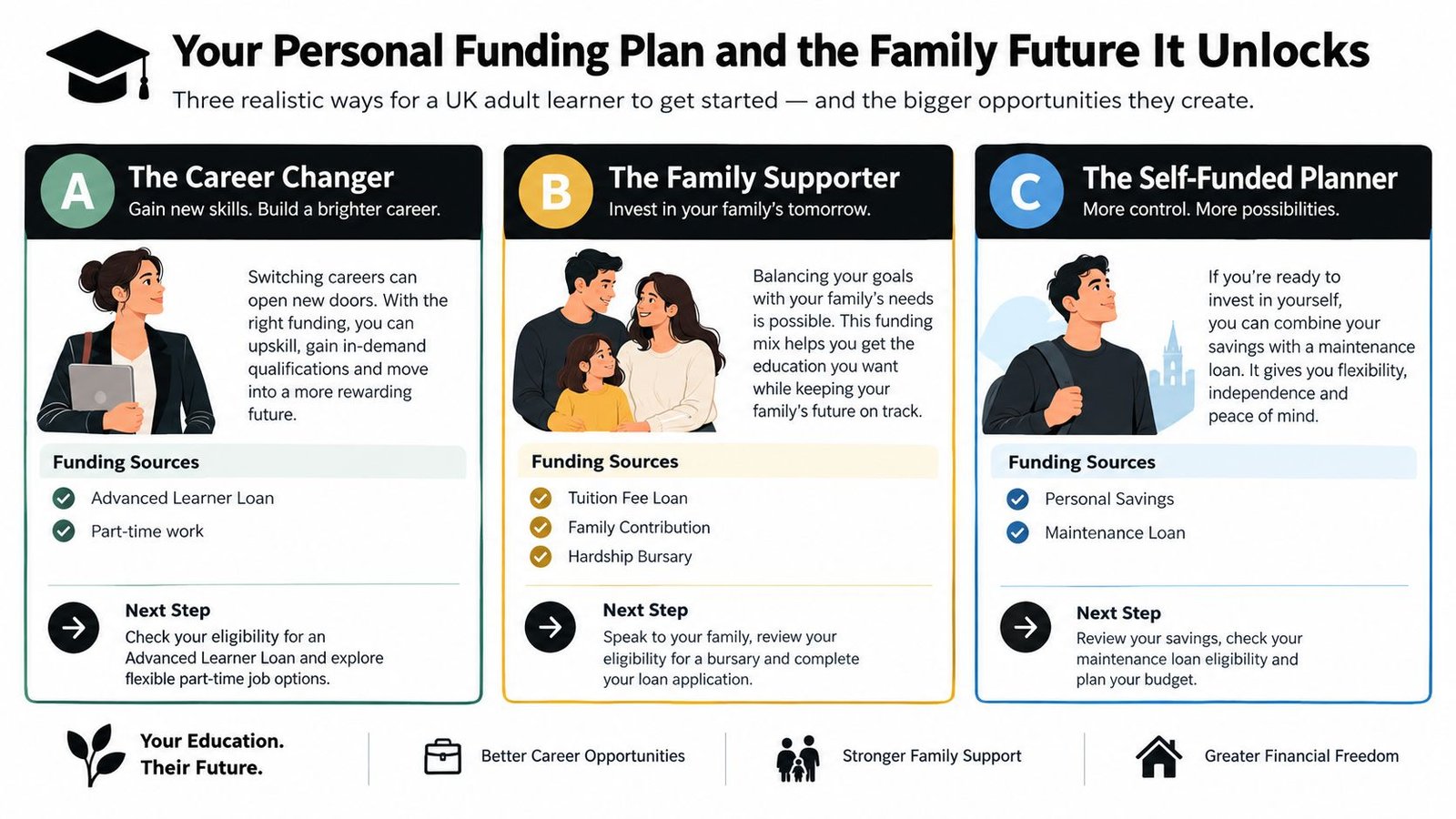
Your funding plan should fit your real life, not an imaginary student's routine. Start with the course, then match each cost to a realistic source of help.
A single mother retaking GCSE English might ask the provider for the full tuition and examination cost. She could then check a college bursary, local support and a payment plan she can manage. A short conversation with school or family may also help arrange childcare on assessment days. These details matter because a plan that ignores care responsibilities can fail even when the course fee is covered.
A learner in their forties changing careers may choose an Access to HE Diploma. An Advanced Learner Loan could cover eligible fees, while part-time work protects the household budget. If university follows, they should ask Student Finance England about the progression rule before accepting the loan. That check can prevent an unexpected repayment issue later.
A key worker adding a Level 3 NVQ should speak to their employer first. Sponsorship or an apprenticeship may suit the role better than personal borrowing, especially when the qualification supports their current work. A GCSE returner, career changer and working parent may each use a different combination of support.
Your five-point money checklist
- List every fee: Include tuition, examinations, materials, equipment and childcare.
- Match each fee to a source: Consider a loan, bursary, employer support, apprenticeship or payment plan.
- Confirm eligibility: Check the provider, qualification, study intensity and funding rules.
- Write down every deadline: Record application dates, payment dates and decision dates.
- Create a buffer: Put aside £20 each month for unexpected study costs.
Funding rules may change. The government has said that from September 2026, student finance is planned to extend to shorter flexible modules from January 2027, with funding worth up to £39,160 across four years of post-18 study, subject to final rules, as described in its announcement about new adult learning reform. Check the confirmed rules when your course begins rather than relying only on an early announcement.
For the wider household budget, this guide to planning your finances in 2026 can help you place course payments beside bills, savings and family goals.
Adult learning can feel brave because it asks you to make room in a busy life. Your children may see you revise at the kitchen table, ask questions and continue after a difficult day. That example can matter, while a new qualification may support promotion, a career change or more fulfilling work.
With the right checks, online college becomes a planned, affordable step around your family.
Next Level Online College offers flexible online GCSEs, Functional Skills, A Levels and Access to Higher Education courses, with payment options that can spread the cost. Visit Next Level Online College to compare suitable courses and ask which finance and support routes may fit your circumstances.