
You might be reading this after a long day at work, with the washing still to do and a hundred worries in your head. Part of you wants something better. Better pay. Better chances. Better choices for your future. But another part of you keeps asking, “Am I too late?” or “What if I'm not clever enough anymore?”
Those feelings are common. They don't mean you can't do this. They usually mean this matters to you.
Many adults look at apprenticeship entry requirements and feel stuck before they even begin. The words can sound formal. The rules can feel hard to understand. Old school memories can come rushing back. But it is much simpler than it first appears. An apprenticeship is not a test of whether you were perfect at school. It's a route into a real job, with training, support and a qualification that can help you build a stronger future.
Ready for a Change You Can Be Proud Of
You get to the end of another working day, sit down for a minute, and catch yourself looking at jobs that seem just out of reach. The pay is better. The work sounds steadier. The future looks more secure. Then the doubt creeps in. What if the qualifications put you out of the running before you even start?
That feeling is real. It can also be misleading.

For many adults, entry requirements look like a locked gate. In practice, they are usually more like a checklist at the start of a journey. If one item is missing, it often means, "sort this next," not, "give up."
That difference matters.
Why this path can feel bigger than it is
If you have been out of education for years, words like level 2, GCSE, provider, or eligibility can stir up old school worries very quickly. You might wonder if apprenticeships are only for school leavers. You might assume everyone else understands the system and you are starting behind.
Many adults feel this way at first, especially if their confidence took a knock years ago. Feeling nervous does not mean you are not capable. It usually means the outcome matters to you, and you want to get it right.
Apprenticeships are a normal route in England, not a rare one. The Department for Education reports that there were 337,140 apprenticeship starts in England in 2023/24, including 195,400 at level 2 and level 3, in its Apprenticeships and traineeships data. This scale shows that apprenticeships are a mainstream option for people at the levels where entry requirements often matter most.
What pride can look like in real life
Pride does not always mean a dramatic career change overnight. Sometimes it means filling in an application you once would have closed. Sometimes it means getting your English or maths sorted after years of telling yourself you were "just no good" at them. Sometimes it means showing your children, your partner, or yourself that your story is still being written.
A better future is usually built in stages. One requirement. One application. One qualification. One good decision at a time.
You do not need to have everything sorted today. You only need to see that these rules can be understood, handled, and worked through. Once that becomes clear, the whole process starts to feel less like a judgement on your past and more like a plan for your future.
What an Apprenticeship Really Means for You
An apprenticeship is often easier to understand if you stop thinking of it as school. It's much closer to learning to drive. You learn the rules and theory with support, but most of your progress comes from hands-on work in practical situations.
That's why many adults find apprenticeships more manageable than they expected. You're not sitting in a classroom all week. You're building skills in a working role.
How the learning is split
Apprenticeship delivery is typically 80% on-the-job and 20% structured learning with a training provider, and the final end-point assessment checks your knowledge and skills through practical tests and discussions, as explained by Careerpilot's guide to how apprenticeships work and are assessed.
That split matters because it suits adults with responsibilities. You're learning in a practical way while gaining recognised training. The structure also helps employers see whether someone is ready to cope with the role and the final assessment.
Why employers look at entry requirements
Employers and providers don't ask for entry requirements just to make life difficult. They want to know whether you can handle the training, the job tasks and the final assessment. If a role includes written work, problem-solving, safety rules or customer communication, they need some confidence that you can build those skills successfully.
Here's what that often means in practice:
- You must be able to do the job role: An apprenticeship is a real job, not just a course.
- You must be able to complete the learning: This includes off-the-job study as well as workplace tasks.
- You must be able to pass the final assessment: Some standards include interviews, tests, discussions or presentations.
An apprenticeship respects your need to earn, learn and move forward at the same time.
For adults who've been out of education for years, that can be a relief. You're not starting from scratch in the way you may fear. You're building on life experience, work habits and determination you already have.
Understanding the Different Apprenticeship Levels
Not all apprenticeships start at the same point. They come in levels, a bit like steps on a ladder. The best starting point depends on your current qualifications, your confidence and the kind of career you want.
Many adults worry they'll have to begin at the very bottom. That isn't always true. Your past qualifications, work history and life experience may help you start at a level that suits you better.
Adults are a major part of the system
Apprenticeships aren't only for school leavers. Government data for England shows that 58% of apprenticeship starts in 2023/24 were by adults aged 19 and over, which confirms that these routes are widely used by career changers and returners, as noted in this overview of apprenticeships and their wider potential.
If you're an adult thinking about a fresh start, you belong here.
Apprenticeship levels at a glance
| Apprenticeship Level | Equivalent To | Typical Entry Requirements |
|---|---|---|
| Intermediate | Similar to GCSE level | Often suitable for beginners. Employers may ask for some basic English and maths evidence. |
| Advanced | Similar to A Level study | Often asks for stronger prior knowledge or GCSEs, especially in English and maths. |
| Higher | Study beyond A Level | Usually for people with stronger qualifications or relevant experience. |
| Degree | University-level study | Often designed for people who can meet higher academic or occupational expectations. |
This table gives a simple guide, not a fixed rule for every job. Apprenticeship entry requirements are occupation-specific and employer-led. One employer may be flexible. Another may be stricter, even for similar job titles.
How to choose your level
Ask yourself these questions:
- What do I already have: Old qualifications, workplace experience and industry knowledge all matter.
- What role do I want: A practical starting role may suit an intermediate or advanced apprenticeship. A more technical or professional route may point towards higher or degree level.
- What can I realistically manage now: The right choice is the one that stretches you without knocking your confidence flat.
A lower starting point is not a failure. It can be the smartest move. It gives you a firm base, helps you succeed sooner and often opens the next door after that.
The Big Question What About English and Maths
You find an apprenticeship that feels right. The hours work. The job sounds interesting. You start to picture where it could lead. Then you spot the words “English and maths” and your stomach drops.
That reaction is common for adult returners. School memories can make these subjects feel bigger and scarier than they are. Apprenticeship rules are often more flexible than people expect, and the key question is usually not “Am I good enough?” but “What do I already have, and what do I need to work towards?”
In many apprenticeships, employers ask for GCSE English and maths, often at grade 4/C or above. If you do not already hold those qualifications, there may still be a route in. The apprenticeship funding rules for England explain that some apprentices may need to study English and maths as part of their programme, depending on their age, prior attainment and apprenticeship standard.
Why these subjects matter
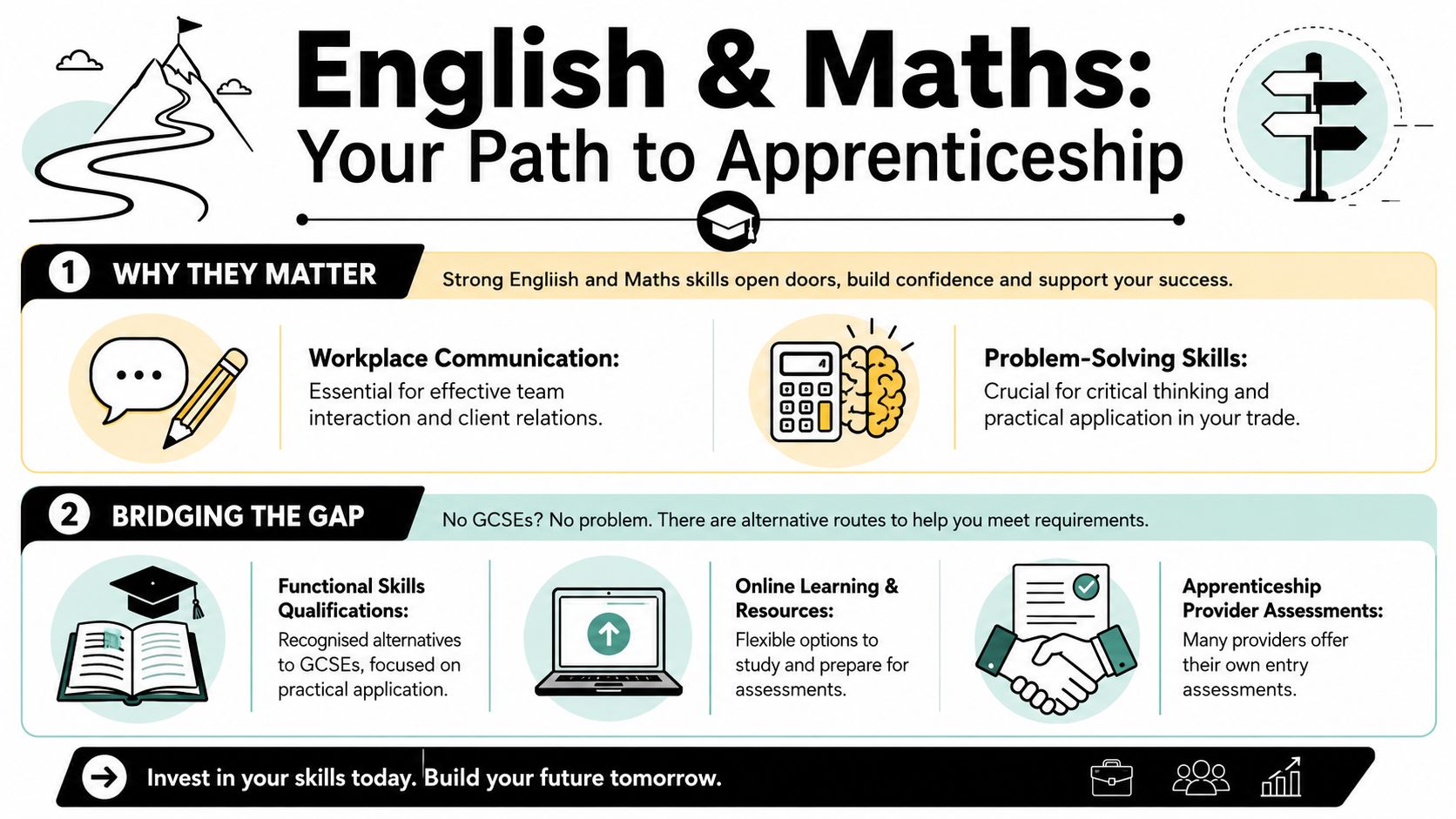
English and maths sit underneath everyday work in the same way foundations sit underneath a house. You may not always notice them, but they support everything above. Reading instructions, writing messages clearly, measuring materials, checking figures, understanding rotas, and speaking with customers all depend on these skills.
Employers are not usually asking for them to make life harder. They want to know you can manage the training and the job itself with confidence.
If the word GCSE makes you tense up, pause there. GCSEs are one route. They are not the only route adults can take.
Functional Skills can bridge the gap
Functional Skills qualifications are designed to be practical and relevant. They focus on using English and maths in real situations, which often suits adults far better than repeating school-based learning. For someone returning to education, that can feel less like going backwards and more like building the tools you need for the next stage.
If you want a clear picture of this option, read about Functional Skills Level 2 in maths and English.
A missing qualification is not a verdict on your ability. It is a gap you can fill.
Plenty of adults start from this point. They sort out English or maths first, gain confidence as they go, and then apply with a much stronger sense of direction. If that is you, you are not behind. You are preparing properly, and that is a strong place to begin.
How to Fill Gaps and Become the Perfect Candidate
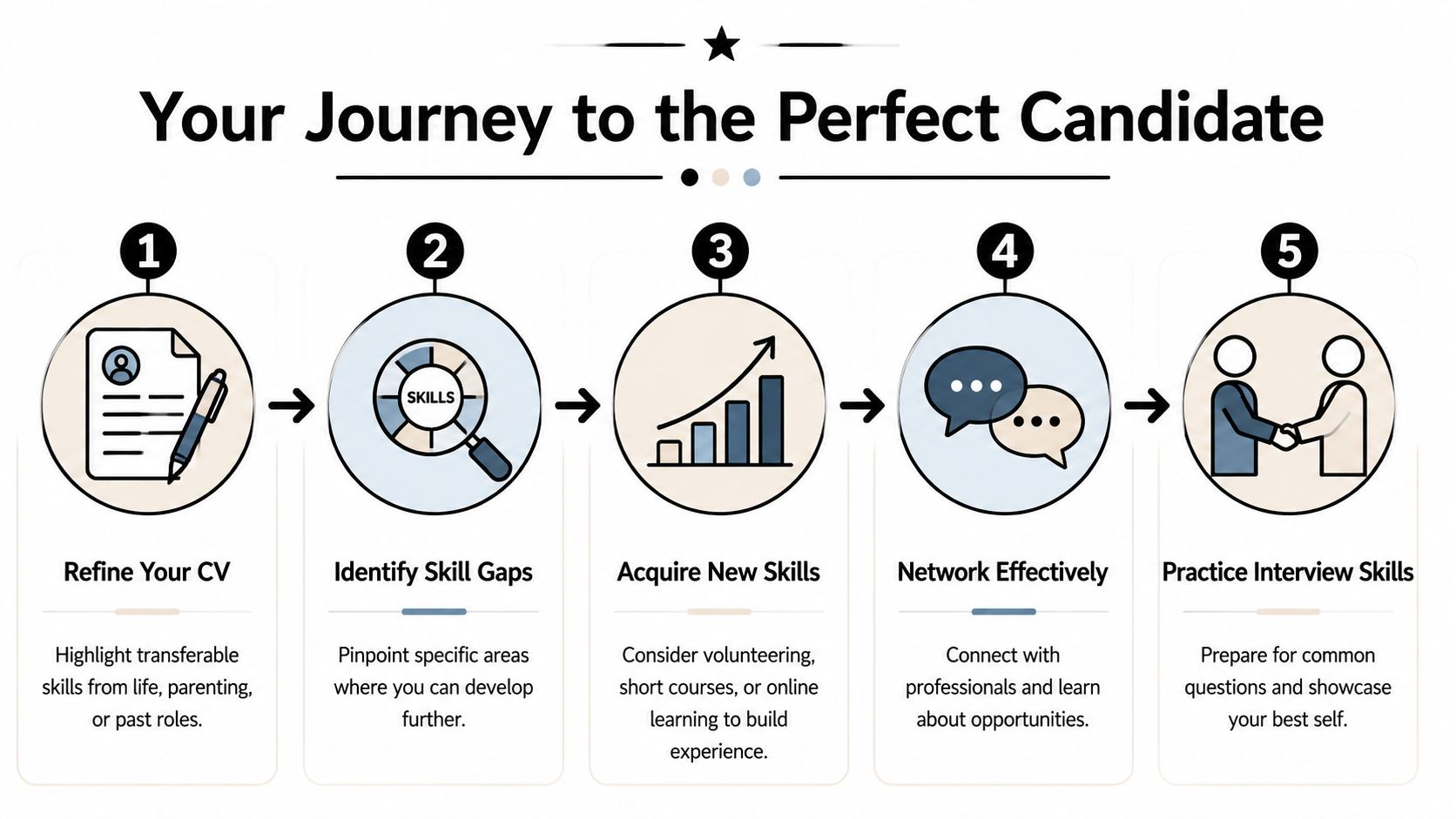
If your first thought is “I'm interested, but I'm not ready yet,” that's useful. It means you can start building a plan instead of guessing. The strongest applications often come from people who know their gaps and work on them step by step.
UK skills policy is increasingly focusing on pre-apprenticeship pathways that help applicants meet minimum requirements. The key idea is simple. Find a route that bridges the gap, such as targeted Functional Skills study or another preparation pathway, as outlined in this direct entry and preparation overview.
Start with what is missing
You don't need to improve everything at once. Focus on the gaps that matter most for the apprenticeship you want.
A simple order can help:
Check the job advert carefully
Write down every requirement. Separate qualifications, work skills and practical conditions.Sort each requirement into two groups
Flexible things can often be worked on. Non-negotiable things usually cannot.Choose one action for each flexible gap
That might mean studying English, improving maths, gaining confidence with digital skills or getting some relevant experience.
Build proof, not just hope
Employers like signs that you're serious. You can create those signs even before you apply.
- Refresh your core qualifications: If you need a GCSE equivalent, start there. This guide to what a GCSE equivalent is can help you understand your options.
- Show interest in the field: A short course, taster session or relevant volunteering can strengthen your application.
- Use your existing life experience: Parenting, caring, organising a household, handling customers or working under pressure all build useful skills.
Think like an employer
An employer isn't just asking, “Does this person already know everything?” They're often asking, “Can this person grow, learn and stick with it?” Adult learners often bring reliability, maturity and determination. Those qualities matter.
A gap is only a problem when it stays hidden and untouched. Once you name it and work on it, it becomes part of your progress.
Your Checklist for a Successful Application
Applications feel less frightening when you break them into small tasks. You don't need to do everything in one sitting. One clear job at a time is enough.
Start with the basics, then move to the details.
Know what can bend and what can't
Apprenticeship entry requirements are not only about grades. They can include age, right-to-work status and role-specific needs, and it's important to understand which requirements are flexible and which are firm, based on this guidance on transparent entry and success requirements.
That's a key point. Some people give up because they treat every requirement as fixed. Others waste time because they assume every rule can be worked around. The smart move is knowing the difference.
A practical checklist
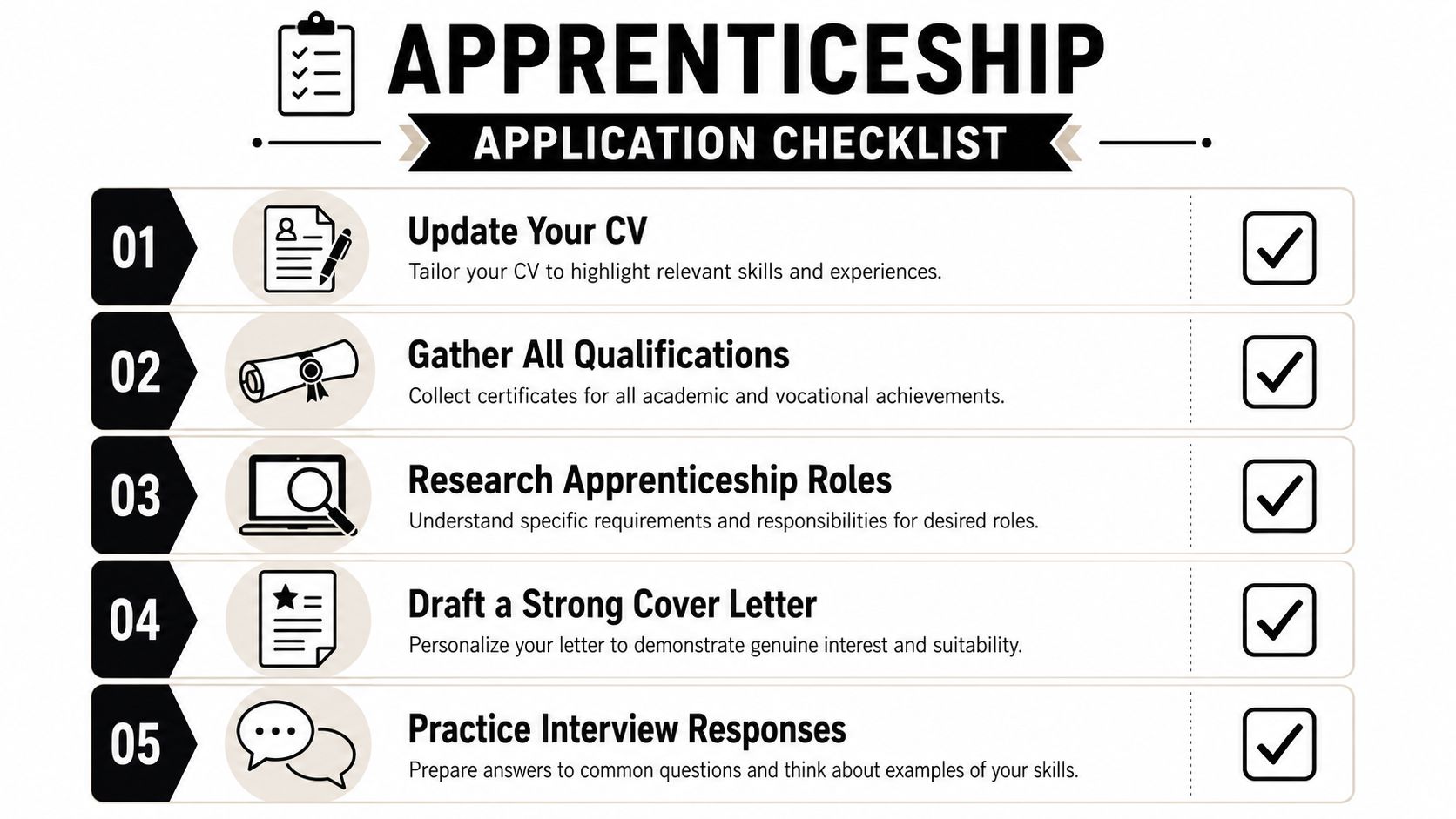
Update your CV
Include paid work, unpaid responsibilities and transferable skills. If you've managed family schedules, budgets, appointments or difficult situations, that shows organisation and resilience.Gather your certificates
Old exam results, training records and workplace qualifications can all help. If something is missing, make a note to ask for replacement information.Read each advert slowly
Look for qualifications, licence needs, work pattern, location and any legal or physical requirements.Ask questions early
If a requirement is unclear, contact the employer or provider. That shows initiative.Prepare for the interview
Think of real examples that show teamwork, reliability, communication and problem-solving.
This short video may help you think about the process in a more practical way.
One useful extra check
If you're unsure how your old grades compare with today's system, this guide to what GCSE grades mean can make things clearer.
You do not need a perfect application. You need a truthful one, a prepared one and one that shows you're ready to learn.
Your Questions Answered
Some worries don't show up until you've started looking properly. These are common ones.
Do old qualifications still count
Often, yes. Older qualifications can still be useful, especially when they show a history of study and achievement. Even if the system has changed since you were at school, providers can often help you understand how your past learning fits with modern requirements.
Can I do an apprenticeship if I already have a job
In many cases, yes. Some adults start an apprenticeship with their current employer if the training matches their role and helps them develop. If that interests you, speak to your employer and ask whether training through an apprenticeship could support your progression.
What if my qualifications are from another country
You may still be able to use them. Employers or providers might ask for evidence showing what those qualifications are comparable to in the UK. It's an extra task, but it's manageable, and many learners do it successfully.
If something about your background feels unusual, ask anyway. Adult learners often assume a rule will exclude them when a quick conversation could give them a route forward.
The biggest mistake is staying silent because you feel embarrassed. Questions are part of the process. Asking them shows commitment, not weakness.
Your New Future Starts Today
If you've read this far, you already care about your future enough to look for answers. That matters. It shows effort, courage and hope, even if you don't feel confident yet.
Apprenticeship entry requirements can look complicated when you first meet them. But once you break them down, they become far more human. Some requirements are fixed. Some can be worked towards. Some need explaining properly. None of that means you're too late.
You can still become the person your children look up to. You can still move into work that feels more secure, more skilled and more fulfilling. You can still prove to yourself that education is not something you missed. It's something you can return to with purpose.
Start small. Check one apprenticeship. Find out one requirement. Improve one qualification. Ask one question.
That's how big change begins. Not in one giant leap, but in brave, steady steps taken by ordinary people who decide they deserve a better future.
If you're ready to take that next step, Next Level Online College offers flexible online courses for adult learners who want to build confidence, gain recognised qualifications and become eligible for new opportunities. Whether you need Functional Skills, GCSEs, A Levels or an Access to Higher Education Diploma, their support can help you move forward around work and family life.