
You're clearing away the dinner plates after a long shift when your child asks, “What do you want to be when you grow up?” You smile, but a quiet thought stays with you: could I become a doctor?
Perhaps you left school years ago. Perhaps work, bills and family responsibilities have filled the space where studying used to be. Medical school entry requirements can look like a tall wall of grades, tests and interviews, but they're easier to understand when you turn them into smaller checkpoints.
This guide will help you identify the academic subjects, admissions test, interview preparation, experience and route that may fit your life. You don't need to solve everything tonight. You only need to find the next sensible step.
You Are Not Too Late to Aim for Medicine
An adult returner often starts with doubt rather than confidence. You may be working in a routine job, caring for children or relatives, and wondering whether universities will take your application seriously. You might also worry that younger applicants have already mastered science, revision and exams while you've been busy keeping your family going.
That comparison isn't fair to you. Life has given you skills that a classroom can't always teach, including patience, responsibility, communication and the ability to keep going when plans change. Medicine needs academic preparation, but selectors also look for people who can listen carefully, act responsibly and understand the human side of care.
Remember: You don't have to feel ready before you begin. Confidence often grows after you take organised, supported action.
The phrase medical school entry requirements can sound like one single test. In the UK, it's more helpful to think of them as several connected checkpoints:
- GCSE preparation: Medical schools generally expect strong results in English, maths and science subjects.
- A-level or equivalent study: Chemistry is central, and Biology is often expected too.
- Admissions testing: The UCAT is now a major selection filter for UK medicine applications.
- Interviews: Universities assess communication, motivation, judgement and empathy.
- Checks and experience: Fitness to practise, DBS processes and evidence that you understand caring work may also matter.
- The right route: Standard entry, graduate-style courses, Access to HE and widening-participation options suit different learners.
The British Medical Association's guidance on applying to medical school explains that applicants are generally expected to show strong GCSE results in English, maths and science, alongside Chemistry at A-level and often Biology. It also notes that students with mainly non-science A-levels would normally be expected to take a foundation course, which adds an extra year to the standard five-year degree.
That doesn't mean your past choices have closed the door. It means you may need to choose a different entrance path and plan your study carefully around your home life. Your children may one day remember not only that you became a doctor, but that you had the courage to begin.
Understanding the Academic Requirements
Academic requirements are the foundation of a medicine application. Think of them like ingredients for a recipe. English and maths help you understand information, communicate clearly and work with figures. Science subjects provide the knowledge needed for later study. If an ingredient is missing, you don't throw away the recipe. You find the right way to add it.
Start with your GCSE picture
Medical schools commonly look for strong GCSE results in English, maths and science. Each university sets its own rules, so don't assume that one school's grade policy applies everywhere. Check the current course page for every university you might consider.
Your first task is to make a simple list:
- Which GCSEs do you already hold?
- Which grades did you achieve?
- Do you need English, maths or science retakes?
- Does your preferred medical school accept equivalent qualifications?
- Would Functional Skills help you progress towards the GCSE level you need?
The BMA confirms that strong GCSE results in English, maths and science are normally expected for applicants. That doesn't mean every adult must repeat every school subject. It means you should compare your existing qualifications with the exact requirements of possible medical schools before enrolling on a course.
Chemistry is usually the core ingredient
Most UK medical schools expect at least AAA at A level, usually including Chemistry and often Biology, according to Royal College of General Practitioners medical-school guidance. Chemistry supports later learning in areas such as pharmacology and physiology. Biology supports anatomy, cell biology and systems-based learning.
A historical benchmark in the same guidance listed the standard A100 medicine route for 2020–21 as AAA in Biology, Chemistry and one other subject. Treat this as a useful illustration of the traditional pattern, not as a substitute for checking current university pages.
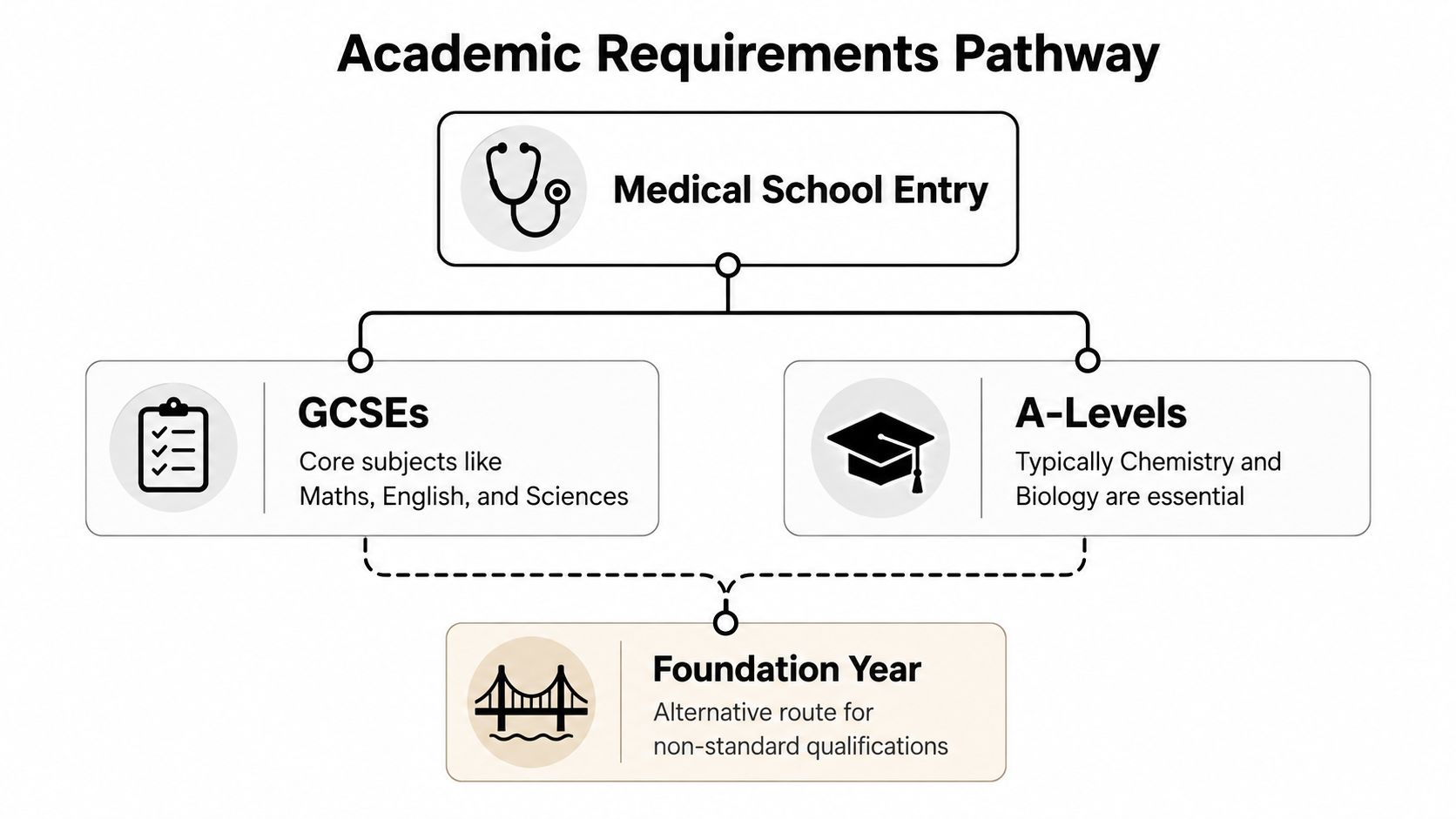
If you didn't take science A-levels, you still have options. A foundation year may be designed for students without the usual science background, while an Access to HE Diploma can prepare adult learners for university-level study. Some graduate-entry-style routes use a degree as part of the academic requirement, so the best choice depends on what you already have and how much time you can give to study.
You can also read this plain-English guide to university entry requirements in the UK before choosing your next qualification.
A helpful rule: Don't ask, “Am I clever enough for medicine?” Ask, “Which subject or qualification do I need to build next?”
Make an appointment with admissions teams before committing to a course. A university may accept an Access Diploma, but it may also require particular modules, grades or GCSE subjects. Writing those requirements down gives you a target you can work towards rather than a worry you carry around.
How UCAT Fits Into the Picture
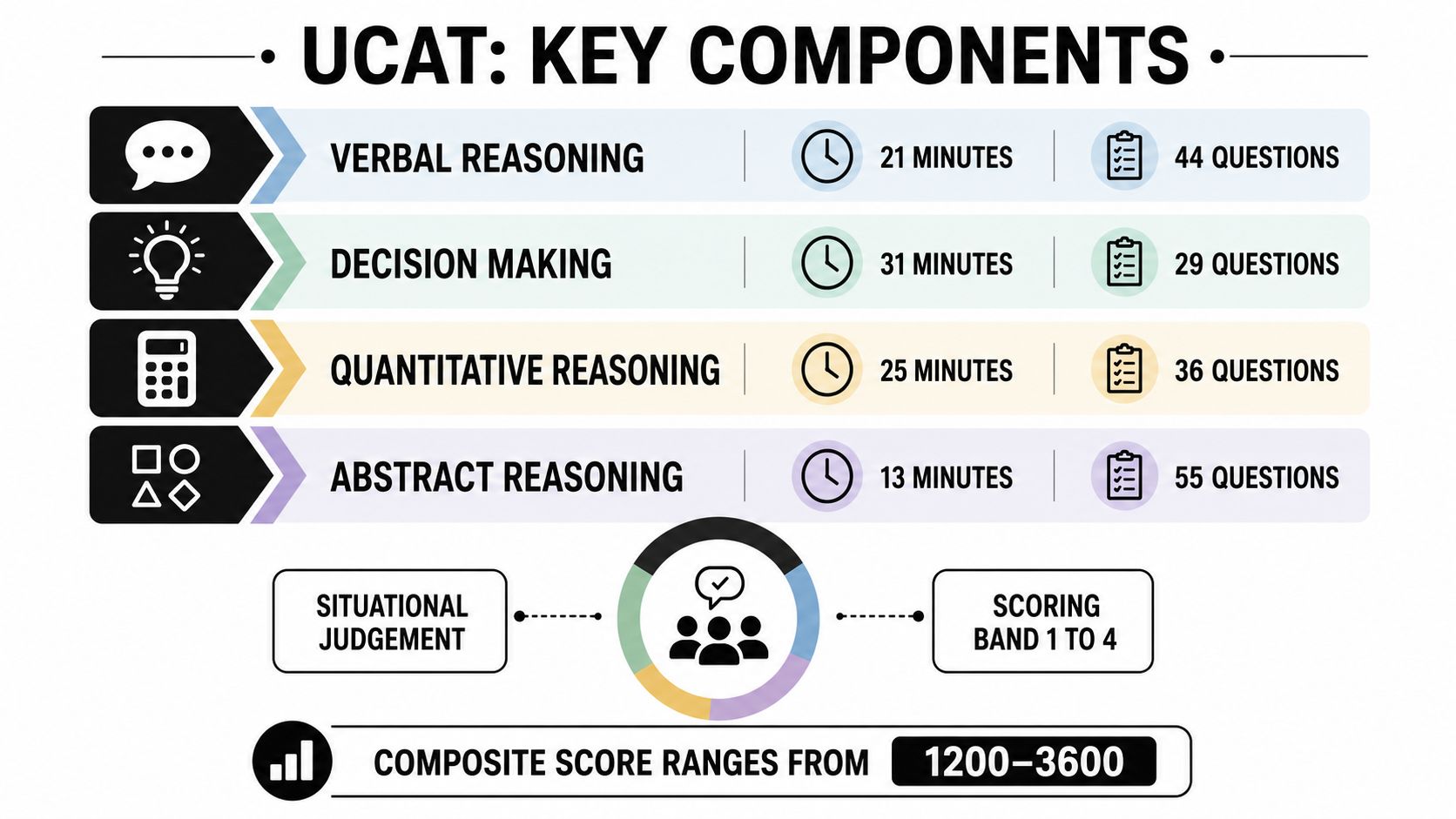
Good grades are important, but they aren't the whole application. The University Clinical Aptitude Test, or UCAT, is a separate admissions test used by medical schools to compare applicants' reasoning and professional judgement.
The Medical Schools Council explains that candidates need to sit the UCAT within the application cycle, and some universities use numerical cut-offs or band restrictions. This creates a second filter. You may meet the academic requirement and still need a competitive UCAT result to reach the interview stage.
That can feel harsh, especially when you're balancing revision with paid work and family duties. It's also useful because it gives you a clear area to prepare for. UCAT practice isn't about memorising a huge textbook. It's about learning the question styles, working under time pressure and reviewing mistakes calmly.
What has changed
The BMAT has been discontinued, so older advice about preparing for both BMAT and UCAT is no longer suitable for current UK applicants. The UCAT structure has also changed, with Abstract Reasoning removed from 2025 onwards, as noted in this UK medicine entry summary.
Always check the current UCAT and university guidance before using a revision book or online course. Older resources may contain sections that no longer appear in the test.
Build preparation into your year
Book UCAT preparation into your plan before application deadlines become urgent. You could begin with short practice sessions at times your household is usually quiet, then increase the challenge as you learn which areas slow you down.
Focus on three habits:
- Review errors: Write down why an answer went wrong, not just the correct answer.
- Practise timing: Learn when to move on instead of spending too long on one question.
- Understand judgement: Situational Judgement questions ask how you'd respond to professional situations, so read each scenario carefully.
UCAS points also show why every part of the application matters. A current UK guide describes a typical medicine offer as AAA, about 144 UCAS points, while more competitive courses may ask for A*AA, about 152 points, and some contextual offers may be AAB, about 136 points. Another medicine-entry summary gives a course range from 128 points, ABB, to 168 points, AAA*, with an average around 136 points, roughly AAB. These figures are provided in the UK UCAS points guide for medicine.
The figures vary by institution. The message is simple: academic grades, UCAT performance and interview readiness all deserve a place in your timetable.
Interviews, Work Experience and Non-Academic Requirements
An interview lets a medical school meet the person behind the grades. You may face a traditional panel interview, where several people ask questions together, or an MMI, Multiple Mini Interview, where you move through short stations that test different skills.

Interviewers may explore why you want medicine, how you respond to an ethical problem, whether you can communicate with empathy and how you work with other people. They aren't expecting you to know everything about being a doctor. They want evidence that you've thought carefully about the role and understand its responsibilities.
Turn ordinary experience into useful evidence
Adult learners often underestimate their own examples. A job in retail can show patience and clear communication. Supervising colleagues can show leadership. Caring for a relative can show reliability and sensitivity, although you should protect private details. Volunteering in a community setting can help you understand how health, poverty, loneliness and access to services affect people.
For each experience, write four notes:
- What happened?
- What did you do?
- What did you learn?
- How might that learning help you as a medical student or doctor?
Avoid claiming that one experience has made you an expert. Instead, show that you can reflect, recognise limits and keep learning.
You can use this guide to write a university personal statement while your experiences are still fresh.
A short video can also help you think about communication and professional behaviour before interview practice.
Understand the checks
A DBS check helps universities and placement providers assess whether there is information relevant to working with patients and vulnerable people. A declaration doesn't automatically tell you that you can't apply, but you must answer questions truthfully and follow the university's process.
Fitness to practise means behaving in a way that protects patients, colleagues and public trust. Universities may consider health, conduct, honesty, professionalism and the ability to respond safely to concerns. If you're worried about a past event or health matter, ask the admissions or occupational-health team for confidential guidance rather than trying to guess.
Interview practice: Answer aloud, record yourself if you can, and practise explaining your thinking. Clear, thoughtful answers matter more than impressive words.
Different Routes Into Medicine and Which One Fits You
There isn't one correct starting point for every adult learner. Your route depends on your existing subjects, degree status, science background, family commitments and the universities you want to approach.
The standard A100 medicine route usually expects the strongest traditional academic profile. The RCGP guidance lists A100 at AAA in Biology, Chemistry and one other subject. Graduate-entry-style pathways can look different. The same guidance lists A101 and A102 examples at BBB or ABC at A level plus a 2:1 degree or higher. These are route examples, so check each university's current rules.
An Access to Higher Education Diploma may suit an adult without the usual A-level combination. It's designed to prepare learners for university study, but medical schools can set specific requirements for modules, grades and prior GCSEs. You can explore the Access to HE Diploma online as one possible progression option.
| Route | Typical Academic Requirement | Best Suited To | Key Extra Check |
|---|---|---|---|
| Standard A100 entry | Usually a high A-level profile, commonly including Chemistry and often Biology | Learners able to complete the required science A-levels | GCSE rules, UCAT and course-specific subject conditions |
| Graduate-entry style route | Some examples use BBB or ABC at A level plus a 2:1 degree or higher | Graduates changing direction towards medicine | Degree subject, required science knowledge and admissions test |
| Access to HE Diploma | A recognised adult route, subject to the university's required modules and grades | Adults without the standard A-level package | Whether the medical school accepts that exact Access Diploma |
| Foundation or gateway year | An alternative route for applicants who don't meet the usual subject profile | Learners whose previous qualifications lack core sciences | Eligibility, additional year, GCSEs and UCAT |
| Widening-participation route | May offer a different academic context, but still has defined conditions | Applicants who meet participation and background criteria | Postcode, school type, region, deprivation measures and school-specific thresholds |
Widening-participation schemes deserve careful reading. The Medical Schools Council's UKWPMED scheme information shows that eligibility can depend on living in a defined region, attending a non-selective state school or meeting particular deprivation indices. These schemes aren't just “lower-grade routes”. You may still need to meet GCSE, A-level and UCAT conditions.
Choose the route that matches your starting point, not the route that sounds most prestigious. A realistic plan that fits work and family life is stronger than an impossible plan that leaves you exhausted.
Your Realistic Timeline and Application Checklist
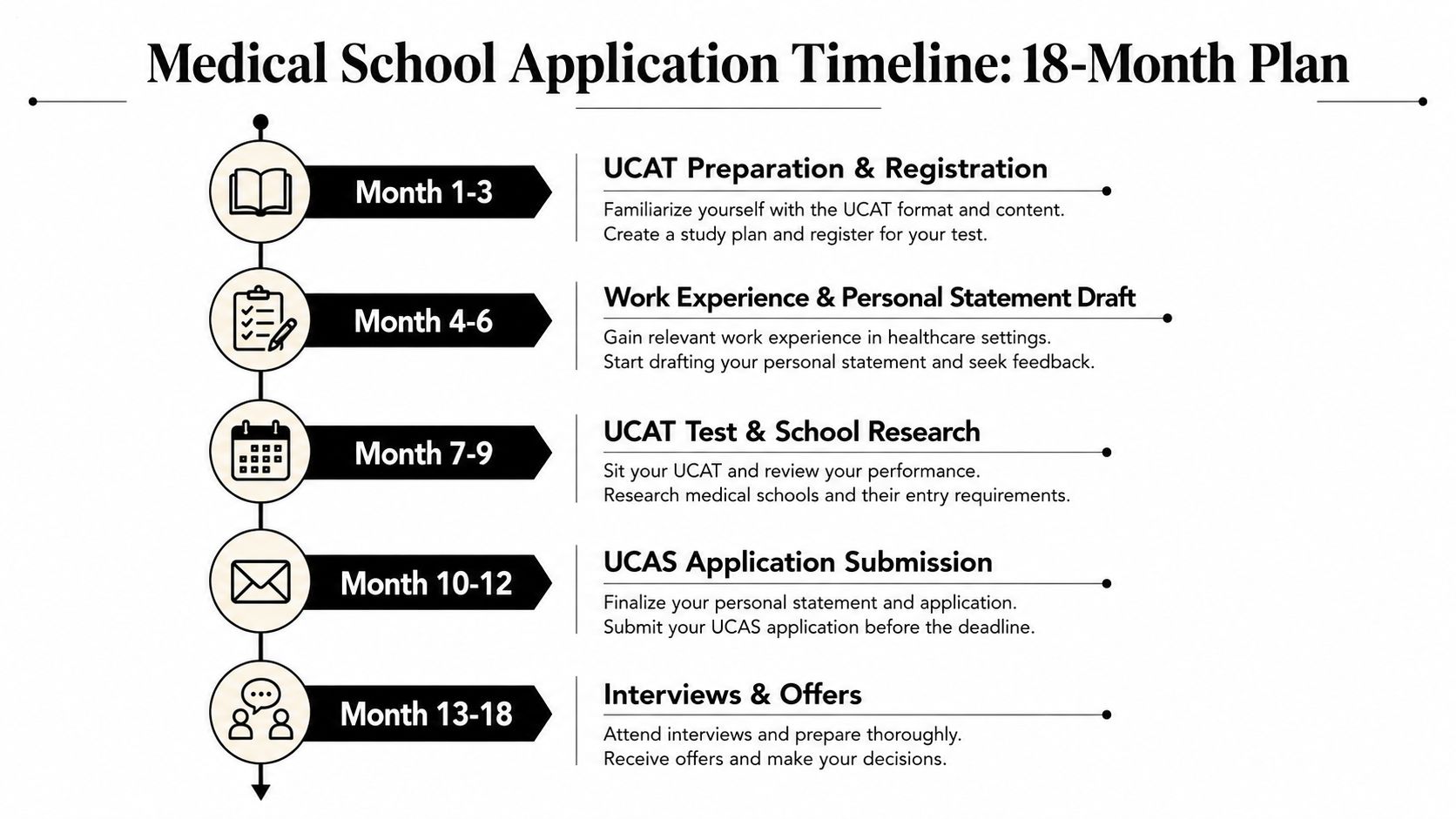
Adult study works best when you treat time as a resource to organise, not a test of personal worth. A 12 to 24 month plan gives you room to build missing qualifications, prepare for the UCAT and collect meaningful experience without pretending that family life will pause.
Months 1 to 3
Start with an audit. Gather certificates, check GCSE subjects and compare them with the universities you may target. Speak with an online college or university admissions adviser about whether you need Functional Skills, GCSEs, A-levels or an Access to HE Diploma.
Create a weekly study pattern that your family can understand. Even a few protected sessions are useful when you keep them regular.
Months 4 to 9
Begin the qualification work that fills your biggest gap. If Chemistry or Biology is missing, investigate the exact A-level or equivalent accepted by your chosen medical schools. Arrange work experience or volunteering that fits around employment, and keep a reflection journal rather than relying on memory later.
Start UCAT practice early enough to learn the format without panic. Research each university's approach, because schools may use the test differently.
Months 10 to 18 and beyond
Prepare your UCAS application, personal statement and references with care. Check application dates directly with UCAS and each medical school, as deadlines and requirements can change. Practise interview answers using examples from work, caring, volunteering and study.
Use this checklist:
- Qualification check: Confirm subjects, grades and accepted equivalents.
- Test plan: Register for the UCAT in the correct application cycle.
- Experience record: Note responsibilities, learning and reflection.
- Finance plan: Review course fees, travel, childcare and reduced work hours.
- Family plan: Agree study times and support arrangements at home.
- Application review: Ask a suitable adviser or tutor to check your documents.
A plan can change without becoming a failure. If a child becomes unwell or work becomes demanding, adjust the week and continue. Progress that bends is still progress.
Your Next Step Toward a Proud Future
Medical school entry requirements aren't a wall. They're stepping stones, including qualifications, testing, experience and interview preparation. You've already taken an important step by allowing yourself to consider a different future.
Your children may see you revise after work, ask for help and keep going when a topic feels difficult. That example can shape how they think about education and their own possibilities. In time, your effort could lead towards a fulfilling career where your knowledge helps people and your family sees what persistence can achieve.
Choose one action today. Find your missing qualification, check a university requirement or speak to an adviser. You don't need the whole route mapped perfectly before you begin.
Next Level Online College offers flexible Functional Skills, GCSE, A-level and Access to HE courses for adults preparing for university progression around work and family responsibilities. Visit Next Level Online College to explore your options and arrange a conversation about a realistic route towards medicine.