
You may be sitting at the kitchen table after work, looking at your children doing homework, and thinking the same quiet thought you've had for a long time. “I want more.” More choices. More confidence. More chances to build a better future for your family.
Maybe school didn't go well the first time. Maybe life got in the way. Maybe you've spent years putting everyone else first and telling yourself that study is for younger people, not for you. That feeling is common, but it isn't the truth.
Part-time GCSE courses can be a fresh start. They aren't about going backwards. They're about moving forwards with purpose, pride, and a clear goal. They can help you open doors to new jobs, further study, and a stronger belief in yourself. They can also show your children something powerful. That learning doesn't stop. That courage matters. That their parent didn't give up.
If you're exploring adult education courses online, you're already taking a brave first step. That step counts.
Your Time to Shine Is Right Now
Sarah is the kind of person many adult learners recognise in themselves. She works hard, cares for her family, and keeps everything going. From the outside, she looks capable. Inside, she worries that she missed her chance.
She sees jobs she'd like to apply for, but they ask for English or maths. She thinks about university sometimes, then quickly pushes the idea away. It feels too big. Too late. Too risky.
That's where part-time GCSE courses change the story.
They give adults a practical way back into learning without asking them to put the rest of life on hold. You don't need to become someone else to do one. You just need to decide that your future matters too.
This is about more than a qualification
A GCSE is useful on paper, but the change often starts long before the exam. It starts when you prove to yourself that you can keep a promise to your own future.
That matters in everyday life. It matters when you fill in an application form with more confidence. It matters when your children see you revising instead of giving up. It matters when you stop saying, “I'm not academic,” and start saying, “I'm learning.”
You don't need a perfect past to build a proud future.
Many adults return to education carrying old school memories that still hurt. A harsh teacher. A bad result. The feeling of being left behind. Adult learning is different. You arrive with life experience, discipline, and a reason for studying that feels real.
Your family can feel the difference too
When you invest in yourself, you're not being selfish. You're showing leadership. You're showing that it's possible to improve your life step by step.
That can ripple through a whole home.
- Your children see resilience: They learn that setbacks don't have to decide the future.
- Your confidence grows: You start speaking up more, applying for more, and aiming higher.
- Your options widen: A qualification can become the start of something much bigger.
This could be the moment you stop waiting for the “right time” and realise that the right time is when you're ready to begin.
What a Part-Time GCSE Really Means for You
At 9:30 at night, the house is finally quiet. The dishes are done, work messages have stopped, and you open a notebook at the kitchen table. In that moment, a part-time GCSE is not just a course. It is a decision to back yourself.
That matters more than many adults realise.
A GCSE still carries real weight with employers, colleges, and training providers. The difference now is your reason for doing it. You are choosing it with purpose. You may want to qualify for a new course, meet entry requirements for a job, or give yourself a better chance of progressing at work. You are not going through the motions. You are building something.
If you want the basics explained clearly first, this guide to what a GCSE is gives a simple overview.
Part time means study bends around real life
Many adults hear the word GCSE and instantly remember school timetables, pressure, and long days in classrooms. Part-time study works differently. It is designed for people who already have a full life.
That includes parents, carers, people working shifts, and adults returning to learning after years away. The qualification is the same standard. What changes is the way you fit it into your week.
A part-time GCSE works like adding a steady savings habit to your routine. Small, regular deposits of effort build into something valuable over time. You do not need your whole life to stop. You need a pattern you can keep.
It measures what you can do now
At this point, confidence often wobbles.
A lot of adults carry an old label from school. Maybe someone once made you feel slow. Maybe you missed lessons, struggled with exams, or left education before you were ready. Those experiences can make a new start feel risky, even when you are more capable than you were back then.
Adult study gives you a different starting point. You understand responsibility. You know how to keep going when things are difficult. You can see why the subject matters, which makes learning easier to hold onto.
A part-time GCSE is a current, recognised qualification. It follows a set syllabus and leads to formal assessment through an exam board. For example, Pearson sets out the structure of its GCSE Statistics qualification, including the subject content and assessment details, in its GCSE Statistics specification. That clear structure is reassuring. You are not guessing what counts. You are working towards something defined and respected.
This is practical, but it is personal too
On paper, you are gaining a qualification.
In real life, you are proving something to yourself.
Each revision session says, “My future is worth my time.” Each lesson tells your family that growth does not stop when school ends. If your children see you studying, they are not just seeing homework. They are seeing courage in action.
That is one reason this step can feel so powerful. You are not only improving your options. You are becoming the person in your family who showed that it is never too late to begin again.
For many adults, the first win comes long before exam results. It comes when they stop saying, “I hope I can do this,” and start saying, “I am doing this.”
Finding a Study Style That Fits Your Life
Some adults learn best in a quiet room at home. Others need the routine of going somewhere each week. Neither choice is better. The right choice is the one you'll be able to stick with when life gets busy.
A typical adult GCSE English course involves around 3 hours of weekly lessons plus about 3 hours of home study, according to an adult GCSE English course description from Activate Learning. That's useful because it turns a vague idea into something real. You can picture it in your week.
For some people, that means lessons after the children are in bed and study on a quieter evening. For others, it means one class at a local centre and short revision sessions across the week.
Online learning at home
Online study can be a strong option if your time changes from week to week. It can suit parents, carers, and people who work shifts.
You may like online learning if you want to:
- Study without travel: Home becomes your classroom.
- Work around family life: You can build learning into the times you already have.
- Learn in a private space: That can help if your confidence is low and you'd rather begin without drawing attention.
Online study also asks something important from you. You need a routine. Because nobody is physically standing next to you, you'll need to protect your study time and keep showing up for yourself.
In-person classes at a local college
In-person classes can feel reassuring if you like a clear weekly pattern. Turning up at the same place, at the same time, can make study feel more solid and easier to maintain.
Many adults prefer in-person learning because:
- The routine is built in: Class time is already set.
- You can ask questions face to face: That feels easier for some learners.
- You meet other adults doing the same thing: That reminder helps when you feel alone.
There's also something powerful about sitting in a room and realising you're not the only one starting again.
Online vs In-Person Study What's Right for You
| Feature | Online Courses | In-Person Classes |
|---|---|---|
| Flexibility | Strong choice for changing schedules and home life | Better for fixed weekly routines |
| Travel | No travel needed | Travel time needs planning |
| Structure | You create more of your own routine | The provider gives you a set class pattern |
| Support style | Often suits independent learners who like learning at home | Often suits learners who want face-to-face contact |
| Study environment | Best if you have a quiet place to work | Helpful if home is busy or distracting |
A simple way to choose
Ask yourself three questions.
- When am I most likely to study well? Early morning, evenings, weekends?
- Do I need outside structure, or do I prefer freedom?
- Will travelling make study harder for me?
Choose the format that fits your real week, not your ideal week.
That small bit of honesty can save you a lot of stress later. The best study style isn't the one that sounds impressive. It's the one that makes success possible.
Choosing Subjects to Build Your Dream Future
When adults think about GCSEs, they often start with one question. “Which subject should I choose?” The best answer depends on where you want your next step to lead.
For many learners, English and maths come first. They're often the subjects that open up the most opportunities. If you've ever felt nervous about them because school was difficult, try to separate the subject from the old memory. Learning as an adult can feel calmer, clearer, and more purposeful.
Start with the subject that removes the biggest barrier
If a job, college course, or training route keeps asking for English or maths, that's a strong clue. Those subjects may be your first move.
They help with everyday confidence too.
- English can help you write clearly, understand information, and speak with more confidence.
- Maths can help with problem-solving, money, measurements, and workplace tasks.
- Statistics can suit learners who like patterns, data, and practical thinking.
The curriculum for GCSEs is standardised across England, with exam boards like AQA and Edexcel following the same core topics, as explained in this guide to GCSE Statistics topics. That's helpful because the syllabus is clear and predictable. You're not left guessing what to revise.
Match the subject to the life you want
Once you've thought about the barriers, think about the future you want to build.
A science subject can be a strong step if you're interested in healthcare or other practical fields where understanding the world matters. Psychology may appeal if you care about people, behaviour, and support roles. English can help if you want stronger communication for almost any profession. Maths supports many routes where accuracy and confidence with numbers matter.
The key is to link the subject to a real reason.
A subject becomes easier to commit to when you can see where it might take you.
Keep your choice simple
If you feel stuck, use this short decision guide:
- Choose English if reading, writing, or communication is the main hurdle.
- Choose maths if number skills are blocking jobs or further study.
- Choose a subject linked to a long-term goal if you already know the direction you want.
You don't have to choose every subject at once. Many adults do best when they pick one clear next step, build confidence, and keep moving from there.
That's how a dream future starts. Not with one giant leap, but with one subject that opens the next door.
How to Get Your Qualifications Without Financial Worry
You might be sitting at the kitchen table, adding up food, rent, travel, and everything the family needs, then looking at a course fee and feeling your confidence drop. That reaction makes sense. For many adults, money is the first obstacle, not because they lack ambition, but because they are trying to be responsible.
The good news is that cost is often more manageable than it first appears.
Many adult learners can study English or maths without paying the full course cost, especially if they are returning to education after time away. Rules can vary by provider and by your circumstances, so it helps to ask directly rather than ruling yourself out too early. A short phone call or email can give you a much clearer picture than guesswork ever will.

Start with the subjects that open doors fastest
If English or maths is the qualification holding you back, check funding first. These subjects often matter most for jobs, training, and further study, so support is commonly focused there.
That can be a huge relief.
It also means your first step may be closer than you thought. One funded course can help you build proof that you can do this, and that matters when confidence has taken a knock in the past.
If there is a fee, break it into smaller pieces
A course cost can feel heavy when you look at it as one total. It becomes easier to handle when you split it into practical questions:
- Can I pay in instalments?
- What is included in the fee?
- Will this qualification help me reach a clear next goal?
That last question matters most. Paying for a course is easier to justify when you can connect it to a better job, a college place, or the example you want to set at home.
Some providers offer ways to spread the cost over time. If that would make study feel more realistic, you can explore finance plans for adult learners.
Ask before you assume
Adult learners often disqualify themselves in their own minds. They assume they earn too much for support, or not enough to manage payments, or that asking about money will feel awkward.
Ask anyway.
Funding, fee support, and payment options are there to be explained. You do not need to know the right words in advance. A simple question such as "What help is available for adult learners on this course?" is enough to start.
Paying for education works like planting something that will keep growing. You are not only covering a course fee. You are building qualifications, self-belief, and a stronger future for yourself and the people who look up to you.
That is not a reckless expense. It is a thoughtful investment in the life you want to build.
Your Enrolment Checklist for a Confident Start
Starting can feel bigger than studying. The unknown often feels heavier than the work itself. That's why it helps to turn enrolment into a few clear actions.
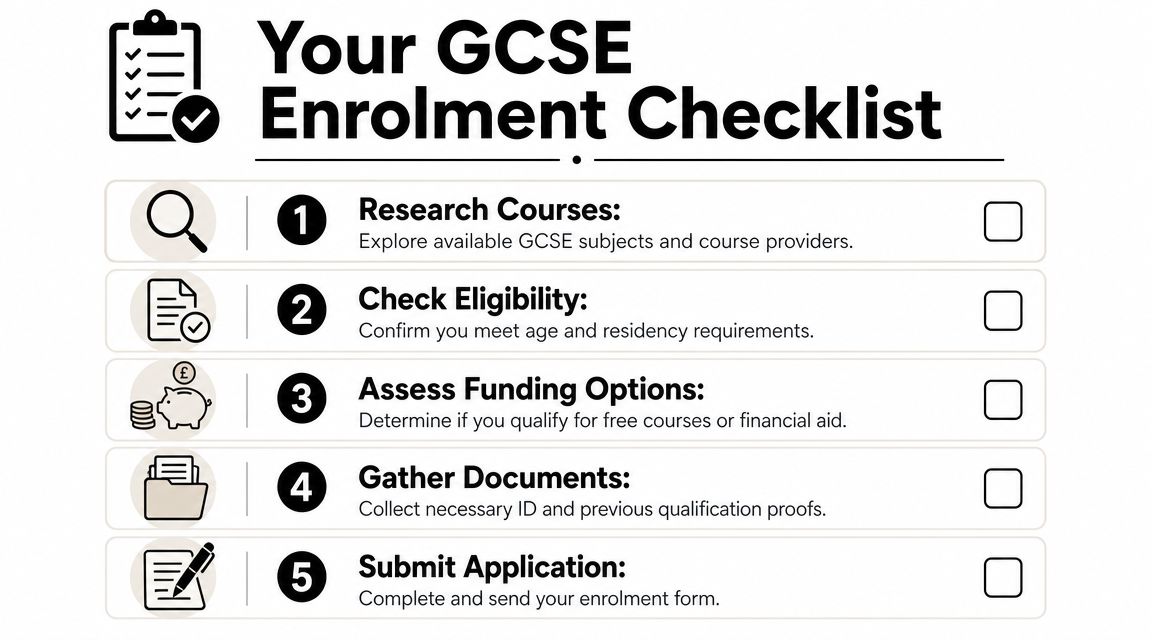
Step one and step two
1. Think about your goal
Start with the reason. Do you want a better job, a route to university, or more confidence with core skills? A clear reason will help you choose the right course and stay motivated when the week feels busy.
2. Find a provider that suits your life
Look carefully at how the course works. Is it online, in person, or blended? Does the schedule match your real routine? The right course should fit your responsibilities, not ignore them.
Step three and step four
3. Check what you'll need before you apply
Some providers ask for basic information, proof of identity, or details of any previous qualifications. If you don't have everything ready straight away, don't panic. You can usually gather it step by step.
4. Ask questions before you commit
This part matters more than people realise. If something feels confusing, ask. Good questions include:
- What support will I get during the course?
- How are lessons delivered?
- What exams or assessments are involved?
- What should I do if I'm nervous about starting again?
Asking questions isn't a sign of weakness. It's a sign that you're taking your future seriously.
A calm rule to follow: if a provider explains things clearly and respectfully, you're more likely to feel supported once the course begins.
Step five
5. Enrol, then prepare your routine
Once you've enrolled, don't wait for motivation to magically appear. Build a plan that makes study easier.
Try a few simple actions:
- Choose your study space: Even a small corner of a room can work.
- Tell your family your study times: That makes your commitment visible and real.
- Set a weekly rhythm: Regular short sessions usually feel easier than last-minute cramming.
Keep the first week small
You do not need to feel fearless to begin. You just need a simple starting plan.
A good first week might include reading the course information, checking your timetable, and setting aside your first study slot. That's enough. Confidence usually grows after action, not before it.
Your Questions Answered with Confidence
Even when you feel ready, doubts can still whisper in the background. That's normal. Many adult learners carry questions that feel very personal, but they're often shared by lots of other people starting the same journey.
Am I too old to do a GCSE
No. Adult learning is for adults. There is no age where growth stops being worthwhile.
Plenty of people return to education after years away because life looks different now. Their children are older. Their career goals have changed. Their confidence is finally catching up with their ambition. Your age is not the problem. It's part of your strength.
What if I fail an exam
Failing an exam would feel upsetting, but it would not mean you are a failure. It would mean one result didn't go the way you hoped.
Adult learners often do better when they stop treating mistakes as proof they can't learn. Mistakes are information. They show where you need more practice, more support, or a different revision approach.
One exam result does not cancel your ability, your effort, or your future.
Will I still have enough time for my kids
Yes, if you choose a course that fits your life and plan your week realistically. Studying part time doesn't mean disappearing from family life. It means making space for something important while still being present.
Your children may even benefit from seeing your commitment. They watch how you respond to challenge. They notice when you keep going.
What if I'm embarrassed because I struggled at school
That feeling is very common. Many adults worry about being judged, especially if past school experiences were painful.
But adult education isn't about reliving your worst memories. It's about building a better experience now. You are not the same person you were then. You've lived, worked, cared for others, and solved real problems. That life experience matters.
What if I don't feel confident enough yet
Confidence rarely arrives first. Action usually comes first.
You don't need to feel completely ready. You need to be willing. Willing to ask questions, willing to try, willing to keep going when it feels unfamiliar. That is enough to begin.
If part time GCSE courses have been on your mind for a while, that thought may be there for a reason. You want more from life, and you're allowed to go after it.
If you're ready to take that next step, Next Level Online College offers flexible online learning for adults who want recognised qualifications, supportive guidance, and a study route that fits around real life. It could be the start of the future you've been hoping for.