
You're working, helping at home, and trying to keep your own goals alive at the same time. Some evenings you feel ready to learn, other evenings your brain feels full before you even open a book. That does not mean you're bad at revision, it means you need a plan that fits real life, not a school timetable from years ago.
The best revision tips GCSE learners can use are the ones that build confidence while they build memory. You do not need perfect conditions, and you do not need to sit for hours in one go. You need short, focused practice, a clear routine, and a way to see progress when life is busy.
That matters even more for adult returners who want to set a strong example for their children, move towards better-paid work, and prove to themselves that education is still possible. A good revision habit can help you feel calmer at work, stronger at home, and more ready for the exam hall. Start small, stay steady, and let each session count.
1. The Pomodoro Technique Helps You Start Without Feeling Overwhelmed
The hardest part of revision is often getting started. A short timer makes the first step feel manageable, because you are not promising yourself a whole evening of study, just one focused burst. For a busy adult returner, that matters. After work, after school runs, or after a long day of looking after everyone else, a small starting point feels far less heavy than a huge revision plan.
A short study block also suits real GCSE work. A subject guide for GCSE Statistics says revision should be interactive and built on practice and more practice, and it encourages early planning across the course rather than leaving everything until the end. Short bursts fit that approach well, because one block can focus on one topic, one question type, or one quick check of what you remember. If you need help organising your routine, you can also use the advice at time management for students.

Keep the session small and specific
A working parent revising GCSE English Literature could use four Pomodoros across lunch and the evening, with each one covering a poem, a character, or a quote. Someone doing shift work might find a shorter burst of 20 minutes easier on lower-energy days. The goal is not to copy someone else's routine. It is to choose a shape of revision that fits a real day and still lets you make progress.
If you want a simple way to begin, use how to use flashcards effectively to set one task before the timer starts.
Practical rule: when the timer starts, choose one task only, then stop when the timer ends.
That rule keeps your attention from drifting from one thing to another. It also gives you a clear sense of progress, especially if you mark finished sessions on a wall chart or calendar. Over time, those small checkmarks become proof that you are showing up, even when you are tired, and that helps when confidence feels low.
2. Active Recall Turns Notes Into Memory
A page full of highlights can feel reassuring after a long day at work or after bedtime checks, supper, and everything else that fills an adult learner's evening. The problem is that reading notes can create a false sense of familiarity. Active recall works by closing the book and bringing the answer back from memory first, and that effort helps the information stick.
BBC Bitesize recommends using active retrieval rather than passive rereading for knowledge-heavy revision, with flashcards, self-testing, timed practice, and topic-by-topic revision built into short sessions across the course (BBC Bitesize revision guidance). The Education Endowment Foundation also identifies retrieval practice as one of the most effective ways to learn, and says students benefit when they are taught how to plan, monitor and evaluate their own learning (EEF guidance via Century). For adult learners balancing shifts, family routines, and study time, revision needs to ask a question of you, not just ask you to look at notes.
Make the recall task simple at first
Start with questions you can handle quickly, then build up. A GCSE Maths learner might test formula cards once a week before moving to full questions, while a Functional Skills learner might use flashcards effectively for vocabulary and grammar. A GCSE business learner could read a definition, cover it, and explain it in plain English before checking the mark scheme.
If you can't say it without looking, you do not fully know it yet.
That does not mean you are falling behind. It means you have found the gap, and finding the gap is useful. One strong habit is to answer a past-paper question without notes, then mark it in a different colour so you can see what you recalled unaided and what only looked familiar after a prompt.
Essay subjects work well with a timed answer first, followed by a comparison with a model answer or mark scheme. Short-answer subjects benefit from saying the answer out loud as if you were teaching it to someone at home. The more often you pull information from memory, the more natural it becomes in the exam hall.
3. Mind Mapping Helps You See the Whole Topic at Once
A busy adult learner often opens a notebook after work and faces a page full of separate points, half-remembered facts, and loose revision notes. A mind map helps because it gathers those pieces into one clear page. The topic stays in one place, and the connections between ideas become easier to see.
One GCSE Statistics course guide from a UK school breaks the subject into 8 topic areas, including data types, sampling, processing and representing data, summarising data, scatter diagrams and correlation, time series, probability, and higher-only index numbers and distributions. That kind of layout suits mind maps well, because each main area can become a branch, and each smaller idea can grow from it (Great Sankey High School GCSE Statistics subject guide). It works especially well for History, Geography, English Literature and Science, where you need to connect causes, effects, themes, and examples without losing track of the bigger picture.
Build one topic map, then shrink it down
Start with one bold word or image in the centre, then add short phrases around it. A GCSE History learner might map World War II with branches for causes, key events, countries involved, and consequences. An English Literature learner might map a novel with branches for character, theme, setting, and key quotes. Keep space around the page so you can add more detail later as your understanding grows.
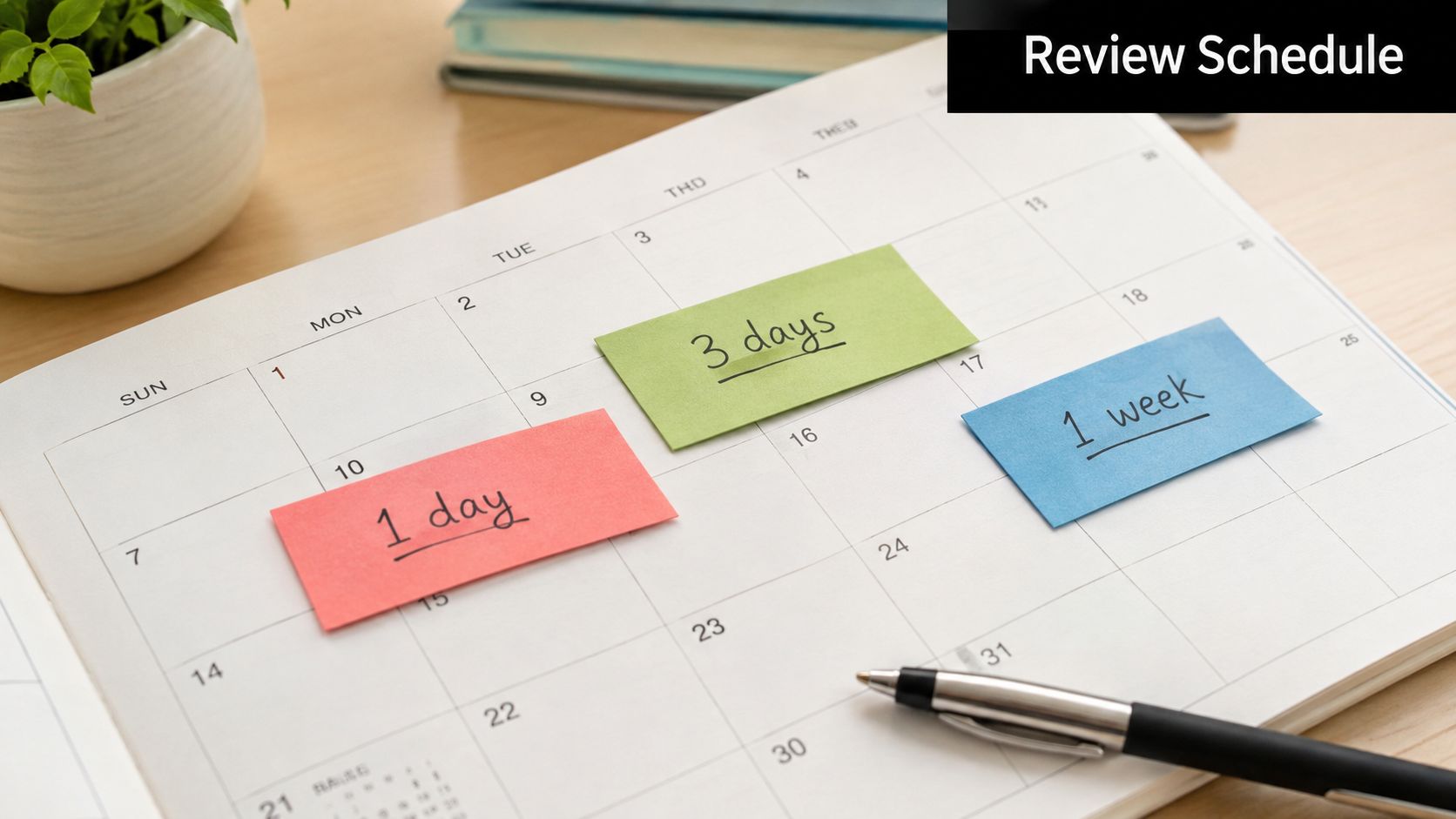
Once the map is finished, take a photo and save it on your phone. That gives you something useful to review in small gaps, such as on a train, during a lunch break, or while waiting outside school pickup. The image below can help you visualise a simple review rhythm, with gaps between each return to the topic.
Mind maps also help before essays. Draw the branches, choose the strongest points, then turn them into a plan. That leaves you with a clear starting point instead of a blank page when the question appears.
4. Spaced Repetition Stops You From Forgetting Everything Between Sessions
Research on the forgetting curve shows that memory can drop sharply within the first 48 hours without review, so a one-off study burst usually fades faster than learners expect. Spaced repetition works with that pattern instead of against it. You review a topic, leave a gap, then return just before it slips away. For busy adult returners, that matters because revision has to fit around work, family, and everything else already filling the week.
Oxford Revise's GCSE business guidance recommends study blocks of about 30 minutes followed by 10-minute breaks, and links that structure to better concentration and more reliable recall under exam conditions (Oxford Revise GCSE business guidance). A practical GCSE revision guide also recommends splitting revision into 10, 20 and 30 minute sessions, putting topics on a realistic timetable, and mixing easy and hard topics so you do not spend all your time on what feels comfortable (Weston Favell Academy revision guide). For adult learners, the benefit is consistency, because a little revision most days is easier to keep going with than long, drained weekends.
Use a simple review rhythm
A sensible pattern is to revisit a topic after a day, then a few days later, then a week later, then less often as it sticks. That works well with flashcards, especially if you sort them into piles for new, learning, and known. It also helps to begin early enough for the spacing to do its job, rather than trying to force everything into one tired evening after work.
A UK revision guide recommends beginning GCSE Statistics revision about 6 to 7 months before the exam season and spending about 120 hours in total, with early starters managing around 3 to 4 hours per day instead of last-minute 7 to 8 hours daily cramming (Great Sankey High School GCSE Statistics subject guide). That does not mean every subject needs the same schedule, but it does show why planning ahead helps. If you spread learning across weeks and months, your brain gets more chances to hold on to the material.
Use spaced repetition for formulae, definitions, key dates, vocabulary, and quotation points. Then bring active recall into each review so you are not just recognising the answer, you are retrieving it.
For GCSE English learners, a short bank of exam questions helps the same way. A set of functional skills English past papers gives you something specific to return to at each review, so you can check whether the idea still comes back without prompts.
5. Past Papers Reveal How the Exam Thinks
Past papers are one of the clearest ways to get exam-ready, because they show the style, wording, and pressure of the final exam. They also show the gap between “I understand this topic” and “I can answer this question quickly, accurately, and in the right format.” That gap matters a lot for adult returners, because confidence often grows fastest when you practise the actual task, not just read about it after work, between family jobs, or in a short study window.
GCSE revision guidance from UK schools recommends using past-paper questions first without notes, then trying them again with resources, and finally comparing your answer against the mark scheme in a different colour so you can see what you can recall on your own and what you only recognise with prompts (Urmston Grammar GCSE revision guidance). Revision World's GCSE economics advice says top-grade answers should quote data accurately, identify trends, and support analysis with figures rather than copying information without interpretation, which also fits GCSE business and statistics work, where the examiner wants evidence handled clearly and not just repeated (Revision World economics guidance).
Mark your work like the examiner would
Use the official mark scheme after you finish. Be honest about where you lost marks, and write down why it happened. Was it timing, a missing keyword, a weak example, or an answer that was too general?
A wrong answer is useful if you learn from it straight away.
That is why the strongest adult learners do not just collect papers, they review patterns. Maybe you always lose marks on multi-step questions, or maybe your essays become clear only when you plan first. Once you know the pattern, you can build a fix, a bit like checking a work task for the step where things usually go wrong, then adjusting that step rather than starting again from scratch.
For Functional Skills English revision support, you can also use past papers and practice papers to get used to real exam style. Start past papers well before the final few weeks, because the early ones are for learning, not for proving yourself.
6. The Feynman Technique Makes You Explain What You Really Know
If you can explain a topic in plain language, you probably understand it properly. That is the heart of the Feynman Technique, and it works because it exposes weak understanding quickly. You choose a topic, explain it in plain language, notice where you stumble, then go back and fill in the gaps.
That is especially helpful for adult learners who are rebuilding confidence. You do not need fancy words to learn well. In fact, simple language often shows deeper understanding because you have to strip the idea down to what really matters.
Teach it like you're helping a younger child
A GCSE Biology learner might explain photosynthesis to a younger sibling without using technical terms like glucose or ATP. A GCSE Economics learner might explain inflation to a family member using shopping prices and weekly bills. An English Literature learner might explain a poem's theme aloud before writing an essay plan.
A practical way to use this is to record yourself on your phone, then listen back and note any point that sounds vague or confusing. You can also teach the idea to a partner, a child, or even a soft toy if nobody else is around. The key is that you must speak it, not just think it.
A separate GCSE support video for geometry and angles tells learners to record known facts, mark diagrams, then infer missing information step by step, which shows the same general idea in action, build from what you know and use it to repair what's missing (GCSE geometry and angles support video). That is why this method is so good for low-confidence learners, because it gives you a path from confusion to clarity.
When you get stuck, stop and mark that spot. That is your revision target for the next session.
7. Study Groups and Peer Teaching Give You Support as Well as Practice
Revision can feel lonely when you are returning to study after a long break. A small study group can change that, because it gives you people who understand the pressure, the nerves, and the small wins. It also gives you a reason to turn up, even on days when motivation is low.
Peer teaching is powerful because teaching someone else forces you to organise your thoughts. If you can explain a topic to another learner, you usually understand it more clearly yourself. For adults, the emotional value matters too, because encouragement can carry you through weeks when self-esteem is shaky.
Keep the group small and purposeful
Three GCSE learners meeting online for 45 minutes can each explain one topic, then quiz the others on questions. A Functional Skills group might use a short video call twice a week for vocabulary and grammar practice. An Access to Higher Education group could keep a WhatsApp chat going for quick questions and reassurance.
Best use of a group: one person explains, the others ask questions, then everyone swaps roles.
That structure keeps the session focused. It also stops one person from doing all the talking while everyone else drifts. If you want, you can use Zoom for a video call, Google Docs for shared notes, and Quizlet for flashcard quizzing.
Next Level Online College can help match learners, which can make it easier to find people at a similar level. Keep the group small, set a topic before each session, and stick to a timer so the meeting stays useful. A short, regular group often works better than a long, loose one.
8. Active Note-Taking Helps You Learn While You Write
Some notes are just copied words on a page. Active note-taking asks you to think while you write, choosing what matters, rephrasing it in your own words, and shaping it into something you can use later.
That matters for busy adults because few people have time to fill notebooks with pages they never open again. Good notes should help you revise, not just look tidy. They should also fit how memory works, which is why short phrases, questions, and summaries are so useful when you are juggling work, family, and study.
Write notes that can turn into questions later
Cornell Notes work well here, with one side for questions, one side for notes, and a bottom section for summary. A GCSE History learner might write “What caused WW1?” in the margin, then answer it in the main space. An English Literature learner might add character comments beside a text, while a Science learner could turn a video explanation into a concept map.
The revision guidance from schools and support providers consistently points towards active methods like retrieval, practice, and clear note structures rather than passive rereading. That same idea fits note-taking too, because notes should give you something to work with later. If your notes cannot be turned into a question, they are probably too passive.
Use colour lightly, not heavily. Three colours are usually enough, for example one for key ideas, one for definitions, and one for things you need to check again. Review what you wrote within 24 hours, then add anything you missed while the topic is still fresh.
Hand-writing notes can help memory more than typing, because the slower pace gives your brain time to decide what belongs on the page. That extra thinking is often where understanding starts, especially when you are studying after a long day and need each minute to count.
9. Interleaving Prepares You for Mixed Exam Questions
Real exams rarely give you one neat topic at a time. They mix ideas, question styles, and marks, so your revision should sometimes mix them too. Interleaving means practising different topics and question types in one session instead of staying on one subject area from start to finish.
At first, that can feel tougher than blocked practice. That reaction is normal. Your brain has to switch gears, and that extra effort helps you choose the right method in the exam instead of repeating the last thing you revised. For busy adult returners, that matters because revision time is often squeezed between work, family, and everything else competing for your attention.
Mix once the basics are in place
A GCSE Maths learner might do 20 mixed questions, with algebra, geometry, statistics, and probability all in one go. A GCSE Science learner might move between biology, chemistry, and physics questions in a single session. An English Literature learner might compare three texts across one revision block instead of spending the whole time on one text.
The key is to start mixing after you can do the basics with some confidence. If a topic is still completely new, keep it separate for a little longer so you are not trying to learn and switch at the same time. Once the basics are in place, mixed practice works like training for a match instead of only practising one drill. It prepares you for the way exam questions arrive, with no warning about which skill they want first.
Start with blocked practice when a topic is brand new, then mix it once you can do the basics.
That order matters. If you mix topics before you understand them, the session can feel messy and unhelpful. Once you know the core ideas, though, switching between them builds flexibility, and that is exactly what you need when an exam question pulls together more than one topic.
Use past papers to build mixed sets, or shuffle flashcards so the topics change from one card to the next. If you get stuck, note the weak area, review it, and return to the mixed set later. That way you keep practising exam thinking, not just subject memory.
9 GCSE Revision Techniques Compared
| Method | 🔄 Implementation complexity | 💡 Resource requirements | ⚡ Speed / efficiency | ⭐📊 Expected outcomes | 📚 Ideal use cases |
|---|---|---|---|---|---|
| The Pomodoro Technique: Breaking Revision Into Manageable Chunks | Low, simple timer routine but needs discipline | Minimal, timer app or kitchen timer; offline-friendly | High for short tasks, not for prolonged deep work | Improved focus, reduced burnout, steady progress ⭐📊 | Busy adults fitting study around work/family; short tasks |
| Active Recall: Testing Yourself to Lock Knowledge Into Memory | Medium, requires creating questions/flashcards and restraint | Moderate, flashcards, apps (Anki/Quizlet), past papers | Very efficient for retention per minute studied ⚡ | Strong long-term memory and gap identification ⭐📊 | Memorisation-heavy subjects; exam practice and self-testing |
| Mind Mapping: Visualising Connections Between Ideas | Low–Medium, creative skill and organization required | Low, paper/markers or digital mind-map software | Moderate, slower to create but quick to review ⚡ | Better conceptual links and visual recall ⭐📊 | Subjects needing connections (History, Geography, essay planning) |
| Spaced Repetition: Reviewing Material at Perfectly Timed Intervals | Medium, requires scheduling and consistent use | Moderate, apps (Anki) or Leitner boxes; initial setup time | Extremely efficient long-term with short daily sessions ⚡ | Excellent long-term retention and reduced exam anxiety ⭐📊 | Vocabulary, formulas, anything needing durable recall over months |
| Past Papers and Mark Schemes: Learning From Actual Exam Questions | Low, straightforward to implement but time-consuming | Low, free past papers/mark schemes from exam boards | Slow per session (full papers take hours) but high exam-readiness ⚡ | Strong exam technique, timing and targeted improvement ⭐📊 | Final-stage exam practice; timing, exam language and mark targeting |
| The Feynman Technique: Explaining Concepts in Simple Terms | Medium, iterative and requires honest self-assessment | Minimal, notes, someone to teach or a recording device | Moderate, deep understanding takes time, not fast facts | Deep conceptual mastery and clear explanations ⭐📊 | Complex/abstract topics; essay planning and conceptual gaps |
| Study Groups and Peer Teaching: Learning With Others | Medium, coordination and group management needed | Moderate, peers, meeting tools (Zoom), shared materials | Variable, can be highly efficient if structured ⚡ | Better understanding via teaching, motivation and accountability ⭐📊 | Motivation/support for adult learners; problem-solving and discussion |
| Active Note-Taking: Creating Notes That Help You Learn and Remember | Medium, requires deliberate formats (Cornell, annotation) | Low, notebooks or digital apps; time investment upfront | Slower initially, time-saving for later revision ⚡ | Personalised, usable notes that boost retention ⭐📊 | All subjects; building reliable revision material and review prompts |
| Interleaving: Mixing Different Topics and Question Types | Medium, needs planning and mixed question sets | Moderate, past papers or custom mixed question pools | Feels harder initially but improves flexible performance ⚡ | Improved transfer, discrimination and adaptable problem-solving ⭐📊 | Exam-style practice where topics/questions are mixed; long-term prep |
10. A Realistic Plan Beats a Perfect One
Adult learners often think they need more willpower, but most of the time they need a simpler plan. The strongest revision tips GCSE learners can use are the ones they can repeat on tired days. A perfect plan that collapses after three evenings is worse than a modest plan you can keep.
The UK guidance is clear that revision works best when it is structured, topic-based, and built around practice rather than passive rereading (Great Sankey High School GCSE Statistics subject guide, BBC Bitesize revision guidance, Urmston Grammar GCSE revision guidance). For adults balancing work, childcare, and study, that means short sessions, clear targets, and honest review. It also means accepting that some weeks will be messy.
Choose two or three habits, not all ten
You do not need to use every technique at once. Pick one for memory, one for understanding, and one for exam practice. For example, you might use active recall, past papers, and spaced repetition during the same week.
A useful rhythm is to review for a short time most days, then use one longer session for a paper or mixed practice. If your energy is low, shorten the session rather than skipping it completely. That keeps the habit alive.
When you feel stuck, return to fundamentals. Some learners do not need more revision, they need to repair missing basics before timed practice becomes effective. That can be the difference between frustration and progress, especially if you are returning after years away from study.
Your children do not need you to be perfect. They need to see you keep going. Every small session tells them that learning is for life, and every steady week brings you closer to better qualifications, more career options, and the pride that comes from finishing what you started.
If you're ready to make revision feel manageable again, choose one or two techniques from this guide and use them this week. Next Level Online College offers flexible GCSE courses, structured support, mentors, and wellbeing guidance for adult learners who need study to fit around real life. Visit Next Level Online College and take the next step towards the qualifications, confidence, and future you've been working for.