
You're sitting at the table after work. The house is finally quiet. You've got a pen, a mug of tea, and a small pile of flashcards. You read the first one, turn it over, nod, and move on. Ten minutes later, it feels like nothing has stayed in your head.
If that's where you are right now, you're not doing anything wrong. You're learning a skill that many people were never properly taught. Studying again as an adult can feel strange at first, especially when you're trying to fit it around work, children, bills, and everything else life throws at you.
You're not the only one starting again. In the UK, over 1,056,500 government-funded Further Education learners aged 19+ were participating in 2022/23, which shows that returning to education is both common and achievable for adults balancing work and family, according to Jobs.ac.uk on adult learners in Further Education.
Your Fresh Start with Flashcards
Sarah is a good example of the kind of learner I meet all the time. She works during the day, helps her children with homework in the evening, and studies late at night for Functional Skills maths. She bought flashcards because she wanted a simple study tool. But at first, she used them like mini notes. She kept rereading them and felt upset when she still forgot things.
That feeling can knock your confidence fast. You might start thinking, “Maybe I'm just not good at studying.” But that isn't the truth. The problem usually isn't you. It's the method.
Why flashcards can feel disappointing at first
A lot of adults use flashcards in a way that looks busy but doesn't help memory much. If you only read the answer and think, “Yes, I know that,” your brain hasn't done much work. It feels familiar, but that's not the same as being able to remember it on your own in an exam.
You don't need to study harder to move forward. You need a method that helps your brain practise remembering.
That's good news. It means you can improve quickly once you know how to use flashcards effectively.
Small wins matter more than long study sessions
You don't need a perfect desk, a free weekend, or hours of quiet. You need a plan you can stick to. Even short sessions can help when they're organised well. If your week feels messy, a simple planner can make your study time feel calmer. A good place to start is with these study planner templates for adult learners.
Here are three signs you're already doing better than you think:
- You came back to learning. That takes courage.
- You're looking for better methods. That shows commitment.
- You want a future change. That matters for you and your family.
Many adult learners want more than just a pass mark. They want to become a positive role model for their children. They want better work, more security, and the chance to say, “I did this.” Learning how to study well is one small step towards that bigger life change.
The Secret Science of Making Memories Stick
Flashcards work best when you try to remember the answer before you turn the card over. That method is called active recall. It sounds technical, but the idea is simple. Your brain gets stronger when it has to pull information out, not when it only looks at it.
According to Birmingham City University's guide to revising with flashcards, approximately 56% of students in the UK use flashcards, but many don't use them well because they rely on passive rereading instead of active recall. The same guidance says that using active recall can double retention rates compared with traditional note review.
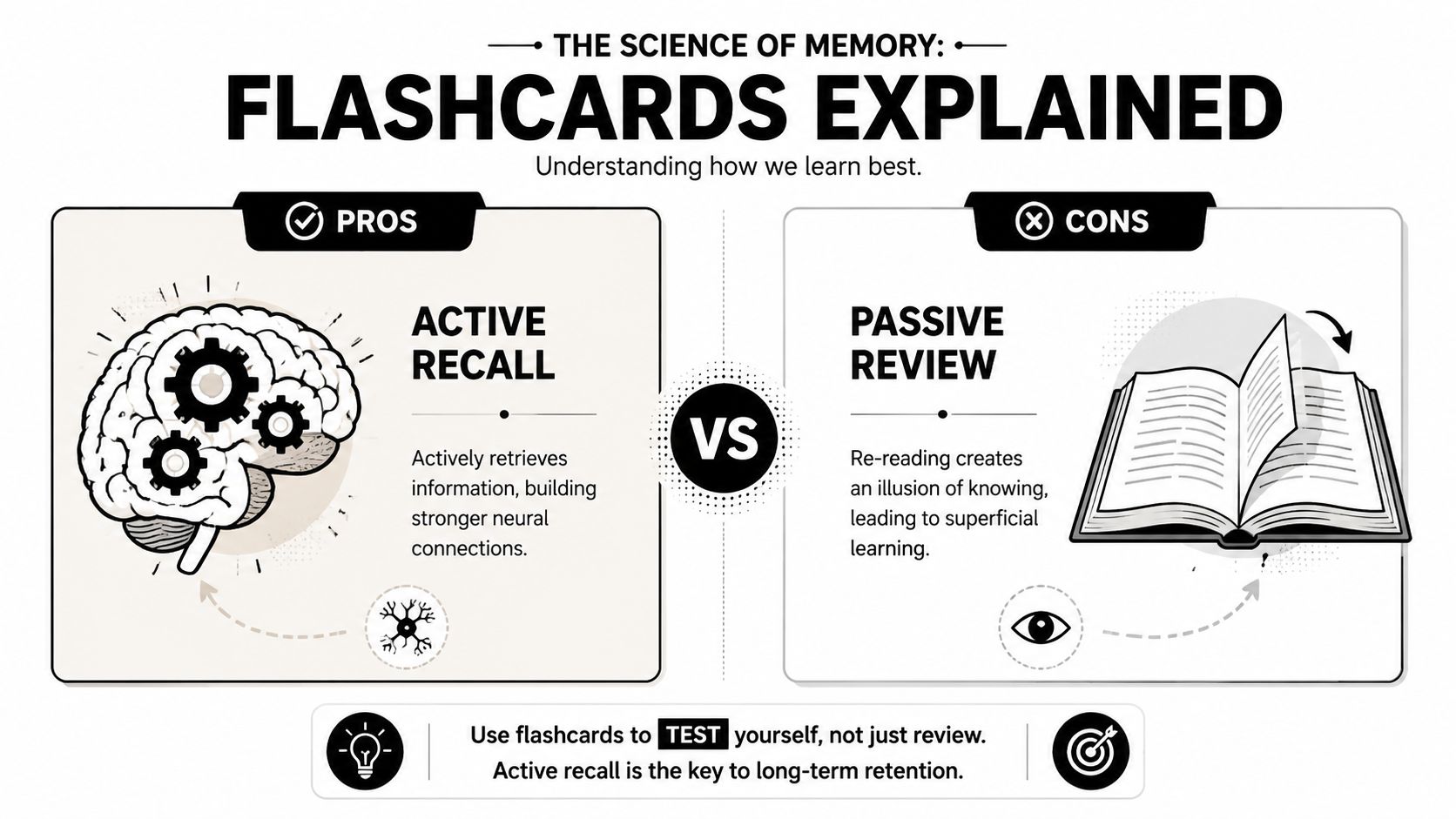
Passive review and active recall
Consider this: Reading the answer on a card is like watching someone else do exercise. Trying to remember it yourself is like doing the exercise with your own muscles.
Here's the difference:
| Method | What you do | What it feels like | What it teaches |
|---|---|---|---|
| Passive review | Read the front and then read the back | Easy and familiar | Recognition |
| Active recall | Read the front, stop, think, say or write the answer, then check | Harder but more useful | Memory retrieval |
That little pause before you flip the card is where the learning happens.
The right way to use one flashcard
Try this every time:
- Read the question only.
- Cover the answer.
- Say the answer out loud, or write it down.
- Turn the card over and check.
- If you got it wrong, don't panic. Do it again later.
Practical rule: If your study session feels a bit effortful, that often means it's working.
For example, if your card says, “What is a fraction?” don't turn it over quickly. Stop first. Make your brain search. That search is what helps the information stick.
If you want more ways to build this habit into your routine, these active learning strategies for adult students can help you move away from passive study methods.
Why getting it wrong can still help
Many adults feel discouraged when they miss a card. I'd like you to see that moment differently. A wrong answer isn't proof that you can't learn. It's proof that you've found the gap. Once you can see the gap, you can fix it.
That's one reason flashcards can be so powerful. They show you exactly what needs more practice. They turn a big, scary subject into small bits you can improve one by one.
How to Create Flashcards That Actually Teach You
A weak flashcard is usually too full, too vague, or too easy to guess. A strong flashcard asks one clear question and makes you think. That's the difference.
Research discussed by Scott H. Young on effective flashcard design says good flashcards follow the one-concept-per-card rule. It also notes that cards with complex sentences can lead to a 40% failure rate in real-world use because learners start guessing from the wording instead of knowing the answer.
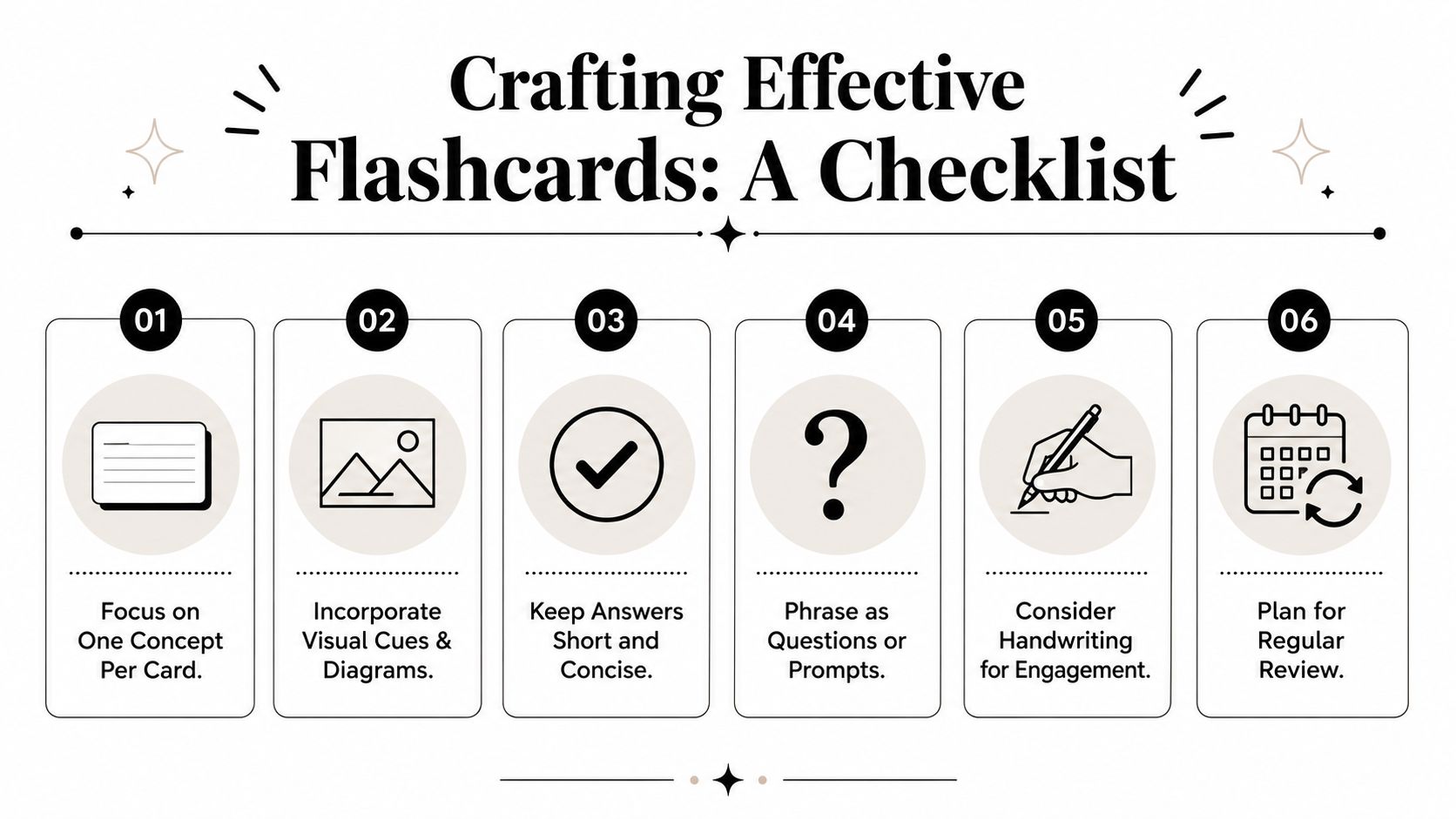
Five rules for better flashcards
Keep one idea on each card
Don't put a whole paragraph on the back. One card should ask for one answer. If a topic has three parts, make three cards.Write a proper question or prompt
“Photosynthesis” on one side isn't as useful as “What is photosynthesis?” or “Why do plants need photosynthesis?”Keep the answer short
Your answer should be clear and direct. If you need a long explanation, break it into smaller cards.Use your own words
Copying from a textbook can make the card harder to understand later. Simple language is better.Add a tiny visual clue when it helps
A symbol, shape, or quick sketch can make a card easier to remember.
Here's a short video that shows flashcard study in action:
Real examples for UK adult learners
These examples work much better than cards that only test single definitions.
| Subject | Weak card | Better card |
|---|---|---|
| Functional Skills maths | “Percentages” | “How do you find 10% of 250?” |
| Functional Skills English | “Adjective” | “What does an adjective describe in a sentence?” |
| GCSE History | “1066” | “Why is 1066 important in British history?” |
Notice the pattern. The better cards make you explain or apply knowledge, not just stare at a word.
Good cards for complex subjects
Adult learners often ask, “Can flashcards really help with maths or English?” Yes, they can, if the card tests a step, a rule, or a piece of thinking.
Try cards like these:
- For maths: “What is the first step when simplifying this expression?”
- For English: “Which punctuation mark should end this sentence, and why?”
- For science: “What happens to particles when a liquid is heated?”
- For history: “What caused this event?”
A flashcard doesn't have to ask only “what”. It can also ask “why” and “how”.
That matters because exams often ask for understanding, not just memory.
A Simple Study Schedule That Fits Your Busy Life
Many adults don't struggle because they're lazy. They struggle because life is full. You may be trying to revise before work, on a lunch break, or after the children are asleep. That's why your flashcard routine needs to fit your real life, not an ideal one.
One of the best ways to do that is with spaced repetition. This means reviewing cards again and again over time, instead of cramming them all at once. According to the University of Southern Maine guide to using flash cards, the Leitner system can help learners retain up to 80% more information over six months. The same guidance says that pairing words with simple images can improve retention by up to 40% compared with text-only cards.
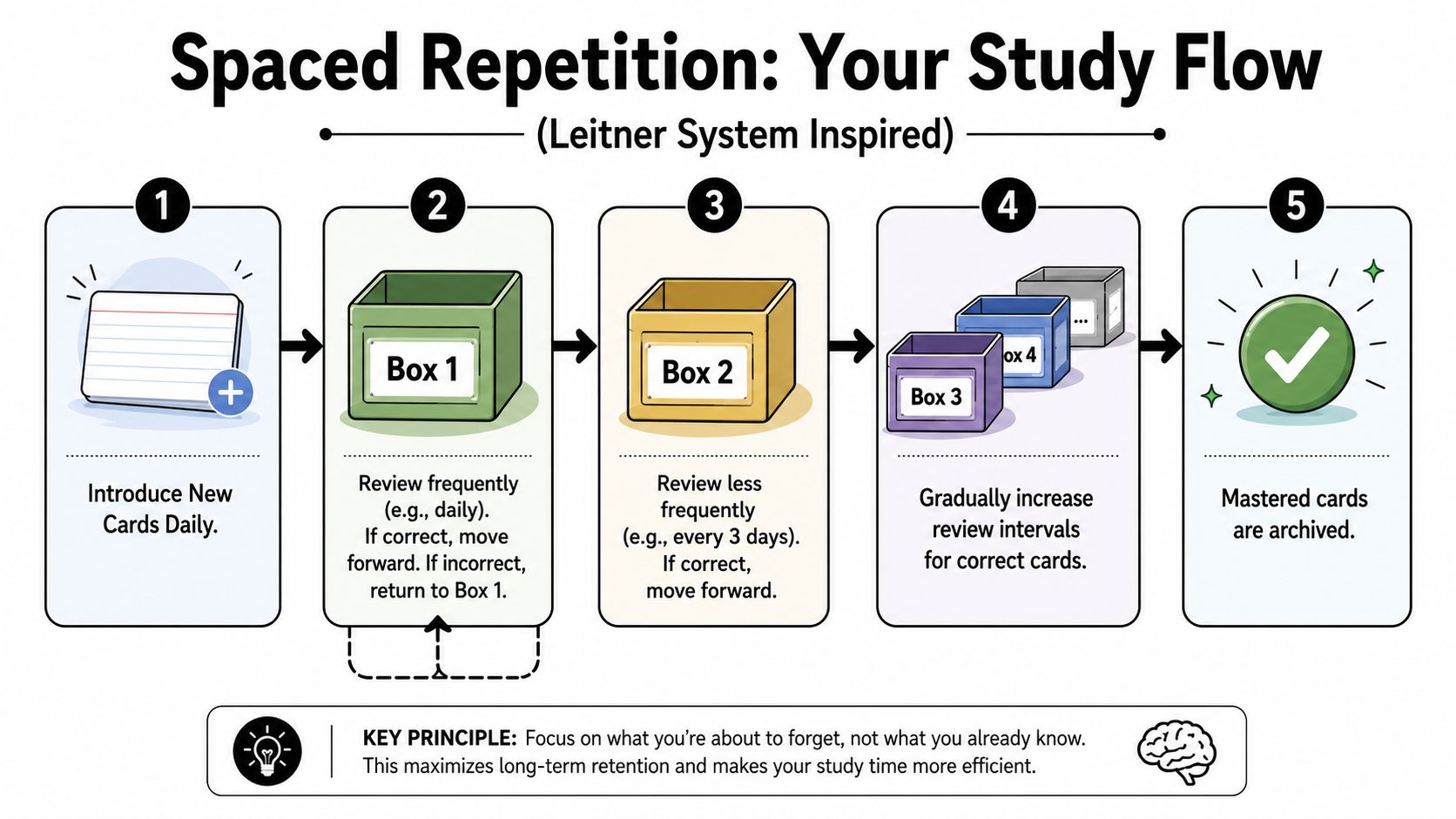
A simple three-pile version
The full Leitner system often uses more boxes, but you can start with three piles on your kitchen table.
| Pile | When to review | What goes there |
|---|---|---|
| Pile 1 | Every day | New cards and cards you got wrong |
| Pile 2 | Twice a week | Cards you sometimes get right |
| Pile 3 | Once a week | Cards you know well |
Here's how it works:
- Start in Pile 1. Every new card begins here.
- Move it up when you answer correctly. A correct answer goes to the next pile.
- Move it back when you forget. If you get a card wrong, return it to Pile 1.
- Keep going until it feels easy. Easy cards need less frequent review.
This system saves time because you don't keep revising everything equally. You focus most on what still needs work.
A weekly routine for a busy adult
You don't need long sessions. You need regular ones. A routine like this can work well:
- Monday to Friday morning: 10 to 15 minutes from Pile 1
- Tuesday and Thursday evening: quick review of Pile 2
- Sunday afternoon: short review of Pile 3 and add a few new cards
That's enough for many learners to build steady progress.
If time management is the hardest part of studying, these time management tips for students with busy lives can help you make a routine that feels realistic.
Physical cards or an app
Some people love paper cards. Others prefer a phone app because it travels with them. Both can work.
Choose physical cards if:
- You remember better by writing
- You like spreading cards out and sorting them
- You want less screen time
Choose a digital app if:
- You study in small moments during the day
- You want automatic reminders
- You need your cards with you at work or on the bus
You don't need the perfect tool. You need one you'll use.
If your routine is small enough to repeat, it's strong enough to change your results.
What to Do When You Feel Stuck or Unmotivated
Some days, flashcards feel helpful. Other days, they feel annoying, repetitive, or impossible. That's normal. Feeling stuck doesn't mean you're failing. It usually means you need to adjust the method, not give up on the goal.
When you keep getting cards wrong
This is the most common worry. You pick up the same card, miss it again, and start feeling hopeless.
Try this instead:
- Shrink the card if it asks too much.
- Say the answer aloud before checking.
- Add a clue such as a keyword or small drawing.
- Review it sooner rather than waiting days.
A difficult card is often just too big. Break it down and it becomes manageable.
When you have too many cards
A huge stack can make you freeze. You look at it and think, “I'll never finish this.”
Use three groups:
| Group | What to do |
|---|---|
| Urgent | Cards for topics coming up soon in class or in an exam |
| Important | Core ideas you must understand well |
| Later | Extra detail you can return to once the basics feel secure |
You don't have to master everything at once. Start with the cards that clarify the rest.
When you feel bored
Boredom often means your routine has become too samey. Change the way you use the cards.
Try one of these:
- Mix subjects together so your brain has to switch gears
- Use spoken answers instead of silent ones
- Study with a partner and take turns asking questions
- Turn cards into a quick quiz for yourself
Forgetting something today doesn't erase the effort you made yesterday.
When confidence drops
Low confidence can make every wrong answer feel personal. Please be gentle with yourself. Learning after a break is emotional as well as practical. You're not just remembering facts. You're rebuilding trust in your own ability.
Keep one small record of progress. It could be a tick on a calendar, a note saying “studied 10 minutes”, or a pile of mastered cards. Visible proof matters. It reminds you that progress is happening, even when it feels slow.
Your Next Step Towards a Brighter Future
Learning how to use flashcards effectively isn't just about revision. It's about becoming the kind of learner who knows how to move forward, even on tired days. That skill can carry you through Functional Skills, GCSEs, Access courses, and beyond.
Many adult learners carry real worries with them. According to EWU's overview of barriers faced by adult learners, 70% worry about tuition and fees, 56% fear new debt, and 37% struggle with time from work. Those worries are real, but support, clear progression routes, and flexible courses can make the path feel much more possible.
What flashcards can really lead to
A flashcard seems small. But small habits can open big doors.
When you build a steady study routine, you're doing more than preparing for a test. You're showing your children what persistence looks like. You're building options for better-paid work. You're giving yourself a chance to reach university, change career, or step into a role where you can make a bigger difference.
That's powerful.
You don't need to feel ready to begin
A lot of adults wait until they feel confident before they start. Usually, confidence comes after the first few steps, not before them. You begin with one card, one session, one week of showing up. Then your confidence grows because you can see yourself doing it.
If you're aiming for English, maths, GCSEs, or a route into higher education, the right support can make studying feel far less lonely and far more achievable.
If you're ready to turn good intentions into real progress, Next Level Online College offers flexible online courses for adult learners across the UK, including Functional Skills, GCSEs, A Levels and Access to Higher Education diplomas. With structured support built around work and family life, it's a practical next step if you want to build confidence, gain recognised qualifications, and create a brighter future for yourself and the people who believe in you.