

Some nights, the house finally goes quiet, and that's when the big thoughts arrive. You sit at the kitchen table with a cup of tea, your phone face down, and a question that won't leave you alone. Could you really go back to learning? Could you get the grades you missed, change jobs, earn more, and show your children what courage looks like?
If that's where you are, you're not behind. You're not foolish. You're not “too late”. You're someone who still believes life can grow.
Studying from home can fit around work, children, bills, and tired evenings. It can be the bridge between where you are now and the future you want for your family. That future might mean university. It might mean a better-paid career. It might mean finally feeling proud when someone asks what you do. All of those reasons matter.
Your Journey Starts Here A Guide to Studies at Home
A lot of adults begin this journey in ordinary moments. A school letter comes home and you wish you felt more confident helping with homework. A job advert catches your eye, but it asks for GCSEs or A Levels you don't have. Your child says they're proud of you for “doing school again”, and suddenly this dream feels real.
That's why studies at home can be so powerful. They don't ask you to pause your whole life. They let you build a new one while still showing up for the people you love.

You're also far from alone. Over 1,056,500 government-funded Further Education learners aged 19 and over participated in UK education and training in 2022/23, with Level 2 courses such as GCSEs and Functional Skills being the most popular (adult learner participation in Further Education). That means many adults across the UK are making the same brave choice you're thinking about now.
Why this matters to your family
When a parent studies, children notice. They see revision notes on the table. They hear you say, “I'm still learning.” They watch you keep going even when something feels hard.
That creates something bigger than a qualification.
- You model courage: Your children learn that setbacks don't have to be the end.
- You build pride at home: Family members often become your cheerleaders when they see your effort.
- You open doors: New qualifications can lead to better options at work and in further study.
Studying isn't a selfish act. For many adults, it's an act of love.
A different kind of starting point
You don't need to feel fully ready. Most adult learners start with nerves, not confidence. Confidence usually comes after the first small win. Finishing a worksheet. Understanding a topic. Sending in an assignment. Realising you can do more than you thought.
That's how studies at home often work. Not in one dramatic leap, but in steady steps that build a brighter future.
Carve Out Your Perfect Study Space
Where you study affects how you feel. It doesn't need to be fancy, and it doesn't need its own room. What it does need is a bit of intention. A small, regular study spot tells your brain, “When I sit here, I focus.”
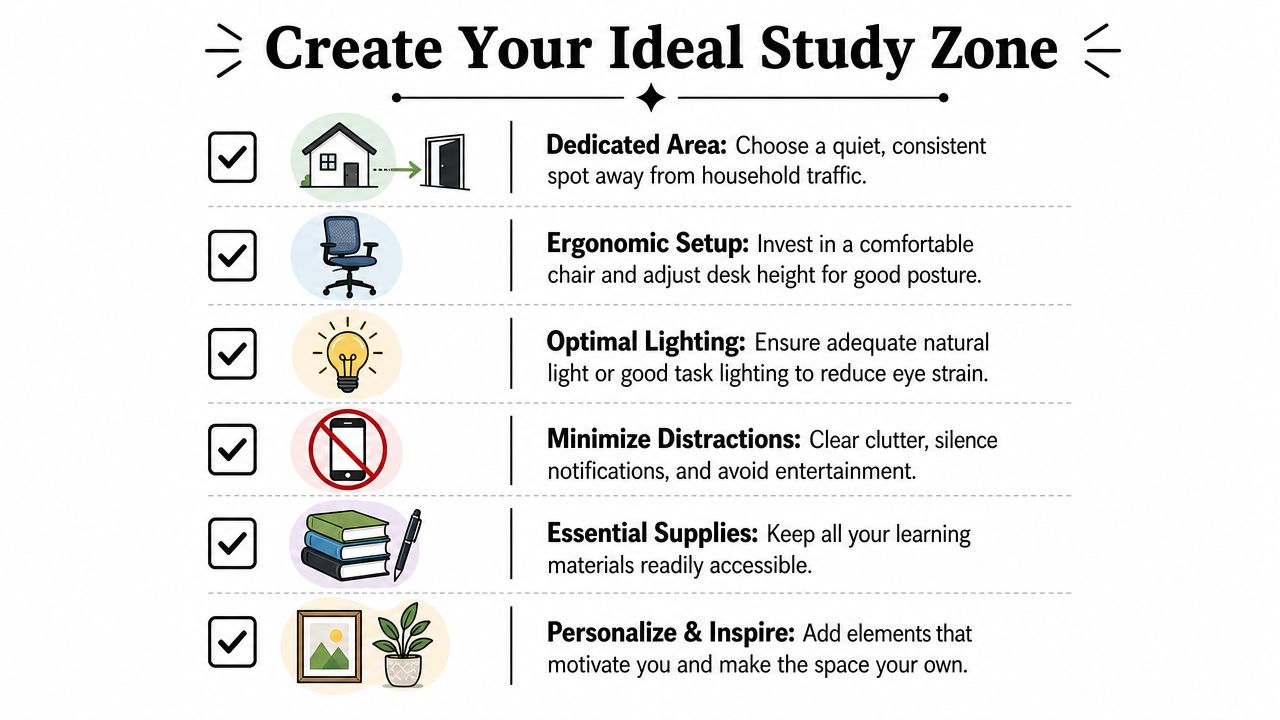
A corner of the dining table can work. So can a quiet chair in the bedroom, a fold-out desk, or even one end of the sofa with a lap tray and headphones. The point isn't perfection. The point is consistency.
Claim your corner
Try choosing one place that becomes your “learning spot”. If possible, keep it the same each time. That saves energy because you're not deciding where to work every day.
A useful setup might include:
- A simple surface: Table, desk, or tray. You need enough room for a notebook and laptop.
- A comfortable seat: Not luxurious, just supportive enough that you can sit without constant fidgeting.
- Easy reach supplies: Pens, charger, notebook, calculator, sticky notes.
If space is tight, keep everything in a study box. When it's time to learn, the box comes out. When you're done, it goes away. That's a practical way to create order without taking over the house.
Practical rule: Make starting easy. If you have to spend ten minutes finding your pen, your motivation drops before you begin.
Cut down distractions kindly
Most adult learners don't study in silent houses. Children need things. Messages ping. Washing waits. You can't remove real life, but you can lower the noise.
Try this short checklist:
- Put your phone on silent and place it out of reach.
- Tell your family your study time so they know when not to interrupt unless it's important.
- Use headphones if your home is busy.
- Clear visual clutter from the area before you begin.
A clear space often creates a calmer mind. That matters when you're already carrying stress.
Later, if you want a quick visual reminder of what a good setup looks like, this video gives practical ideas for making home study feel more manageable.
Make it feel like yours
Your study area should support you, not punish you. Add one or two things that lift your mood. A small plant. A family photo. A printed quote. A lamp with warm light. Tiny details can make the space feel welcoming rather than heavy.
Here's a simple guide:
| Part of the space | Keep it simple |
|---|---|
| Lighting | Use natural light if you can, or a lamp that lights the page clearly |
| Storage | Use a box, folder, or drawer for all study materials |
| Comfort | Sit somewhere that helps your back and shoulders feel settled |
| Mood | Add one item that reminds you why you started |
This isn't about pretending life is perfect. It's about making room for your future inside the life you have now.
Make a Study Schedule for Your Real Life
Many adults think they need huge blocks of free time to succeed. That idea stops good people before they've begun. Most home study works better when it fits into real life, not an imaginary tidy week where nobody gets tired and nothing goes wrong.
A schedule should support you, not shame you.
Start with what cannot move
Take a plain weekly planner and write down the fixed parts first. Work hours. School runs. Caring duties. Meals. Sleep. Appointments. Once those are in place, you'll start to see smaller gaps.
Those smaller gaps matter. A lot.
You might have:
- Twenty minutes in the morning before the house wakes up
- Half an hour at lunch on two work days
- A quiet pocket in the evening after the children are asleep
That is enough to begin. If you need a simple layout, these study planner templates for home learners can help you map your week in a way that feels realistic.
Try study snacking
Think of learning in small bites. You don't always need a long session. Short bursts can be easier to start, easier to repeat, and easier to fit around family life.
Here are a few ways that looks in practice:
- On a commute: Listen to a recorded lesson or review key terms.
- On your lunch break: Answer a few practice questions.
- Before bed: Read one page and write three quick notes.
- While dinner is in the oven: Revise a formula or spelling rule.
This method works because it lowers pressure. You're not waiting for a perfect free evening that may never come.
A short session you actually do is more useful than a long session you keep postponing.
Build a week you can repeat
You don't need every day to look the same. Some adults like set evenings. Others prefer flexible slots they can move around. The best schedule is the one you can keep returning to.
A balanced week often includes:
- One heavier session: For assignments, essay planning, or harder topics
- A few lighter sessions: For reading, flashcards, or quick practice
- One catch-up slot: For anything that slipped
Leave breathing room. Life happens. Children get ill. Work gets busy. A missed session doesn't mean you've failed. It means you're a person with responsibilities.
Keep your promise small at first
Don't begin by promising yourself hours every day. Start with a target you can meet even on a difficult week. That could be three short sessions or one fixed evening plus a weekend hour.
Then notice the effect. Each time you keep that promise, your confidence grows. That feeling matters because adult learning isn't only about information. It's also about rebuilding trust in yourself.
Study Smarter Not Harder with Proven Methods
A lot of adults return to education and use the same methods they used years ago. They read the same page over and over, underline half the book, and hope it sticks. That can feel busy without being effective.
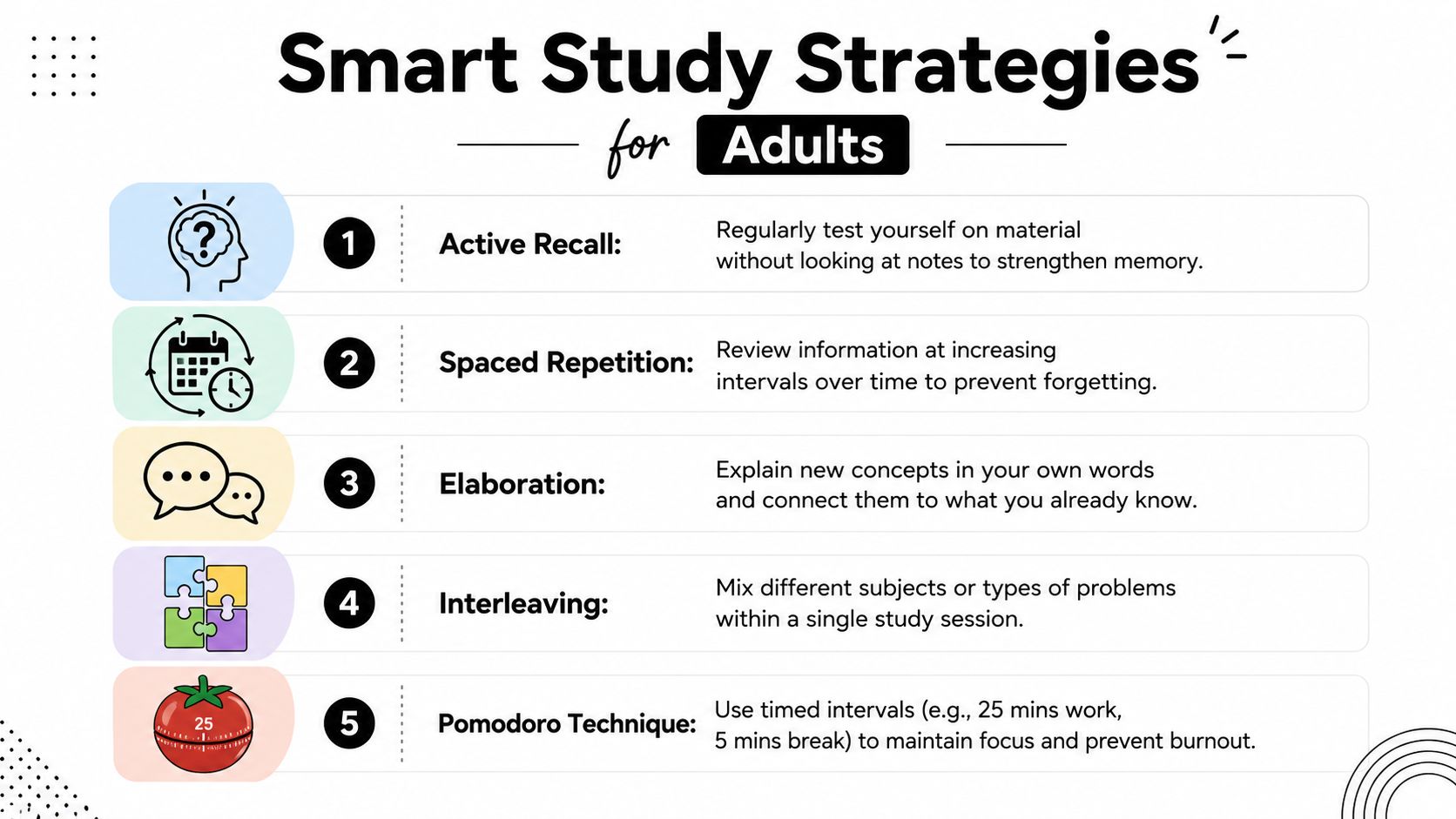
Smarter study is more active. You do something with what you're learning.
There's also good reason to trust focused home learning. Success rates show 66.7% of UK home-educated students graduate from college versus 57.5% of public school peers, while 78% of peer-reviewed studies confirm statistically significant superior academic performance (home education outcomes in the UK). The lesson here isn't that learning at home is magically easy. It's that focused study in the right way can work very well.
Active recall
This is one of the strongest methods you can use. Instead of staring at your notes, close the book and try to remember what you just learned.
You can do that by:
- writing everything you remember on scrap paper
- answering practice questions without looking
- covering definitions and saying them out loud
If you get stuck, that's not failure. That's useful feedback. It shows you what needs more attention. These active learning strategies for adult students give more examples of how to turn passive reading into real learning.
Pomodoro for tired brains
When you're juggling work and family, concentration can feel fragile. The Pomodoro Technique helps by giving your brain a short, clear finish line.
Try this:
- Work for 25 minutes on one task.
- Take a 5 minute break.
- Repeat if you still have energy.
The break matters. Stand up. Stretch. Refill your drink. Then come back. Short focused sessions often feel less overwhelming than telling yourself to “study all evening”.
If your brain feels crowded, shrink the task. Twenty five minutes can carry you further than dread ever will.
Feynman for true understanding
The Feynman Technique is simple. Learn something, then explain it in plain language as if you were teaching a child. If your explanation gets tangled, you've found a gap.
Try it with:
- a maths method
- a science idea
- a paragraph from English literature
- a topic from health or social care
You might say it out loud while washing up or explain it to a family member who's willing to listen. If you can make it simple, you probably understand it well.
Pick tools that fit the task
Different methods help with different goals.
| If you need to… | Try this |
|---|---|
| Remember facts | Active recall |
| Stay focused | Pomodoro |
| Check understanding | Feynman |
| Revise little and often | Flashcards and short quizzes |
You don't need to use every method every day. Use the tool that matches the job.
You Are Not Alone Lean on Your Support Network
Studying at home can feel quiet. Sometimes too quiet. You might wonder if everyone else understands things faster, manages time better, or feels more confident than you do. Most adult learners have those thoughts at some point.
That's one reason support matters so much.
Research shows that adult learners who begin their studies at age 25 or older in the UK have a year-over-year persistence rate of only 46%, compared to 81% for those starting at age 20 or younger (adult learner persistence and support needs). That gap says something important. Adults don't usually struggle because they lack ability. They struggle because life is heavy, time is short, and trying to do everything alone is hard.
Support can take different forms
A good support network isn't only one thing. It can include family, friends, tutors, mentors, and classmates. Each person helps in a different way.
Here's what that can look like:
- At home: A partner watches the children while you sit an assessment.
- With study: A tutor answers a question that was blocking you for days.
- With motivation: A mentor helps you reset after a bad week.
- With wellbeing: Someone checks in when stress starts affecting your focus.
Formal support makes home learning stronger
If you choose a structured provider, ask what support is included. Some programmes offer content but little human contact. Others include regular academic and pastoral help. Next Level Online College is one example of a UK provider that offers online courses for adult learners with dedicated academic and wellbeing support, alongside recognised qualifications.
That kind of support matters in ordinary moments. You get stuck on algebra and can ask for guidance. You feel embarrassed after missing a deadline and someone helps you make a fresh plan instead of giving up.
Asking for help is not weakness. It's a study skill.
Tell people what you need
People often want to help, but they don't know how. Be specific.
Try saying:
- “Can you give me one hour on Tuesday evening to revise?”
- “Please don't interrupt me unless it's urgent.”
- “Could you test me on these flashcards?”
Clear requests are easier for others to respond to. They also remind you that your education deserves space and respect.
Looking Ahead to Assessments and Your Next Steps
Assessments can make adults nervous, especially if school memories weren't kind. But exams and assignments don't have to be mysterious. When you know what you're aiming for, they become much easier to face.
Prepare in a calm, practical way
Good preparation is usually simple.
- Use feedback well: If a tutor points out a weak area, that's your map for revision.
- Practise under similar conditions: Mock papers help you get used to timing and question style.
- Read the question carefully: Many lost marks come from rushing, not from lack of knowledge.
- Review patterns: Notice which topics come up again and again in your mistakes.
Keep your revision focused. You don't need to know everything perfectly in one day. You need steady improvement.
Think beyond the assessment
A qualification is not just a certificate. It's a key. New GCSEs or Functional Skills can help you move into further study or improve your job options. A higher qualification can support a career change. For many adults, this path leads to university, which once felt far away.
If university is part of your plan, this guide on how to get into universities as an adult learner can help you see the route more clearly.
There's also help on the financial side. The UK government has pledged to create a new Lifelong Loan Entitlement that will provide all adults with loans covering four years of post-18 education, enabling adult returners to access university without financial fear (Lifelong Loan Entitlement overview).
Your next step doesn't have to be your final destination. It just has to move you forward.
If you're studying at home now, you're already changing the story. You're showing your children that effort matters. You're showing yourself that your future still belongs to you. One lesson, one assignment, one exam at a time, you can build a life that feels bigger, steadier, and full of possibility.
If you're ready to turn studies at home into a clear plan, Next Level Online College offers flexible online courses for adult learners in the UK, including Functional Skills, GCSEs, A Levels and Access to Higher Education options, with support designed to fit around work, family and everyday life.