
You're sitting at the kitchen table with a course page open, a mug of tea going cold, and one question keeps coming back to you, what do these tariff points mean for me? If you've been out of education for a while, the numbers can look cold and official, but they're just a way of turning your grades into something you can read at a glance. Once you understand the system, it becomes much easier to see how your effort is building towards university, a new career, and a future your family can be proud of.
What Tariff Points Mean for Your Future
A lot of adults first meet tariff points A Level when they see a university offer like “120 points” and wonder if that is good, bad, or out of reach. It sounds technical, but the idea is plain enough once someone walks you through it. UCAS uses tariff points so universities can compare different Level 3 qualifications on one shared scale, and your grades become part of a bigger picture of progress, as UCAS explains on its tariff points page.
Tariff points work like a progress counter. Each grade adds its own amount, and the total shows where you stand. A current A Level tariff gives 56 points for an A*, 48 for an A, 40 for a B, 32 for a C, 24 for a D, and 16 for an E, so every subject contributes something real to the total rather than fading into a vague average.
Practical rule: tariff points help universities compare different routes fairly, not catch you out.
That matters if you are returning to learning with nerves. The numbers are not a test of your worth. They are a measuring stick, and once you know how to read them, you can make calmer choices about subjects, target courses, and the route that fits your life. If you want a quick reference alongside this explanation, the A Level grades to UCAS points guide is a useful companion.
The Current A Level Tariff Points Table
For many adult returners, the table is the part that makes the whole system click. One grade sits above another, just as one rung sits above the next on a ladder. The higher the grade, the more points it adds to your total, and the lower the grade, the fewer points it gives.
| A Level Grade | UCAS Tariff Points | What It Means for You |
|---|---|---|
| A* | 56 | Top grade, the strongest single contribution to your total |
| A | 48 | A very strong grade, and often the one learners aim to build around |
| B | 40 | Solid progress, still a meaningful step towards an offer |
| C | 32 | A useful pass that keeps you moving forward |
| D | 24 | Lower pass, but still counts towards your total |
| E | 16 | Lowest pass grade, and still part of the scale |
For A Levels, the current tariff scale is the one universities use to compare entry profiles in a standardised way. Manchester's tariff explanation notes that this newer system replaced the older A level values of 140, 120, 100, 80, 60 and 40 with the current scale Manchester tariff explanation.
A few learners find it helpful to keep a simple reference open while they study. The A Level grades to UCAS points guide does that neatly, and it can make the numbers feel less abstract.
AS Levels sit on a separate lower scale. They use A 20, B 16, C 12, D 10 and E 6, and you cannot combine an AS Level and an A Level in the same subject for tariff scoring. That keeps the comparison fair, because an AS Level and a full A Level do not carry the same weight AS Level tariff explanation.
Keep the table close when you revise. It is much easier to feel settled when the numbers are plain in front of you.
How to Add Up Your Tariff Points Step by Step
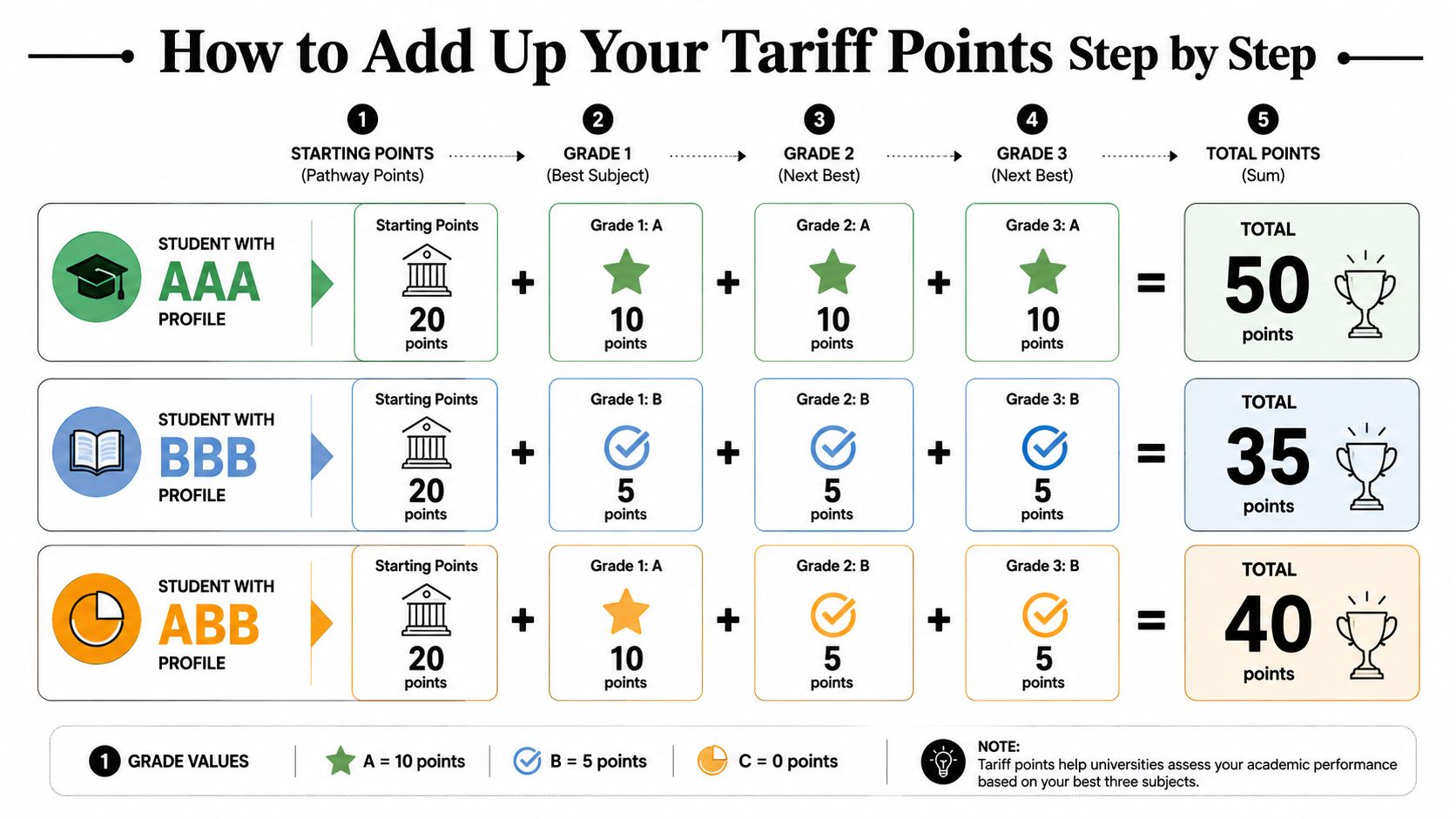
The maths is gentler than it first looks. You don't average the grades, and you don't need to guess. You just add each subject's points together, then compare the total with the course offer.
Take AAA. That's 48 + 48 + 48, which gives 144 points. That is why AAA is often seen as a strong entry profile, because each subject pulls its own weight. A mixed profile like ABB becomes 48 + 40 + 40, which gives 128 points grade-by-grade calculation example.
Here's the same idea with one more example.
A calm whiteboard check
- AAA. 48, 48 and 48. Total 144.
- BBB. 40, 40 and 40. Total 120.
- ABB. 48, 40 and 40. Total 128.
That's the whole method. No averaging, no hidden trick, just straight addition.
If you're using predicted grades, work with the marks you're likely to achieve, then compare the total with the course requirement. If you already have results, the same method tells you where you stand right now. A lot of adults feel embarrassed doing this on paper, but it really is the kind of sum that gets easier with a pencil and a few quiet minutes.
Useful habit: write each subject in its own line before you add up the total. It stops simple mistakes.
Combining A Levels with Other Level 3 Qualifications
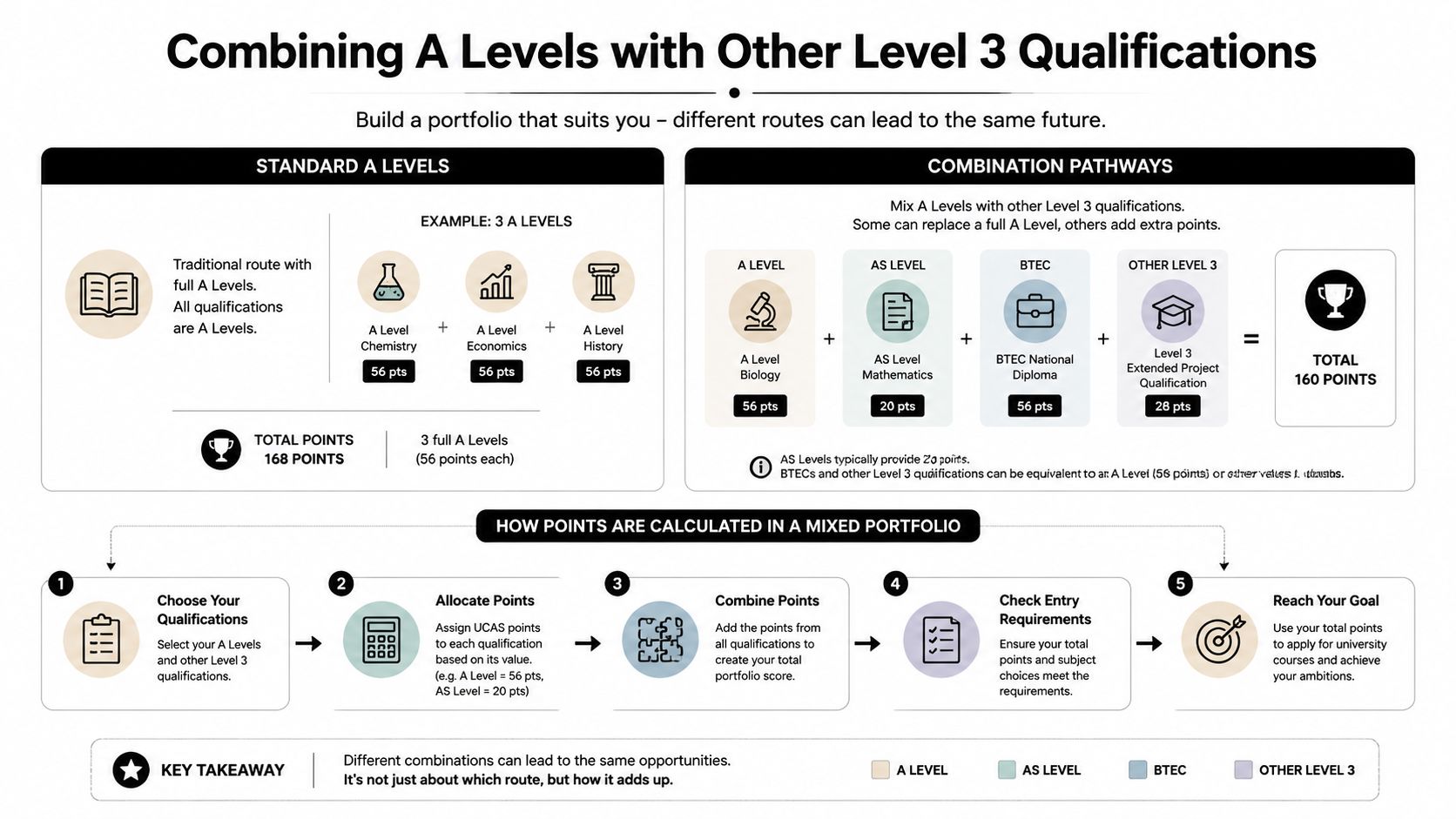
Many adult learners do not arrive with the neat old pattern of three A Levels and nothing else. Work changes, caring duties grow, money gets tight, and the route back into study often looks a bit mixed. Tariff points are built with that in mind, because each Level 3 qualification is given a value that can be added to the others on the same scale.
AS Levels are the first thing many people ask about. They do count, but they sit on their own lower scale, and you cannot count the same subject twice by combining an AS Level with the full A Level in that subject AS Level and A Level rule. In practice, the higher qualification in that subject is the one that matters for tariff points.
Mixed routes work when the total matches the offer
A university may ask for a points total rather than a fixed pattern of grades. If that happens, a mixed profile can still be enough. An adult learner who is comparing A Levels with other routes can also use a BTEC Level 3 UCAS points guide to see how another qualification fits onto the same admissions scale.
The main idea is simple. You are building a total, not collecting separate badges. If one qualification gives you a strong contribution and another fills a gap, the final number may still meet the offer.
For a lot of people, that is a relief. It means the route back into education does not have to be all or nothing. A combination of subjects, if the points add up, can be just as valid as a straight A Level line-up.
If you are studying around work or caring responsibilities, that flexibility can matter a great deal. It lets you choose the route that fits your life now, including modern options such as T Levels, Access to HE, or online A Levels, while still working on the same points scale.
How A Levels Compare with T Levels and Access to HE
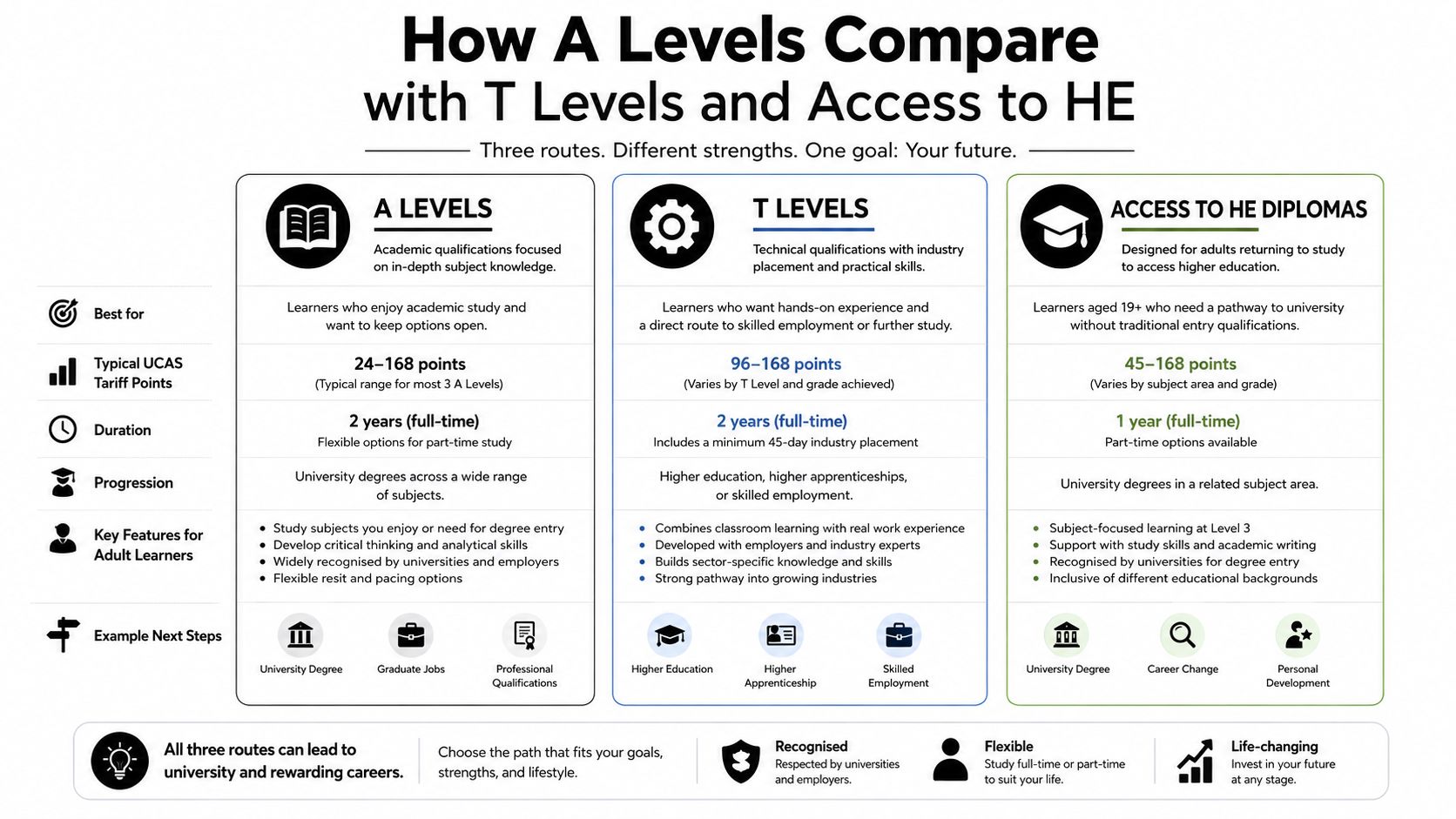
For many adults, the question isn't “How do A Level points work?” It's “Which route suits me now?” That's where it helps to look at A Levels, T Levels, and Access to HE Diplomas side by side, because they all lead towards university entry in different ways.
T Levels are especially useful to understand because they carry points equivalent to three A Levels. UCAS and T Level guidance show that a Distinction* is worth 168 points, and a Pass is worth 72 or 96 depending on the core outcome T Levels and UCAS points. That makes them a serious route for applicants who want a more technical path.
Access to HE Diplomas work differently, but they are widely used by mature learners and accepted by universities. If that route feels more realistic for your situation, you can read more about an Access to HE Diploma online option.
Choosing the route that fits real life
- A Levels suit learners who want a subject-based academic route and maybe need a specific set of subjects for a course.
- T Levels suit people drawn to technical learning and structured workplace-linked study.
- Access to HE suits adults returning after a break and looking for a recognised bridge into higher education.
That doesn't mean one is better than the others. It means they serve different lives. If you're balancing work, children, or a long gap since school, the right path is the one you can finish with confidence.
Why This Matters for You and Your Family
When you're an adult learner, the numbers are never just numbers. They can stand for a better salary, a more fulfilling career, and the quiet pride of showing your children that learning doesn't stop when school ends. That's why tariff points A Level deserve your attention. They turn effort into a visible total, and that total can move you towards university courses in fields like teaching, nursing, engineering and business.
UCAS has used the current A level tariff since the 2017 reform, and universities and colleges use tariff points to compare applicants on a common scale UCAS points and offers. That may sound technical, but for you it means something much simpler. It gives your progress shape. It lets you see that each study session, each assignment, each revision hour is not wasted.
A small step can become a family story
You may be studying late at night after work, or during stolen pockets of time between school runs. That effort matters. It builds toward a total that can support a new chapter, and your family will see that persistence long before you ever get a certificate in your hand.
Your grades are not a verdict on your past. They're a measure of where you're heading next.
If you want support with flexible study, Next Level Online College offers online routes into A Levels and Access to HE that fit around work and family life. For many adults, that kind of structure makes the difference between hoping for change and starting it.
Common Questions and Your Next Steps
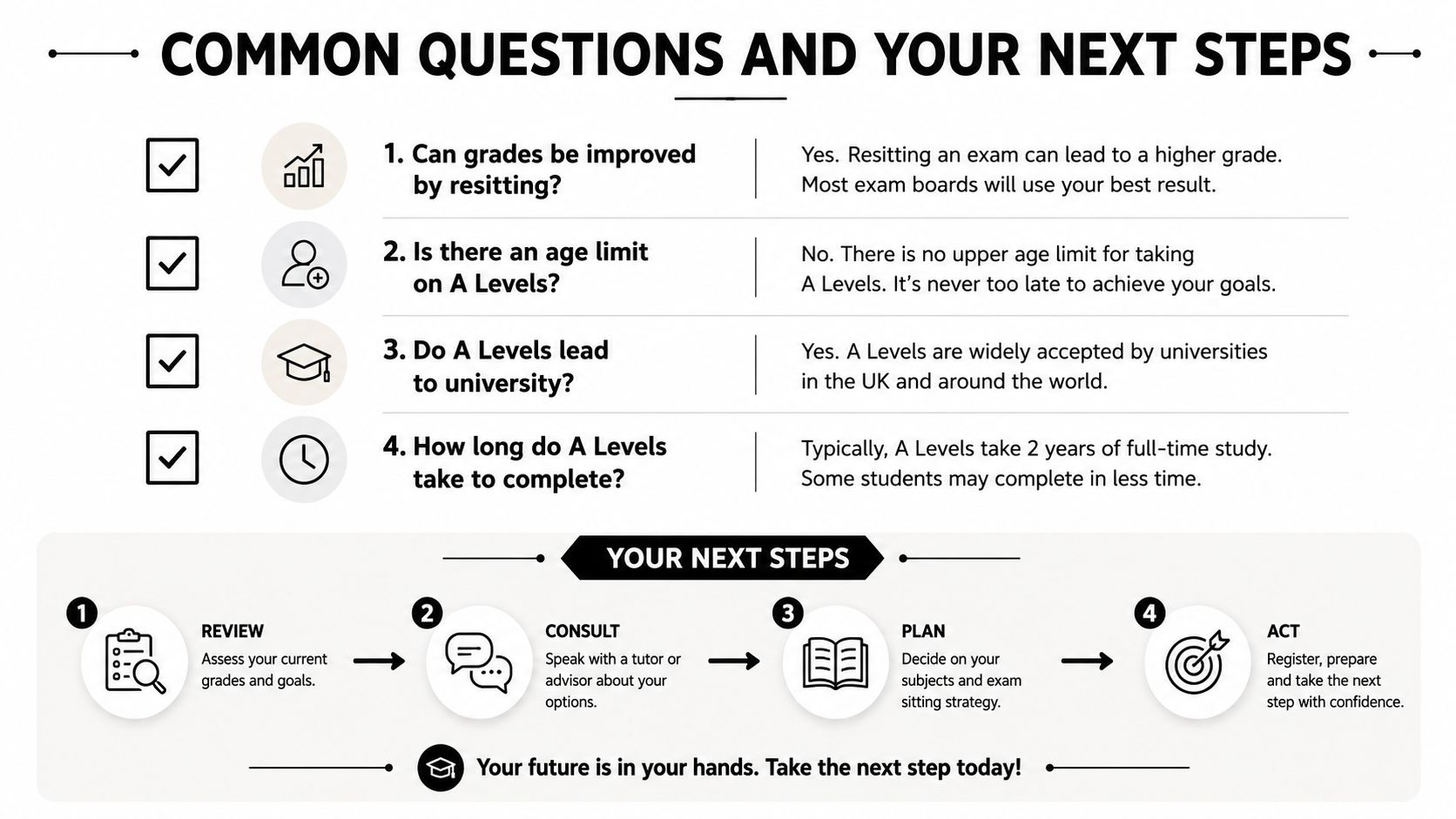
A few questions come up again and again when adults start looking at university routes. The good news is that the answers are usually reassuring.
Can grades be improved by resitting? Yes, if you choose to resit, the new result is the one that matters for your final profile. Is there an age limit on A Levels? No, adults can study them too. Do A Levels studied online carry the same tariff weight as school-based A Levels? Yes, the qualification is what matters, not the room you studied in. What should you do next? Start with the course requirements and work backwards from there.
The first practical move is simple:
- Check the points table so you know what each grade is worth.
- Look at a target course and see whether it asks for points or specific grades.
- Choose your subjects with your end goal in mind.
- Explore a flexible study option that fits work, family, and confidence level.
UCAS introduced its original Tariff in 2001 for students starting higher education in September 2001, and it was redesigned again for courses starting in September 2017 into the current size band and grade band model UCAS tariff history. That long history is useful because it shows the system has changed with time, and so can you.
If you're ready to take your next step, visit Next Level Online College to explore flexible A Levels and Access to HE study that fits around real life. Their online courses are designed for adult learners who want clear support, steady progress, and a route towards university or a stronger career.