
You might be reading this after a long day, with work, children, bills, and a quiet worry that it's too late to start again. Maybe you want a steadier income, a job people respect, and a future your family can feel proud of. Accounting can look intimidating from the outside, but it's really a set of practical skills that many adults learn step by step, even if school wasn't a happy place the first time round.
The good news is that types of accounting are easier to understand than they first seem. Once you can see the different branches clearly, you can make a smarter choice about the path that suits your strengths, your time, and the kind of life you want to build. This guide keeps the language simple, the ideas practical, and the focus firmly on real progress, not perfection.
Your Journey to a Brighter Future Starts Here
A lot of adults worry that accounting is only for people who never struggled with maths. Plenty of people who build a strong career in the field start from the same place as you, with doubt, then discover that accounting relies more on clear thinking, careful habits, and learning the right rules than on being a maths genius. Those skills can be learned step by step, and they can open real doors.
For someone trying to give their family a steadier life, the subject can feel distant at first. Words such as “financial statements” or “tax accounting” may sound like they belong to another world, especially if school did not go well the first time round. Accounting is built around specialist roles, not one vague “accountant” stereotype, and UK training reflects that structure through distinct branches and supervision, as the Financial Reporting Council explains in its profession-wide overview of specialist functions and regulation Financial Reporting Council overview of the accountancy profession.
Practical rule: if you can keep records, spot patterns, and follow steps carefully, you already have the beginnings of accounting thinking.
That matters because accounting is not one single job. In the UK, it includes financial accounting, management accounting, cost accounting, tax accounting, forensic accounting, auditing, and accounting information systems, and each branch serves a different purpose in a business or organisation. Once you see those differences clearly, the subject stops feeling like a wall and starts feeling like a map. That kind of map is useful when you are trying to move from uncertainty to a clear next step.
This path can also support something bigger than a job title. It can mean greater security at home, more confidence when helping children with their studies, and the quiet pride that comes from building a future with your own effort. If you want a flexible place to begin, this career change course route is a sensible starting point.
The Two Big Pictures Financial and Management Accounting
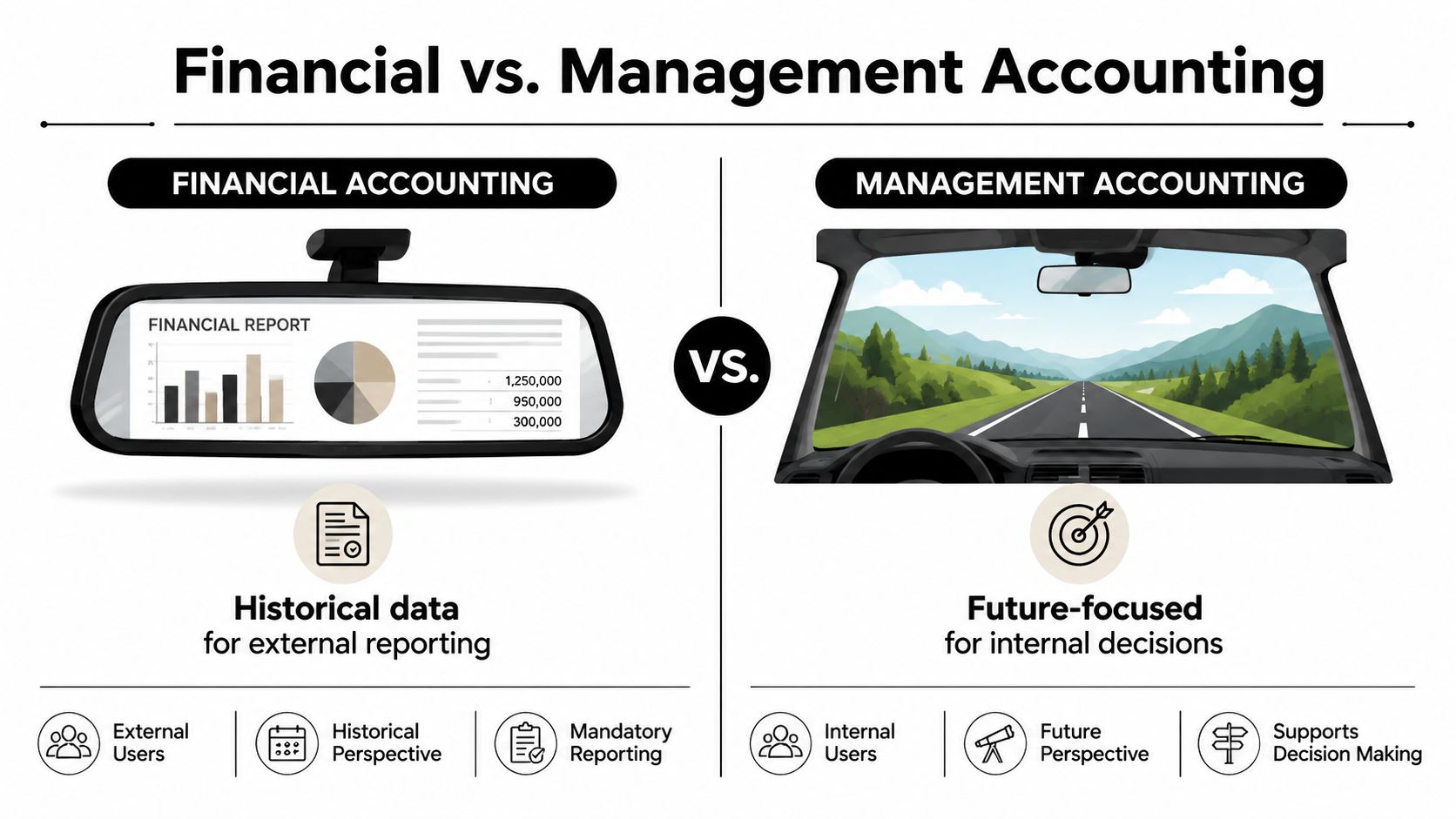
Financial accounting looks back
A business can feel overwhelming until you split it into two views. Financial accounting gives the outside view. It records what has already happened and turns that history into official reports for people outside the business, such as lenders, investors, and compliance bodies. In the UK, annual accounts must be prepared under UK-adopted IFRS or UK GAAP, depending on the entity type, so the reporting method affects recognition timing, disclosure, and comparability UK accounting methods and reporting basics.
One point often causes confusion for new learners, the difference between cash accounting and accrual accounting. Cash accounting records money when it physically moves. Accrual accounting records income and expenses when they are earned or incurred, even if the cash moves later cash and accrual accounting methods. For official reports, UK companies generally use accrual accounting because it gives a truer picture of performance.
That is why financial accountants spend so much time on statements, reconciliations, and checks. Their job is to help outside readers trust the numbers, and to help the business present its performance in a format that meets the rules. For an adult learner, that can be a reassuring starting point. You do not need to know everything at once, you need to learn how the pieces fit.
Management accounting looks ahead
Management accounting works like a satnav inside the business. It helps people decide where to go next. Instead of focusing on published reports, it supports internal planning, budgeting, and control.
This branch asks practical questions. How much should be spent next month? Which product line is performing best? Where are costs rising? Management accountants often work with budgets, forecasts, and performance reports that help directors make better decisions before problems grow. It suits people who like solving puzzles and want to see their work shape real decisions.
A simple way to remember the difference is this, financial accounting tells the story of what happened, while management accounting helps shape what happens next. Both matter, but they serve different readers. One keeps outsiders informed. The other helps the business steer safely and make better choices for the future.
Getting into the Details Cost and Tax Accounting

Cost accounting shows what each product really costs
A bakery makes the idea of cost accounting easy to see. If a shop bakes bread every morning, the owner needs to know what each loaf really costs to make. That means adding up the flour, yeast, energy, packaging, wages, and the other expenses tied to production. Without that information, the owner might set the price too low and lose money, or set it too high and lose customers.
This branch turns everyday business activity into information people can act on. It helps owners spot waste, compare products, and plan with more care. A bakery might see that one line of cakes takes longer to produce than expected, or that ingredient costs are rising and need attention. Small lessons like that matter, because they can guide better choices before problems grow.
Cost accounting also helps people build confidence in their own skills. You do not need to guess your way through it. Once you learn how costs flow through a business, the numbers start to make sense, and that understanding can support steadier work, better decisions, and a more secure future for a family.
Tax accounting follows HMRC rules
Tax accounting works with a different rulebook, because the government does not always treat profit the same way a business does. In the UK, corporation tax is worked out from accounting profit after specific HMRC adjustments, including items like capital allowances and non-deductible expenses. That means a company's book profit is often different from its taxable profit UK tax accounting and HMRC adjustments.
That difference matters in practice. Finance teams often need a bridge between the accounts used for reporting and the figures used for tax returns. It helps with year-end planning, fixed-asset decisions, and staying compliant with the rules. HMRC's corporation tax framework makes this a specialist branch of accounting, not just routine admin UK tax accounting and HMRC adjustments.
Practical rule: if the business has made a sale, spent money, or bought an asset, the tax treatment may still be different from the accounting treatment.
That is why tax accounting suits people who are careful, patient, and comfortable following rules exactly. It is one of the most practical accounting specialisms because every business needs it, and mistakes can be costly. For an adult learner, that can be encouraging. A skill like this can lead toward a stable role that people rely on, and it can be learned step by step from where you are now.
The Detectives and Guardians Forensic and Auditing Roles
A business can look healthy on the outside and still hide problems in its records. Forensic accountants and auditors step in to protect trust, and trust is what keeps money, contracts, and public confidence moving.
Forensic accounting follows the money trail
Forensic accounting is the money detective branch. When there is suspicion of fraud, theft, or another financial crime, a forensic accountant looks through records, bank activity, invoices, and other documents to work out what happened and how. Specialist learning resources describe this branch as combining accounting, auditing, and investigative skills, often for legal purposes Forensic accounting overview and specialist methods.
This role suits people who enjoy solving puzzles. The work can involve tracing patterns, comparing documents, and building a clear picture from messy evidence. It is not only about numbers. It also depends on judgement, careful reading, and the ability to tell a truthful story from the records.
For an adult learner, that can be encouraging. You do not need to be a genius with spreadsheets from day one. You need patience, attention to detail, and a willingness to keep asking, “What does this record show?” Those are skills you can build step by step, and they can lead toward work that people respect and rely on.
Auditing protects confidence
Auditing is the guardian of trust. An auditor checks whether financial statements are fair and reliable. That independence matters because the people reading those accounts need confidence that the numbers are not just neat, but also honest. The UK profession includes auditing alongside other specialist functions because external assurance serves a different audience from internal management reporting FRC profession structure and specialist roles.
Auditors often ask hard questions. They test documents, compare records, and look for signs that a company may have recorded something wrongly. That work supports lenders, investors, and the wider public. It also gives a business a chance to correct mistakes before they become bigger problems.
These two branches show that accounting can be active, meaningful, and protective. It can support fair business practice, help in legal disputes, and keep confidence strong where money is involved. For someone aiming for a stable career that can support their family, that kind of work can be a strong and practical path.
Accounting for a Cause Public Sector and Nonprofit Work
Not every accounting job is about profit. Some of the most meaningful roles sit in places where the goal is public value, not private gain. That can be a strong fit if you want work that feels useful to other people, not just to a company's bottom line.
Public sector accounting serves the public good
Public sector accounting is used by bodies such as local authorities and health services to manage money responsibly. The focus is accountability. Taxpayers need to know that public funds are handled carefully, spent wisely, and tracked properly. That means the work is tied to control, transparency, and good stewardship.
For some learners, that sense of duty matters a great deal. It can feel satisfying to know your work helps systems that families rely on every day. A person may never meet the people affected by the reports they prepare, but the work still supports real lives.
Nonprofit accounting supports mission-led organisations
Nonprofit accounting works in charities and similar organisations. These groups often rely on donations, grants, and fundraising, so careful record-keeping is essential. The accountant helps the organisation show where money came from, where it went, and whether it was used in line with the mission.
That role can suit people who want their career to reflect their values. The work is still technical, but the purpose is deeply human. It helps charities stay organised, transparent, and effective, so more of their energy can go into the people or causes they serve.
A good accounting job does not have to drain your sense of purpose. It can strengthen it.
If you want work that gives back to society as well as to your own household, these branches deserve serious attention.
Your Path to a New Career in Accounting
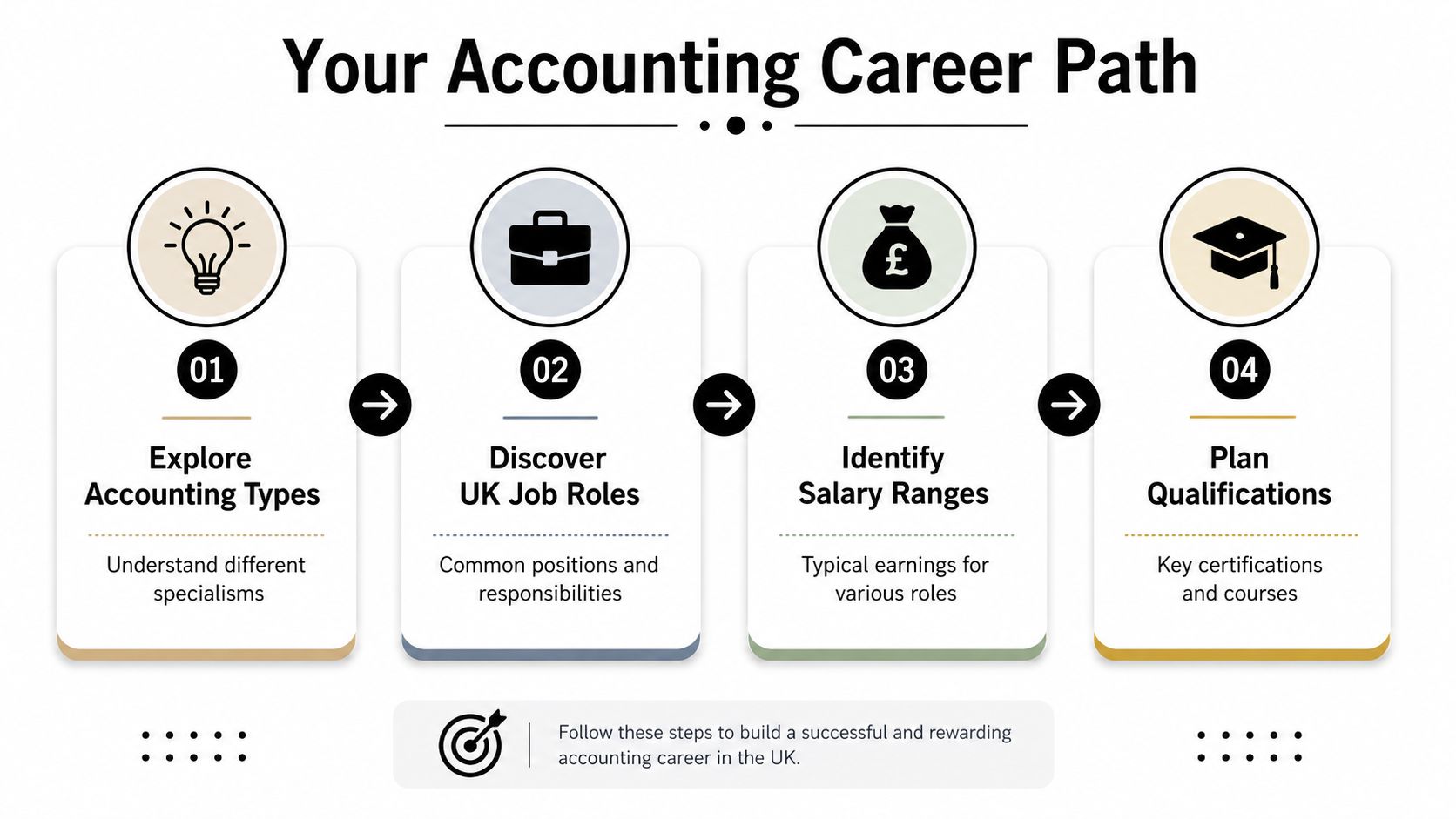
A new accounting career can start from a very ordinary place, like a spreadsheet you already understand, a job where you handle invoices, or a moment when you realise you want steadier work for your family. The profession is built around specialist roles, not one single job title, so you can choose one path first and learn the rest later. That matters for adult learners because it gives you a clearer first move instead of asking you to master everything at once. It also helps to separate accountants and bookkeepers early on, because the first rung on the ladder often begins with the simpler day-to-day records before you move into broader analysis and reporting this guide on the difference between accountants and bookkeepers.
Start with the role, then work backwards
Many adults stall because they try to choose a course before they understand the job. A better approach is to begin with the kind of work you want to do. If you like order and accuracy, tax or financial accounting may suit you. If you enjoy solving puzzles and asking why numbers changed, management or forensic work may feel more natural. If you care about public service or charities, public sector or nonprofit accounting may fit your values and the kind of future you want to build.
You do not need a degree before you begin. Entry-level roles often start with basic bookkeeping, admin support, or trainee finance work, then grow into more specialist jobs as your confidence rises. That route can feel more manageable because each step builds on the last, the way learning to read a map becomes easier after you have already learned the roads near your home.
Build qualifications in a way that suits adult life
Adult learners often need flexibility, not pressure. Structured online study can fit around work, children, and everything else that fills a week. An Access to Higher Education Diploma in Business and Accounting can create a pathway to university, which matters if your long-term goal is a degree or a professional route that begins with higher education.
If your children are watching you study, they see more than homework on a table. They see persistence, self-belief, and the idea that learning still has a place in adult life. That can change the feel of a home. It tells them that a new chapter is possible, even after a long pause, and it gives your own household a stronger story to build on.
Your Questions Answered and Next Steps
You do not need to have every answer before you begin. Most adults start with doubts, then build confidence through small wins. The questions below are the ones many learners ask themselves.
Do I need to be a maths genius
No. Accounting uses numbers, but it also uses logic, care, and structure. If you can follow instructions, check details, and stay organised, you already have useful strengths. Skill comes through learning the rules and practising them until they make sense.
Am I too old to start
No. Adult learning is common, and mature students often bring focus, life experience, and commitment that younger learners may not have yet. Those qualities matter in accounting because employers value reliability and judgement as much as raw speed.
How can I fit study around family and work
Flexible online learning helps because you can study in smaller chunks. That makes it easier to keep going without turning your whole life upside down. A steady routine, even if it is short, is often better than waiting for the “perfect” time.
Is there real demand for these skills
Yes. In the UK, demand for specific accounting skills is growing partly because of Making Tax Digital. By March 2025, over 1.4 million self-employed people and landlords had signed up for MTD, which has boosted demand for tech-savvy bookkeepers and tax assistants Making Tax Digital and accounting skill demand.
If you want a route that supports university entry as well, these UK university entry requirements guidance pages can help you understand what to aim for next. A clear plan can turn a scary subject into a practical future.
Next Level Online College offers flexible, fully supported study that can help you move from doubt to direction, whether you're starting from scratch or preparing for university. If you want a realistic first step into accounting and a route that fits around family life, visit Next Level Online College and take the first step today.