

You might be reading this after putting the kettle on, squeezing study thoughts into the quiet gap between work, school runs, bills, and everything else life asks of you. You want a better future. You may even have a picture in your mind of yourself working in law, helping people, earning well, and showing your children that it's never too late to start again.
You may also be thinking, “I've left it too long,” or “I wasn't great at school,” or “I don't even know which A-levels I need.”
That feeling is normal. It doesn't mean you can't do this.
A law career can look polished from the outside, but every legal professional started by learning one step at a time. If you're asking what A levels for law are best, you're already doing something powerful. You're looking for a route forward. And for many adult learners, that first decision becomes the moment life starts to change.
Your Dream of a Law Career Is Closer Than You Think
A lot of adult learners carry an old story about themselves. Maybe it's “I'm not academic.” Maybe it's “university is for other people.” Maybe it's “I should have done this years ago.”
Those stories can feel heavy. But they aren't facts.
I've spoken to many adults who want to study law because they want more stability, more purpose, and more pride in their working life. Some want to support their family better. Some want to move into a respected profession. Some want to prove to themselves that they're capable of more than they were once told.
That matters.
Choosing education as an adult is not a small thing. It takes courage to begin again when you've got responsibilities and people depending on you. It takes grit to study after a long day. It takes love to build a better future not just for yourself, but for the people watching you.
Why this goal matters so much
A career in law can mean many things. It can mean helping someone understand their rights. It can mean working in a firm, a public service role, or a business setting. It can mean doing work that has structure, meaning, and progression.
For many adults, the dream is bigger than the job title.
- For your children: They see you learning, trying, and not giving up.
- For your confidence: Each assignment passed chips away at old self-doubt.
- For your future: Education can open doors to better-paid and more fulfilling work.
- For your sense of purpose: Law is about people, fairness, rules, and real-life problems.
Your age, your past results, and your time away from education do not cancel your ambition.
There isn't one perfect route into law. There is only the route that fits your life now.
That's good news, because adult learners often do better when they stop trying to copy the traditional school-leaver path and start building a plan around their own strengths. If you can stay organised, show commitment, and keep going when things feel difficult, you already have qualities that matter in serious study.
Start with the question behind the question
When people ask what A levels for law they need, they're often asking something deeper.
They're asking:
- Can I still do this?
- Do I need the exact same subjects younger students take?
- Will a university even take me seriously?
The short answer is yes, yes, and yes.
The Big Secret You Don't Need A-Level Law
It often happens like this. You start looking at law degrees after work, perhaps late in the evening, and one thought keeps needling at you. “Have I already fallen behind because I did not take A-level Law?”
You have not.
For most UK law degrees, A-level Law is optional, not a standard requirement. Universities usually want strong Level 3 qualifications and good grades, but they do not usually insist that one of those subjects must be Law. That matters because it gives you room to build a plan around the subjects you can study well now, not the ones you feel you should have taken years ago.
A helpful way to look at this is to separate content from skill. University law courses are there to teach you legal rules, cases, and methods. What admissions tutors often want to see first is whether you can read carefully, weigh different views, and explain your reasoning in clear writing. Guidance for applicants often points to subjects such as History, English Literature or Language, Philosophy, and Politics because they build those habits of mind, as explained in this guide to A-levels for aspiring lawyers.
That is why A-level Law can be useful without being necessary.
It works a bit like learning basic phrases before a holiday. Helpful, yes. Required before you are allowed on the plane, no. A university law department can teach legal content from the ground up. What is harder to teach quickly is the habit of reading with care and writing with control. Subjects that train those skills can serve you just as well, and sometimes better.
This is especially reassuring if you are an adult learner balancing study with work, children, money worries, or all three. Flexibility matters. If you can choose subjects that fit your timetable and play to your strengths, you give yourself a better chance of earning the grades you need and keeping your confidence intact.
A simple rule helps here:
- If you are strong in writing, English-based subjects may suit you.
- If you enjoy discussion and big ideas, Politics or Philosophy may fit well.
- If you like evidence, explanation, and structured essays, History is often a strong choice.
Practical rule: choose subjects that show clear thinking and give you a realistic chance of strong grades. That usually helps your application more than choosing Law for the title alone.
If you do not yet have traditional qualifications, there are other routes into higher education too. This guide on how to get into university without A-levels can help you see the full range of options.
One more point may settle your nerves. A-level Law is a mainstream subject, not an obscure one, so choosing it is perfectly valid if it suits you. The Law Gazette's results coverage reported strong interest in law-related study using recent A-level results data. So yes, you can take A-level Law if you want to. You just do not need to treat it as the single door into a legal career.
For many adults, that is the secret. You do not need a perfect past. You need a workable plan, honest subject choices, and the belief that starting now still counts. It does.
The Best A-Level Subjects to Build Your Case
Once you know A-level Law isn't the only answer, the next question becomes much easier. Which subjects help you prepare well?
The best answer is this. Choose subjects that build the habits a law student uses every day.
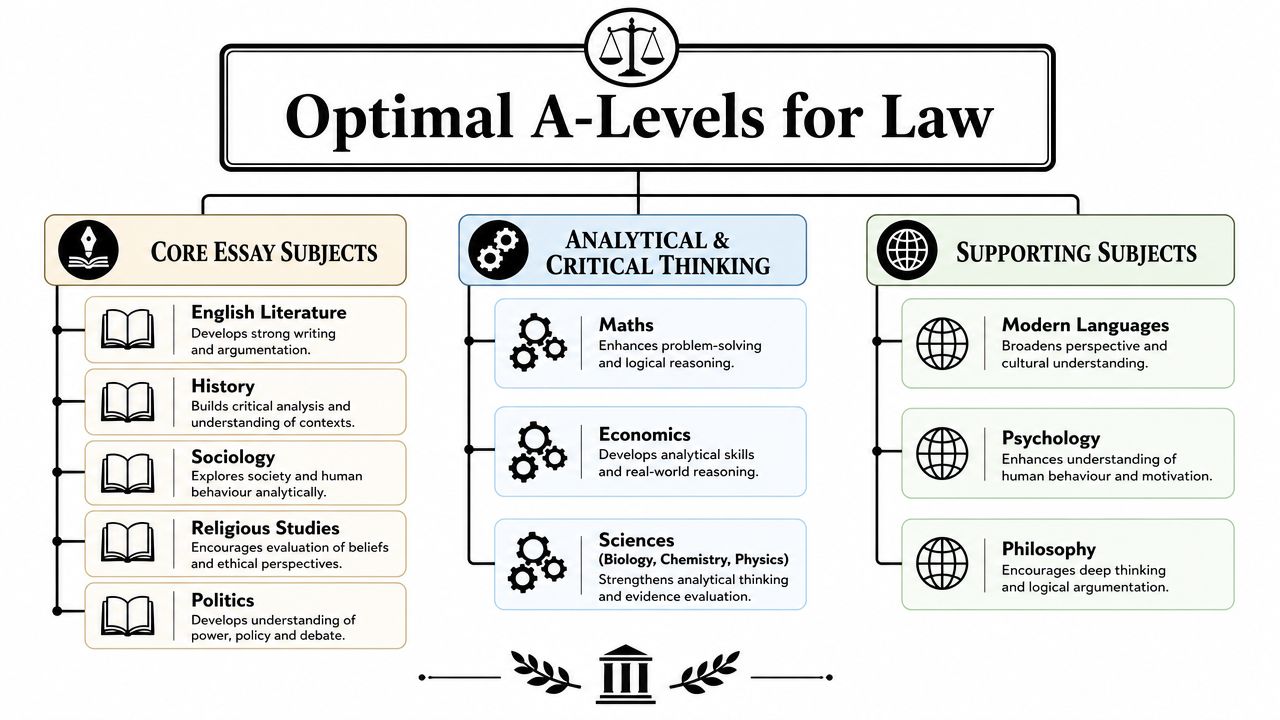
Core essay subjects
These are often the strongest fit for future law students because they train you to read, think, and write under pressure.
- History helps you weigh evidence. You learn that not every source says the same thing, and you must decide what is most convincing.
- English Literature or Language helps you write with control. You learn how language works, how arguments are built, and how to support a point clearly.
- Politics gets you thinking about power, government, rules, rights, and public debate.
- Philosophy teaches careful reasoning. It makes you slow down and examine what a claim really means.
A lawyer does these things all the time. They read closely. They test ideas. They explain a position in a way others can follow.
Analytical and reasoning subjects
Not every useful subject for law is essay-heavy. Some subjects build a different kind of legal strength.
Maths can sharpen logic and accuracy. A foreign language can improve precision and awareness of meaning. These can support strong law applications when paired with subjects that also show writing ability.
Cambridge gives a clear example of this wider view. The University states a typical offer of A*AA for Law, says Law A-level is not required, and notes that taking four A-levels will not normally give an advantage. It also says essay-based subjects such as English and History are good preparation for law study, as shown on Cambridge's Law admissions page.
That's helpful because it cuts through a common worry. You don't need to overload yourself with extra subjects just to look impressive.
A simple subject-matching guide
If you're unsure what to choose, match your strengths to the kind of study each subject demands.
| If this sounds like you | A-levels worth considering | Why they help |
|---|---|---|
| You enjoy reading and writing | English, History | Strong preparation for essays and argument |
| You like discussion and current affairs | Politics, Philosophy | Helps with reasoning and debate |
| You want balance | One essay subject plus one analytical subject | Shows range without losing focus |
| You're returning to study after a long break | Subjects you can commit to steadily | Consistency matters more than chasing the “perfect” mix |
Don't choose with fear
Many adults choose subjects based on what sounds impressive rather than what they can succeed in. That often backfires.
A better plan is to ask:
- Which subjects can I stay motivated with?
- Which subjects fit around my life?
- Which subjects give me the best chance of strong grades?
That's a smart legal mindset already. You're not guessing. You're weighing evidence.
If A-level Law itself interests you, there's nothing wrong with choosing it as part of your mix. Just treat it as one option among several, not a gatekeeper. You can look at a flexible A-level Law course if you want to explore how the subject is taught.
A good subject choice is one that stretches you without breaking you.
What University Grades You Will Need for Law
You sit down one evening, open a university course page, and see a grade offer that looks far higher than you expected. Your stomach drops. It can feel as if the door has closed before you have even knocked.
It has not.
Law entry grades vary a great deal between universities, so one demanding offer is only one part of the picture. A more helpful way to read entry requirements is to ask, “Which universities match my current starting point, and which ones could I grow into?”
That small shift matters. It turns panic into planning.
A calmer way to read law entry requirements
Some universities ask for very high grades because they are highly selective. Others offer a more accessible route into the same qualifying law degree. For an adult learner, that difference is encouraging. You are not looking for one mythical “right” university. You are looking for the right fit for your life, your study time, and the grades you can realistically work towards.
A shortlist works a bit like building a legal case. You do not rely on one fragile point. You build a balanced position.
| University Type | Typical A-Level Offer | What it can mean for adult learners |
|---|---|---|
| Most selective | A*AA | Best suited to students with strong academic preparation and plenty of study time |
| Competitive | AAA to ABB | A strong target range for applicants aiming high with solid support and consistency |
| Broad range of providers | BCC to ABB | Often a more realistic route for adults balancing study with work or family responsibilities |
The most selective universities can sound intimidating at first glance. Try not to let one headline offer define your whole plan. A law degree is still within reach through many providers, and the best choice is often the one you can complete strongly, not the one that sounds most impressive at the start.
What this means for your next step
A useful approach is to sort your options into three groups:
- Ambitious choices, where the offer stretches you
- Well-matched choices, where your expected grades fit comfortably
- Safer choices, where entry requirements give you more margin
That mix protects more than your application. It protects your confidence.
Adult learners often carry an extra weight here. You may be asking not only, “Can I get in?” but also, “Can I afford to get this wrong?” That is a real concern, especially if your studies affect your children, your finances, or the time you can give your family. A balanced shortlist helps reduce that pressure because it gives you options instead of pinning everything on one outcome.
Grades matter, but they are not the whole story
Universities use grades to judge academic readiness. They do not measure your character, your parenting, your work ethic, or the grit it took to return to study after years away.
That is why it helps to prepare your application as a full picture, not just a set of marks. If you know your grades may be modest, strong written application materials matter even more. This guide on writing a university personal statement that shows motivation and maturity can help you present your experience clearly.
If your past results were disappointing
Poor results in the past do not mean law is out of reach. They mean you need a plan that fits the person you are now.
One exam at a time. One assignment at a time. One week of steady study at a time.
That is how adults rebuild academic confidence. And every grade you improve is not just a number on a page. It is evidence for yourself and your family that this new chapter is real, practical, and worth the effort.
More Than Grades Your Complete Application
A law application is never only about A-levels. That's especially encouraging for adult learners because you bring more to the table than exam results alone.
Your application is really a picture of who you are as a learner and why law makes sense for you now.
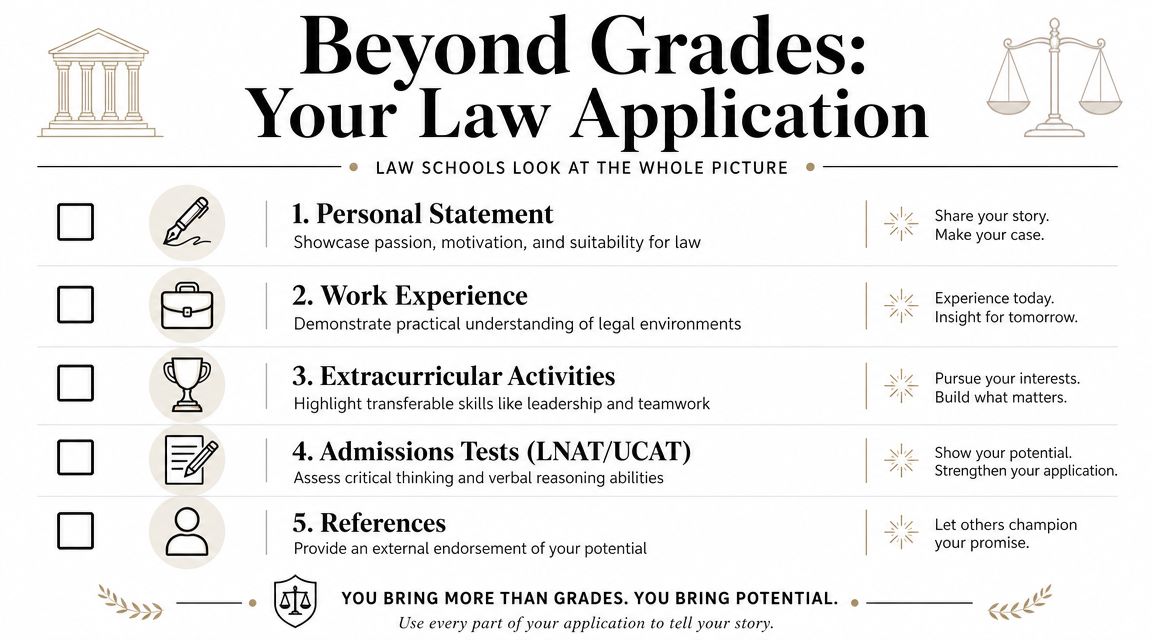
Your personal statement can be your strength
If you've worked, raised children, managed a household, supported relatives, or rebuilt your life after setbacks, you have real experience of responsibility and resilience.
That doesn't replace academic readiness, but it can strengthen the story of your application.
A strong personal statement for law often shows:
- Motivation: Why law matters to you
- Evidence of fit: Reading, study, or experience that connects you to the subject
- Maturity: What you've learned from life and work
- Commitment: Proof that you can stay focused over time
If writing about yourself feels hard, help is available. This guide on how to write a university personal statement can make the task feel much less daunting.
Life experience counts differently, but it counts
A younger applicant may talk about school clubs or recent classroom achievements. You may be able to talk about managing pressure, communicating with difficult people, solving problems calmly, and sticking with a goal even when life is busy.
Those are not small things.
They show steadiness. In law, steadiness matters.
Universities don't only look for polished school-leavers. They also value applicants who can think seriously, write honestly, and show they're ready for demanding study.
Other parts of the application
Depending on where you apply, you may also come across admissions tests such as the LNAT. If that happens, try not to see it as a sign you don't belong. It's merely another piece of preparation.
You can think of the full application like this:
- Your grades show academic potential.
- Your personal statement explains your reasons and readiness.
- Your reference supports your ability and attitude.
- Any admissions test checks skills such as reasoning and reading.
- Your overall story shows why this route makes sense now.
That last part is often where adult learners shine. Your story may be less traditional, but it can be more grounded.
Smarter Paths to Law for Adult Learners
Many adults ask what A levels for law they need when the better question is, “Which route gets me there in a way I can manage?”
That shift matters.
Most advice for law applicants repeats the 2–3 A-levels rule, but for mature learners, route planning is often the main issue. Entry requirements vary from BCC to A*AA, and alternative pathways such as Access to HE diplomas can be a practical route into university, as explained in Whatuni's guide to law degree entry requirements.
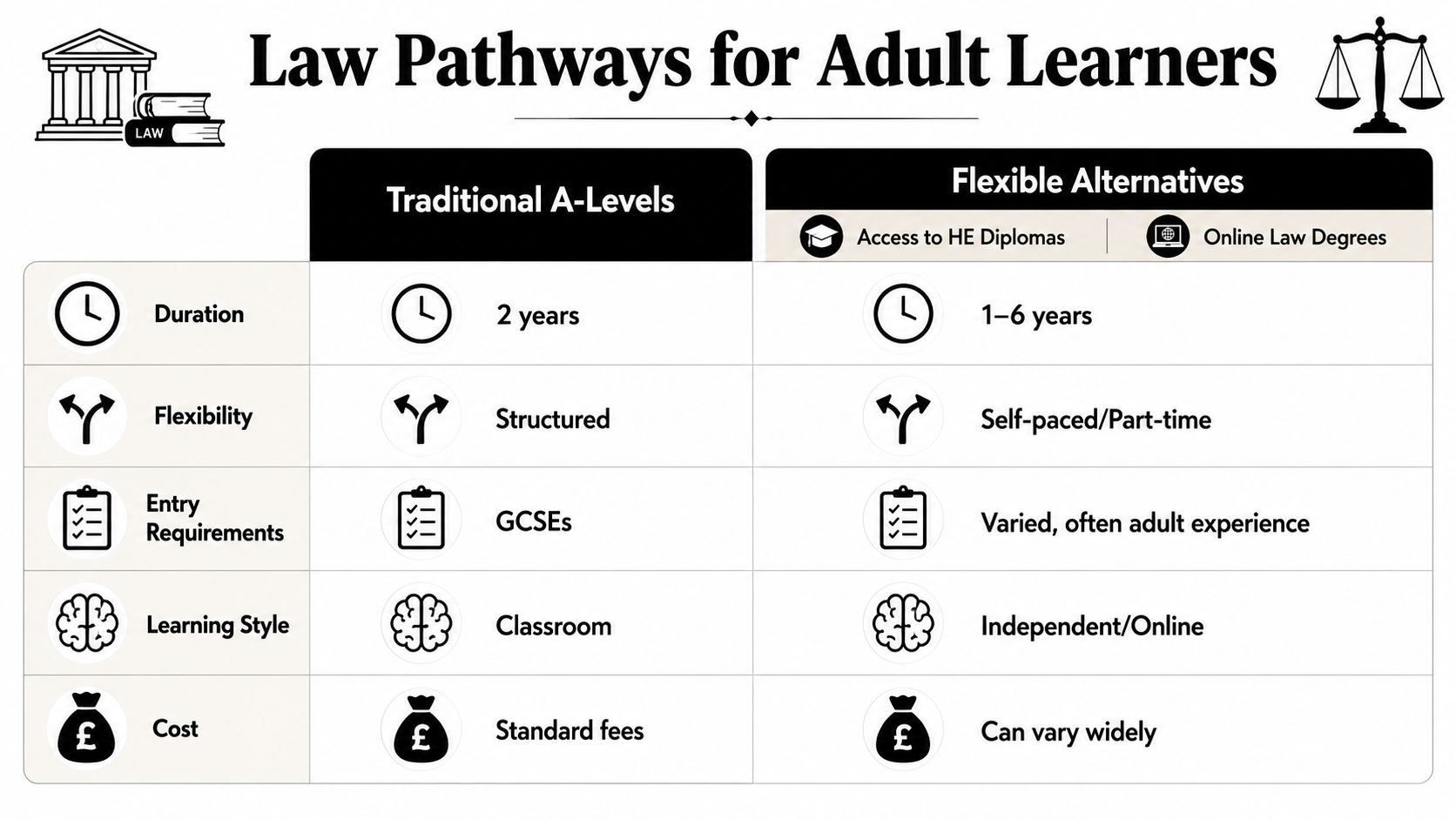
The traditional route isn't the only route
A-levels can be a strong option if you want subject depth and a familiar university-entry qualification. They can work very well if you need time to rebuild confidence or if your chosen universities clearly prefer that route.
But adult life doesn't always fit neatly around a standard study pattern.
That's where alternative pathways can make more sense.
Flexible options worth serious thought
- Access to HE Diplomas: These are often chosen by adults returning to study who want a direct route towards university.
- Online A-level study: This can suit people balancing work, childcare, and other responsibilities.
- Resits or top-up study: Useful if you already have some qualifications but need stronger results.
- Foundation routes or related entry pathways: These can open doors where a standard school-leaver route doesn't fit.
The key point is this. A flexible route is not a lesser route. For many adults, it's the more realistic and therefore the more powerful one.
Here's a quick video that may help you think about progression and planning:
Choose the path you can finish
The best study route is not the one that looks most impressive on paper. It's the one you can complete well.
Ask yourself:
- Can I study consistently each week?
- Do I need flexibility because of work or family?
- Am I better starting with a direct adult-focused route?
- Would online study help me keep going?
If the answer points away from a traditional sixth-form model, that's not failure. That's wise decision-making.
A lot of adult learners feel relief when they realise they don't have to force themselves into a system built for teenagers. They can choose a route that respects their real life.
Take Your First Step Towards a Life in Law Today
By now, I hope one thing feels clearer. A future in law isn't reserved for people who took a perfect path through school.
It can belong to the parent studying after bedtime. The worker revising on lunch breaks. The adult who once doubted themselves but has decided that their story isn't finished yet.

You do not need to know everything today. You only need to take the next step. That might be choosing subjects. It might be comparing entry routes. It might be finally saying, “Yes, I'm going to do this.”
Your family will see your effort. Your children will remember your courage. And you'll build something that reaches far beyond a qualification. You'll build proof that change is possible.
If you're ready to explore a flexible route into university, Next Level Online College offers online courses designed for adult learners who need study to fit around real life. Whether you need GCSEs, A Levels, or an Access to Higher Education pathway, you can find supportive options that help you move towards law with confidence.