
Somewhere in the back of your mind, this may have been sitting there for years.
You want a better job. You want more choices. You want to stop feeling held back every time an application asks for GCSEs. You may also want something intimately personal. To prove to yourself, and to your children, that it isn't too late.
A lot of adults come back to education carrying old school memories that still sting. Maybe you were told science “wasn't for you”. Maybe life got busy, money was tight, or you had to put everyone else first. So when you look up an online GCSE Biology course, the biggest worry often isn't the studying itself. It's this: will this lead to a real qualification that people respect?
That's a fair question.
If you're balancing work, family, bills, and tired evenings, you can't afford to spend time on the wrong course. You need something real, recognised, and worth the effort. You also need a learning path that feels possible, even if your confidence is low right now.
The good news is that adult learners succeed at this every year. Not because they have endless free time or perfect memories, but because they choose the right course, take one step at a time, and keep going. Biology can open doors to further study, healthcare routes, science-based careers, and a huge sense of personal pride.
Your Time to Shine Is Now
A woman I once taught reminds me of many adult learners. She worked hard, cared for her family, and had spent years telling herself she'd “missed her chance”. She wanted to move into a role where science mattered, but one missing qualification kept blocking her.
She didn't need someone to lecture her. She needed someone to say, calmly and reassuringly, that starting again was allowed.
That may be where you are today. You might be looking at your options late at night after the children are asleep. You might be wondering if you're too old, too busy, or too far behind. You're not. An online GCSE Biology course can fit around real life, and it can be the first step towards college, university, a career change, or proving to yourself that you can do something difficult and worthwhile.

For many adults, studying doesn't start with confidence. It starts with courage. If you're exploring GCSE courses for adults online, you're already doing something important. You're taking your future seriously.
Why this matters so much
Biology isn't just another subject on a list. It's often part of a bigger dream.
- For career progress: You may need science qualifications to move into healthcare, education, or another new field.
- For family pride: Your children see more than you think. When they watch you learn, they learn what resilience looks like.
- For self-belief: Passing a GCSE as an adult can change the way you see yourself.
You do not need to become a different person before you start. You start, and that's what helps you grow.
The first fear to let go of
Many adults are concerned that online study is somehow second best. That fear stops good people from taking life-changing action.
It's better to ask a sharper question. Not “Is online learning real?” but “Does this course lead to a recognised qualification, and is it right for my next step?”
That's the question that protects your time, your money, and your future.
What an Online GCSE Biology Course Really Is
A good online GCSE Biology course gives you a clear route to a recognised qualification, taught in a format that fits around adult life. You are still working towards formal subject knowledge and exam success. The difference is that you can study in the evenings, early mornings, or whenever your week allows, instead of squeezing yourself into a school timetable.
For many adults, the main worry is not the learning itself. It is whether the qualification will be taken seriously by universities, employers, or training providers.
That is the right question to ask.
It should follow a real specification, not a collection of loose lessons
A proper course is built around an official exam specification. That means the topics, language, and exam preparation are tied to a named qualification, rather than a provider uploading biology notes and calling it a GCSE course.
For example, some providers base their teaching on Pearson Edexcel International GCSE Biology (4BI1). One provider, on CloudLearn's online GCSE Biology course page, describes its course as 5 units over 120 hours and states a 98% pass rate. Details like these are useful because they show the course is structured around a defined qualification pathway rather than random worksheets.
A simple way to picture it is this. The specification is the map. The course provider is the guide. If the map is missing, it is much harder to know whether your revision is leading to the right destination.
GCSE and International GCSE are not always the same thing
This part often causes confusion, especially for adults returning to study after many years.
Some providers say GCSE Biology when the course prepares you for an International GCSE. That is not automatically a problem. In many cases, International GCSEs are well known and widely accepted. What matters is whether the course provider explains exactly what qualification you are taking, which exam board sets it, and whether it matches your next goal.
Before you enrol, check these points:
- the full qualification name
- the exam board
- whether the exams are sat in a test centre
- whether the qualification is accepted for your intended college, university course, or career path
If you are weighing up Biology on its own against a broader route, it can help to compare it with an online GCSE science course and see which option fits your plans better.
Practical rule: Do not sign up until you know the exact qualification title, the exam board, and where that qualification can lead.
Why this format suits adults better than they expect
Adults often study with more purpose than they did at school. You know why you are here. You are not revising for a lesson because someone told you to. You are doing it because this subject may open the door to nursing, teaching, further study, or a fresh start you have wanted for years.
That changes how you learn.
A well-designed online GCSE Biology course gives you order, support, and a sensible path through the subject. Instead of trying to hold everything in your head at once, you build understanding step by step. Cells lead to transport in cells. Transport helps you make sense of organs and body systems. Genetics stops feeling like a wall of new words and starts feeling like a set of linked ideas.
That is often the moment confidence begins to grow. Not because the subject becomes easy overnight, but because it starts to feel teachable, manageable, and real.
Making Your Dream a Reality How You Will Study
It is 8:30 in the evening. The house is finally quiet, you have a cup of tea beside you, and you are staring at a biology lesson wondering whether you can really do this after so many years away from school.
You can.
The biggest surprise for many adult learners is how manageable biology becomes once the course is laid out in a clear order. You are not expected to memorise a textbook from front to back. You study one idea, then the next idea that grows naturally from it, much like building a staircase one step at a time.
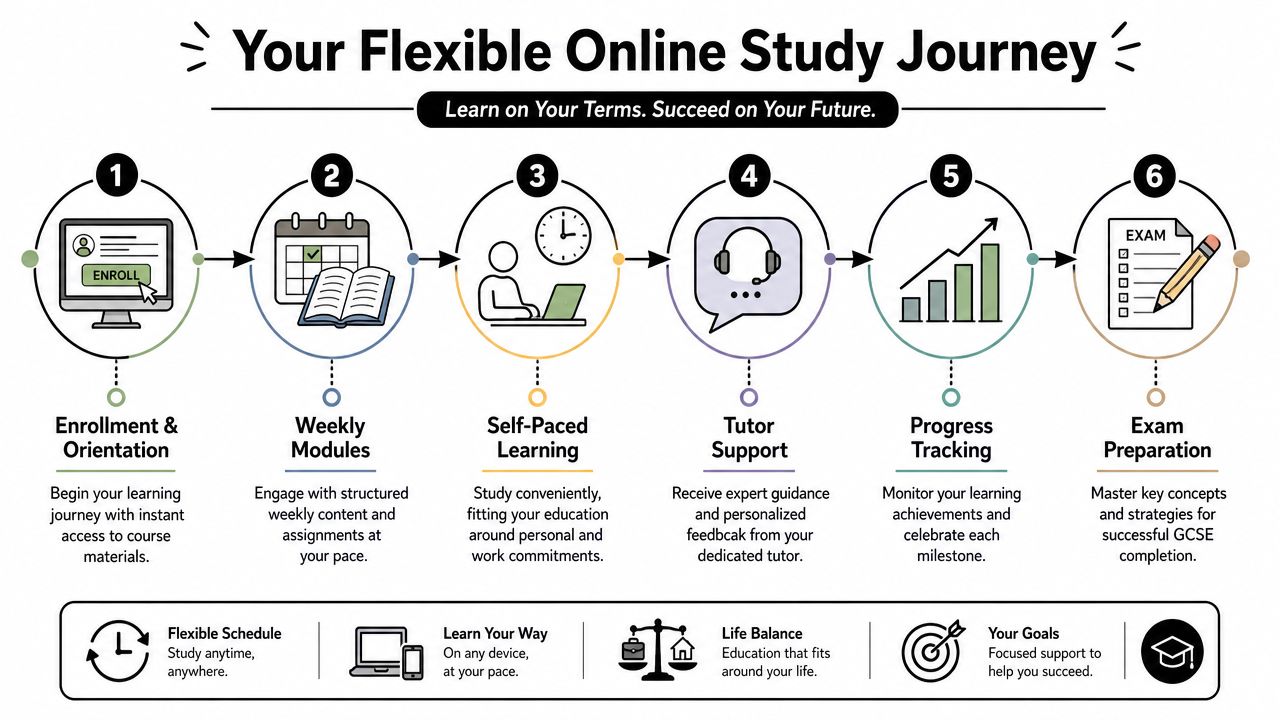
The course usually follows a clear topic path
A good online GCSE Biology course is organised so each topic supports the next. Some courses follow a structure similar to the topic sequence used in qualifications such as Pearson Edexcel International GCSE Human Biology, moving from cell structure and function into areas like transport, coordination, reproduction, genetics, and disease. That helps because biology is full of connected ideas. Enzymes do not belong to one chapter only. Diffusion does not matter in one lesson and then disappear. These ideas keep returning in new settings, and that repetition is part of how understanding grows, as outlined in this YouTube overview of the specification structure.
That means this subject starts to make more sense when you stop seeing it as a pile of separate facts.
A simple way to picture it is like this:
- Cells lead into movement of substances
- Movement of substances helps you understand gas exchange and transport
- Enzymes appear in digestion and many other body processes
- Genetics connects inheritance, variation, and disease
Study works better when those links are clear. Instead of asking yourself, "Why am I learning this?", you can see where each topic fits.
What a normal study week can look like
Many adults worry that successful study means hours of free time every day. It usually means something much simpler. A routine you can keep.
You might study for twenty minutes before work three times a week. You might do one longer session on a Sunday afternoon. You might read a lesson on Monday, make notes on Wednesday, and answer questions on Saturday. Online learning gives you room to fit study around shifts, school runs, and family life.
A steady weekly pattern could look like this:
- Read one lesson carefully and write a few notes in your own words.
- Go back over the explanation if a topic feels unfamiliar.
- Complete the task or assignment to check your understanding.
- Ask for support early so small gaps do not turn into bigger ones.
- Revisit an older topic each week to keep it fresh.
If you are returning to education after a long break, that rhythm matters more than speed. Slow and steady often beats a rushed start.
Small wins matter more than long cramming sessions
Biology rewards regular contact. It works like learning a language or building fitness. Short, repeated practice helps ideas stick.
Twenty focused minutes can move you forward. Waiting for the perfect free afternoon often means you never begin.
This is also the stage where many adult learners start to believe the qualification is within reach. You complete one topic, then another. You hand in work. You begin to understand the words that looked intimidating a few weeks earlier. Later, when results day comes, knowing what GCSE grades mean can help you see clearly how your work translates into the grade you need for your next step.
Later in your study journey, this video can help you picture the learning process and what steady progress looks like.
If you have been out of education for years, start gently. One lesson. One set of notes. One marked piece of work.
That is how confidence grows. And for many adults, that confidence reaches far beyond biology. It changes how they see their future, and what feels possible for their family too.
Understanding Your Exams and Assessments
You might be fine while studying a topic, then feel your stomach drop the moment you think about the exam. That reaction is common, especially for adults coming back to learning after years away.
What helps is clarity.
Once you know what kind of assessment you are working towards, revision becomes much less foggy. You stop guessing what matters and start preparing with purpose.
What you are actually being assessed on
A good online GCSE Biology course should explain the assessment format clearly from the start. You need to know whether you are working towards a GCSE or an IGCSE, which exam board the course follows, and how the final assessment is organised. Those details matter because they affect how the qualification is viewed by colleges, universities, and employers.
Some online courses follow a traditional GCSE assessment model with written exam papers and practical science requirements built into the course structure. The key point is simple. You should be preparing for a recognised qualification with a clear exam framework, not a vague end-of-course certificate.
That distinction matters a great deal for adult learners. If your goal is university entry, a new career path, or meeting a course requirement, you want to be sure the qualification at the end has real value.
Why structure lowers anxiety
Exams feel harder when they seem mysterious.
They feel more manageable when you can see the shape of them in advance. Biology is a bit like driving on an unfamiliar route. If someone hands you a clear map, the journey immediately feels easier, even if the distance stays the same.
A strong course should show you:
- how you will be assessed
- what kinds of exam questions to expect
- how practical skills are covered
- what revision materials or mock papers are included
If you are also unsure how the final mark is reported, this guide to what GCSE Biology grades mean in practice can make the results side feel much easier to follow.
What good assessment support looks like
Learning the content is only one part of success. You also need practice in using that knowledge under exam conditions.
That usually means regular marked assignments, feedback from a tutor, progress checks, and opportunities to try practice papers before the exam. Those checkpoints work like training sessions before a race. You build stamina, spot weak areas early, and get used to the style of questions you will face.
This is one of the clearest signs that a course is taking your goal seriously. A provider should not leave you to study chapters in isolation and hope for the best. It should help you measure your progress all the way through, so the final exam feels familiar rather than frightening.
The exam is your chance to prove what you know, one question at a time.
And if you have been asking yourself, "Will I really be able to do this?" the answer is often yes. With the right course, the exam becomes a planned final step, not a leap into the unknown.
Choosing the Right Course Provider For You
You sit down after dinner, open two course pages, and both seem promising. Both say they are flexible. Both mention tutor support. Both sound encouraging. But one question keeps tugging at you. Will this lead to a qualification that universities and employers will respect?
That question is wise, not overcautious.
For adult learners, the right provider is the one that makes the qualification clear before you pay. A good course should tell you exactly what you are working towards, how it is examined, and whether it fits your next step. If you need Biology for nursing, further study, teacher training, or a career change, those details matter far more than glossy wording.
The recognition question comes first
Many adults return to study with a practical goal in mind. They are not collecting certificates for the sake of it. They need a recognised qualification that can support an application, meet an entry requirement, or strengthen a long-delayed plan.
That is why you need to check the difference between a GCSE and an International GCSE carefully. They are related qualifications, but they are not identical, and some providers explain that difference poorly. Confusion around this shows up in learner discussions, including this GCSE Biology course discussion page, where questions about course type and recognition are part of the concern.
The simple rule is this. Never assume. Ask.
Questions worth asking before you pay
A reliable provider should answer clearly and in plain English. If the replies feel vague, rushed, or slippery, treat that as a warning sign.
Ask:
- Which exam board does this course follow?
- Is this a GCSE or an International GCSE?
- What qualification name appears on the final certificate?
- Is this course suitable for my goal, such as university entry, access to further study, or a career change?
- How do you support adult learners if they get stuck or lose confidence?
- What does the study plan look like from enrolment to exam entry?
Those questions are like checking a map before a long drive. A few minutes now can save you from months of effort in the wrong direction.
Finding your perfect online course provider
| What to Look For Green Flags ✅ | What to Avoid Red Flags 🚩 |
|---|---|
| Clear exam board information that names the specification directly | Vague wording such as “GCSE level” or “equivalent” without stating the actual qualification |
| A plain explanation of GCSE versus International GCSE | Blurry marketing that mixes the two together and leaves you to work it out |
| Straight answers about recognition for university, training, or employment goals | No firm answer when you ask whether the qualification fits your next step |
| Tutor support with real feedback | Self-study only with little or no help when topics become difficult |
| A structured course plan with milestones and a clear order of study | A pile of resources with no clear route through them |
| Flexibility designed for adults balancing work, children, and other responsibilities | School-style rigidity that assumes you are available at fixed times |
What matters most for adult learners
Adults usually do best with clarity, steady support, and a course that respects real life. You may be studying around shifts, school runs, or caring responsibilities. The provider should make the process feel manageable, not confusing.
The best choice often feels reassuring from the start. You can see what qualification you will earn. You understand why it is recognised. You know what help is available if confidence dips halfway through.
That calm feeling matters. It usually comes from good information.
One final check is worth making. Look at the entry requirements for the university course, training programme, or job you want next, and compare them with the qualification being offered. Matching the course to your destination is one of the smartest choices you can make, and it gives your hard work the value it deserves.
Your Path to a Brighter Future After Your GCSE
Once you pass Biology, life doesn't suddenly become perfect. But something important changes. More doors open, and you start walking towards them with proof that you can finish what you started.
For many adults, this qualification becomes the first solid step on a staircase that once felt out of reach.
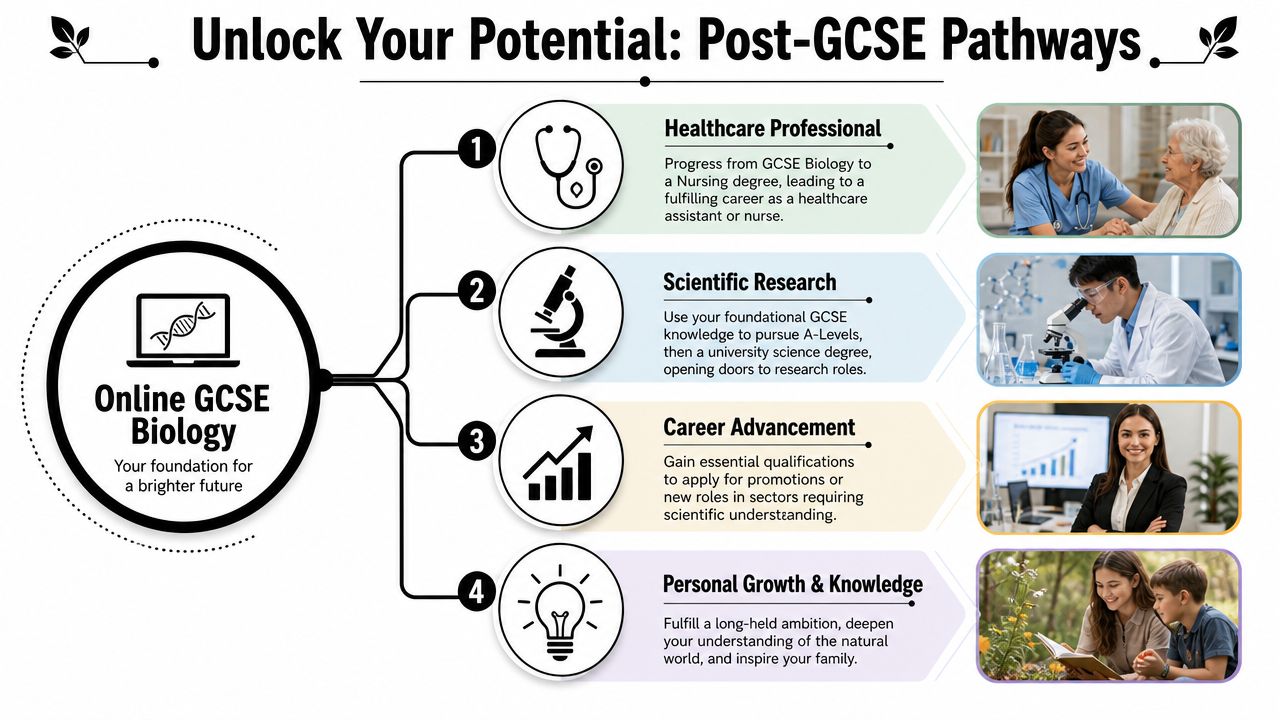
A few common progression stories
One learner uses GCSE Biology to move towards a healthcare path. Another needs it before starting further science study. Someone else needs only a recognised science qualification to strengthen an application for training or promotion.
These journeys look different, but they share something important. The GCSE is not the end point. It's a key that opens the next room.
- Healthcare route: Biology can support progression towards courses connected to caring professions and health-based study.
- Further academic study: It can help prepare you for more advanced science learning.
- Career change: It can strengthen your profile when moving into a role where science knowledge matters.
- Personal achievement: It can fulfil a goal you have carried for years.
The family impact is real
Children notice effort. They notice when a parent studies after work, keeps going after a bad day, and sits an exam even when nervous.
That example can ripple through a family for years.
When adults return to education, they often change more than their own future. They change what achievement looks like at home.
You do not need the whole future mapped out
Some learners start because they know exactly what they want. Others begin with only a feeling that they want more. Both are valid.
If all you know right now is that you're tired of being held back, that's enough to begin. An online GCSE Biology course can give you momentum, confidence, and a recognised stepping stone. Sometimes the next dream becomes clear only after you've completed the first brave step.
Your Questions Answered About Online GCSEs
Even when you feel ready, a few worries can still whisper away in the background. Let's answer the ones that stop many adults from moving forward.
How can I afford it
This worry is completely understandable. Most adults have to think carefully before spending money on education.
The best starting point is to look at the full picture, not just the headline course fee. Ask what support is included, whether there are payment options, and what exam-related costs you need to plan for. A cheaper course isn't always better value if it leaves you without tutor help or proper exam preparation.
Try this simple approach:
- Set a clear goal: Know why you need Biology and what it may help you do next.
- Check what is included: Ask about materials, marking, support, and exam guidance.
- Think long term: A recognised qualification can support bigger life changes later.
What if I don't have enough time
Most adult learners don't have spare time lying around. They make progress by using the time they already have more deliberately.
You do not need to study all day. You need a routine you can repeat. That might mean two evenings a week and a short weekend session. It might mean studying before work, during a lunch break, or after the house goes quiet.
A few habits help:
- Keep your study space simple: A notebook, your course materials, and a quiet corner are enough.
- Use short sessions well: Focus on one task instead of trying to do everything.
- Protect your study time: Treat it as an appointment with your future.
What happens if I struggle with a topic
You probably will struggle with something at some point. That doesn't mean you're failing. It means you're learning.
Biology includes ideas that can feel unfamiliar at first. The answer is not to panic or quit. It's to slow down, go back, ask questions, and practise. A good provider should make this normal. Tutor support, feedback, and structured materials matter most on the days when your confidence dips.
Needing help is not proof that you can't do the course. It's proof that you're doing a real course and taking it seriously.
If your confidence has taken a knock in the past, remember this. Adults often learn better than they expect because they care more about the result. You don't need perfect knowledge. You need persistence, guidance, and a course that leads somewhere worthwhile.
If you're ready to turn hesitation into action, Next Level Online College offers flexible online learning designed for adults who want recognised qualifications, supportive guidance, and a realistic path back into education. If your goal is university, career progress, or simply proving to yourself that you can do this, taking the first step today could change far more than just your CV.