
You might be reading this after work, with a cup of tea going cold beside you, wondering if it's too late to try again. Maybe you left school years ago. Maybe maths was once your strongest subject, or maybe it was the one that made you doubt yourself. Either way, the thought keeps coming back. You want better options, more confidence, and a future that feels bigger than the one you've settled for.
That feeling matters. Wanting more for yourself doesn't make you unrealistic. It makes you brave.
For many adults, an A Level Maths online course isn't only about passing exams. It's about proving something to yourself. It's about showing your children that learning doesn't stop when life gets busy. It's about opening the door to university, a stronger career, and the quiet pride of saying, “I did it.”
A Fresh Start Is an A Level Maths Online Course for You
Sara is the sort of person many adults will recognise. She works hard, looks after everyone else, and rarely puts herself first. She's thought about going back to study for years, but the doubts always arrive first. Am I too old? Have I forgotten too much? What if I fail?
Those worries are normal. They don't mean you're not ready. They mean this matters to you.

Many adults are choosing learning again. Research shows that 52% of adults in the UK have taken part in learning within the last three years, the highest rate since the survey began, according to the Adult Participation in Learning Survey 2024. That means if you're thinking about studying now, you're not the odd one out. You're part of a very real movement of adults building a new future.
Why this moment can matter so much
Adult learners often come back to education for personal reasons:
- For family pride: You want your children to see what determination looks like.
- For your future: You may need better qualifications for university or a career change.
- For self-respect: You want to stop telling yourself that you “missed your chance”.
You don't need a perfect past to build a strong future.
An A Level Maths online course can suit adults because it doesn't ask you to become a different person first. It starts with the life you already have. Your job, your family, your worries, your hopes. Then it helps you move forward from there.
You don't need to feel ready to begin
A lot of people think confidence comes first and action comes second. In real life, it's often the other way round. You start before you feel fully ready. Then confidence grows each time you complete a topic, understand a tricky idea, or hand in a piece of work.
That's why returning to study can be so powerful. You're not only learning maths. You're rebuilding trust in yourself.
More Than a Qualification Your Path to a Brighter Future
An A Level in Maths can change how you see your future. Yes, it's a recognised qualification. Yes, it can help with university entry and career progression. But for many adults, the biggest change happens inside. You stop seeing yourself as someone who nearly did something. You become someone who followed through.
Children notice that. Partners notice that. You notice it every time you sit down to study instead of giving up.
Success isn't only for school-leavers
It's easy to look at younger students and think they've got the advantage. They may be fresh from school, but adult learners often bring something just as valuable. Focus. Purpose. A clear reason for doing the work.
That matters more than people think.
In 2025, 4,043 students in England achieved three A grades or more across their A Levels*, as reported in Tutorful's review of A Level pass rates by subject. That figure shows that excellent results are possible with dedicated study and support. High achievement isn't some distant fantasy. It happens when learners commit, practise, and keep going.
What this qualification can lead to
For many adults, maths is a key that opens the door to the next stage. It can support applications for university courses, especially if you're aiming for subjects linked to science, technology, business, finance, teaching, or other professional routes. If you're working out entry requirements, a guide to A Level grades and UCAS points can help make the system feel much clearer.
Here's what often sits underneath the decision to enrol:
| Hope | What it can mean in real life |
|---|---|
| More money | Access to roles with stronger long-term prospects |
| University entry | A clearer path to the course you really want |
| Pride | Being able to say you finished something difficult |
| Role modelling | Showing your children that effort matters |
| Purpose | Moving towards work that feels meaningful |
A truth many adults need to hear: gaining qualifications later in life doesn't make your success smaller. It often makes it more hard-won, and more powerful.
This is about the life around the certificate
The certificate matters. So does the person you become while earning it.
You learn how to keep promises to yourself. You learn that one difficult week doesn't mean the whole plan has failed. You learn that your old school story doesn't have to be your forever story.
That's why an A Level Maths online course can be a turning point. Not because it's easy, but because it gives your effort somewhere important to go.
What You Will Learn in A Level Maths Explained Simply
A Level Maths can sound intimidating when people list the topic names. Pure Maths. Statistics. Mechanics. Those words can feel heavy at first. They're much less frightening when you see what they mean.
Think of the course like learning how the world works through patterns, numbers, and movement.
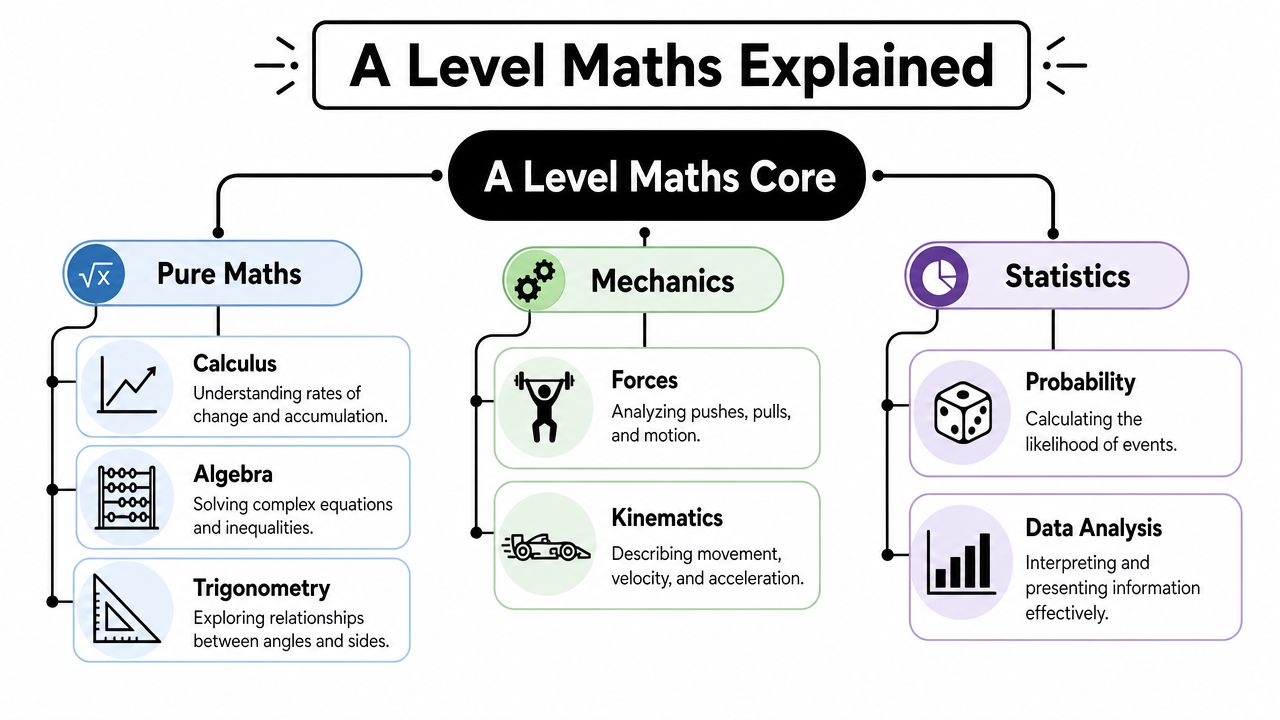
A typical course needs about 500 hours of study time and covers core areas such as pure mathematics, quadratics, probability, statistics, and mechanics, building on GCSE-level knowledge, according to Wolsey Hall Oxford's A Level Maths course information. That sounds like a lot when you hear it in one number. It feels far more manageable when you break it into regular study sessions over time.
Pure Maths is the main structure
Pure Maths is the heart of the course. It gives you the rules, methods, and patterns that support everything else.
Here are some of the main ideas in plain language:
- Algebra: using letters and symbols to solve number puzzles.
- Quadratics: working with curved graphs and equations that often have two answers.
- Trigonometry: understanding angles and lengths, especially in triangles.
- Calculus: looking at change. For example, how quickly something is moving or growing.
- Logarithmic and exponential functions: learning how numbers behave when they grow or shrink in special ways.
If that sounds like a lot, remember this. You don't have to know it all at once. You learn one step, then the next.
Statistics helps you make sense of information
Statistics is about understanding data. It teaches you how to read patterns, judge likelihood, and think clearly about information.
A few examples make this easier:
- If a news story shows a chart, statistics helps you question what it really means.
- If you want to understand chance, statistics introduces probability.
- If you collect results from an experiment or survey, statistics helps you organise and interpret them.
This part of maths often feels more familiar than people expect because it connects to everyday life.
Maths isn't only about getting the right answer. It's also about understanding why an answer makes sense.
Mechanics explains movement and force
Mechanics looks at how things move. It brings maths closer to the physical world.
You might study ideas such as:
| Topic | Simple meaning |
|---|---|
| Forces | Pushes and pulls |
| Motion | How things travel from one place to another |
| Speed and acceleration | How fast something moves, and how that speed changes |
If you've ever watched a car brake, a ball bounce, or a person lift a box, you've already seen the kind of real-world thinking mechanics uses.
It builds from GCSE, but it also stretches you
A Level Maths starts from earlier knowledge, then takes it further. That's why adults sometimes feel nervous. They remember some of the basics, but they worry about the jump.
That's understandable. The good news is that fear often fades once the course stops being a mystery. Once you know what the subjects mean, they become topics to learn, not monsters to avoid.
How Online Study Fits Around Your Family and Work
Most adults don't need more pressure. They need a study method that works in real life.
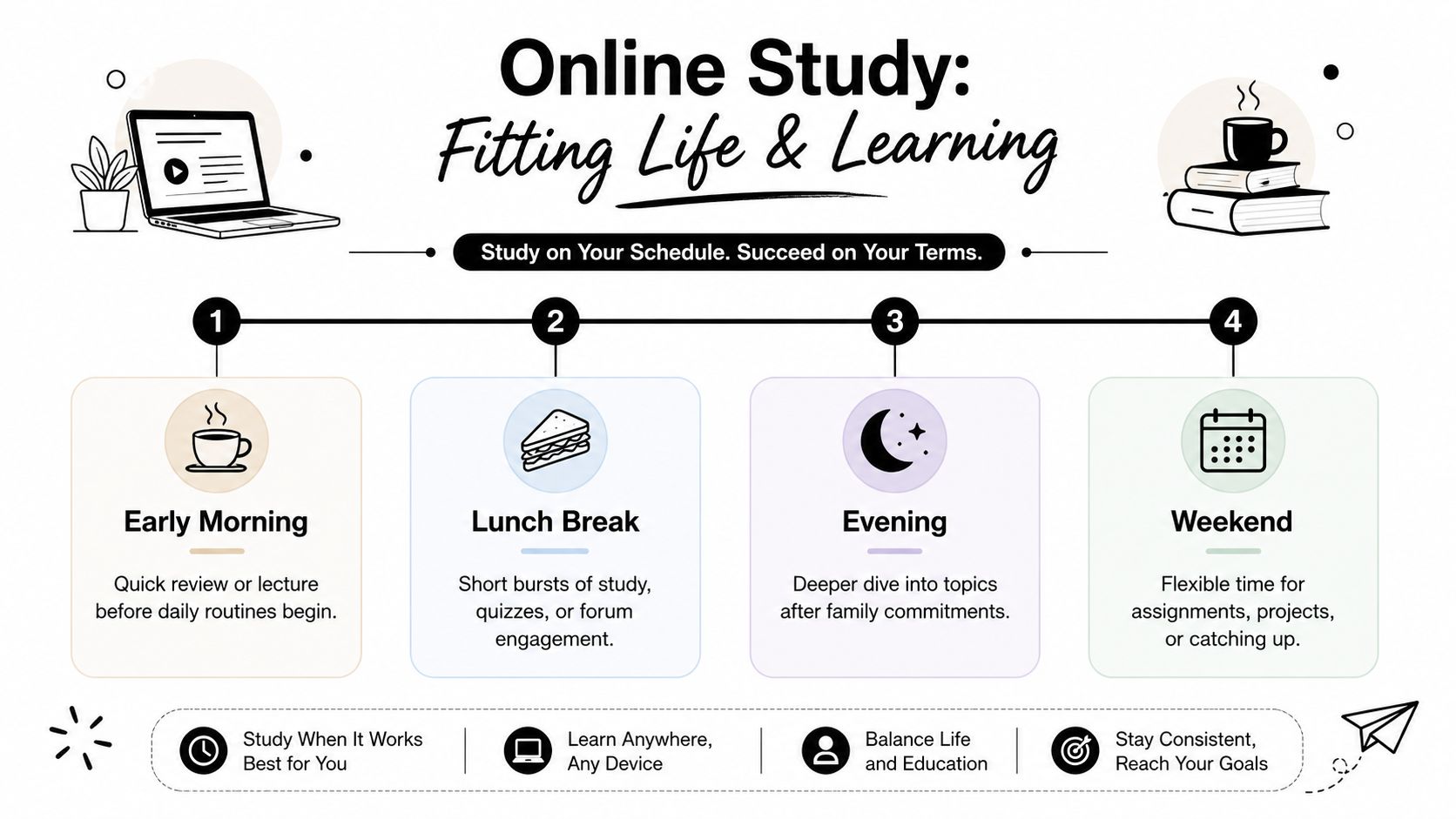
That's where online learning can help. A good A Level Maths online course lets you build study into the spaces you already have, instead of forcing your life to bend around fixed classroom times. You might study before the house wakes up, during a lunch break, or after the children are asleep.
What flexible study can look like
Tom works full time. He doesn't have huge blocks of free time, and he can't attend lessons at the same hour every week. So he studies in smaller pieces.
His week might look like this:
- Early morning: a quick review of notes with coffee before work
- Lunch break: a short quiz or a worked example
- Evening: a focused session on a new topic
- Weekend: longer time for assignments and revision
That sort of rhythm is why many adults look at online A Levels in the UK when they need learning to fit around real responsibilities.
Support still matters when you study from home
Flexible doesn't mean unsupported.
Many online courses combine digital materials with human help. Adult learners often benefit from tutor feedback, guidance on difficult topics, and encouragement when motivation dips. Some providers also offer progress support, which can help you keep moving when life gets busy.
A course can feel much less overwhelming when you know someone will answer questions, check your work, and help you stay on track.
Practical rule: don't wait for the “perfect” free week to begin studying. Most adults succeed by using regular small pockets of time.
A part-time pace can make the course feel possible
The size of the course becomes easier to handle when you spread it out. Some adults prefer a steady pace over a longer period, especially if they're balancing work and family life. Others move faster if they've got more time available.
Here's a simple example of how study can be organised:
| Study style | What it feels like |
|---|---|
| Slower and steady | Easier to manage around a busy household |
| Moderate pace | Good for keeping momentum without rushing |
| More intensive | Suits learners with larger study windows |
What matters most isn't copying someone else's timetable. It's choosing a rhythm you can keep.
Costs Funding and Making Sure You Are Ready
You might be sitting at the kitchen table after work, checking course fees on your phone, and wondering two things at once. Can we afford this right now? And if I spend the money, am I really ready for A Level Maths?
Those questions matter because this course is rarely just about maths. For many adults, it is tied to better work, more security at home, and the quiet pride of showing your children, or yourself, that it is still possible to begin again.
Understanding the cost without getting overwhelmed
Course prices vary across the UK. Some are priced lower but offer less support. Others cost more because tutor marking, learning materials, or exam guidance are included.
That is why the headline price only tells part of the story.
Before you enrol, check what you are paying for:
- Tutor help: Can you ask questions and get feedback on your work?
- Study materials: Are books, videos, and practice tasks included?
- Exam support: Will someone explain entries, deadlines, and what you need to do?
- Payment choices: Can you spread the cost into monthly payments?
A cheaper course can become frustrating if you are left to work everything out alone. A more expensive one may be better value if it gives you structure and support that help you finish.
There is also a wider change in adult education funding. Policymakers have been looking at ways to make later-life study more accessible, including more flexible loan support for adult learners, discussed by the Institute for Fiscal Studies in its review of adult education policy. If you want to compare finance routes in practical terms, this guide to advanced learner loans for adult students can help.
Are you ready academically?
This is the part many adults worry about most.
Readiness does not mean remembering every GCSE topic perfectly. It means having enough of the basics in place that the first part of the course does not feel like trying to build a house on soft ground. If your number skills and algebra are rusty, the answer is usually not "I can't do this." The answer is "I need a short warm-up first."
That is a much kinder, and much more useful, way to look at it.
A simple way to check your starting point
Ask yourself:
- Can you work with fractions, decimals, percentages, and negative numbers without too much stress?
- Can you solve simple algebra problems, even if you are a bit slow?
- Can you read a graph and explain what it is showing?
- If some of that feels unfamiliar, are you willing to spend a few weeks refreshing it?
If you answered "not confidently" to some of those, do not let that knock your confidence.
It just gives you your starting line.
A short refresher in arithmetic, algebra, graphs, and equations can make a huge difference. Adult learners often do better when they rebuild the basics first, because each new topic then has something solid to rest on. That steady start can protect your confidence, keep stress lower, and help the course feel like progress rather than panic.
Refreshing old maths is not a sign that you are behind. It is how many capable adults give themselves the best chance to succeed.
How to Choose the Right Online A Level Maths Course
You sit down after work with a cup of tea, open three course pages, and within ten minutes they all start to blur together. One promises support. Another talks about flexibility. A third mentions exams but does not explain what that really means for you as an adult learner.
That confusion is common.
Choosing well matters because the right course does more than prepare you for a qualification. It gives you a steady path back into learning, one that fits the life you already have and supports the future you want to build for yourself and your family.
Start with what has to be clear
Begin with the facts a provider should explain plainly.
First, check the exam board. A good course will tell you whether it follows AQA, Edexcel, or another recognised board. That matters because universities and employers need to see a qualification they know and accept.
Then check how the course leads to the final exams. A Level Maths is assessed by formal written papers, so you need a provider that explains the assessment route clearly and does not leave you guessing about what happens at the end.
This part works like checking the map before a long journey. If the route is unclear at the start, stress usually shows up later.
Questions to ask before you enrol
A course provider should be able to answer simple, direct questions without vague language or sales talk.
Ask:
- Which exam board does this course follow?
- What study materials are included? For example, lessons, worked examples, marked assignments, or revision help.
- How do I contact a tutor, and how quickly do they usually reply?
- What happens if I get stuck on a topic for a week or two?
- Do you explain how private candidates arrange exams?
- Can I see a sample lesson or part of the student platform before I pay?
- Are there deadlines, or can I study at my own pace within a set period?
These questions are practical, but they also tell you something deeper. They show whether the provider respects adult learners who need clarity, not confusion.
What good support actually looks like
Support is easy to promise and harder to define, so it helps to know what you are looking for.
A supportive provider usually gives you a clear study order, helpful feedback, and a simple way to ask questions. The course area should be easy to use. Lessons should build step by step instead of assuming you remember everything from school.
That matters more than many adults expect. If your confidence is shaky, a messy course can make maths feel harder than it is. A well-structured course lowers that pressure. It lets you focus on learning, not on hunting for the next worksheet or wondering what to do next.
Signs you can trust a provider
Use this quick check as you compare options:
| Good sign | Why it helps |
|---|---|
| Clear course outline | You can see what you will study and how the topics build |
| Honest explanation of exams | You know what you must arrange and what the provider will help with |
| Visible tutor support | You are less likely to feel alone when a topic feels difficult |
| Sample materials | You can judge the teaching style before committing |
| Plain English on the course page | Clear writing often reflects clear teaching |
A provider does not need flashy wording to be good. Clear answers, calm explanations, and realistic expectations are usually a better sign.
Choose the course that helps you keep going
Many adult learners worry about choosing the perfect course. A better goal is to choose the course you are most likely to stay with.
That often means picking the provider that feels steady, respectful, and easy to understand. The best choice is usually the one that helps you keep showing up after a tiring day, because steady effort is what turns this course into something bigger. Better career options. More security. A child seeing you study and learning that fresh starts are possible.
You are not only buying lessons.
You are choosing the environment in which you will rebuild trust in your own ability.
Your Questions About A Level Maths Answered
I've been out of education for years. Am I too late
You get home from work, make tea, glance at a maths page, and feel that old school worry rise up. That feeling is common. It does not mean you are too late.
Many adults come back to study after years away. The biggest hurdle is usually not age. It is the fear of feeling behind. If your skills feel rusty, start with a refresher and rebuild the basics first. Maths works a bit like fitness. You do not begin with the heaviest weight. You build strength steadily, and each session makes the next one easier.
Slow progress still counts. In fact, adult learners often do well because they know why they are studying. It is not just for a grade. It is for a better future, more choice, and the quiet pride of proving to yourself that you can begin again.
How do I sit the exams as a private candidate
This part can feel confusing at first, so it helps to break it into small steps.
You will usually need to check which exam board your course follows, find an exam centre that accepts private candidates, and contact that centre early about deadlines, paperwork, and fees. Booking early gives you more choice and less stress. It also gives you time to sort out any documents the centre asks for.
Private candidate fees vary, so ask for a full cost before you commit. The CloudLearn online A Level Maths course page also notes that private candidates should expect separate exam-related costs.
Keep a simple record of emails, dates, and names.
That small habit can save a lot of worry later. If anything feels unclear, ask direct questions. Which papers do I need? What is the entry deadline? Are there any extra centre charges? You do not need to know everything at once. You just need to handle one job at a time.
The exam process looks bigger than it is. Once you split it into steps, it becomes much easier to handle.
What happens after I finish the course
That depends on what this course means for you.
Some adults take A Level Maths because they want to apply for university. Others want better job options, a route into further study, or proof that they can do more than they once believed. For many adult learners, this course marks a turning point. It can help you move towards work that pays better, feels more secure, or gives your family a stronger foundation.
A qualification matters. So does the person you become while earning it.
You build discipline, patience, and trust in your own ability. Those changes often reach further than the final grade.
What if I'm scared I'll fail
Being scared does not mean you are not capable. It usually means this matters a great deal to you.
Plenty of adults carry this fear, especially if school was a painful experience the first time around. The answer is not to wait until you feel fearless. The answer is to study in a steady way, ask for help early, and treat mistakes as part of learning. Maths rewards practice more than perfection.
Some days will feel good. Some will feel slow. Both kinds of days count.
If you are reading this, you are already considering a different future for yourself. That matters. It could mean more opportunities, more stability at home, or the moment your child sees you studying and learns that it is never too late to start again.
If you're ready to turn hope into action, Next Level Online College offers flexible online study designed for adult learners who want recognised qualifications, real support, and a path towards university, career progress, and family pride.