
You might be reading this after the children have gone to bed, with a cup of tea going cold beside you. Part of you wants a better future. Another part keeps whispering that university is for other people, people who got the right grades the first time, people who didn't take a long break from study, people who feel confident filling in forms and talking about careers.
If that's you, you're not behind. You're human. Many adults reach a point where they want more. More stability. More pride. More choice. More money coming in. More chance to do work that matters. Wanting that doesn't make you unrealistic. It means you're ready to grow.
You Can Go to University Your Dream Is Closer Than You Think
A lot of adult learners carry quiet disappointment. They help their children with homework and wish they could say, “I did it too.” They work hard in jobs that don't use their full ability. They look at university websites and feel lost before they even begin.
That feeling is common. It also isn't the full story.
In the 2024 UCAS application cycle, the overall national acceptance rate for full-time undergraduate study was approximately 74.5%, meaning roughly three out of four applicants secured a UK university seat, according to this guide to UK university acceptance rates. That tells us something important. University can be competitive, but for many people it is also achievable.
Why this matters for adult learners
Regarding university entry requirements UK, many anticipate a wall of rules. They assume one missing grade means the door is shut. In reality, the system is much more flexible than many adults realise.
You don't need a perfect school history to move forward now. You need a clear route, the right qualifications for your course, and the courage to start.
You are not trying to go back and become your teenage self. You are moving forward as the adult you are now.
A different way to see your dream
University isn't only about lectures and essays. For many adults, it means:
- Better options for jobs that are more stable and better paid
- A stronger example for your children, who see what determination looks like
- A new identity beyond feeling stuck or overlooked
- Real pride in finishing something that once felt out of reach
If you've been telling yourself it's too late, take a breath. It isn't. Your dream may be closer than you think. The next step is learning how the routes work.
Understanding the Main Pathways to University
The easiest way to understand university entry requirements in the UK is to think of them like roads leading to the same place. The destination is your degree. The road you take depends on where you're starting from now.
The motorway route
A Levels are the route many people already know. They're the traditional path, often taken by younger students after school. If you're an adult learner, A Levels can still be a very good option, especially if you want a subject that asks for specific qualifications.
For example, some courses want you to show strong knowledge in one or two subjects before you begin. A Levels can do that clearly.
The specialist route
BTECs work well for learners who prefer practical study or already know the area they want to move into. They are often linked to a career field and can still lead to university.
They suit people who like applied learning and coursework. If exams have never brought out your best, this route may feel more natural.
The returners' route
Access to Higher Education diplomas are one of the most important hidden pathways for adults. They were built for people coming back to learning after time away.
That matters because adult learners often need more than just content. They need structure, confidence, and a course that respects real life.
Simple rule: A Levels, BTECs, and Access to HE can all lead to university. The best one is the one that fits your life, your confidence level, and your chosen course.
How to choose the right road
Ask yourself these questions:
Do I already know the degree I want?
If yes, check what that course asks for.Do I need a flexible route made for adults?
If yes, Access to HE may suit you well.Do I need subject-specific preparation?
Some degrees want this, especially in science-based areas.Do I learn better through practical work or traditional study?
Your learning style matters.
One important point about course requirements
Some subjects are open and flexible. Others are stricter. UCAS explains that the tariff system converts different Level 3 qualifications into a common measure, and it also notes that some courses have subject-specific requirements. For example, STEM courses like Electrical Engineering require A Levels in Mathematics and Physics as essential prerequisites, while many courses also expect a good general education background including English and Maths, as shown on the UCAS entry requirements guidance.
So there isn't one single answer to university entry requirements UK. There is your answer, based on the course and the route that fits your life.
Making Sense of Grades and UCAS Tariff Points
The phrase UCAS Tariff points puts a lot of adults off. It sounds technical. It sounds like maths. It sounds like something you were supposed to understand years ago.
It isn't as scary as it looks.
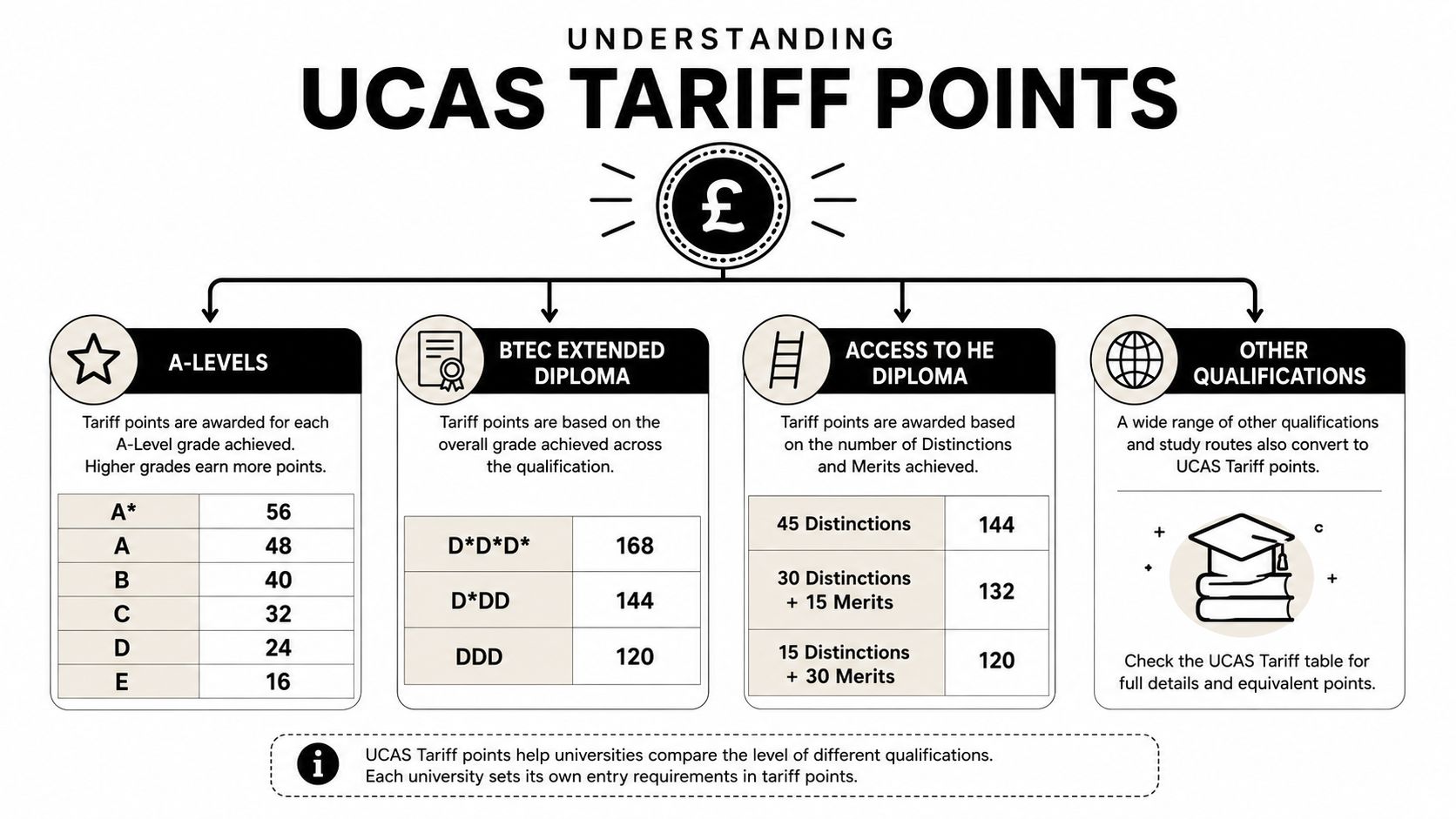
Think of tariff points as a common language
Different qualifications come in different forms. A Levels look different from BTECs. T Levels look different again. Universities need a way to compare them fairly.
That's why the UCAS Tariff point system exists. It converts different Level 3 qualifications into one number, so a university can ask for a points total rather than one exact set of grades. UCAS explains this clearly in its entry requirements information. If you want a simpler way to see how grades turn into points, this A Level grades to UCAS points guide can help.
What an offer might look like
A university might ask for 112 points. That means they are open to different qualification combinations, as long as the total reaches that target.
A simple way to understand it is:
| Qualification style | What the university is doing |
|---|---|
| A grade-based offer | Asking for specific grades in named subjects |
| A points-based offer | Asking for a total number of tariff points |
| A mixed offer | Asking for both points and a certain subject |
So if a course says it wants points plus a specific subject, it isn't being awkward. It is checking both overall readiness and subject knowledge.
Why this can help you
Points can give you flexibility. If your route isn't the standard school route, a points-based offer can make things feel more open.
That is good news for adults who may be taking a different path back into education.
Here is a short video that helps explain the idea in a more visual way.
Practical rule: Don't just look at the number. Read the full offer. Some courses want a points total. Some also want a specific subject studied in depth.
Where adults often get confused
Many people think tariff points replace all other requirements. They don't. They usually sit alongside other checks such as English, Maths, or subject choice.
That means your plan should be in two parts:
- Meet the Level 3 requirement through A Levels, BTEC, Access to HE, or another accepted qualification
- Check the extras such as English, Maths, interviews, portfolios, or a required subject
Once you understand that, the system starts to feel less like a puzzle and more like a target.
Why English and Maths Are Your Keys to Unlocking Offers
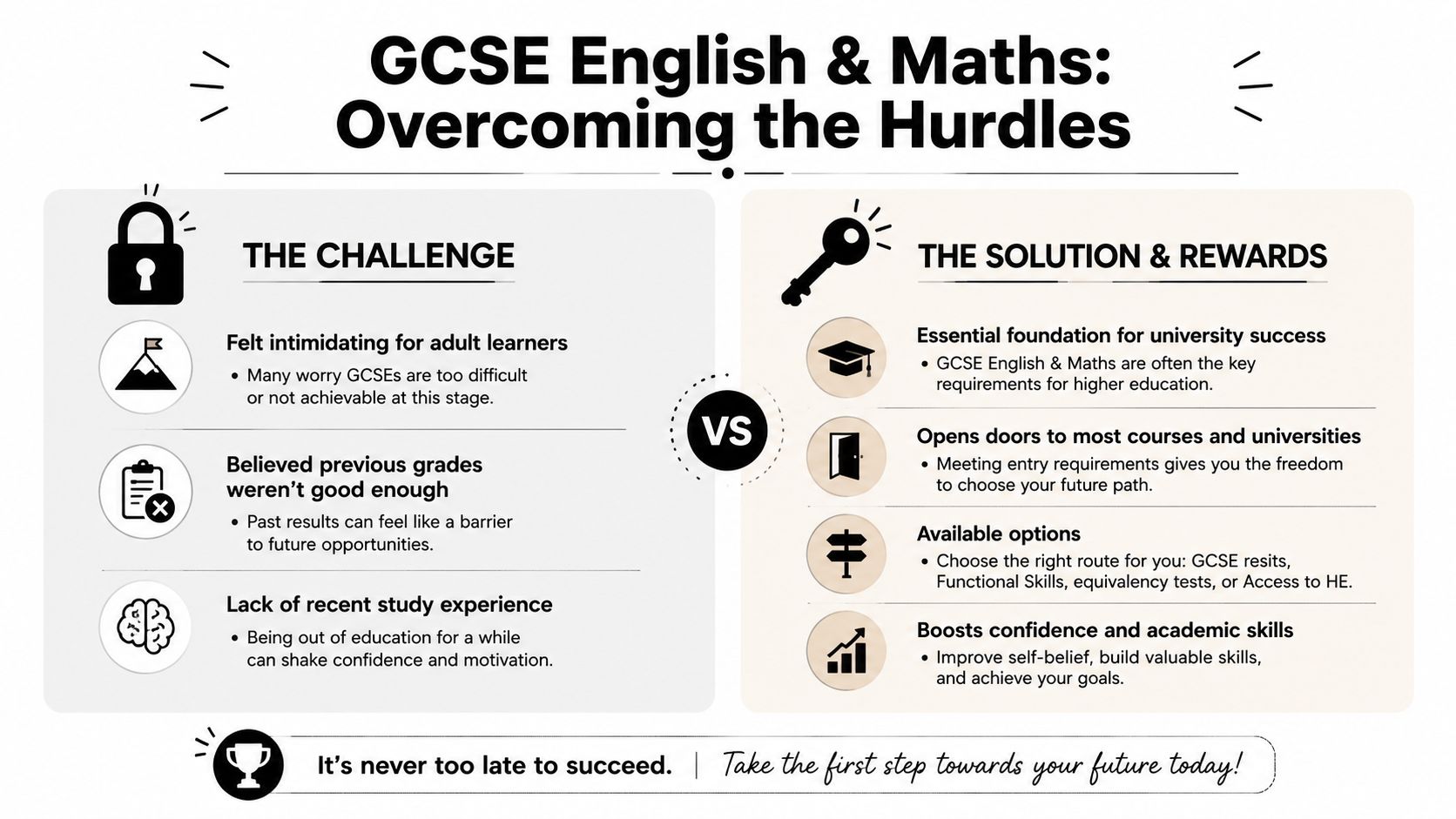
For many adults, this is the part that hurts most. Not because English and Maths are impossible, but because old school memories can make them feel bigger than they are.
A lot of people stop themselves before they start because they think, “I never got those GCSEs, so university isn't for me.” That belief shuts down good futures every day.
The requirement most courses expect
For courses starting in 2026, most UK universities require a GCSE grade 4 (or C) in English and Maths, and they also accept Functional Skills in English and Maths at Level 2 as the official equivalent, according to this 2026 eligibility guide.
That last part matters hugely.
The smarter route many adults miss
You may not need to go back and retake full GCSEs. Functional Skills Level 2 can provide a direct alternative for busy adults who need to meet this core requirement in a practical way.
This is one reason so many adults feel relief when they finally understand the system. The route they need often already exists. They just haven't been shown it clearly. If you want to explore this option in more detail, this guide to Functional Skills Level 2 Maths and English is a useful place to start.
Why Functional Skills can suit adult life
- It is focused on the essential literacy and numeracy skills universities want to see
- It is practical for adults balancing work, family, and study
- It removes a major barrier that keeps many capable people from applying
- It builds confidence because progress can feel more manageable than going back to school-style study
If English and Maths are the locked door, Functional Skills can be the key.
Don't let old grades define your future
Your school record is a snapshot from one part of your life. It is not your final verdict. Adult learners often study with more purpose because they know why they're doing it now.
If your confidence has taken a knock, start here. Get your English and Maths sorted first. That one step can change how you see yourself. It can also change what your children see when they look at you. They won't just see a parent hoping for more. They'll see a parent doing something brave.
Showing Your Potential Beyond Your Grades
Grades matter, but they aren't the whole application. Universities also want to know whether you can cope with the course, stay committed, and bring something useful to the learning community.
Adult learners often have more to offer here than they realise.
Your application is your story
A personal statement, interview, audition, or portfolio gives you the chance to show more than certificates. In these, you explain why you want the course and what has prepared you for it.
That preparation may come from life as much as study.
For example, someone who has raised children while working has probably built time management, resilience, and organisation. Someone who handles difficult people at work has likely developed communication and problem-solving. Someone who has cared for a relative may have deep patience, empathy, and responsibility.
Turn life experience into evidence
You don't need to sound fancy. You need to be clear and honest.
Try framing your experience like this:
- At work you may have trained new staff, solved problems, or managed competing tasks
- At home you may have budgeted carefully, organised family routines, or supported others through stress
- In the community you may have volunteered, coached, helped in schools, or supported local groups
All of these can say something important about your readiness to study.
Universities aren't only asking, “What grades did this person get?” They are also asking, “Can this person succeed here?”
Places where you can shine
Different courses use different ways to assess potential:
| Part of application | What it can show |
|---|---|
| Personal statement | Motivation, maturity, commitment |
| Interview | Communication, interest, reflection |
| Portfolio | Creativity, effort, original thinking |
| Admissions tasks | Preparation and subject understanding |
If writing about yourself feels hard, you're not alone. Many adults find it awkward at first. This guide on how to write a university personal statement can help you turn experience into strong evidence.
What to avoid
Keep away from vague claims like “I work hard” unless you prove it with an example. Specific details are stronger. Say what you did, what challenge you faced, and what happened next.
Your story does not need to be dramatic. It needs to be real. Real stories are often the most powerful.
Your Journey as an Adult Learner Is Your Superpower
A lot of adults think they are applying from a weak position. They worry they are too old, too rusty, too busy, or too far behind.
That view misses something valuable. Adult learners often bring exactly the qualities that help people do well in higher education.
What your experience has already taught you
You may have spent years dealing with pressure, deadlines, family needs, financial strain, and hard choices. None of that is wasted.
It can build strengths such as:
- Focus, because you know why this matters now
- Persistence, because you've kept going through difficult seasons
- Perspective, because you understand how study connects to real life
- Responsibility, because other people rely on you
A younger version of you may have lacked confidence or direction. The version of you applying now may be much more ready.
The hidden shortcut adults often don't hear about
Many guides still don't make this clear enough. Functional Skills Level 2 in English and Maths are widely accepted equivalents to GCSEs for adult learners, which means many people can meet the core entry requirement more efficiently without going back and repeating full school exams, as explained in this adult learner university guide.
That matters because it changes the story from “I have to start all over again” to “I can take a direct route forward.”
Your gap in education isn't proof that you can't do this. It may be the reason you take it more seriously and make more of it.
You are becoming a role model
Children notice effort. Partners notice courage. Families remember the moment someone decided not to settle.
When you study as an adult, you don't just gain a qualification. You show the people around you what growth looks like. You show them that mistakes don't have to be permanent. You show them that learning can begin again.
That can ripple through a whole household. The message becomes simple. We don't give up on ourselves.
Pride has practical value too
There is emotion in this journey, but there is also practicality. Education can open doors to more fulfilling work and stronger earning potential. It can help you move into roles with more purpose, more security, and more room to progress.
So don't talk yourself down. Your life experience isn't dead weight. It is one of the strongest parts of your application.
How to Start Your University Journey Today
The hardest part is often the first step. Once you take that step, things usually feel less overwhelming because you are dealing with a plan instead of a fear.
Start small. Stay steady.
A simple order to follow
Choose a broad direction
You don't need your whole life mapped out. Start with the area you feel drawn to.Check one or two university course pages
Look at the actual entry requirements for the degree, not what you assume they might be.Identify your gap
Is it English, Maths, a Level 3 qualification, or confidence with the application itself?Pick the route that fits your life
That might be Functional Skills, GCSEs, A Levels, or Access to HE.Work backwards from the UCAS deadline
This turns a dream into a timetable.
Keep the deadlines in view
For 2026 entry, the main UCAS deadline for most undergraduate courses is 14 January 2026, while the deadline for Medicine, Dentistry, and Oxbridge is 15 October 2025, according to this UCAS 2026 application guide.
You don't need to panic. You do need to plan.
What matters most right now
If you feel uncertain, focus on the foundation. English and Maths often open the path to the next stage. After that, your Level 3 route becomes much easier to choose and complete.
Small steps count. One enquiry, one course page, one qualification started. That is how a new future begins.
Your search for university entry requirements UK doesn't need to end in confusion. It can end in action. A year from now, you could be much closer to the life you want. Your family could be watching you grow in confidence. You could be building a future that once felt far away.
If you're ready to take that first step, Next Level Online College offers flexible online courses in Functional Skills, GCSEs, A Levels, and Access to HE for adults who want a clear path to university. If you're juggling work, family, and low confidence, their support can help make study feel manageable, realistic, and worth it.