
Some days you do everything right and still feel stuck. You work hard, you look after other people, and you keep going even when you're tired. Yet part of you still wonders whether life could be bigger than this. A better job. Better pay. More confidence. A future your children can point to and say, “My mum did that” or “My dad went back and changed everything.”
That feeling matters.
For many adults, staff training and development isn't just about work. It's about proving to yourself that you're still capable of learning, growing and moving forward. It's about showing your family that change is possible at any age. It's about becoming the person who breaks old patterns and builds new opportunities.
You don't need to have all the answers today. You only need a starting point, a bit of support, and a reason strong enough to keep going. If you want a future that feels more secure, more fulfilling and more hopeful, learning new skills can help you build it step by step.
Your Time to Grow and Inspire
You might be in a job where you know you can do more, but nobody has shown you the path. Maybe you've watched other people move up while you stayed where you are. Maybe you've told yourself, “I'm too busy,” or “I'm not academic,” or “It's been too long since I studied.”
Those thoughts are common. They're also not the end of the story.

A lot of adults come back to learning after years of putting other people first. They've worked, raised children, paid bills and carried responsibilities without much time left for themselves. Then one day something shifts. They realise they want more than getting through the week. They want progress.
Learning can change more than your job
Good staff training and development gives you more than a new skill. It can help you speak up with confidence, apply for a better role, understand what employers are looking for, and feel proud of your own progress again.
That pride matters at home too. Children notice when adults keep going. They notice effort. They notice courage. When they see you studying after work, asking questions, trying again and refusing to give up, they learn something powerful about resilience.
You don't have to be fearless to begin. You just have to decide that your future is worth the effort.
There's also a bigger picture in the UK. Despite total UK training expenditure falling to £53.0 billion in 2024, overall employee participation rose to 63%, with employers training a record 19.6 million staff according to the Employer Skills Survey 2024. That tells us something important. People are still learning. People are still stepping forward. You can too.
What this looks like in real life
Staff training and development might mean:
- Building core skills such as English or maths so you can move into further study or a stronger job role
- Learning workplace skills such as communication, leadership, customer service or digital tools
- Working towards qualifications that help you apply for promotions, university or a career change
- Growing your confidence so you stop seeing yourself as “behind” and start seeing yourself as capable
If you've been waiting for the right time, this may be it. Not because life has suddenly become easy, but because your goals still matter, even with a busy life.
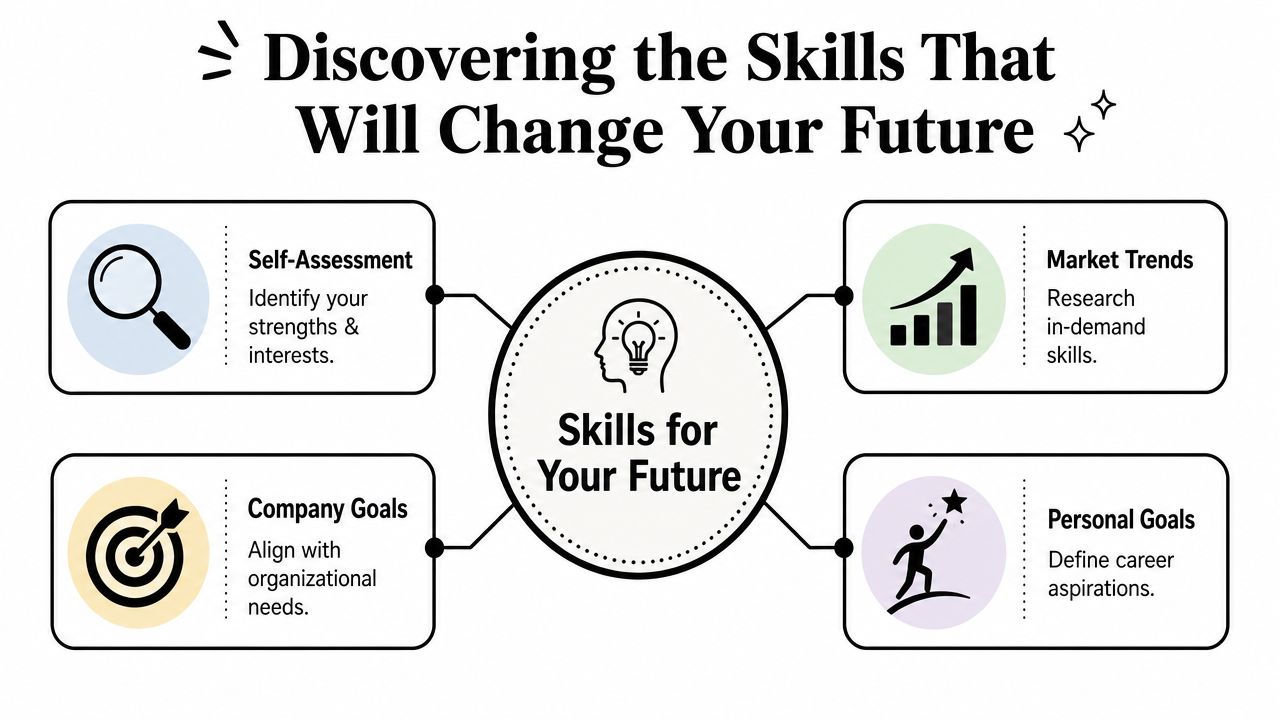
Discovering the Skills That Will Change Your Future
One of the hardest parts is knowing where to begin. Many adults don't struggle because they lack ability. They struggle because nobody has helped them sort through the noise. Should you improve maths? Build confidence with writing? Learn management skills? Start with a short course or aim for a full qualification?
A simple skills check can bring calm to that confusion.
Start with what you already know
You already have experience, even if you don't always give yourself credit for it. If you've managed shifts, helped customers, kept records, trained a new colleague, organised a household, handled difficult conversations or worked under pressure, you've built useful skills.
Ask yourself these questions:
- What do people already trust me to do?
- Which tasks feel natural to me?
- What kind of work would make me feel proud?
- What job or course have I talked myself out of applying for?
- Which skill gap keeps holding me back?
Sometimes the answer is practical. You may need English or maths to access a course, apprenticeship or university route. Sometimes it's about confidence. You may know more than you think, but need support to express it clearly.
Match your goals to the right kind of learning
Not every learning path suits every person. Some adults need a fast confidence boost. Others need a full progression route.
A helpful way to think about it is below.
| Where you are now | What may help next |
|---|---|
| You feel rusty and unsure | A short course or refresher learning |
| You need entry requirements | English, maths or a recognised qualification |
| You want promotion potential | Role-specific training and leadership development |
| You want a complete career change | A structured qualification with progression options |
This is also where quality matters. Poor training wastes time and can knock confidence. Expert analysis of UK training methodology reveals that organisations with thorough, formalized training programs achieve 218% higher income per employee compared to those without, while 40% of employees who receive poor training leave their positions within the first year according to BuildEmpire's training analysis.
That's a strong reminder that staff training and development should be clear, supportive and well organised. It shouldn't leave people guessing.
A practical way to strengthen your study habits is to use methods that keep you active, not passive. Ideas such as discussion, note-making, recall practice and short tasks can make a real difference, and these active learning strategies for adult learners show what that can look like in daily study.
Here's a useful overview to help you think about learning choices in a simple way:
Keep your future in view
Try not to choose a course only because it sounds sensible. Choose one that connects with the life you want. Maybe that means a better role at work. Maybe it means qualifying for university later on. Maybe it means being able to say yes when an opportunity comes up instead of stepping back because you don't feel ready.
Practical rule: Pick learning that solves a real problem in your life now and opens a door for later.
That's how skills become life-changing, not just interesting.
Creating a Learning Plan That Fits Your Life
Many adults don't worry about learning itself. They worry about fitting it in. Work takes energy. Family needs attention. Life doesn't pause because you've decided to improve your future.
That's why your plan has to fit your real week, not an imaginary perfect one.
Build around your energy, not just your diary
A good learning plan starts with honesty. If you're exhausted late at night, don't promise yourself two hours of study every evening. If mornings are chaotic, don't build your routine around them. Choose times when you can focus.
For some people that means studying on the bus with headphones in. For others it means an hour on Saturday morning before the house gets busy. Some adults prefer short sessions after the children are asleep. Others do better with one longer session each week.
Try these simple planning ideas:
- Use small pockets of time by reading notes during lunch or reviewing key terms while travelling
- Choose a steady rhythm so study becomes part of normal life instead of a last-minute panic
- Keep one catch-up slot in your week because life will sometimes get in the way
- Set one clear weekly target such as finishing a unit, submitting an assignment or revising one topic
Pick a style of learning that works for you
Different learning models suit different lives. Online learning can give you flexibility. Blended learning can give you both independence and structure. Tutor support can help if you need regular guidance and accountability.
What matters is not choosing the most impressive option. It's choosing the one you can stick with.
A personalised plan often works better than a rigid one-size-fits-all timetable. If you want to see how customized study can reduce stress and keep goals realistic, these personalised learning plans give a clear picture of how that approach supports busy adults.
If your study plan only works on your best days, it isn't a strong plan yet.
Make your plan family-friendly
Staff training and development becomes easier when the people around you understand why it matters. Tell your family what you're working towards. Let children see that study time has a purpose. You're not taking time away from them without reason. You're building something for all of you.
A simple family conversation can help:
- Explain your goal so people know what you're aiming for
- Agree quiet times when you need to focus
- Ask for one practical favour such as help with chores or keeping interruptions low
- Share milestones so your progress feels visible and encouraging
That support can turn learning from a private struggle into a shared mission.
Leave room for progress, not perfection
You don't need a flawless routine. You need a flexible one. Some weeks will feel smooth. Some won't. The key is to restart quickly instead of treating one missed study session as failure.
A learning plan that fits your life should feel manageable, not punishing. When it does, your confidence grows because you keep proving to yourself that you can follow through.
Building Your Circle of Support to Succeed
A lot of adults think success depends on willpower alone. It doesn't. Determination matters, but support matters too. When confidence is low, the right people can help you keep moving on the days when self-doubt gets loud.
That's especially important because 13% of adults in the UK say that “lacking confidence to learn” is a barrier to taking part in education, as reported by FE Week's coverage of adult education participation. If that sounds familiar, you're not weak and you're not the only one.
The people who can lift you up
Support doesn't have to mean a huge network. A few steady people can make a big difference.
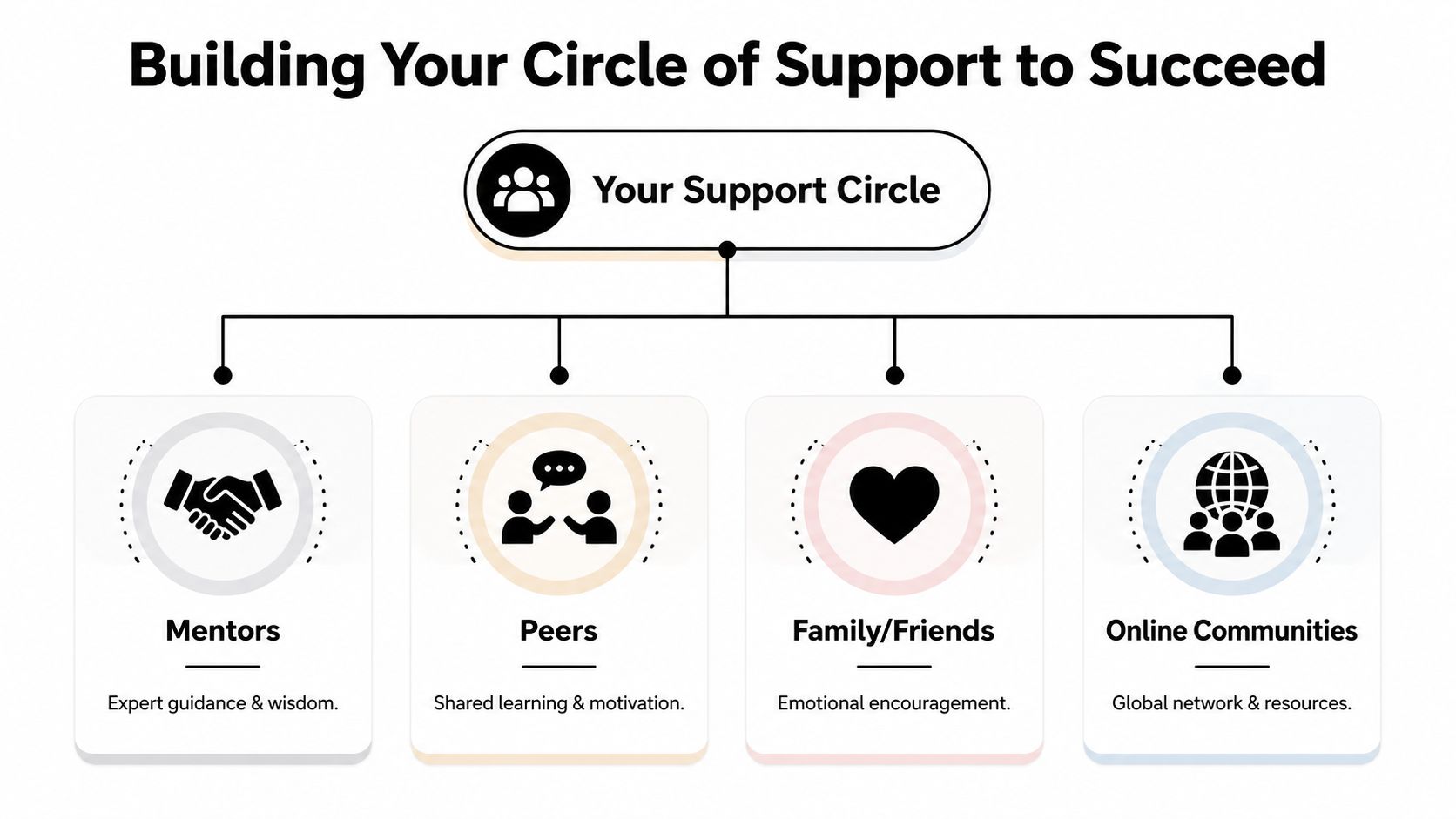
- Tutors and teachers can explain difficult topics, mark your progress and help you recover after a setback
- Mentors can help you connect learning to work, career goals and next steps
- Friends and family can encourage you when motivation drops
- Other learners can remind you that struggle is normal, not proof that you don't belong
Some support is academic. Some is emotional. Both matter.
Why asking for help is a strength
Many adult learners carry an old fear that asking questions will make them look foolish. In truth, asking for help is often the moment progress begins. Confusion left alone tends to grow. Confusion talked through often shrinks quickly.
Here are signs you may need more support, not more pressure:
| Sign | Better response |
|---|---|
| You keep rereading the same material | Ask for a different explanation |
| You avoid assignments | Break the task into smaller parts with guidance |
| You feel embarrassed about falling behind | Tell someone early and make a catch-up plan |
| You're losing confidence | Talk to a mentor, tutor or supportive peer |
“I need help with this” is a strong sentence. It moves you forward.
Build support on purpose
Good staff training and development shouldn't leave people alone with a login and a deadline. The human side matters. Encouragement matters. Gentle accountability matters. So does having someone who notices when your confidence dips.
Try building your own circle in practical ways:
- Choose one person you can update weekly
- Join a learner group or discussion space
- Write down questions instead of carrying them around
- Celebrate small wins out loud, even if it's just finishing one task
- Keep reminders of your reason nearby, such as your career goal or the future you want for your family
Support won't remove every challenge. It will make those challenges easier to face. And when you feel seen, guided and encouraged, it becomes much easier to believe that success belongs to you too.
Earning Qualifications That Open New Doors
You finish a shift, check your results, and see that you passed. For a moment, the room feels different. The qualification in front of you is not just paperwork. It is evidence that you kept going on tired days, studied around real responsibilities, and proved to yourself that your future can grow from here.
That moment stays with people.
A qualification can help you apply for a new role or continue into higher study. It can also do something quieter and just as important. It can rebuild self-trust. Adult learners often carry old doubts from school, past jobs, or years spent putting other people first. Completing recognised training gives you something solid to point to and say, “I did this, and I can do more.”
Assessments show growth in a visible way
Words like exam, assignment, or assessment can still bring back stress. That is a common fear. Many adults are not afraid of learning itself. They are afraid of being judged.
It helps to see assessments for what they are. They work like a driving test. You do not take one to be caught out. You take one to show that you can handle the road ahead.
That change in perspective can steady you. An assessment is a chance to demonstrate progress, not a sign that someone expects you to fail.
Qualifications often lead to:
- Better chances of promotion in your current workplace
- Access to further study if you want to keep building
- Stronger job applications because your skills are formally recognised
- Personal pride at home, where children, partners, and relatives can see your effort turn into results
Recognition matters because people notice
Gaining qualifications later in life is not a smaller achievement. In many cases, it asks for more patience, discipline, and courage. Studying as an adult often means fitting learning around work patterns, family routines, bills, and unexpected setbacks. Finishing under those conditions says a great deal about your character.
Other people notice too. Managers may see stronger commitment. Family members may see someone who kept a promise to themselves. Children often see something even more powerful. They see an adult who did not give up on learning.
If you are exploring practical routes that connect training with recognised progress at work, these workforce development programmes can help you compare options that support both career development and long-term goals.
One qualification can change your identity
The certificate matters. The person you become while earning it matters more.
Key insight: A passed course can change your self-image. Once you begin to trust your own ability again, larger goals start to feel reachable.
You may start with one course to improve a skill you use every day. Later, that success can lead to a diploma, professional training, or preparation for university-level study. What begins as staff training can become a turning point in how you see your place at work, at home, and in your future.
That is the human side of staff training and development. It strengthens your CV, but it also helps you stand taller, give your family something to feel proud of, and become the kind of example other people remember.
Your First Steps to a Brighter Future Today
Big change usually starts with a small decision. Not a perfect decision. Not a fearless one. Just a real one.
If you've been waiting to feel completely ready, you may wait a long time. Confidence often grows after action, not before it.
A simple roadmap you can start now
Use this as a gentle starting point.
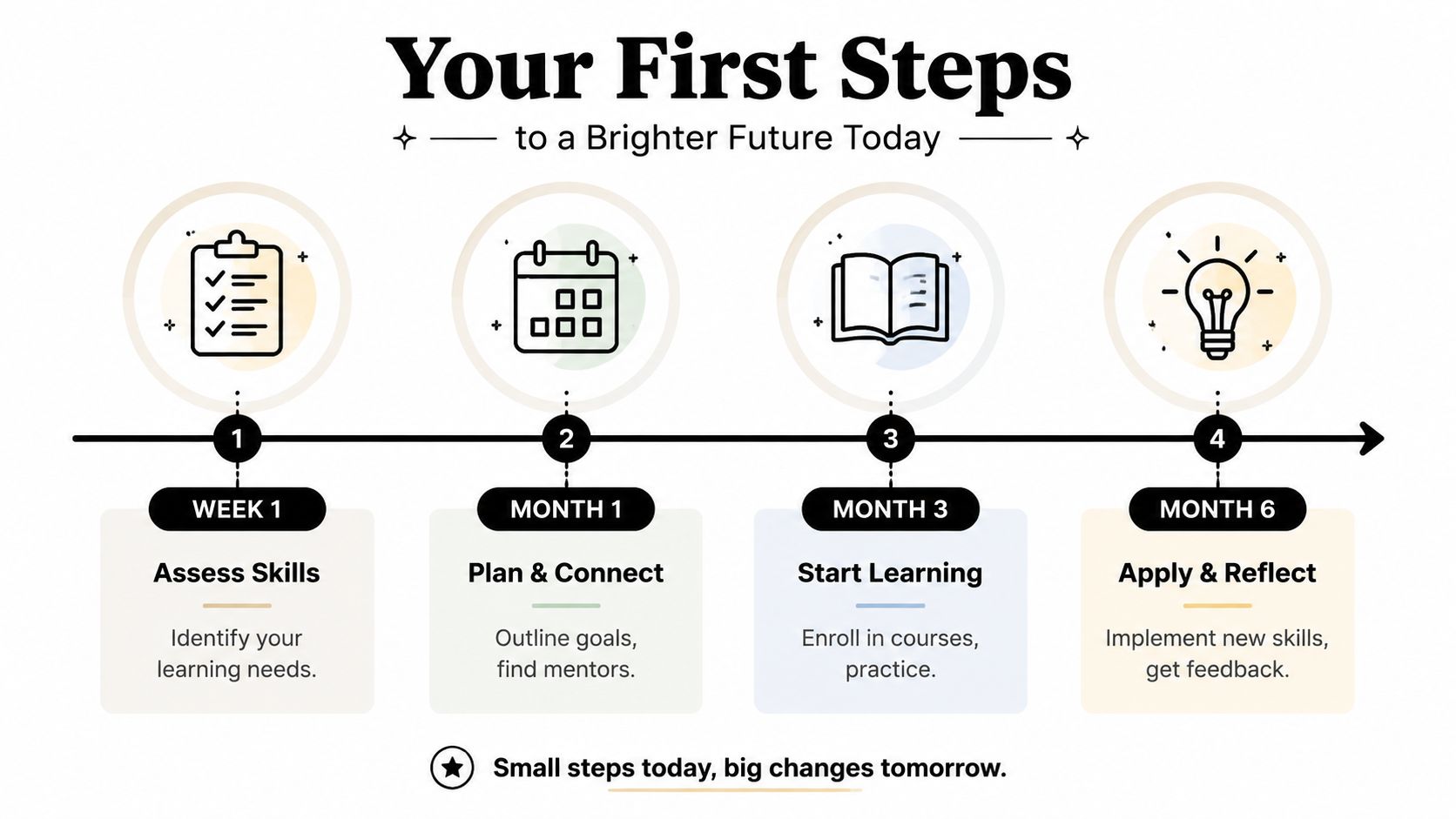
- Write down your reason. Keep it honest. Better pay, more security, university, career change, family pride. Your reason will steady you when motivation dips.
- Choose one skill to improve first. Don't try to fix everything at once. One clear focus makes action easier.
- Look for a study option that fits real life. Flexible learning works best when it respects work and family commitments.
- Tell one trusted person. Saying your goal out loud makes it more real and helps support find you.
- Take the first formal step. That might be asking for advice, comparing courses or preparing to enrol.
Keep an eye on future opportunities
If flexible learning is important to you, there's also an encouraging development ahead. From September 2026, eligible UK students will be able to access student finance for flexible modules equivalent to up to £39,160 across their working lives, according to the UK government announcement on lifelong learning reform. That future option could make bite-sized study more manageable for adults balancing work and family.
That matters because your path doesn't have to look traditional. It can be built in stages.
Let this be your moment
You don't need to become someone else to succeed. You need the chance to grow into more of who you already are. Capable. Hard-working. Worth investing in.
The best part is this. When you choose learning, you don't only change your own future. You show your children, your family and the people around you that growth is possible. You become the example. You become the proof.
Your first step doesn't need to be huge. It just needs to happen.
If you're ready to take that step, Next Level Online College offers flexible online learning for adults across the UK, with recognised qualifications, structured study, and dedicated academic and pastoral support. Whether you want to build confidence in English or maths, gain GCSEs or A Levels, or work towards university entry, their team understands how to help busy adults learn around real life and keep moving towards a future they can be proud of.