
You may be reading this after a long day at work, with dinner waiting, children needing help and a quiet worry in the back of your mind. Perhaps you missed GCSE English at school, need a grade for a new job or want to reach university, but you're unsure whether you can study again after such a long break. You're not alone, and you haven't left it too late.
A GCSE English online course can fit around shifts, family life and limited confidence. With the right support, you can turn small weekly efforts into a recognised qualification, stronger self-belief and more choices for your future.
Start Your Comeback with Confidence
The first study session may happen after a shift, school run and a pile of washing. You might open your laptop while the house is finally quiet, still remembering a time when English felt difficult. That does not tell you what you can achieve now. Adult life is busy, so your course needs to fit around it rather than ask you to put everything else on hold.
People return to GCSE English for different reasons. A qualification may help you apply for a better-paid role, change direction or meet an entry requirement for university. It can also show your children that learning is possible at any age. A pass is more than a result on paper. It can mark the moment you kept a promise to yourself.
You will not be the only adult starting again. English is one of the GCSE subjects taken widely across the country, so there is no reason to feel ashamed about returning to it. Begin with the skills you have, then build from there.

A course that fits real life
Online learning removes the need to travel to a college building. You can watch a lesson after work, replay an explanation when you have more time and send a question to a tutor when a task feels unclear. If your shifts or family plans change, you can adjust your study time without abandoning your goal.
Digital skills can improve along the way too. Opening lessons, uploading work and joining online support may feel unfamiliar at first, like finding your way around a new kitchen. After a few tries, each action becomes easier.
A small routine works like laying one brick at a time. Protect a short study slot, complete one task and record what you have done. These simple wins can rebuild trust in your ability, even after a difficult week.
Your starting point doesn't decide your finishing point.
If low confidence is stopping you from beginning, confidence-building courses for adults may support your wider goals alongside your English study. Set a manageable target, ask for help early and keep your reason for starting close by. With steady support, this exam can become a practical stepping stone towards better work, a proud example for your family and future university study.
What a GCSE English Online Course Really Covers
A GCSE English Language course teaches you how to understand texts and communicate clearly. It isn't about memorising difficult words or sounding like a professor. It's about learning how writers create meaning and how you can express your own ideas in a clear, organised way.
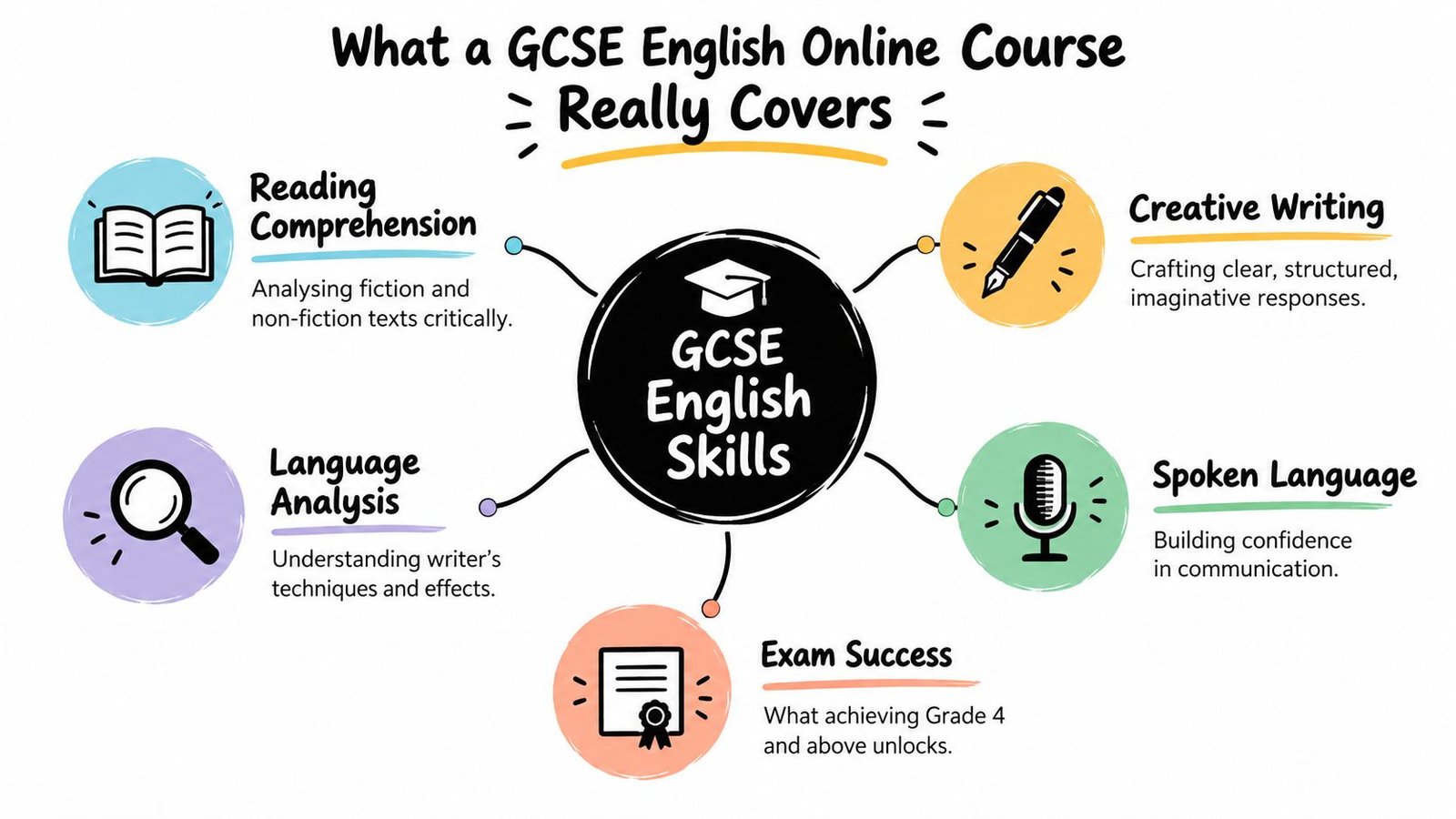
Most courses build five connected skills:
Reading comprehension means finding information, explaining ideas and making sensible points about what you've read. You may study fiction and non-fiction texts, then support your answer with details from the passage.
Creative writing helps you produce descriptions, stories and other imaginative responses. You'll practise planning, choosing precise vocabulary, structuring paragraphs and checking your spelling and punctuation.
Language analysis asks you to notice the choices a writer makes. For example, you might explain how a powerful verb creates tension, or how a short sentence makes a moment feel sudden.
Spoken language develops confident communication. Depending on the course and awarding arrangements, you may prepare and deliver a presentation or take part in a speaking activity.
Exam success brings these skills together under timed conditions. You'll learn how to read questions carefully, plan answers and leave time to check your work.
Understanding the grade you need
GCSEs use a 9 to 1 grading scale, with 9 at the top. For GCSE English, grade 4 is treated as a standard pass and grade 5 as a strong pass, according to 2026 GCSE grade information from CloudLearn.
That difference can confuse adult learners. If a college, employer or course asks for a standard pass, grade 4 may be the target. If it asks for a strong pass, you may need grade 5. Always check the exact entry requirement for the next step you want to take.
A grade doesn't measure your worth or intelligence. It records how your work met the assessment standard on the exam. Your course should help you identify the marks available, practise the required skills and set a target that matches your plans.
For a simple explanation of how GCSEs compare with other qualifications, you can read what a GCSE equivalent means. This can be useful if you're comparing routes into college, work or further study.
How Online Learning and Exams Actually Work
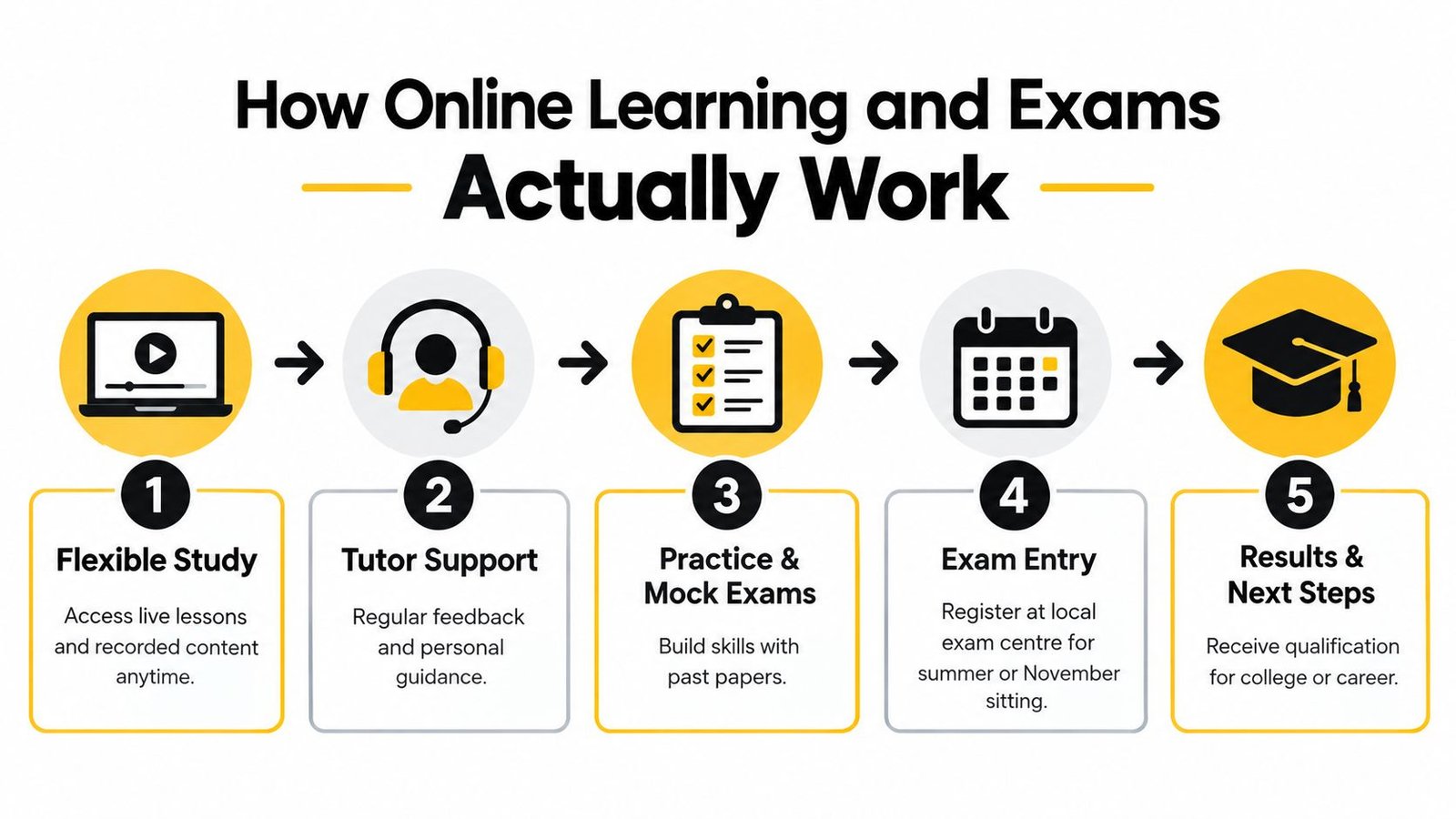
An online GCSE course may combine recorded lessons, live teaching, written tasks, quizzes, tutor feedback and mock exams. The exact mix differs between providers, so ask what you'll receive before enrolling. A course that says “online” might mean fully self-paced study, regular live classes or a blend of both.
Think of the learning journey as a set of practical steps:
- Study the lesson: Read the explanation or watch the teaching material.
- Try the skill: Complete a task, such as analysing a paragraph or writing an opening.
- Receive feedback: Use tutor comments to see what worked and what needs changing.
- Practise under time: Attempt questions without unlimited time.
- Review and repeat: Correct mistakes and try a similar question again.
The exam is one complete assessment journey
GCSE English Language in England follows a linear, exam-based model. Your final grade is determined after marking is almost complete, and grade boundaries are set each year to maintain standards, rather than to make the exam easier or harder, as explained in Ofqual's GCSE assessment information.
This is why finishing one online module doesn't automatically mean you're exam-ready. You need to practise moving between questions, working within time and keeping your concentration when a paper feels difficult. Your tutor should help you understand your target grade and the type of performance needed to reach it.
You'll also need to check the practical requirements. Some courses expect a laptop, microphone, webcam and reliable internet connection. Others may offer recorded content or alternative ways to communicate. If you have weak digital skills, ask whether someone will show you how to log in, upload work and join a lesson.
Here's a short visual introduction to the learning process:
Ask before you enrol: “What happens if I miss a live lesson, lose internet access or need help using the platform?”
You'll usually sit the exam at an approved exam centre rather than at home. The provider may help with registration, but you should confirm who arranges the entry, where the exam takes place and which costs are separate.
How to Choose the Right Provider and Support
The cheapest-looking course isn't always the easiest course to complete. Adult learners often need more than learning materials. They may need a tutor who explains a confusing question, a mentor who helps them restart after a difficult week and clear instructions for the exam itself.
Provider setting can affect the experience. In England, adult GCSE English achievement at grades 9–4 in 2022/23 was 36.8% in General FE Colleges, 56.0% in local authority provision and 12.5% in the private-sector publicly funded category, according to qualification results published by the UK Government. These figures don't tell you what you personally will achieve, but they do show why support, organisation and setting deserve careful attention.
Compare the details, not just the headline
| What to Check | Why It Matters for You | Good Sign to Look For |
|---|---|---|
| Awarding arrangement | You need a qualification accepted for your next step | The provider clearly names the awarding partner and exam route |
| Tutor access | You may need help with marking, structure or difficult texts | Regular feedback and a clear way to ask questions |
| Lesson format | Live attendance may be hard around shifts or childcare | Recorded resources, flexible tasks or catch-up options |
| Digital requirements | Equipment or low confidence can become a hidden barrier | A simple platform and support with logging in and submitting work |
| Exam preparation | English is assessed under timed conditions | Mock papers, timed practice and feedback on exam technique |
| Pastoral support | Stress can make it harder to continue after a setback | A named mentor, wellbeing contact or progress check |
| Progression advice | You may be working towards college, university or a new job | Clear guidance on the next qualification or application |
Some courses are described as online but still require you to attend a particular place or join lessons at fixed times. Ask direct questions about equipment, attendance, study hours, exam-centre arrangements and what happens if family life interrupts your plan.
Accredited online courses in the UK may also help you compare recognised study options. Next Level Online College is one provider offering flexible online GCSE English study with tutor support. Treat every provider as a choice to investigate, and select the arrangement that matches your real week.
Timelines Costs and Funding Made Simple
Before you enrol, turn the course into a simple personal plan. You don't need a perfect timetable. You need an honest one that allows for work, school runs, tired evenings and the occasional missed session.
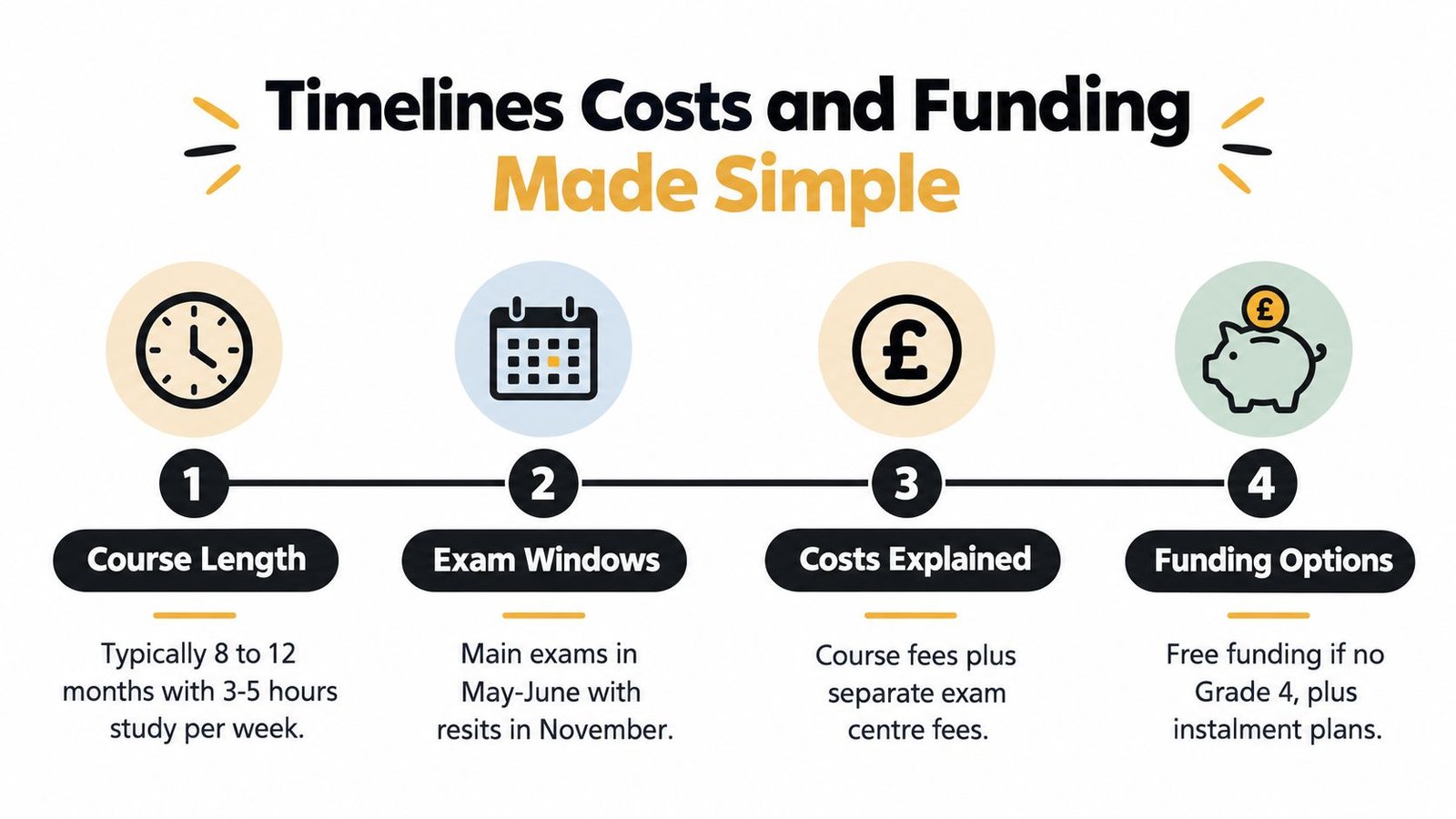
Many adult courses describe a study period of 8 to 12 months with 3 to 5 hours of study each week, with main exams in May and June and resits in November. These course-planning details should be confirmed with the provider because your route, awarding body and exam entry may differ.
Build a plan you can keep
Start by choosing a likely exam window. Then work backwards and leave time for revision, mock exams and unexpected breaks. A useful weekly pattern might include one lesson, one reading task, one writing task and a short review of feedback. The exact hours matter less than keeping a steady rhythm that you can repeat.
Costs usually include the course fee and a separate exam-centre fee. Ask whether exam entry is included, whether learning materials cost extra and whether you can pay in instalments. Don't assume that “online” means free.
Funded or free places may exist for eligible learners, and some providers offer instalment plans. Eligibility depends on your circumstances and the funding rules at the time, so ask the provider or adult-learning service to confirm what applies to you before making a payment.
Check the size of the opportunity
GCSE English remains a major qualification in England. Ofqual's 2026 GCSE outcomes record 819,260 English language entries, 1,047,750 students receiving GCSE results overall and an average of 5 GCSEs per student. The same summary records 52.3% of English language grades at 4 and above and 47.7% below grade 4.
Those results show both the importance of the subject and the need for proper preparation. Set a budget, choose a realistic start date and confirm the exam arrangements before you commit.
Study Tips That Build Confidence Every Week
Confidence grows when you collect evidence that you can do the work. A learner who once avoided writing might begin by describing a room in five sentences. The next week, they may add a clear opening and a stronger ending. Later, they can complete a timed response and use feedback without feeling defeated.
Adult participation in English study remains substantial. In the first nine months of the 2025/26 academic year in England, 137,330 adults participated in an English course, compared with 179,760 in 2024/25, while total adult participation in Education and Training was 948,340 and Level 2 was the most popular level with 336,710 learners, according to adult participation data from Ofqual.
Use a small weekly routine
- Read regularly: Choose a news article, short story or familiar non-fiction text. Underline a sentence you find effective and explain why.
- Write in short bursts: Set a timer for a brief writing session. Focus on one skill, such as varied sentence openings or accurate punctuation.
- Read aloud: Hearing your own sentences can reveal missing words, repeated phrases and awkward punctuation.
- Keep a mistake page: Write down corrections from tutor feedback. Review the page before your next task.
- Celebrate completed actions: Record lessons watched, questions attempted and drafts improved. These are signs of progress.
Children notice more than adults often realise. When they see you study after work, ask for help and try again, you show them that education isn't only for people who found school easy. You become a positive example of patience, courage and effort.
A poor first draft is not failure. It's material you can improve.
Digital tools can also help you understand how technology supports learning and work. For broader background, building and deploying AI agents offers a useful introduction, but use any tool carefully. It shouldn't write your exam answers or replace your own thinking. Your course tutor and the exam rules should always guide what help is allowed.
Your Next Level and Brighter Future Ahead
After work, with family needs waiting and confidence still growing, you may wonder whether a GCSE English pass can really change your options. It can give you a route into further study, help you meet an employer's entry requirement or support a career change. It can also make everyday jobs feel less stressful, such as writing a formal email, completing an application or speaking in a meeting.
The qualification can become a bridge rather than a final destination. A pass may lead towards university, better-paid work or a role with more responsibility. It gives you evidence of a skill you can build on, even if school left you feeling that English was not for you.
Your progress can matter at home as well. Children may see you study after work, ask questions and try again after a difficult task. You show them that learning is possible at any age, and that a hard start does not decide the ending. That example can strengthen your own pride too.
Take the next step carefully
- Write down your reason: Choose the goal that matters most, such as university, a new job or setting an example for your family.
- Check the required grade: Find out whether you need grade 4, grade 5 or another result for your chosen route.
- Compare providers: Ask about tutors, digital support, exam entry, costs, funding and what happens if you miss a lesson.
- Choose a manageable routine: Fit study around your actual work and family responsibilities. A short, regular session is more useful than an ideal plan you cannot keep.
- Ask for support early: Contact your tutor when a task feels confusing. Quick help can stop one worry becoming a reason to give up.
You do not need to feel fearless before starting. Take one practical action, then another. With flexible online study, patient guidance and a routine that fits adult life, GCSE English can become a realistic stepping stone to better opportunities, university and a stronger future for your family.
Next Level Online College offers a flexible online GCSE English course for adults, with structured learning, tutor guidance and support designed around work and family commitments. Visit Next Level Online College to review the course options, ask about entry and funding arrangements, and choose your first step towards a GCSE English pass.