
You've opened the course page three times, but you still haven't filled in the form. Perhaps the children are finally asleep, the kitchen is quiet, and your notes are ready. Then a familiar thought appears: “What if I'm not good enough?”
That worry doesn't mean you can't learn. It means this decision matters to you. Confidence building courses for adults can give you a supported way back into education, whether you want stronger English and maths, a new career, or a route towards university. You don't need to feel ready before you begin. The right course helps you become ready as you learn.
What Confidence Building Courses for Adults Really Are
After the school run, an adult returner sits at the kitchen table and opens a notebook. The first question may be, “Is education still for me?” It can arise after years of work, childcare, caring for relatives or keeping daily life going. A difficult school experience may still feel close, especially if one mistake in front of classmates became proof that learning was not for you.
Education can still be part of your life. Confidence building courses for adults are structured programmes that combine learning with support, helping you rebuild trust in your ability while gaining practical skills.
A course may cover English, maths, digital skills or vocational study. It may also include study skills, personal development, confidence coaching, peer support and pastoral care. You are given manageable tasks, clear explanations and someone to contact when you get stuck. Confidence grows through practice, much like strength grows through regular exercise.
Support alongside real qualifications
These programmes can lead to a practical next step. That might be Level 2 Functional Skills, GCSE resits, confidence coaching modules, vocational learning or an Access to Higher Education Diploma. They are different from a hobby class because learning is connected to a goal, such as applying for a job, progressing at work or preparing for university.
Access courses can suit adults who want degree study but do not have the usual entry qualifications. For example, Access to Higher Education courses for adult returners are designed for adults aged 19 or over and can provide a flexible route towards university.
Delivery may include tutor-led sessions, online activities, recorded materials, discussion with other learners and regular feedback. This structure matters when family life is busy. You can plan study around work or caring responsibilities, while still knowing what to complete and where to ask for help. Funding and eligibility depend on the course and your circumstances, so check the provider's current guidance before enrolling.
A good programme treats you as a capable adult with useful life experience. You may need help with essays, revision, online platforms or exam nerves. That support is a starting point, not a judgement about your intelligence.
The course builds confidence through action. You complete a task, receive helpful feedback, understand more than you did before, and then take the next step.
Why Low Confidence Stops Adults Going Back to Learning
What stops adults enrolling? Often, it is not a lack of interest. It is the belief that they may not cope. A parent might want to study nursing but worry about written work. A warehouse worker may hope for promotion but avoid a leadership course. Someone who left school early may still treat old results as a verdict on what they can do now.
That doubt can affect the whole household. Work may change from week to week, childcare may be difficult to arrange and money may be tight. You might fear meeting new people, being judged by friends or returning to a classroom that feels too much like school. The course becomes one concern among many, even when the goal matters to you and your family.
UK participation data shows that adult learning decisions sit within a wider pattern. In 2024, 52% of UK adults said they were currently learning or had learned within the previous three years, compared with 49% in 2023, the highest level recorded by the long-running survey since it began in 1996. The survey interviews around 5,000 adults aged 17 and over each year and has tracked adult learning for nearly three decades. The 2024 Adult Participation in Learning Survey places your choice within a broader return to learning.
A wider pattern, not a personal failure
The historical picture shows why gentle support still matters. In 2017, 37% of UK adults were in current or recent learning, the lowest rate recorded at that point. Nineteen per cent were currently learning and 17% had learned within the previous three years, while 36% had not learned since leaving full-time education. Participation was 37% in England, 38% in Scotland and 34% in Wales. The UK Participation in Learning Survey 2017
| Survey finding | Value |
|---|---|
| UK adults currently learning or recently learning in 2024 | 52% |
| UK adults currently learning or recently learning in 2017 | 37% |
| Adults who had not learned since leaving full-time education in 2017 | 36% |
Confidence shapes ordinary decisions. You may delay applying for a better role, asking about a college place or telling your family that you want to study. Learning about types of career growth can connect education with the changes you want in work and family life. Practical advice on motivation for studying can also help you name the reason that will keep you going when study feels unfamiliar.
How Confidence Building Courses for Adults Actually Work
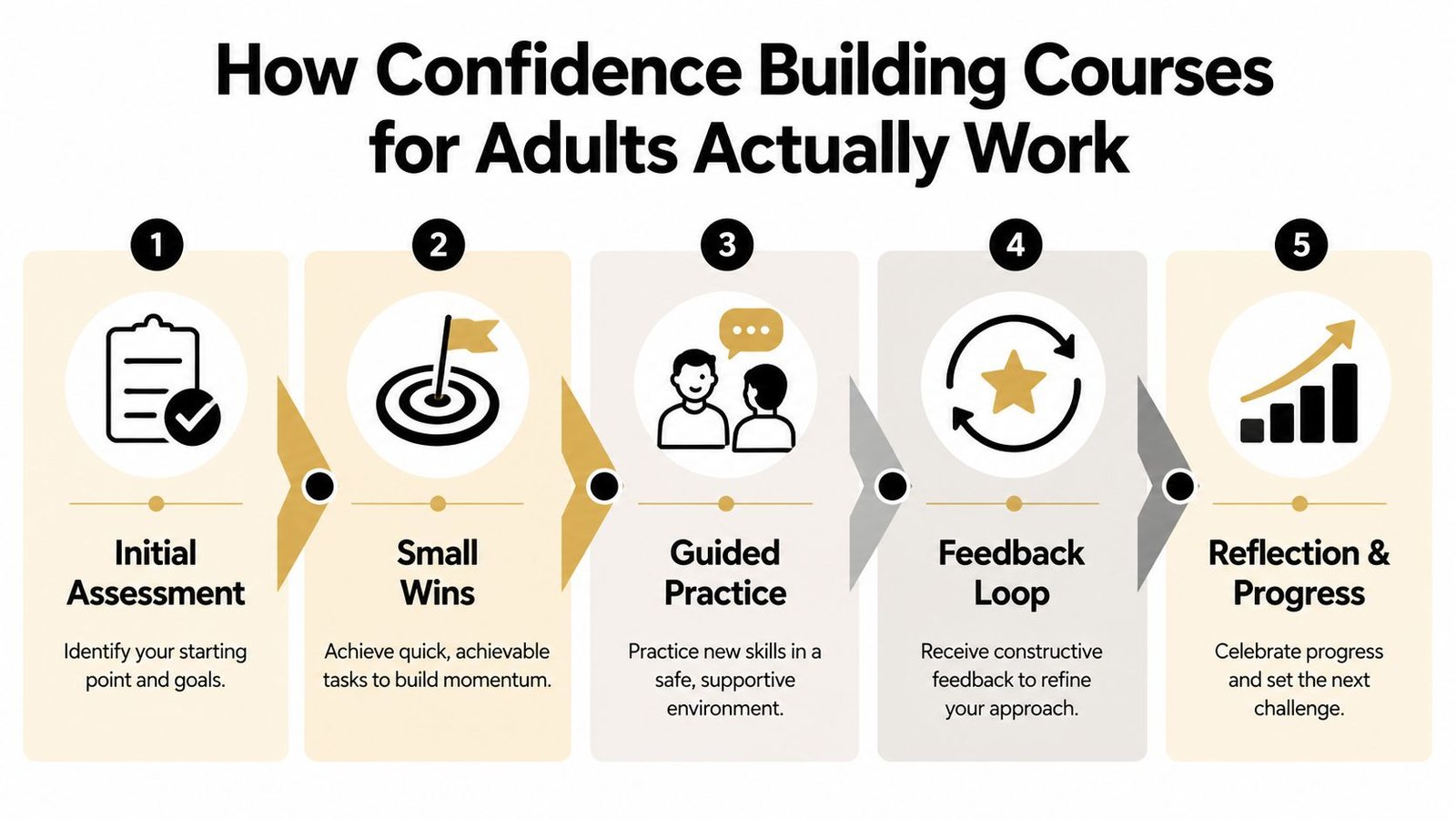
The strongest courses don't expect confidence to appear before the first lesson. They build it into the design. You start with a clear picture of your current skills, practise in manageable stages, and receive feedback before a small worry grows into a reason to leave.
The usual learning journey
Begin with an assessment. A tutor may discuss your goals and check your starting point in English, maths, digital skills or another subject. This isn't a test of your worth. It helps the provider avoid giving you work that's far too easy or too difficult.
Work through bite-sized lessons. Government evidence identifies low confidence, fear of learning, feeling too old and fear of tests or exams as major barriers. It recommends bite-sized courses and discrete units, so learners can collect early wins before extending their study. The Scottish Government's adult lifetime skills review supports this practical approach.
Practise before high-stakes assessment. Short quizzes, draft answers and scaffolded assignments let you try a skill without feeling that one mistake will decide everything. A progress tracker or micro-credential can make improvement visible.
Receive personal feedback. A subject tutor explains what you've done well and what to try next. The best feedback is kind and specific. “Your paragraph has a clear point. Now add an example” is more useful than “Try harder”.
Use wider support when you need it. Forums, Teams or WhatsApp check-ins, study planners and optional coaching touchpoints can reduce isolation. A pastoral team may also notice when a learner stops logging in and contact them before the problem becomes overwhelming.
Confidence becomes measurable through these learning gains. A University of Warwick study identified confidence as one of the most commonly selected benefits of adult learning, including confidence when dealing with new situations. The University of Warwick adult education report also supports structured progression, regular feedback and low-stakes assessment.
You can find more practical ideas in these active learning strategies. For a sense of how online teaching may feel, watch the short course video below.
Online, In-Person or Blended Which Format Suits You
The right format is the one you can keep attending when life becomes busy. There's no prize for choosing the most fashionable option. Think about your work pattern, family duties, travel time and the kind of support that helps you stay calm.
| Format | How Learning Happens | Best Fit For | Main Strength | Main Limitation |
|---|---|---|---|---|
| Online | Lessons and resources sit in a virtual learning environment, with recorded content and live tutorials | Parents, carers and workers needing flexibility | You can study around home and work commitments | You need a quiet plan for independent study |
| In-person | You attend scheduled classes at a college or training centre | Learners who prefer routine and face-to-face contact | Immediate discussion with tutors and classmates | Travel and fixed times may be difficult |
| Blended | Workshops combine with online tasks completed between sessions | Adults who want structure with some flexibility | Offers personal contact and independent practice | You must manage two types of attendance |
Online learning
Online courses can suit a parent who studies after the children go to bed, or a shift worker who needs to use recorded lectures at a different time. You may pause and replay a lesson, revisit instructions, and join a live tutorial when your timetable allows. You'll still need a study routine, because flexibility doesn't remove the work.
Digital confidence deserves attention here. UK evidence for 2025 reported that 34% of adults felt confident using video meetings for learning, showing why a supportive course should explain the platform rather than assume you already know it. The Adult Education Survey analytical report provides relevant UK evidence on digital participation and access to learning.
In-person and blended learning
A college classroom may be better if you learn through conversation, need a fixed weekly appointment, or feel more motivated when other people are studying beside you. Blended learning can offer a middle path. You might attend a workshop, complete an online activity at home, then return with questions for your tutor.
Choose the format that protects your consistency. Ask yourself when you're most alert, who can help with childcare, and whether travel would make attendance harder. A course that fits your real life gives confidence room to grow.
How to Choose the Right Confidence Building Course for Your Life
Course pages can sound alike, so use a simple check before you enrol. You're not being difficult by asking questions. You're protecting your time, money and confidence.
Start with recognition. Find out which organisation awards the qualification and whether it supports your intended next step. If you want university, ask whether the course leads to an accepted progression route. If you want work, check that the subject and level match the roles you're considering.
Questions worth asking
- Check the tutors: Ask about teaching experience, subject knowledge and how they support nervous adult learners.
- Look beyond marketing: Ask for clear information about completion, achievement and learner outcomes. If a provider uses the phrase “success rate”, ask what it means.
- Test the support: Find out whether you'll have one-to-one tutor calls, mental health signposting and a named progress coach.
- Match the workload: Ask how much weekly study the course expects and whether lessons are recorded. Be honest about work, school runs and caring duties.
- Follow the route: Check what comes after the course, such as Functional Skills, GCSEs, A Levels, an Access Diploma, university or employment.
Funding needs the same careful attention. The Adult Skills Fund rules for 2026 to 2027 treat English, maths and digital learning at Level 2 as essential for independent life and work. The rules say adults may be eligible for funding when their earnings are below £26,800 a year, and that unemployed learners can receive support. They also state that a learner must work at least 16 hours a week for four consecutive weeks to trigger certain payment conditions if they move into a job during study. Read the Adult Skills Fund funding rules for 2026 to 2027, then ask the provider how the rules apply to you.
Some learners also compare the wider professional picture, including presentation and interview preparation. A practical guide to image consultant services and costs may help if appearance and confidence affect your career plans, but it shouldn't replace recognised learning or proper pastoral support.
Finally, trust your response to the provider. Would you feel respected, supported and stretched on a hard week? If the answer is no, keep looking. A personalised plan can make the difference, so ask about personalised learning plans.
Real Outcomes University, Careers and Proud Family Moments
Confidence matters because it changes what you're willing to attempt. A stronger learner may submit an application, sit an exam, speak in a tutorial or ask an employer about progression. Adult education can support confidence and self-esteem alongside academic development, which is why many learners value it as more than a route to a certificate. The Learning and Work Institute review of adult learning identifies increased self-confidence and self-esteem as important learner outcomes.
A route towards university
An adult returner may begin with English or maths, progress to GCSE study, and then consider an Access to Higher Education Diploma. Access courses are designed for adults aged 19 or over who don't yet have the entry qualifications for university, and can provide a flexible route back into degree study. For a parent who once put a university dream aside, that route can make the goal feel practical rather than distant.
The outcome isn't always a university place. It might be a stronger application for a new job, a promotion, or the confidence to contribute at work. Adult learning outcomes are also linked with employment, health and wellbeing, inclusion and wider life transitions, according to government research on barriers to learning.
Consider three possible journeys. A single mum studies towards an Access Diploma, receives steady tutor support, and gains a place on a midwifery course. A warehouse operative completes an online leadership module, begins speaking up in team meetings and moves into a team leader role. A grandfather refreshes his literacy, then reads to his grandchild for the first time.
These examples show the kinds of change adult learners may seek, but they aren't claims about named people or guaranteed results. Your route may look different. Perhaps your first achievement is passing a Functional Skills assessment, writing a clear personal statement, or logging in even though you feel nervous.
Becoming a role model at home
Children notice effort. They notice when a parent opens a laptop to study, asks for help, keeps going after a difficult mark and celebrates a completed unit. Your learning can show them that education isn't only for people who had an easy start.
Next Level Online College offers online Functional Skills, GCSEs, A Levels and Access to Higher Education Diplomas, with academic and pastoral support for adults studying around real responsibilities. Its progression pathways connect study with further education, university and career development, but your provider should always explain entry requirements and outcomes clearly before you enrol.
A qualification can support your earning potential and lead towards more fulfilling work, but the first change often happens earlier. You start seeing yourself as someone who can learn, contribute and create a different future for your family.
Your Next Step to Start Building Confidence Today
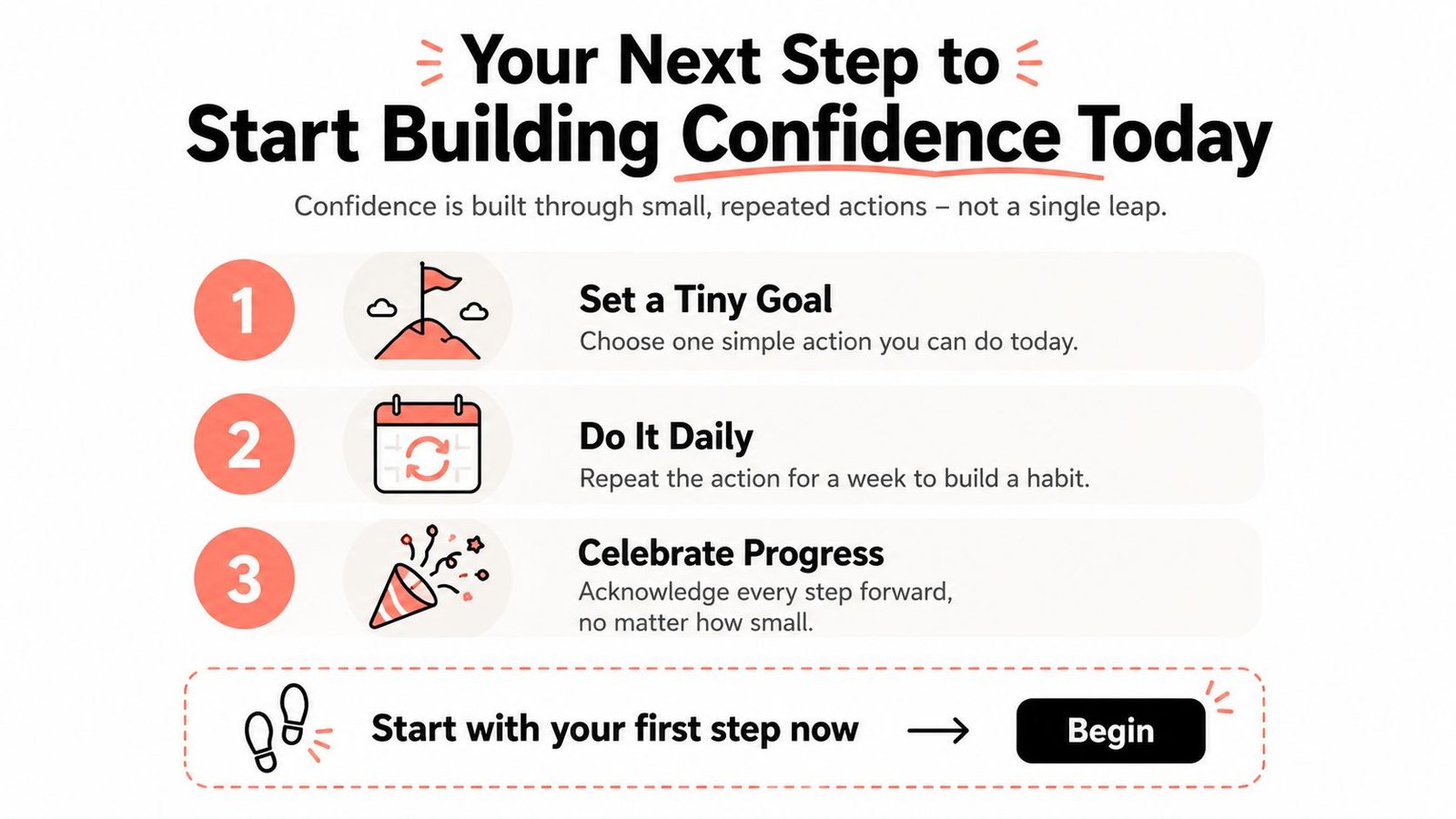
You don't build confidence through one dramatic leap. You build it by taking a small action, repeating it, and noticing that you managed it. That action could be finding a course, asking about funding, opening a study planner or sending a message to a tutor.
Start with one honest question: What would I like education to change? Your answer might be a university place, a better-paid role, stronger English and maths, or the pride of showing your children that it's never too late to grow. A clear reason can carry you through the days when motivation feels low.
Make the first move manageable
Use this simple starting point:
- Choose one task today. Visit a course page, write down your target qualification, or prepare three questions about support.
- Set a gentle routine. Decide when you'll look at your options again, and tell someone you trust what you're planning.
- Mark every gain. Keep a note of each action, even if it feels small. Evidence of effort helps challenge the old belief that you can't do this.
Funding may be available through routes such as the Adult Skills Fund, depending on your circumstances and the course. Providers may also offer flexible scheduling, payment options and tutor support, so ask for precise information rather than guessing from a course title.
You don't have to hide your nerves. Tell the admissions team that you're returning after a break, that family commitments matter, and that you want a supportive learning environment. A good conversation can turn a frightening application into a clear plan.
Remember: your children don't need to see a perfect student. They need to see someone who takes a brave step and keeps learning.
You may one day hold your first certificate, watch your child see you study, or open a university offer that once seemed impossible. That future starts with a conversation, not with having every answer.
Visit Next Level Online College to explore flexible confidence building courses for adults, including Functional Skills, GCSEs, A Levels and Access to Higher Education Diplomas. Ask about tutor guidance, pastoral support, funding and a study route that fits around your family and work, then take the first practical step towards your next chapter.