
You can sit at the kitchen table with a mug of tea, your phone buzzing, the washing still not done, and a course leaflet open in front of you. You want to study, you really do. But part of you wonders if you're too old, too busy, or too far behind to start again.
That feeling is common, and it does not mean you lack ambition. It usually means life is already full, so study has to share space with work, family, money worries, tiredness, and self-doubt. For adult learners, motivation for studying is rarely about feeling ready every day. It is about building the right support around you so progress can keep going even when your energy drops.
Why Motivation Feels So Hard When You Return to Study
A parent once told me they kept opening their workbook after the children went to bed, then closing it again without writing a single line. Not because they didn't care. They cared. The problem was that the evening already felt used up before study even began.
Returning after a long break changes the whole game
When you come back to learning as an adult, you are not the same person you were at school. You may be paying bills, caring for children, working shifts, or managing health needs. That means the usual advice, “just make a plan and stick to it”, often misses the point.
Practical rule: if study depends on perfect days, it will fail on ordinary ones.
The challenge is not only remembering facts or passing assignments. It is finding a way to study when your head is already busy. That is why so many adult learners feel their motivation rise and fall. The dips are not proof that you are lazy. They are often proof that your life is demanding.
Confidence takes a hit before progress begins
A lot of adults carry the fear that they are “not academic enough”. That thought can freeze you before you even start. If you have been out of education for years, a blank page can feel bigger than it really is.
The good news is that confidence usually grows after action, not before it. Small starts matter. Reading one page, writing three lines, or watching one short lesson can shift a day from “I can't do this” to “I've started”. That shift is powerful, especially for parents who want to show their children what persistence looks like.
Your motivation may feel shaky at first because it is being asked to do too much on its own. A better setup gives it somewhere to land. Clear expectations, flexible timing, and visible progress turn study from a personal battle into something more manageable.
Understanding the Two Types of Study Motivation
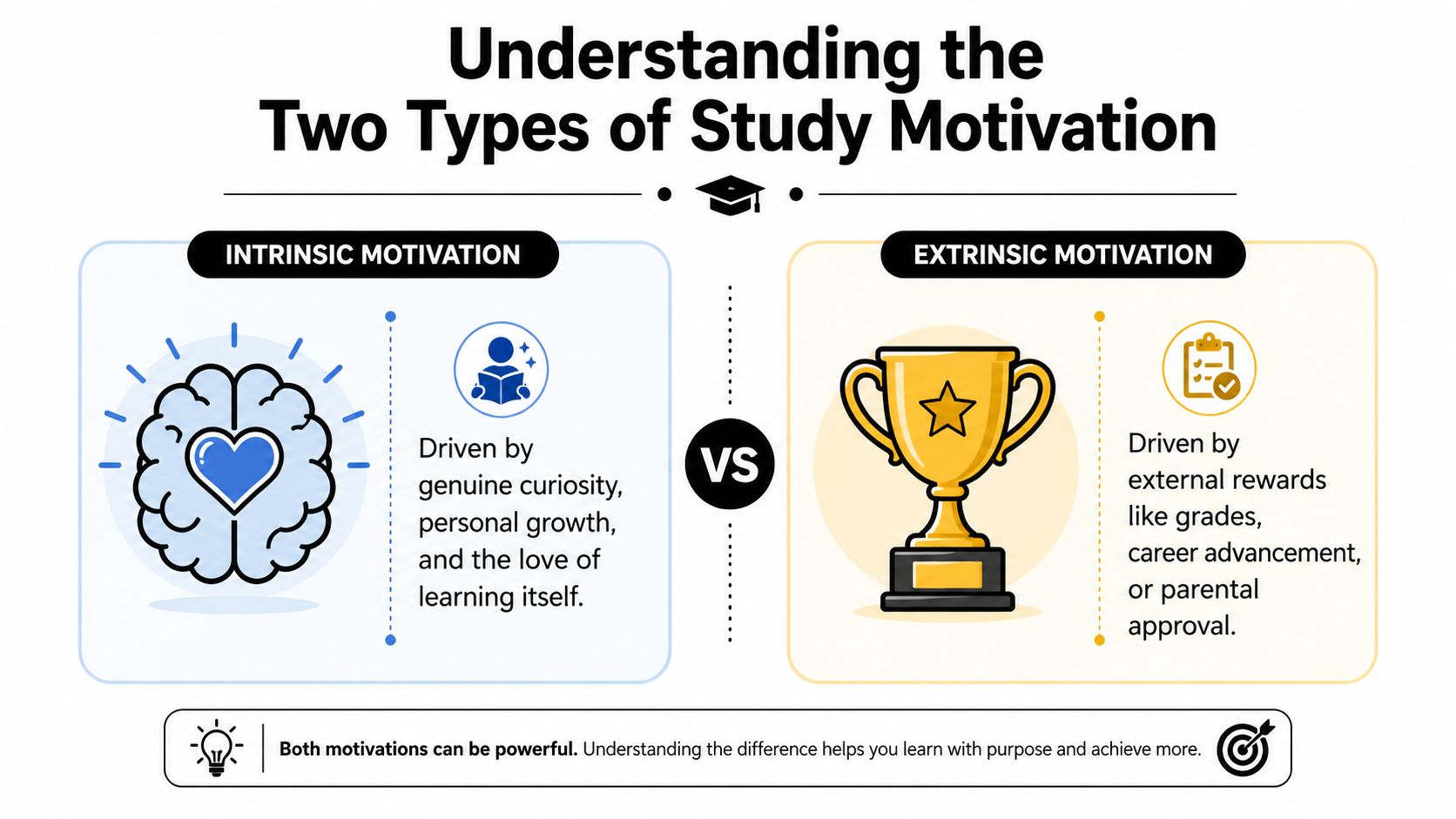
There are two simple reasons people study. The first comes from inside. The second comes from outside. Most adult learners need both, and trying to survive on one alone usually makes the journey harder.
Intrinsic motivation is the pull of the subject itself
Intrinsic motivation means you study because you want to learn, improve, or understand something better. It might be the satisfaction of finally understanding fractions, the pleasure of writing clearly, or the confidence that comes from solving a problem on your own.
Cooking a meal you enjoy is a good example. You keep going because the process itself gives something back. Even if the task takes effort, it still feels worthwhile.
Extrinsic motivation is the reason beyond the lesson
Extrinsic motivation is driven by external rewards. That could be a qualification, a better job, higher pay, university entry, or making your family proud. For many adult learners, these are not shallow reasons. They are real, practical, and personal.
If you want to earn more, move into a better career, or show your children that learning never ends, that matters. In fact, UK adult learners often study for exactly those reasons, with job prospects, better jobs, and progression in work being common motives (UK government survey of adult further education learners).
The strongest study plans usually mix both
If you rely only on rewards at the end, every hard week feels like a tax. If you rely only on curiosity, the moment work or family life gets heavy, study can slip. A steadier mix sounds like this, “I want the qualification, and I also want to become the kind of person who can stick with hard things.”
That combination is what helps adults keep going. The qualification gives direction. The personal growth gives staying power. Together, they create a form of motivation for studying that can survive ordinary life.
Why Adults Lose Motivation and How to Recognise the Signs
A learner can start a course with good intentions and still find themselves drifting away a few weeks later. That shift usually says more about pressure and stability than about character. Money worries, housing strain, caring duties, tiredness, and poor mental health can crowd out the attention study needs. When daily life feels unsettled, learning has less room to breathe.
Stability problems often look like motivation problems
An independent white paper on underserved students places basic needs, such as food, safe housing, health care, and financial management, at the centre of whether learners can keep going (underserved student analysis white paper). Many adults blame themselves when the issue is overload. They are carrying too much before the book even opens.
The same paper also points to something many returning learners recognise quickly. Support matters more than inspiration. Competence support and autonomy support are stronger drivers than pressure from others, and teacher autonomy support is a strong predictor of self-determined motivation. In plain language, people are more likely to continue when they feel capable, respected, and able to choose sensible next steps.
Motivation is easier to protect when the person studying feels safe, seen, and guided.
That is why a supportive study setup can work like a sturdy walking stick on an uneven path. It does not remove the rough ground, but it helps you keep your balance.
The warning signs are often small at first
Motivation usually does not disappear in one dramatic moment. It slips away in small, easy-to-miss ways. You avoid opening the workbook. You keep saying you will begin tomorrow. A task that once took ten minutes now feels heavy before you even start.
Other signs can be quieter still. A tiny job, like naming a file or reading an instruction, feels oddly difficult. You may also feel embarrassed about needing help, even when the problem is not skill but strain. That is often a sign of cognitive overload. Your mind is already spending energy elsewhere.
A UK context makes this even more important
The pressure does not stay at home. Workplaces now expect many people to read evidence, compare trends, and use digital tools with confidence. For adults returning to study, that can make a course feel less like a short-term task and more like a bridge back into work that asks for sharper judgment. A study routine that is held together only by daily inspiration can wobble fast when family life or work shifts.
That is why recognising the signs early matters. If you keep waiting for the right mood, you can miss the core issue. The problem is often not lack of desire. It is lack of support, time, or mental space. Adults usually do better when the study plan is built around steadiness, not willpower alone.
Evidence-Based Strategies to Build Lasting Study Motivation
The best study habits for adults are not fancy. They are practical, repeatable, and kind to real life. You do not need a perfect schedule. You need a system that still works when the week gets messy.
Start with a tiny win and build from there
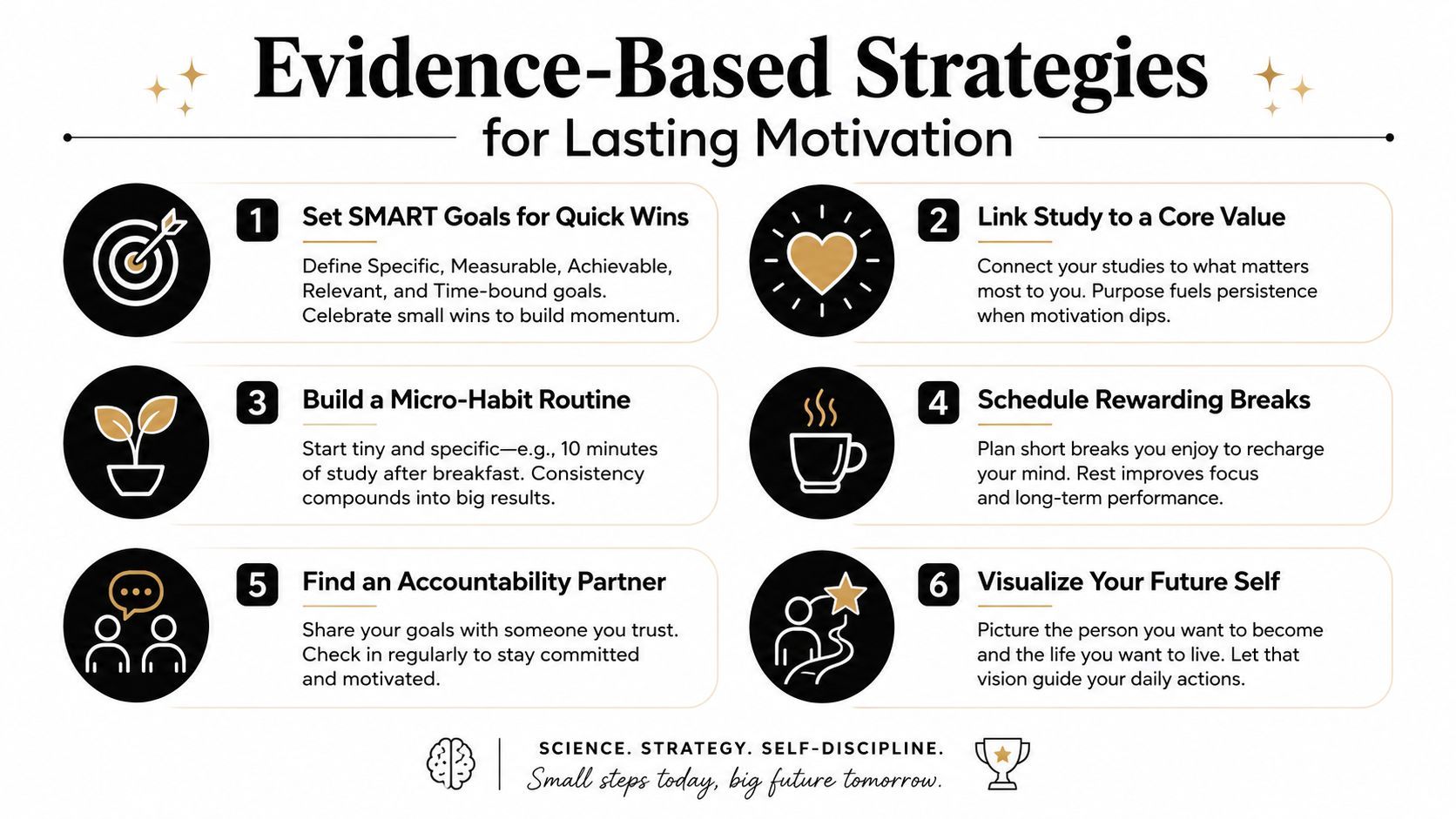
A goal should be clear enough that you know what to do next. “Study more” is too vague. “Read two pages after dinner on Mondays and Wednesdays” is better. It gives your brain a finish line.
The point is to make success visible quickly. That matters because adults often lose motivation when effort feels endless and progress feels hidden. Small wins build trust. Trust builds momentum.
Make the habit fit your day, not the other way round
If your evenings are chaotic, use lunch breaks. If mornings are quieter, study before work. A habit works best when it sits inside an existing routine, like putting on the kettle and then opening your notes.
The article on time management at Next Level Online College's study time guidance can help you think about where study fits into an already busy week. The wider lesson is simple, you are not trying to become a different person. You are trying to make learning easier to return to.
Use your phone to reduce decision fatigue
Set one reminder for the same time each day. Keep your books, laptop, or notes in one place. If opening the course feels like a chore, remove one of the steps that slows you down.
A good rule is this, if something needs effort every single time, it will eventually be skipped. Make the start easy. That is where many learners win or lose their evening.
Break study into pieces that feel finishable
Microlearning works because the brain likes clear edges. Ten focused minutes can be easier to begin than an undefined hour. One topic can be split into one definition, one example, and one short practice question.
Simple truth: a short study session you actually do is better than a long session you keep postponing.
Build accountability and protect energy
Tell one person what you are studying and when. It could be a partner, a friend, or another learner. A quick message saying “done for today” can keep you honest without turning study into pressure.
You also need rest. Skipping sleep or trying to study when you are completely drained usually backfires. A tired brain does not learn well. So plan breaks, water, food, and sensible stopping points.
The video below is a useful reminder that motivation grows when you build a routine that fits your life, not when you try to force yourself into someone else's ideal.
Real Examples of How Different Learners Stay Motivated
Three adults can look at the same week and need three different kinds of support. That is normal. Motivation grows faster when study matches the life you live, not the life you wish you had.
The working parent who studies GCSEs at night
Mina works full time and has two children. She studies GCSE English after the school run and again for twenty minutes once the house is quiet. She does not try to do everything on weekdays. She keeps weekends lighter so she can rest and catch up.
What helps her most is a simple routine, one past paper question, one short review, and one note about what confused her. That way, she never feels lost when she opens the book. Her confidence grows because every session ends with something finished.
The career changer fitting Access to Higher Education around part-time work
James wants a new career and is completing an Access to Higher Education diploma while working part-time. He studies in two blocks, one on his day off and one after work. He uses a notebook for quick wins, like questions he can answer in under five minutes, so he can see progress even on a busy week.
He says the hardest part was not the work itself. It was believing he had enough time. Once he stopped aiming for huge sessions, he became more consistent. That consistency matters more than intensity.
The learner building foundations through Functional Skills
Aisha left school early and came back through Functional Skills in maths and English. She started with the feeling that she was “behind”. That feeling made every task seem bigger than it was.
Her tutor helped her keep the first steps small. She practised one maths topic at a time and used short writing tasks instead of trying to produce long answers straight away. She also tracked what she could do now that she could not do a month before. That visible progress changed how she spoke to herself.
What these stories have in common
Each learner stayed motivated by making study easier to start and easier to measure. None of them depended on perfect confidence. They depended on routines, small wins, and support that matched their situation.
The same pattern shows up in UK higher education more broadly. By 2023/24, the UK had around 2.9 million students in higher education, and participation among young people entering higher education had reached about 40% for English 18-year-olds from state schools by the early 2020s, according to official participation statistics (participation statistics summary). That wider picture matters because it shows study is not reserved for one type of person. People come back at different stages, and they still belong.
How Structured Support Transforms Motivation into Achievement
A lot of adults think they need more self-discipline. Often, they need a better system. The right learning environment lowers the number of decisions you have to make and raises the chance that you will keep going when life gets busy.
Structure does part of the motivation work for you
A clear course layout reduces confusion. When lessons follow a sensible order, you do not waste energy guessing what to do next. That matters for adult learners because cognitive load is already high before study even starts.
Low-stakes starts help too. A first task that feels safe, like a short quiz or a guided activity, can make the next task less frightening. Once progress is visible, confidence follows. That is one reason structured learning often feels more sustainable than trying to self-direct everything alone.
Good support keeps momentum alive
Adult learners do better when questions are answered quickly and kindly. A tutor who explains what good work looks like can remove the fog that makes learners stall. A mentor who checks in can turn a difficult week into a manageable one.
The most helpful courses also make progression clear. If you can see how today's effort connects to university entry or a new career, the work feels more purposeful. The pages on personalised learning plans show how study support can make a course feel more manageable for adults balancing work and family.
Why this matters for confidence as much as grades
Adults who have been away from education often do not need more pressure. They need proof that progress is happening. Visible milestones do that. So does consistent pastoral support, especially when home life is complicated.
For many learners, the shift is emotional. Study stops feeling like a test of worth and starts feeling like a path forward. That shift can be life-changing, especially for people who want to become stronger role models for their children and build better paid, more fulfilling work for themselves.
Your Personal Action Plan for Sustained Study Motivation
Motivation becomes much easier to trust when you turn it into a routine. You do not need to solve your whole future today. You only need a clear starting point and a way to keep moving when energy dips.
Begin with your real reason
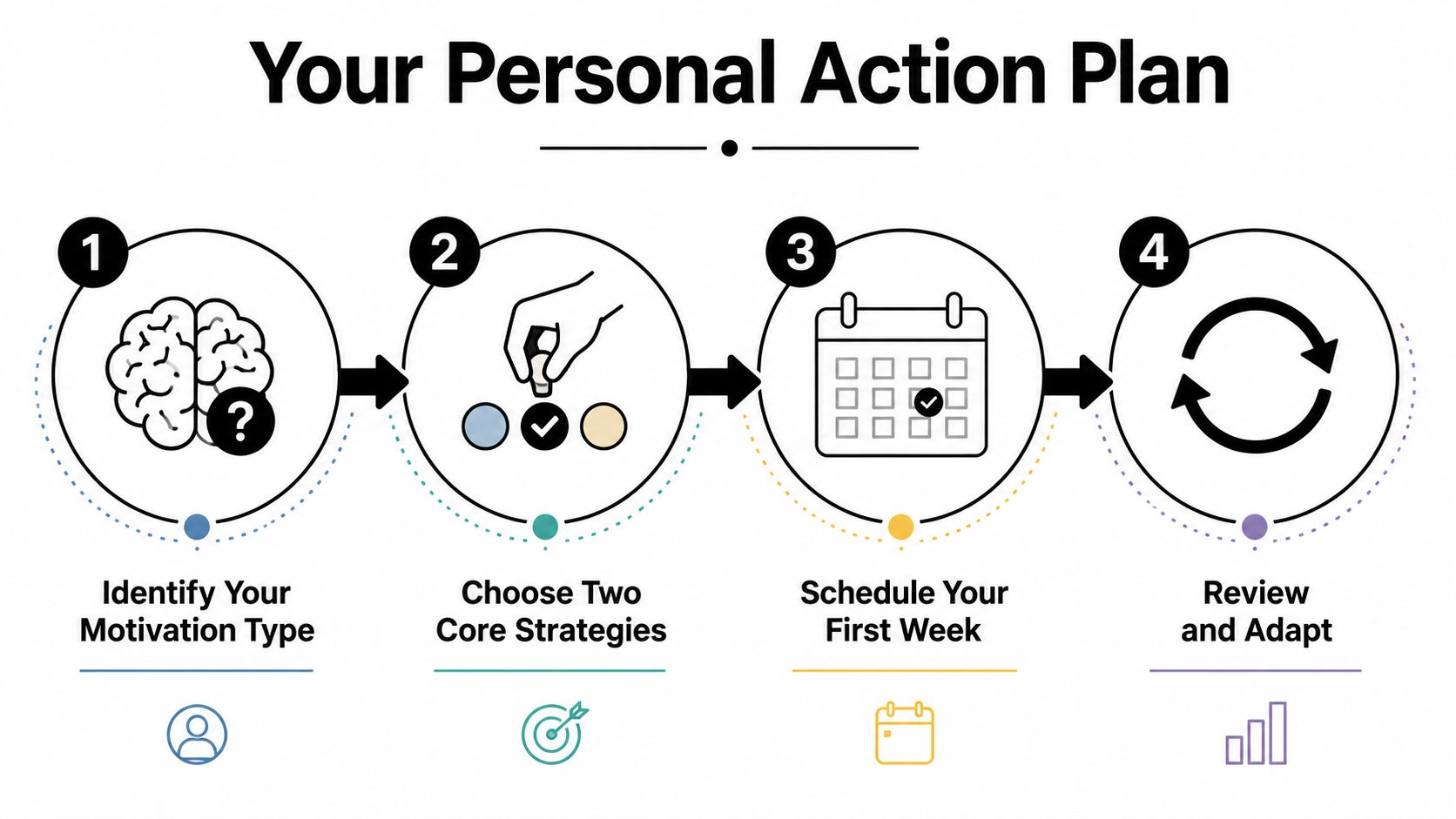
Write down why you want to study in one sentence. Keep it plain. It might be about earning more, helping your children, qualifying for university, or changing career.
Then circle the part that matters most to you right now. That is your main driver. If you keep that reason visible, it will help you through the less exciting parts of the course.
Choose two strategies, not ten
Pick two habits from the middle section and use them for one week. For example, a short daily study block and a phone reminder. Or a study buddy and a weekly review.
Too many changes at once can make you give up early. Two good habits are easier to protect than six half-finished ones. Keep the plan simple enough that you can repeat it on a difficult day.
Plan the first week before you start
Use a calendar or a paper planner and write down three study slots. Make them short enough to feel realistic. If your week changes, move the slot rather than abandoning it.
The study planner templates page can help you build a routine that fits around your life. What matters most is not the tool. It is whether the plan tells you exactly where to begin.
Review progress with kindness
At the end of the week, ask three questions. What did I complete? What got in the way? What will I adjust next week?
That review is not a judgement. It is a tune-up. If you missed a session, do not turn it into a story about failure. Treat it like useful information.
Your children do not need you to be perfect, they need to see you keep going. Your future also does not need a flawless start, it needs a steady one. If you are ready to study with structure, confidence, and support that fits real adult life, visit Next Level Online College and explore courses designed to help you move from hesitation to progress.