
It's late. The kids are finally asleep, the washing is still waiting, and you're sitting at the kitchen table with a maths book open in front of you. You want this qualification, but your head is crowded with everything else. Work shifts. School runs. Bills. That old fear that maybe you've left education too long.
If that sounds like you, you're not behind and you're not alone. Plenty of adults come back to maths carrying nerves, embarrassment, and low confidence. They also come back carrying something powerful. A reason. You're not revising just to pass a paper. You're doing it to open doors, earn more, set an example for your children, and prove to yourself that your story didn't stop when school did.
Revising GCSE Maths as an Adult Returner
Adult learners often think they need to revise the way teenagers do. That's usually the first mistake. Teen revision advice assumes free evenings, school support, and long stretches of uninterrupted time. Your life probably doesn't look like that.
Your version might look more like this. You revise for twenty minutes before a shift. You watch a quick explanation on your phone while dinner is in the oven. You answer three questions in the car before the school pick-up. That still counts. In fact, for many adults, that kind of steady, repeated practice works better than one huge weekend session that leaves you drained.
Why this qualification matters
GCSE maths still matters because it affects what can come next. In England, official data show that 46.2% of pupils achieved grade 5 or above in both English and maths in the 2023 to 2024 school year, with 26% of disadvantaged pupils doing so compared with 53% of all other pupils. The same data show a one-year change from 45.5% to 46.2%, which tells you this qualification is watched closely and remains a real gateway to progression, training, and work in England (government attainment data for age 16/attainment_at_age_16/latest)).
That matters for you now. Passing GCSE maths can help with college entry, university plans, apprenticeships, and jobs that ask for a solid maths grade. It can also change how your children see education at home. When they see you keep going, even when you're tired, they learn what persistence looks like.
You don't need perfect study conditions. You need a plan you can actually keep.
Small wins build confidence
Most adult learners don't need more pressure. They need structure. A calm routine beats panic every time. Short daily focus, targeted practice, and honest checking will take you further than trying to “cover everything” in one go.
If you want a course built around adult life rather than a school timetable, you can look at this GCSE maths for adults course. What matters most right now, though, is this. You can do this in small pieces. You can rebuild your maths step by step. You can become the person in your family who didn't give up.
Building a Realistic Revision Timetable Around Your Life
A timetable only works if it fits your real life. Not your ideal week. Not the week you wish you had. Your actual week, with tired evenings, moving shift patterns, and last-minute family jobs.
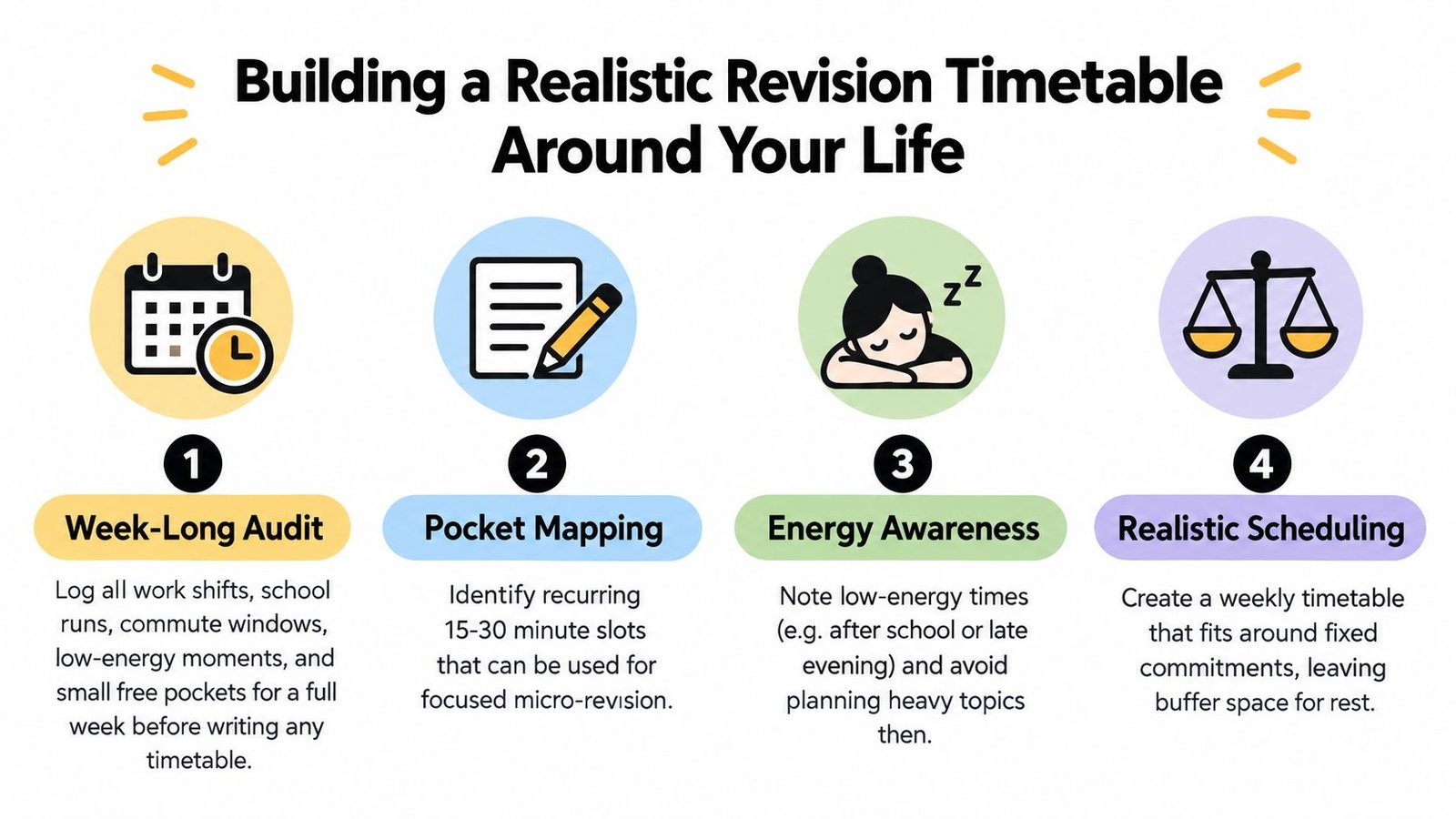
Start by watching your time for one full week before planning anything. Keep it simple. Use your phone notes, a diary, or the back of an old envelope.
Do a one-week audit first
Write down the fixed parts of your week and the hidden study pockets around them.
- Work blocks. Include shifts, commute time, and how you feel after each one.
- Family duties. School runs, bath time, meal prep, caring responsibilities.
- Energy dips. Times when you're technically free but too tired for hard thinking.
- Useful pockets. A lunch break, a quiet early morning, twenty minutes after the kids go to bed.
You're looking for patterns, not perfection. Many adults find they have more usable time than they thought, but it's scattered.
Choose anchor sessions
Once you've seen your week clearly, pick two or three anchor sessions. These are your main revision blocks. Keep them short enough to be realistic and long enough to matter.
A good anchor session might be:
- Before work if your mind is clearer in the morning
- After bedtime if the house is calmer then
- On one weekend morning before the day gets busy
Protect one rest day each week. If every spare minute becomes “study time”, you'll start dreading revision and your plan will collapse.
Practical rule: Build a timetable that would still work on a tiring week, not only on a good week.
A notebook template you can copy
Try this simple weekly pattern:
| Day | Time | Task | Energy level |
|---|---|---|---|
| Monday | 7:15 pm | 25 minutes algebra | Medium |
| Tuesday | Lunch break | 15 minutes number practice | Good |
| Wednesday | Rest | No revision | Low |
| Thursday | 8:00 pm | 30 minutes past paper questions | Medium |
| Friday | Commute notes | Formula-free recap and mental methods | Low |
| Saturday | 10:00 am | 40 minutes topic practice | Good |
| Sunday | 6:00 pm | Buffer catch-up session | Medium |
Keep one buffer session each week. That's the space that saves your plan when a child is ill, work runs late, or life happens.
If you want a ready-made layout, these study planner templates can help you turn rough ideas into a timetable you'll use.
Diagnosing Your Maths Gaps Before You Start
Many people waste weeks revising the wrong things. They go back over topics they already half know because it feels safer than facing what they've forgotten. That feels busy, but it doesn't move marks.
A better first step is diagnosis. You're not testing your worth. You're finding out where to aim.
Use a red, amber, green check
Get a topic list from your exam board, such as AQA, Edexcel, or OCR. Then, from memory only, rate each topic:
- Red if you don't know where to begin
- Amber if you sort of remember it but make mistakes
- Green if you can do it confidently without help
Don't overthink it. Your first judgement is usually accurate enough.
Here's a tracker you can copy into a notebook or spreadsheet.
| Topic | Confidence (R/A/G) | Error Type (Slip / Lost Skill / Never Learned) | Priority for Revision |
|---|---|---|---|
| Fractions | |||
| Percentages | |||
| Ratio | |||
| Linear equations | |||
| Area and perimeter | |||
| Probability |
Sit one paper as a diagnostic
Do one past paper early, but don't use it to judge yourself. Use it like a mechanic uses a check list. You're finding faults so you can fix them.
Mark it. Then sort your mistakes into three groups:
- Careless slips. You knew it, but copied a number wrongly or rushed.
- Lost procedures. You used to know the steps, but they've gone fuzzy.
- Never learned. You look at the question and have no method at all.
That last group can feel upsetting, especially if school was hard the first time round. But it's useful. A “never learned” topic is often easier to improve than a messy half-known one, because you can build it cleanly from the start.
If a topic makes no sense today, that doesn't mean you're bad at maths. It means that topic needs proper teaching and a bit more time.
Cut the list down
Don't try to attack the whole syllabus at once. Pick five to eight weak topics and make them your first month's priority. That narrow list gives you focus and stops the common adult learner habit of jumping between resources without finishing anything.
Many people finally feel relief here. Instead of saying, “I'm awful at maths,” you can say, “I need work on percentages, solving equations, ratio, area, and reading graphs.” That's a problem list. Problems can be solved.
Topic-by-Topic Study Techniques That Actually Stick
Once you know your weak areas, keep each study session simple. You don't need a huge stack of books or hours of highlighting. You need a repeatable method that works when you're tired.
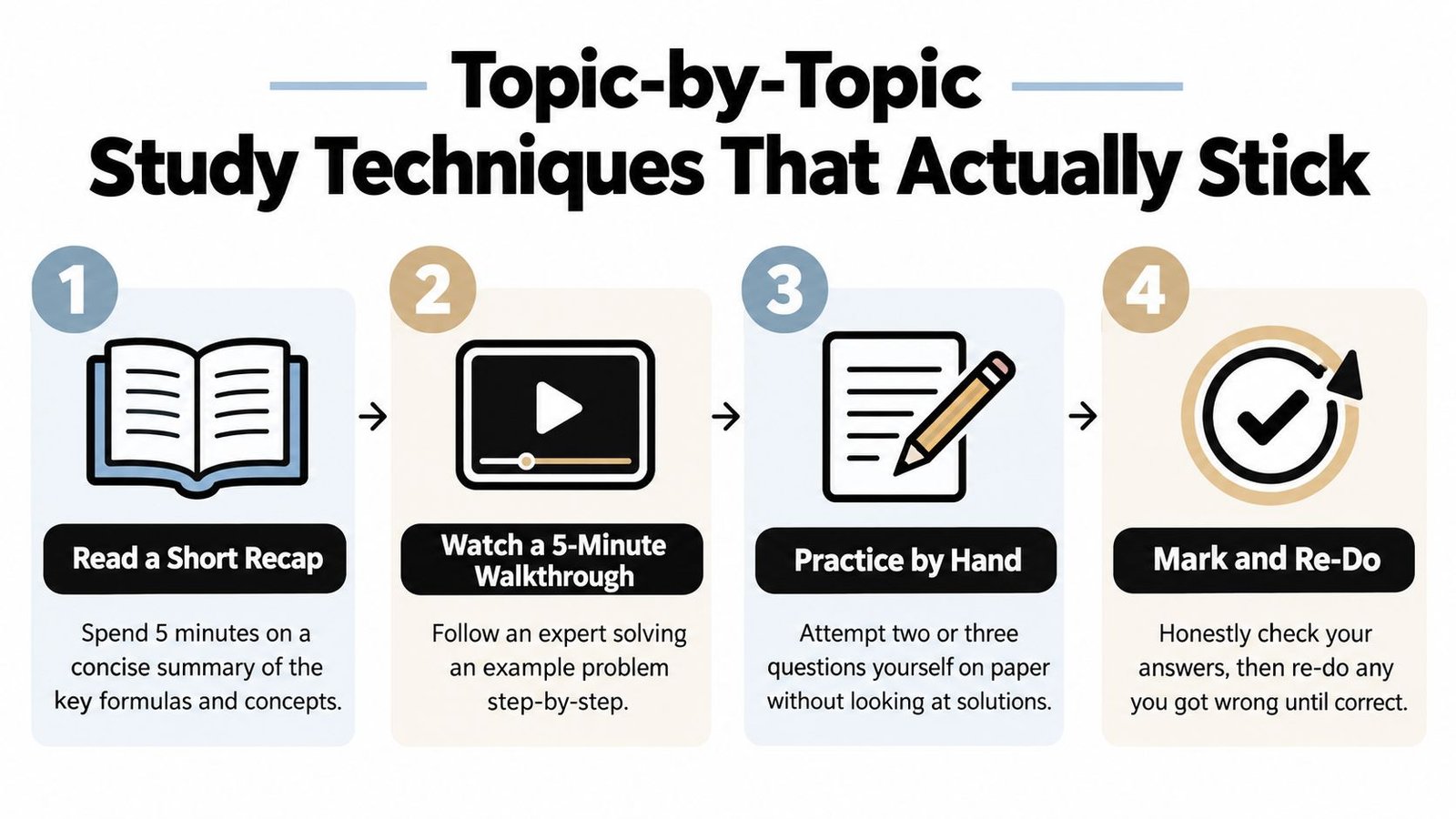
Use the same four-step pattern for every topic.
The four-step routine
Read a short recap
Spend a few minutes reminding yourself what the topic is about.Watch one short walkthrough
A quick explanation can help when a textbook feels too dense.Do two or three questions by hand
This matters most. Don't just nod along. Write every step out.Mark and re-do
Check your answers, then do the missed ones again without looking.
Because current GCSE maths specifications don't require learners to memorise formulae, revision is often better spent on method, question choice, and exam technique rather than trying to learn long lists by heart (Ofqual analytics and current specification context).
Five topic groups to cycle through
Give each of these one short block in your week.
- Number
Example: turn 3/4 into a percentage. First change it to a decimal, then multiply by 100. - Ratio and proportion
Example: share £30 in the ratio 1:2. Add the parts, then split the total fairly. - Algebra
Example: solve x + 5 = 12. Undo the +5 to find x. - Shape and measures
Example: find the area of a trapezium by writing down the values clearly and following the method carefully. - Probability and statistics
Example: work out the mean from a frequency table by multiplying, adding, then dividing.
Here's a short video if you want a guided explanation before you practise:
Why writing matters
Reading solutions can trick you into feeling ready. The exam won't ask whether the method looks familiar. It will ask whether you can produce it on paper under pressure.
Keep a small stuck list. Write down question types that slowed you down or confused you. Bring that list back in the next session. Watching your stuck list shrink is one of the fastest ways to rebuild confidence.
Using Past Papers and Practice Questions the Smart Way
You finish a shift, clear the tea things, and grab twenty minutes at the table before the next job starts. In that kind of study window, past papers need to do a clear job. They are not just something to “get through”. They are a checking tool. Used well, they show you where marks are slipping away and which small fixes will help most.
That matters for adult learners because time is tight. One focused paper review can do more for your grade than two hours of random revision.
Use papers in three stages
Each stage has a different purpose. If you use all papers in the same way, it becomes hard to tell whether the problem is knowledge, timing, or nerves.
| Stage | How to do it | Why it helps |
|---|---|---|
| Stage one | Do a paper calmly, with enough time to think and notes nearby if needed | Shows which topics are still shaky |
| Stage two | Do another paper to a time limit, without extra help | Checks whether your revision is sticking under pressure |
| Stage three | Sit a full paper under full exam conditions | Builds concentration, pacing and confidence |
This works a bit like learning to drive. You would not start with a mock test in rush-hour traffic and expect that to teach you everything. First you learn the moves, then you practise them, then you test whether you can do them reliably.
GCSE maths papers are also split by tier. Foundation covers grades 1 to 5. Higher covers grades 4 to 9, with the possibility of a grade 3 at the lower end. That is why it helps to practise the right paper for your tier, rather than picking papers at random (GCSE maths tier explanation).
Mark papers for clues, not just scores
The score matters, but the reason behind each lost mark matters more.
A paper with 38 marks can feel disappointing. Yet if 12 of those lost marks came from sign errors, missed units, and rushing one ratio question, that is good news. Those marks are easier to win back than a whole paper of methods you have never seen before.
Keep a simple log after each paper:
| Question number | Topic | Type of error | Action next session |
|---|---|---|---|
| Q4 | Fractions | Slip | Check arithmetic more slowly |
| Q9 | Ratio | Method forgotten | Practise 3 similar questions |
| Q13 | Algebra | New skill needed | Start with a basic worked example |
A log like this turns worry into a plan.
Look for recoverable marks first
Adult returners often make progress fastest by tidying up the marks that are already within reach. That usually means number work, fractions, percentages, ratio, basic algebra, reading graphs, and writing the final answer in the right form.
You do not need to chase every hard question straight away.
If you are working towards a pass, it helps to ask, “Which marks could I get next week with steady practice?” That question is more useful than, “How far am I from my target grade?” Exam boards publish grade boundaries after results, and they can change from one series to another, so the safest approach is to keep collecting the marks that regularly appear on your papers instead of relying on one set of boundary numbers.
Make practice fit real life
A full paper is useful, but it is not the only way to revise. If your week is broken up by work and family, use shorter paper slices.
Try one of these:
- 15 minutes on questions 1 to 8 only
- one page of non-calculator questions before work
- a timed set of five mixed questions while dinner is in the oven
- one full paper at the weekend when the house is quieter
Short practice still counts. In fact, it often works better because you are fresh enough to notice your mistakes.
If you need more topic-based material between full papers, these GCSE maths practice questions can give you structured practice without wasting time searching.
Rotate practice, then repeat weak spots
Doing ten papers back to back can make revision feel productive, but it often turns into spotting familiar layouts rather than improving your maths. A better pattern is paper, review, targeted practice, then another paper.
That cycle keeps the practice honest. It also suits busy adult life because each step is small enough to fit into the cracks of the day.
One trusted college or one reliable set of materials is usually enough. You do not need five revision guides, three apps, and a pile of printed worksheets. You need clear feedback, repeated practice on your weak areas, and a method you can keep going even on tired weeks.
Exam Technique and Time Management on the Day
You have made it to exam day after fitting revision around work, children, tired evenings, and all the small jobs that still need doing. That matters. The paper is not only testing maths. It is also testing whether you can stay calm enough to show what you know.
A simple routine helps here. It works like laying out everything for a busy morning before you go to bed. You are making the day easier for a tired version of you.
Know the paper setup
Exam windows are typically in May and June. A future window might look like early May to late June, with maths papers spread across that period. In GCSE maths, you can expect one non-calculator paper and two calculator papers, so your preparation needs to cover mental methods, written methods, and using your calculator accurately.
Board structure matters too. For example, AQA GCSE Mathematics Paper 1 is non-calculator, so it helps to go in ready to do number work confidently by hand (calculator and non-calculator paper structure example).
That catches many adult learners out. If you have revised mainly with a calculator because it felt quicker after a long shift, the non-calculator paper can feel like cycling uphill. It is still the same maths, but it asks more from your memory and written method.
A simple routine for the day
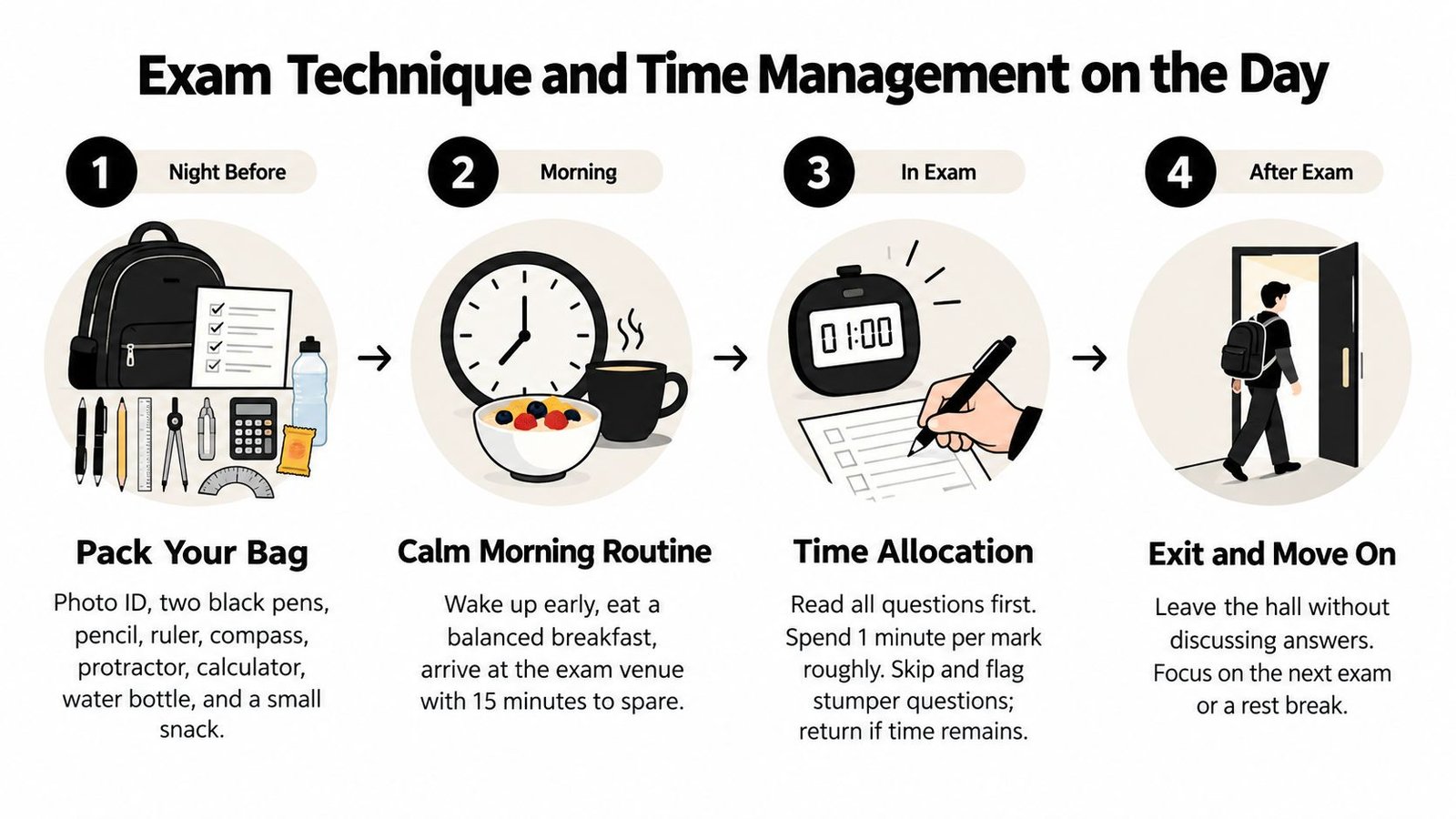
Pack your bag the night before so you are not hunting for things while making breakfast or sorting the school run.
Take:
- Photo ID
- Two black pens
- A pencil and ruler
- An approved calculator
If your centre has given specific instructions, follow those first.
During the exam, use the clock in a calm, practical way. A good guide is about one minute per mark. A 3-mark question should not take ten minutes. If it does, put a small mark next to it, move on, and come back later if you have time.
Read each question twice. On the first read, get the gist. On the second, look for the detail that changes the method, such as units, rounding, negatives, or whether the answer must be in standard form, money, or time. Many lost marks come from rushing past those details, not from not knowing the maths.
Show your working, even on questions that look easy. Markers can often give credit for the method, and written steps also help you spot your own mistakes. If your answer looks odd, such as a negative length or an impossibly large area, pause and check it. Real life is useful here. If a fence cannot be minus 4 metres long, your exam answer cannot either.
Grade boundaries change from one exam series to the next, so avoid fixating on one rumoured pass mark. Exam boards publish them after each series, and OCR's archive shows separate GCSE English and Maths boundaries for November 2025 as one example of that yearly process (OCR grade boundaries archive).
A waiting-room reset
Nerves often show up as a blank mind, shaky hands, or the sudden feeling that you have forgotten everything. That is a stress response, not proof that you cannot do the paper.
Try this:
- Put both feet on the floor.
- Breathe in slowly.
- Breathe out for longer than you breathed in.
- Drop your shoulders.
- Say to yourself, “One question at a time.”
Keep that phrase with you once the paper starts. You do not need a perfect performance. You need enough steady moments to pick up marks across the paper, one question at a time.
Your Final Weeks Plan and Where to Get Support
It is 9.20pm. The children are finally settled, your work bag is still by the door, and you are trying to decide whether 20 minutes of maths is even worth it.
It is.
The final weeks are not about heroic study sessions. They are about keeping a steady pattern, protecting your energy, and using the little pockets of time you do have. Adult returners often get better results from a short daily check, focused practice, and clear support than from long, tired revision sessions that leave nothing behind.
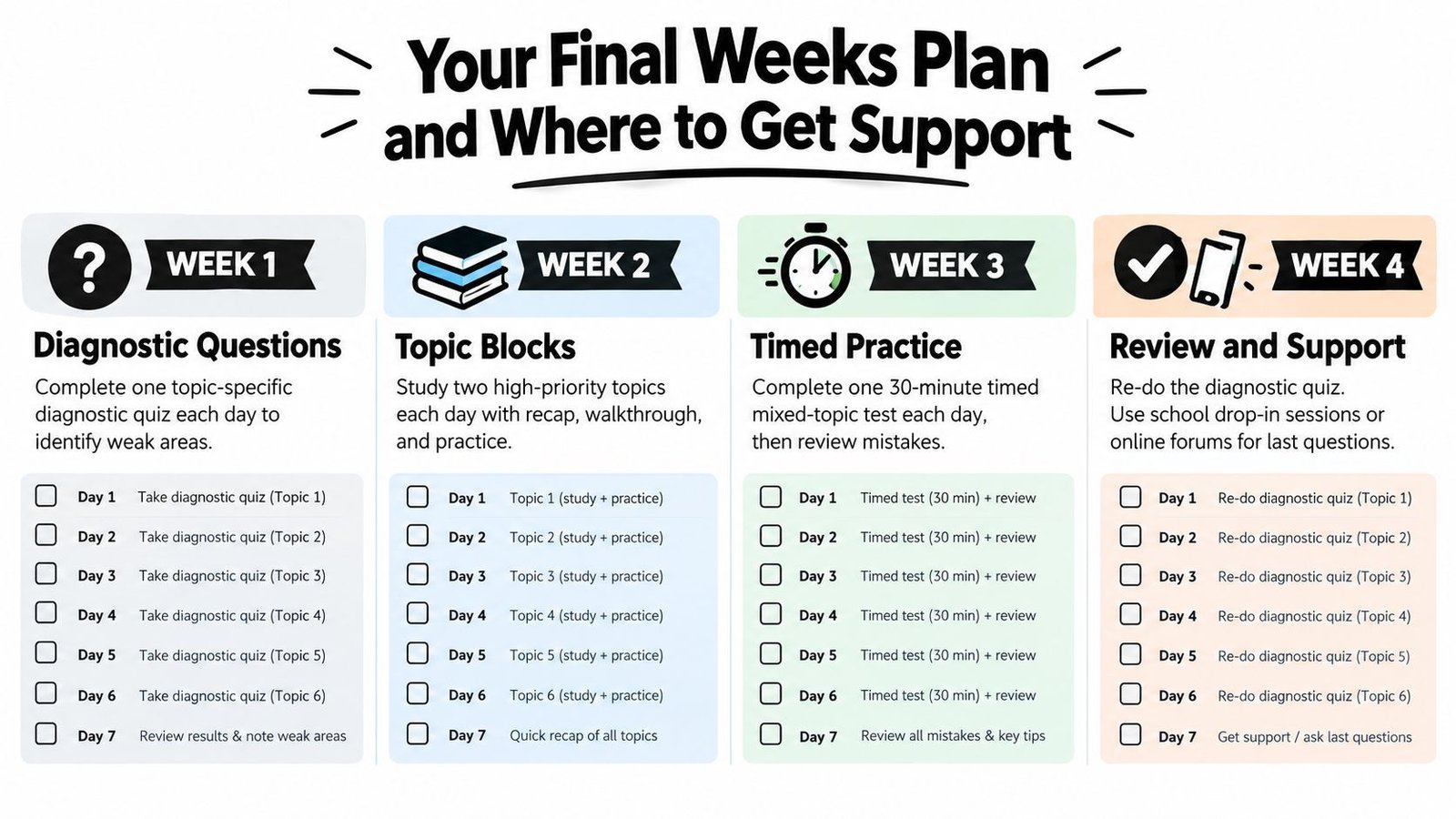
A four-week countdown you can follow
Week 1
Spend a few minutes each day testing yourself on mixed questions. Spot the topics that still feel shaky and tighten up the basics, especially number skills.Week 2
Pick two weak topics a day and work on them in short bursts. Write the method out by hand, then do a few similar questions so the steps start to feel familiar.Week 3
Switch to timed mixed practice. This helps you change gear between topics calmly, which matters in the exam when algebra can be followed by probability or ratio.Week 4
Keep things light and clear. Review your error list, walk through one final paper, and protect your sleep the night before the exam.
A simple plan like this works because it gives each week one job. You are not trying to do everything at once. You are building the same way you would build strength after time away from exercise. Small, regular effort beats one exhausting burst.
Support matters more than trying to do all of this alone
Many adult learners carry the feeling that they should sort it out by themselves. That can sound sensible, especially if you are used to holding everything together for other people. In practice, maths revision usually goes better when one other person knows your plan.
Tell a partner, friend, grown-up child, or colleague what you are aiming for. Ask them to check in once a week. Put your study time on the family calendar. Let the people around you see that this matters. For many adults, that turns revision from something vague and easy to postpone into something real and steady.
A college can help with that structure too. Next Level Online College offers flexible online learning for adult returners, with recognised courses, tutor guidance, and pastoral support built around work and family responsibilities.
Steady support can turn a lonely plan into one you finish.
You do not need a perfect routine. You need one you can keep. If your study happens before a shift, in the car before school pick-up, or at the kitchen table after everyone else has gone to bed, it still counts. Those small sessions are not second best. For a busy adult learner, they are often the reason progress happens.
If you want support that fits around shifts, childcare, and everyday life, Next Level Online College offers flexible online courses for adult learners, with structured study, tutor guidance, and pastoral support. If you're serious about learning how to revise for GCSE maths without doing it alone, it's a practical next step that can help you stay organised, confident, and prepared.