
Sitting down to revise maths as an adult can feel brutal. You open a worksheet, see fractions, graphs or algebra, and your stomach drops. You might be thinking, “I was never good at this,” or “It's too late for me now.”
It isn't.
GCSE Maths isn't just another exam. It can help you get into university, qualify for better work, earn more, and show your children what persistence looks like. Passing sends a message to your family and to yourself. You didn't give up. You came back, faced something hard, and finished it.
Your Journey to GCSE Maths Success Starts Here
A lot of adults come back to maths carrying old shame. Bad school memories. Embarrassment. The fear of looking silly. None of that means you can't succeed now. In fact, adult learners often bring something teenagers don't have yet. Patience, life experience, and a real reason to pass.
That matters more than people think.
For GCSE maths resits in 2025, adult learners aged 20 and above had a pass rate of 34%, compared with 15.3% for those aged 17–19, according to FE Week's reporting on GCSE resit pass rates. Adult learners are not behind. In many cases, they're better prepared for the discipline and purpose that this challenge demands.
Your age is not the problem
You're not walking into this as the same person you were at school. You've handled work pressure, bills, children, setbacks, and responsibilities. That gives you resilience. Maths revision needs consistency more than genius, and adults are often far better at building consistent habits.
Practical rule: Stop telling yourself you're “bad at maths”. Say you're “in training for maths”.
That shift sounds small, but it changes the way you react to mistakes. If you're training, then errors are part of progress. If you think you're hopeless, every wrong answer feels like proof.
This qualification can change more than your CV
A pass in GCSE Maths can open doors to courses, job applications, promotions, and routes into higher study. It can also repair confidence that's been damaged for years. Many adults don't just want a certificate. They want to feel capable again.
That's why I'm opinionated on this. You shouldn't drift through random revision and hope for the best. You need a proper plan, steady practice, and support that respects adult life. If you want a clear route designed for adult returners, look at GCSE Maths for adults.
Do this for the bigger reason
Your children notice what you do. They notice when you keep going after a long day. They notice when you study at the kitchen table instead of switching off. They notice courage.
Use that.
- For your family: Show them learning doesn't stop when school ends.
- For your future: Open doors that low confidence has kept shut.
- For yourself: Prove that one difficult subject doesn't get to define your whole life.
You don't need to feel confident before you begin. You begin first. Confidence comes after repeated effort, not before it.
Build Your Foundation with the Right Questions
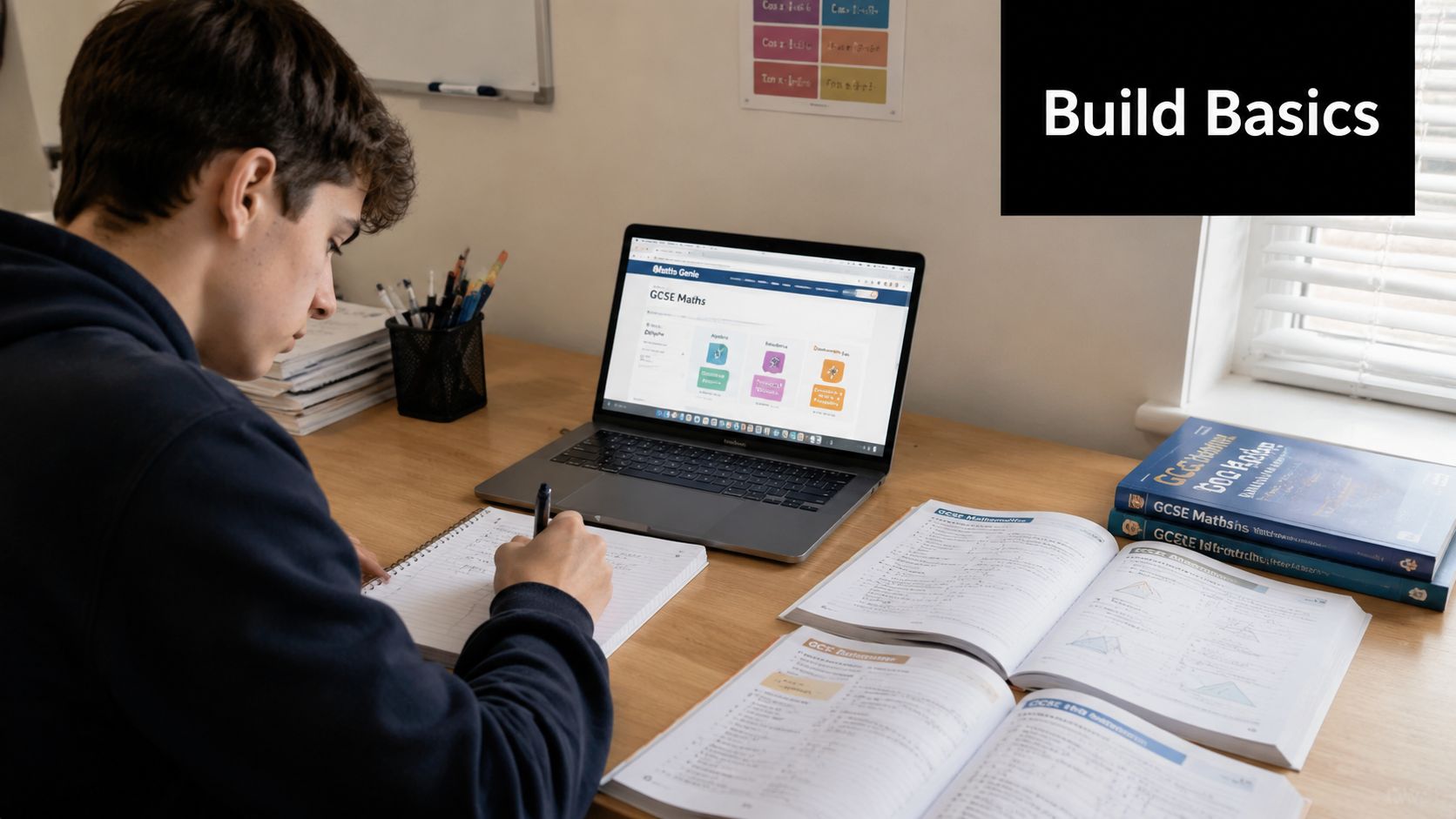
You sit down after work, open three tabs, print a worksheet, and ten minutes later you already feel behind. One sheet is too easy. One is clearly for the wrong exam board. One looks like it was made for someone who never struggled with maths in the first place.
That is not a motivation problem. It is a setup problem.
Adults returning to maths need order before intensity. If your practice questions are random, your confidence takes hit after hit. Good practice should calm you down, show you what to do next, and give you proof that you are improving.
Pick the right tier first
Check whether you are studying Foundation or Higher before you answer a single question. Skip this step and you make revision harder than it needs to be.
Here is the difference:
| Tier | Best for | Main aim |
|---|---|---|
| Foundation | Learners rebuilding core skills and confidence | Secure the strongest grade available in that tier |
| Higher | Learners who are ready for wider and harder content | Aim for the highest grades available |
Questions that are too hard too soon do significant damage. They make you feel stuck when the underlying problem is poor sequencing. Questions that are too easy waste time you cannot afford to lose.
Choose the tier that fits your current level, not the level you wish you had already reached.
Match your exam board and topic
AQA, Edexcel, and OCR do not present content in exactly the same way. The wording changes. The structure changes. Sometimes the style of problem changes too. If you want exam success, practise the kind of question you are going to face.
Use this order and keep it simple:
- Confirm your exam board from your course details, tutor, or registration email.
- Check your tier so your question level is right.
- Choose one topic at a time instead of jumping straight into full papers.
- Start with a topic you can partly do so you get early marks on the page.
That early success matters more than people admit. Adults who have been told for years that they are poor at maths need evidence that the story can change.
Build confidence before you build speed
Start with questions that let you practise one skill clearly. Percentages. Fractions. Basic algebra. Reading charts. The exact topic matters less than the result. You need a few solid wins that tell your brain, "I can do this if I work through it properly."
A strong first week looks like this:
- Pick one familiar topic and do a small set of questions.
- Work in short sessions so your concentration stays sharp.
- Mark every answer and correct mistakes while the topic is still fresh.
- Write down weak spots so your revision has a clear target next time.
If your study routine keeps collapsing, the problem is usually not effort. It is structure. Use a plan that breaks revision into clear topics and next steps, like these GCSE revision techniques for adult learners.
Use questions to rebuild trust in yourself
This section is about more than worksheets. The right questions help you rebuild trust in your own ability. Each matched topic, each completed set, each corrected mistake gives you something many adult learners have been missing for years. Evidence.
That evidence grows into confidence. Confidence changes how you study, how you apply for courses, how you speak about yourself at home, and what your family sees when life gets hard.
Start small. Stay organised. Let the right questions carry you forward.
Turn Practice into Progress with Model Answers
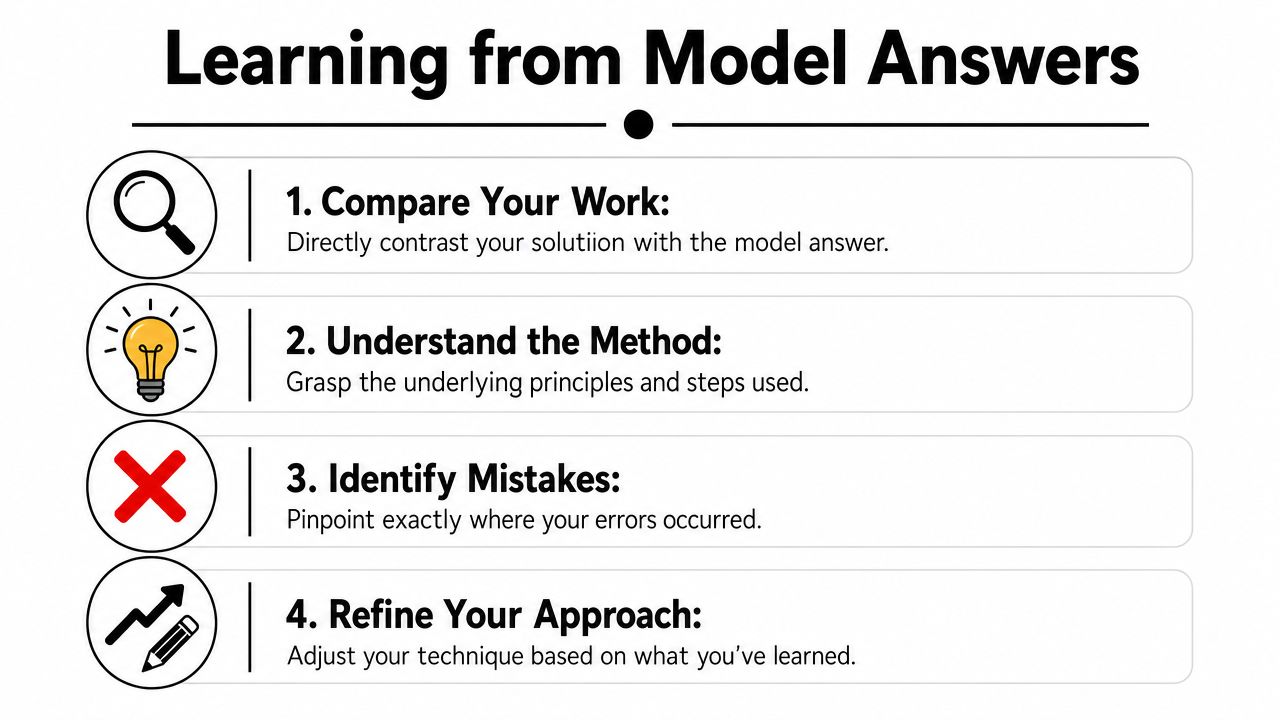
Doing questions is only half the job. Significant progress comes from checking your thinking. That's why model answers and mark schemes matter so much. They show you how the examiner wants the method laid out, not just the final answer.
Too many adults mark work like this: right, wrong, move on. That's a mistake. If you only check the answer, you miss the reason you lost marks.
Learn the method, not just the result
Examiners award marks for process. That means your working has value, even if the final answer is wrong. Write down formulas. Show each step. Label units. Draw a quick diagram for a word problem if it helps you think clearly.
That approach does two things. It helps the examiner see what you know, and it helps you see where your own thinking slipped.
Use model answers like a mirror:
- Compare line by line: Don't just look at the answer box.
- Circle the first mistake: That's usually where the marks started to fall away.
- Notice layout: Good answers are often tidy, logical, and easy to follow.
- Steal the structure: If a model answer lays out steps clearly, copy that style next time.
Keep an error journal
This is one of the best habits in maths revision, and hardly enough adults use it. Your error journal is not a list of failures. It's a map of what to fix.
Create a simple page with four parts:
| Question type | My mistake | What I should do next time | Practice follow-up |
|---|---|---|---|
| Fractions | Forgot common denominator | Find denominator first | Redo 5 fraction questions |
| Graphs | Read the wrong axis | Check labels before answering | Practise reading scales |
| Algebra | Missed a negative sign | Slow down when expanding | Redo similar expressions |
You don't need fancy software. A notebook works. A spreadsheet works. What matters is honesty and consistency.
Your mistakes are giving you revision instructions. Listen to them.
Mark actively
When you finish a question set, don't rush to the next one. Spend time on the post-mortem. That's where improvement happens.
Try this routine:
- Attempt the question without help.
- Mark it with the model answer or mark scheme.
- Rewrite the solution correctly in your own words.
- Add the mistake to your journal if needed.
- Reattempt a similar question later.
If your revision has felt repetitive and unproductive, this is often the missing piece. Better study habits matter as much as effort. If you want more ways to revise with intention, have a look at GCSE revision techniques for adult learners.
Master Timed Practice and Mock Exams
You sit down after work, open a paper, start the timer, and your mind goes blank by question three. That feeling is common for adults returning to study. It is also trainable.
Timed practice matters because the exam tests maths and control. You need both. If the clock has been beating you, stop treating speed as something you either have or do not have. Build it step by step until exam pressure feels familiar.
Use a three-stage build-up
Start with controlled pressure, then increase it.
Stage one is single timed questions. Set a short limit for one question and practise staying steady. Read carefully, choose a method, write each step. The goal is clear thinking under pressure, because panic causes more lost marks than lack of knowledge.
Stage two is timed topic sets. Do a short run of questions on the same area in one sitting. This builds focus, helps you notice when your pace drops, and shows whether you really know the method well enough to use it quickly.
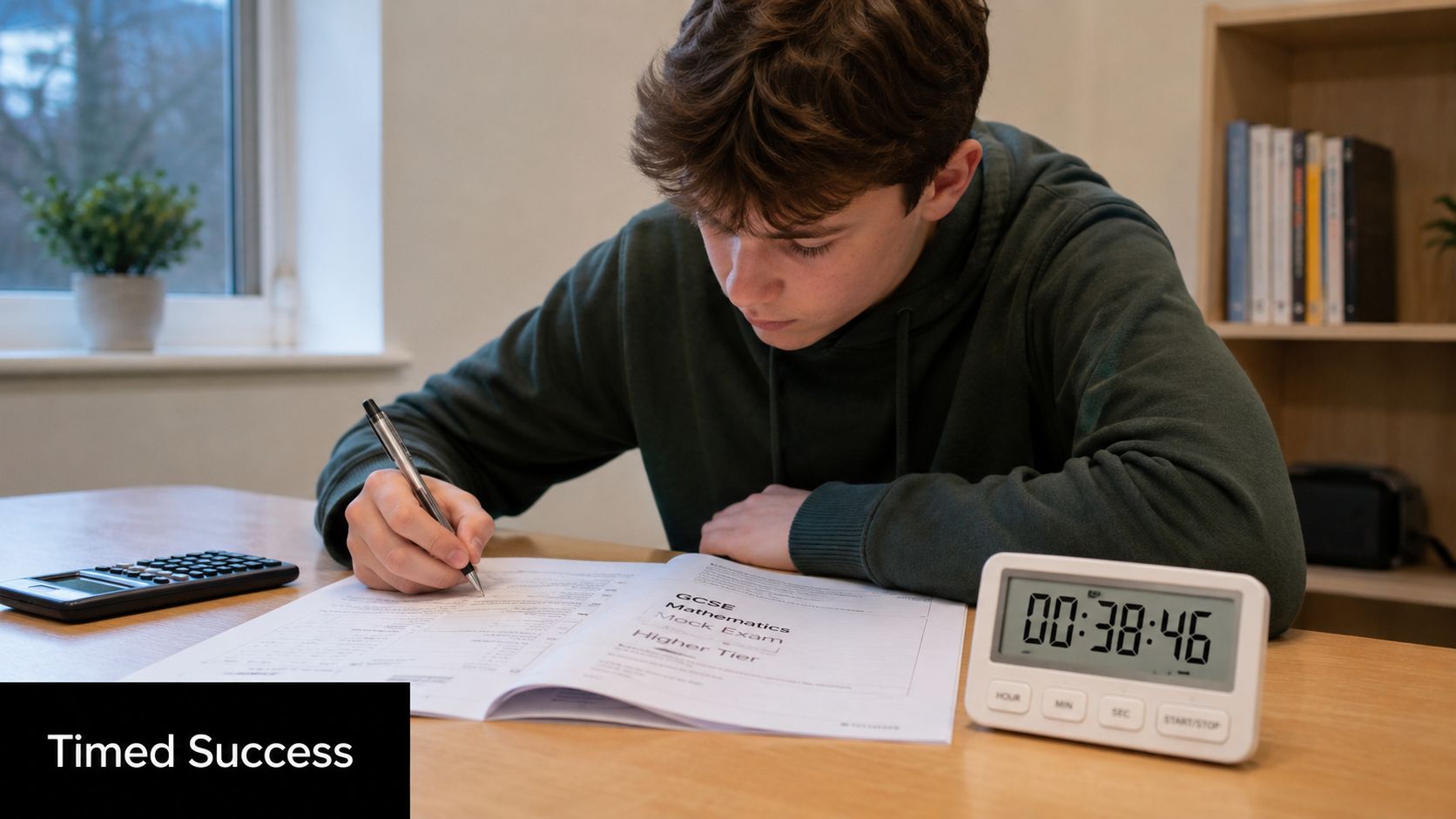
Stage three is the full mock paper. Sit it properly with exam materials only, no phone, no breaks, and no checking answers halfway through. As a practical target, I recommend completing 8 to 12 full timed past papers from your own exam board before the actual exam. That amount gives you enough repetition to spot patterns, improve pacing, and walk into the exam room feeling prepared instead of exposed.
Create exam conditions at home
Treat mocks seriously. Casual practice creates false confidence.
Use this checklist:
- Clear desk: Keep only the items you will have in the exam.
- Timer running: Start it once and leave it running.
- Quiet space: Ask for protected study time and defend it.
- Correct equipment: Use the same calculator, pens, pencil, and ruler each time.
- Full marking after: Review the paper properly once the time is up.
Later in your preparation, this video can help you settle into the right revision mindset before timed practice:
Learn how to move on without giving up
A timed paper rewards decisions. If a question stalls you, do not sit there bleeding minutes. Mark it, move on, and come back with a clearer head.
Never leave a question empty if you can write something useful. Put down the formula, the method, the values you know, or the first algebra step. GCSE Maths mark schemes often award marks for correct working, even when the final answer is wrong.
Write enough to give yourself a chance at marks.
That habit changes more than your score. It teaches you to stay functional under pressure, which is exactly what many adult learners need after years of doubting themselves. Every mock you finish builds proof that you can stay calm, recover, and keep going.
If pacing is your weak point, use a simple plan for time management for students. Good timing is learned behaviour. It is not luck, and it is not talent.
Use Smart Revision to Overcome Plateaus
Every learner hits a patch where effort feels flat. You revise, answer questions, and still feel stuck. That doesn't mean you're failing. It usually means your revision has become too general.
Plateaus break when your practice becomes sharper.
The modern GCSE Maths course uses the 9 to 1 grading scale, introduced for all students in England from the June 2017 exam series, replacing the old A* to G system. It also increased the focus on Statistics and Probability to approximately 20% of the total mark across major exam boards, according to this TES resource on GCSE Maths Statistics and Probability. If your revision ignores those areas, you're leaving important marks untouched.
Use your weak spots as a plan
Your error journal should now be doing serious work for you. Look back through it and ask one simple question. Which mistakes keep repeating?
That tells you where to focus.
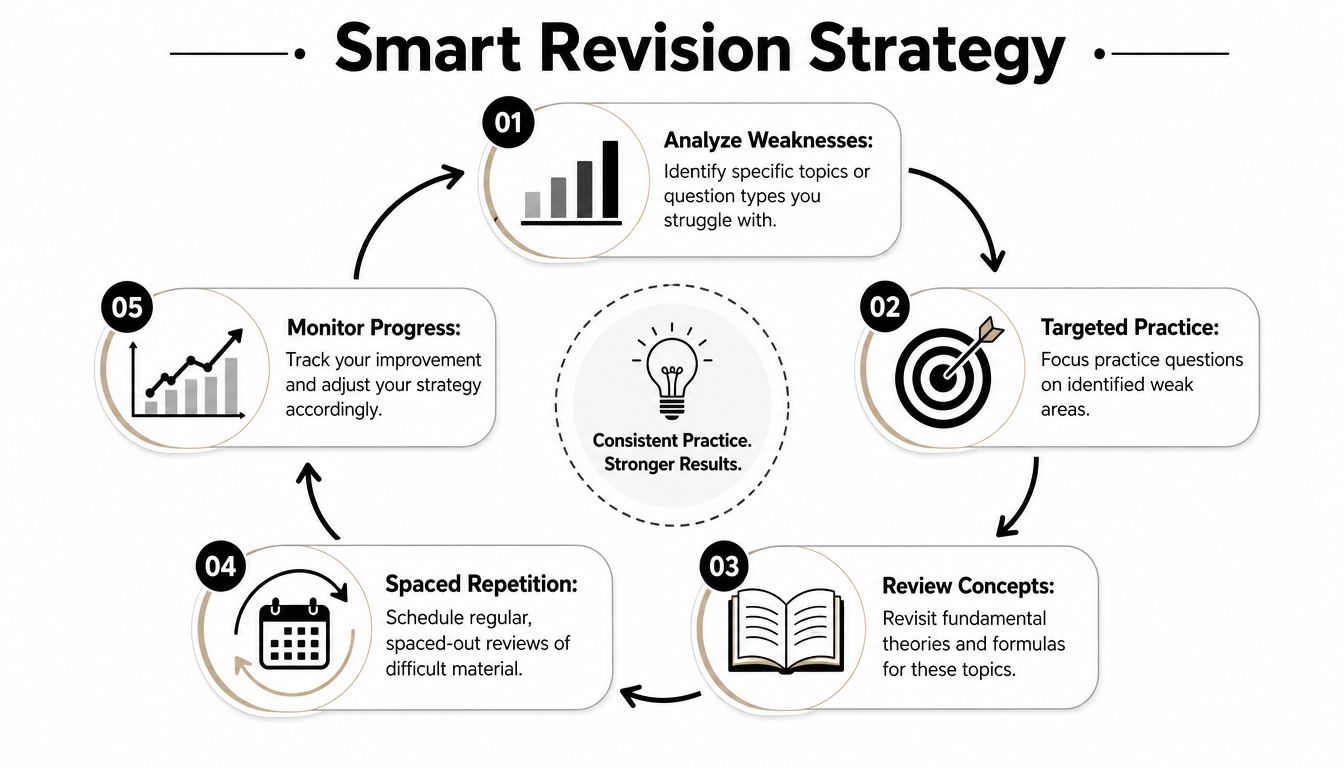
A smarter revision cycle looks like this:
- Spot the pattern: Repeated trouble with fractions, ratio, algebra, or reading graphs means that topic needs direct attention.
- Practise tightly: Do a small batch of GCSE maths practice questions on that exact skill.
- Review the rule: Go back to the method or formula only after you know what's going wrong.
- Return later: Revisit the same topic after a gap so it sticks.
The 80/20 principle offers a useful approach. Don't spread equal time across every topic every week. Put more time into the smaller set of weaknesses that are costing you the most marks.
Give extra respect to statistics and probability
Many adults put these topics off because they look wordy or unfamiliar. That's a mistake. Since they make up a significant part of the paper, they deserve regular practice.
Focus on practical habits:
| Topic area | What to practise |
|---|---|
| Statistics | Reading charts, averages, comparing data sets |
| Probability | Basic probability rules, tables, clear step-by-step working |
| Worded questions | Underlining key information, checking units, writing the method out |
If you're studying GCSE Statistics as a separate subject or meeting crossover topics, be careful with specification differences. Verified data notes that Edexcel Higher includes advanced areas such as Multivariate Data, Stratified Sampling, Control Charts, and the Petersen Capture Recapture Formula, while AQA covers the same topics but differs in how some content is assessed, according to Save My Exams' GCSE Statistics topic guide. That's another reason generic question packs can slow you down.
Some weeks won't feel impressive. Keep going anyway. Quiet progress still counts.
When motivation drops
Don't wait to feel inspired. Protect the routine instead. A short focused session beats a dramatic plan you never start.
Try this when your energy is low:
- Do one question only.
- Mark it properly.
- Fix one mistake.
- Stop if needed.
That tiny win keeps your study identity alive. And that identity matters. You are not the person who gave up on maths. You are the person who came back and learned how to beat it.
You Are Ready to Build Your New Future
You don't need luck now. You need trust in the process.
You know what to do. Choose the right tier and exam board. Use GCSE maths practice questions that match your course. Learn from model answers instead of just checking whether you were right. Keep an error journal so mistakes become instructions. Build up timed practice until exam pressure feels normal. Then revise smart, with extra care given to the topics and question types that matter most.
That's a proper system. And systems beat panic.
Your confidence is built by evidence
Confidence doesn't appear out of nowhere. It grows because you can point to real proof. A worksheet you understand. A method you can now explain. A mock score that improved. A topic that used to scare you and now feels manageable.
Keep noticing that evidence.
- You are learning discipline: Every study session proves you can keep promises to yourself.
- You are building options: GCSE Maths can open routes into further study, job progress, and university entry.
- You are changing the example at home: Your children see effort, responsibility, and courage in action.
That last point is powerful. Children don't need perfect parents. They need honest role models. When they watch you return to education, they learn that setbacks aren't the end.
Don't measure yourself against your old school self
That version of you had different pressures, different support, and probably less purpose. You're not trying to rewrite the past. You're building a new future with better tools.
Maybe you want a better paid career. Maybe you want to qualify for nursing, teaching, social work, business, construction management, or university study. Maybe you want to stop feeling embarrassed when maths comes up. All of those reasons are strong enough.
GCSE Maths can be a turning point because it changes how you see yourself. You stop being the person who says, “I can't do that.” You become the person who says, “I'm working on it, and I'll get there.”
Keep it simple and keep moving
If you feel overwhelmed, come back to this short routine:
| Day | Core action |
|---|---|
| Day 1 | Topic questions on one weak area |
| Day 2 | Mark carefully and update error journal |
| Day 3 | Redo similar questions |
| Day 4 | Timed mini-practice |
| Day 5 | Review methods and restudy gaps |
That kind of steady structure is what helps adults win. Not perfection. Not last-minute cramming. Repeated, honest work.
You are capable of far more than old experiences have told you. A maths grade won't define your worth, but earning it can strengthen your confidence, widen your choices, and give your family a reason to feel proud. Above all, it can give you that reason too.
Keep going. Your future isn't built in one dramatic moment. It's built in small sessions, marked papers, corrected mistakes, and the decision to return tomorrow.
If you're ready to turn effort into a recognised qualification, Next Level Online College gives adult learners a flexible, fully supported way to study around work and family life. With expert guidance, clear progression routes, and courses designed for real adult responsibilities, it's a strong next step if you want to build confidence, pass GCSE Maths, and move closer to university, a better career, and a future your family can be proud of.