
You may be reading this after the children are in bed, with work finished and a university course open on your phone. Perhaps you've wanted a different career for years, but the words entry requirements make you wonder whether too much time has passed. If you left school without the qualifications universities ask for, that doubt can feel very real.
The good news is that an Access to Higher Education Diploma was created for adults in exactly this position. It can give you an organised route back into learning, help you build academic confidence and prepare you for degree-level study, even when your work and family responsibilities are already demanding.
What This Guide Is Really About
Take Sam, a parent who works during the week and wants to train for a career that feels meaningful. Sam has practical experience, plenty of determination and a clear reason for returning to education, but no traditional route into university. The first question isn't “Am I clever enough?” It's “What do I need to do?”
That's where many adult learners get stuck. A university course may mention GCSEs, Level 3 credits, tariff points, subject units, interviews and contextual offers on the same page. Each term has a meaning, but together they can look like a locked door.
The access to higher education entry requirements process becomes easier when you separate it into manageable questions:
- Do I need an Access Diploma? This depends on your existing qualifications, experience and chosen degree.
- Which subjects should I study? Nursing, teaching, social work, business and humanities courses can ask for different preparation.
- What grades will I need? Universities set their own offers, so the same diploma result may suit one course but not another.
- Do my circumstances matter? They can. Contextual admissions may take barriers and background into account.
- What can I do about gaps? GCSEs, Functional Skills and preparatory study can help you meet missing requirements.
You don't need to know every answer before you start. You need a sensible order in which to find them, and someone who'll explain the unfamiliar parts without making you feel embarrassed.
A useful starting point: Your past qualifications describe where you're beginning. They don't decide how far you can go.
An Access course can also become something your children see every day. They'll see you make time for study, recover from difficult assignments and keep going when confidence dips. That example can matter just as much as the qualification itself.
What the Access to HE Diploma Is
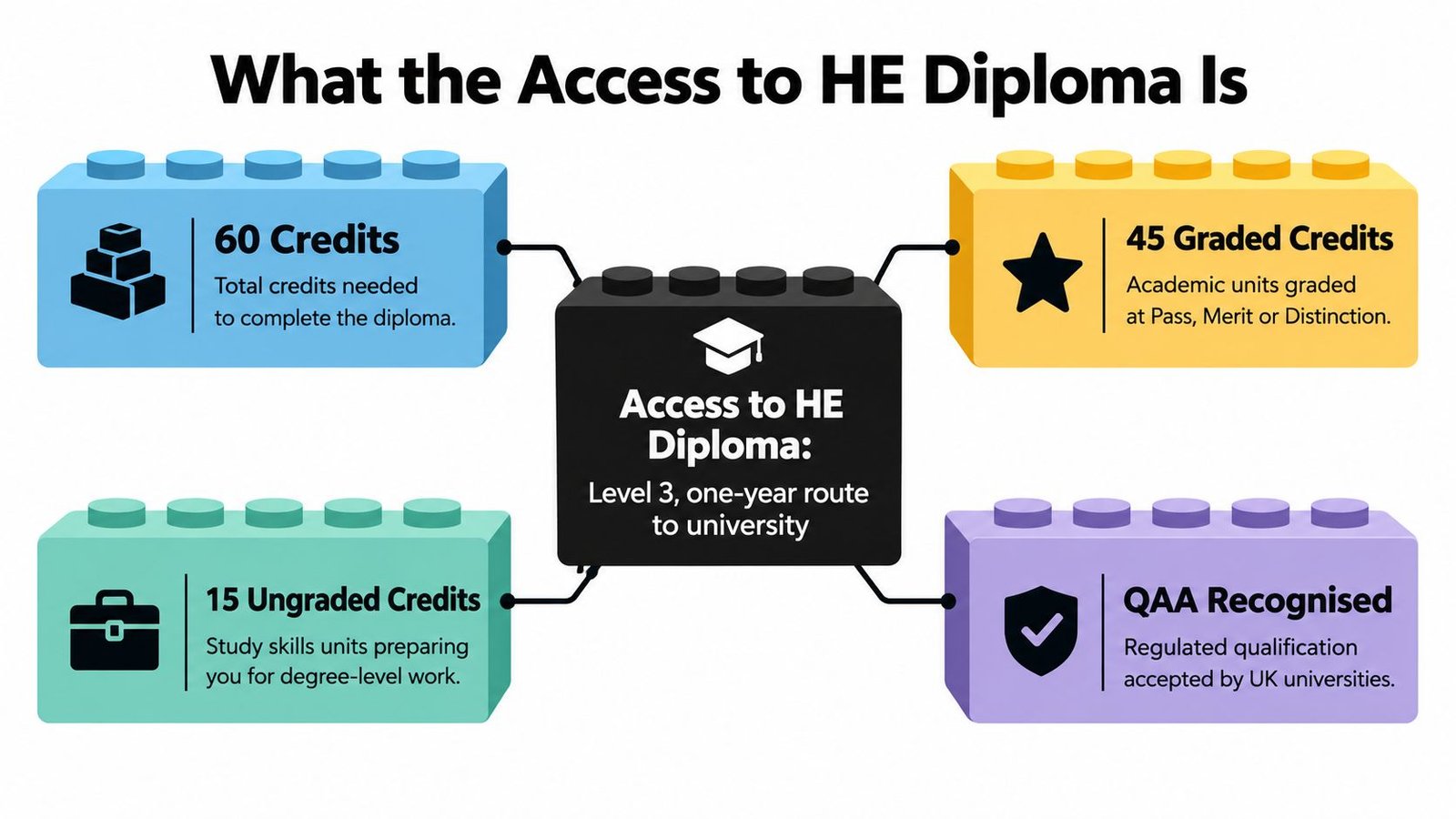
If work, childcare and bills already fill your week, returning to education can feel like adding another structure to an already crowded room. The Access to HE Diploma gives that return a clear shape. It is a complete qualification made up of 60 credits, including 45 graded credits at Level 3, as explained in the historical overview of Access to HE.
How the credits fit together
The credits work like sections of a route map:
- Level 3 graded credits: These are usually assessed at Pass, Merit or Distinction. They show how well you have met the academic learning outcomes.
- Ungraded credits: These commonly build study, research, communication and preparation skills for degree-level work.
- A complete qualification: You need the required total across the diploma, not only a strong mark in one assignment.
Level 3 means advanced study. You may write essays, assess evidence, use academic references, give presentations and examine ideas linked to your subject. Providers introduce these skills over time, which can help if you have been away from classrooms for several years. You are not expected to know how university works on your first day.
The Access to HE Diploma information from the Access to HE website describes it as a route for adults without traditional higher education qualifications. Figures reported by the Access to HE body show over 37,000 people registered in 2017–18 and around 40,550 in 2019–20. In 2016–17, 24,895 students entered higher education after studying for the diploma, and 87% were aged over 21. The figures also report that 22% came from low-participation areas, 32% were from ethnic minority backgrounds, and 18% reported a disability or learning difficulty.
These figures place the diploma in context. It is a structured route back into education for adults whose earlier qualifications, circumstances or timing did not lead directly to university. For someone balancing family and paid work, that structure can turn a large ambition into manageable study blocks.
Why recognition matters
The Quality Assurance Agency, usually called the QAA, has regulated the Access framework in England, Wales and Northern Ireland since 1997. That history makes the diploma an established part of the UK higher education entry system, rather than a temporary project.
Your provider will set out the exact units and assessment plan because pathways vary by subject. A health-related course may include science, while a humanities pathway may give more time to writing, analysis and social research. Check those details before enrolling, so the course fits both your intended degree and the time you can realistically give it.
Academic Prerequisites and UCAS Points Explained
Universities usually look at two connected things: whether you have the right preparation for the degree, and whether your predicted or achieved diploma profile meets their offer. The precise combination varies, so you should treat tariff points as a guide rather than a universal pass mark.
The Access Diploma's graded credits can be converted into UCAS Tariff Points. A common conversion is shown below.
Access to HE Diploma Grades Converted to UCAS Tariff Points
| Diploma Grade Profile | UCAS Tariff Points | Equivalent Performance |
|---|---|---|
| 45 Distinctions | 144 | Highest listed diploma performance |
| 30 Distinctions and 15 Merits | 132 | Very strong performance |
| 15 Distinctions and 30 Merits | 120 | Strong performance |
| 45 Merits | 108 | Solid performance |
| 30 Merits and 15 Passes | 96 | Moderate performance |
| 15 Merits and 30 Passes | 84 | Lower tariff profile |
| 45 Passes | 72 | Pass-level completion |
These conversions don't replace the university's wording. A course might ask for a particular number of Distinctions in relevant units, rather than accepting any combination that reaches the same total. A nursing course, for example, may care about science credits as well as the overall profile.
Your application may also require GCSE English and maths, or an accepted equivalent. Some courses ask for additional science preparation, a portfolio, an interview or evidence of relevant experience. Read the course page carefully and ask admissions staff to clarify anything that could affect your application.
If you're developing your academic writing, writing a research paper tips can help you practise planning, structure and source use before assignments become demanding.
You can also review how diploma results may relate to university offers through this Access to HE Diploma UCAS points guide.
What universities mean by an offer
An offer may be conditional, which means you must achieve stated results before your place is confirmed. It might refer to an overall diploma profile, a number of graded credits or specific subjects.
Don't compare yourself with a friend applying for a different degree. Their university may use different requirements, even if both of you are studying Access. Your chosen course is the document that matters.
Subject-Specific Entry Requirements by Degree Route
The diploma route you choose should match the degree you want. A general Access pathway may not provide the science depth needed for nursing, while a health pathway may not be the most useful preparation for primary teaching.
| Degree Route | Typical Diploma Grades | GCSE Requirements | Subject Emphasis |
|---|---|---|---|
| Nursing | Often 30 Level 3 credits at Distinction | English and maths commonly required, with science increasingly specified | Biology, human biology and other science-heavy units |
| Midwifery | Often a strong Level 3 profile, with Distinctions in relevant units | English and maths commonly required | Biological science, health and evidence-based practice |
| Primary teaching | Depends on the university and course | English and maths at GCSE grade C/4 or equivalent are commonly requested | Relevant Level 3 study, communication and subject knowledge |
| Social work | Graded diploma profile | Literacy and numeracy evidence may be required | Social science, communication and reflective practice |
| Business or humanities | Often more flexible about diploma subject | English and maths requirements still vary | Academic writing, analysis and the relevant subject area |
These are typical patterns, not guaranteed offers. Nursing and midwifery courses may ask for particular science units and may expect A-level-equivalent depth in those areas. GCSE science is increasingly part of nursing entry requirements, but each university sets its own rules.
Primary teaching courses can be especially particular about English and maths. A provider may accept an equivalent qualification, while another may insist on a specific GCSE or approved alternative. Social work courses often look for evidence that you can communicate clearly, handle information and reflect on experience.
Business and humanities degrees may be more open about the Access subject, but they can still set a UCAS tariff requirement or ask for a particular grade profile.
Before enrolling: Find two or three university course pages for the degree you want, then compare their requirements side by side. It's much safer than choosing an Access pathway first and hoping it matches later.
Admissions rules can change, and requirements can differ even within one subject. Contact the university directly if the wording is unclear.
How Evidence and Assessment Work in Practice
Most Access students don't spend the whole year sitting silent, high-pressure exams. Assessment commonly includes essays, reports, presentations, portfolios and short timed tests. Your tutor will normally explain the learning outcome, the evidence expected and the marking criteria before you submit work.

Build an evidence trail
A strong assignment isn't just about sounding clever. It shows that you can answer the question, use suitable sources, organise ideas and reflect on feedback. You'll have opportunities to improve these skills, especially if you haven't written academically for years.
Recognition of Prior Learning, or RPL, may help you show that previous workplace training, NVQ units or life experience match specific diploma learning outcomes. RPL doesn't automatically convert experience into credits. Your provider must map what you know to the module requirements and check evidence such as certificates, witness statements or reflective accounts.
Read more about how Recognition of Prior Learning in the UK may work before you assume that past experience can't count.
Keep your evidence organised from the first week:
- Create digital folders: Use separate folders for each unit, assignment and piece of feedback.
- Record experience: Log relevant training, responsibilities and hours while the details are fresh.
- Save documents: Keep certificates, workplace records and written confirmation from supervisors.
- Ask early: Speak to your tutor about RPL before the module deadline, not after you've completed it.
- Review feedback: Turn comments into a short checklist for your next assignment.
Internal verification checks that assessment decisions are consistent. External moderators sample work through the quality framework, helping confirm that standards are applied properly across providers.
You can see how study tasks may be explained and structured in the following video.
Assessment is still work, but it's learnable work. A tutor can show you how to plan an essay, reference a source and use feedback. You aren't expected to remember how to be a student on your first day.
Widening Participation and Contextual Admissions
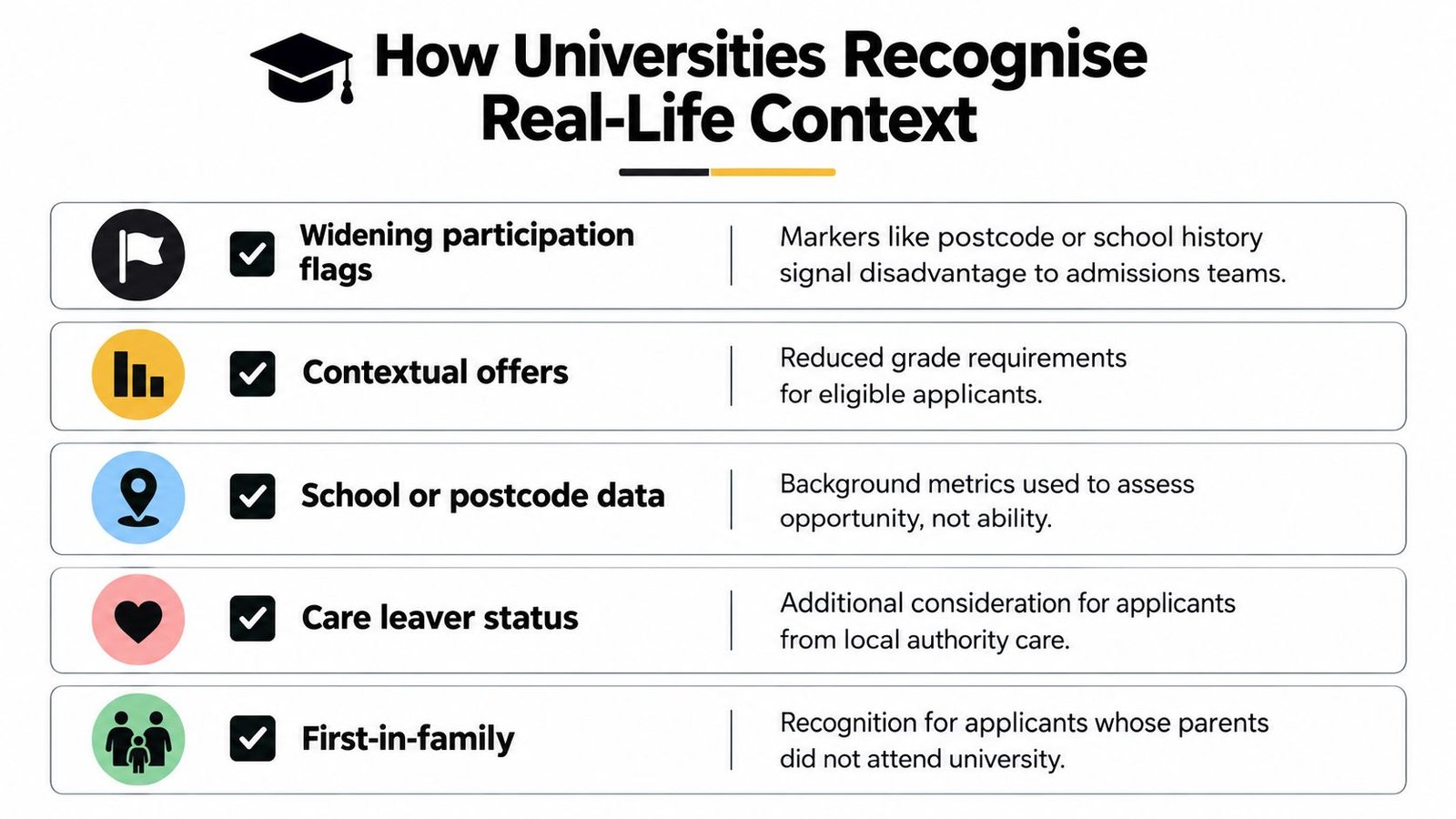
A university's published grade requirement isn't always the whole story. Widening participation aims to improve access for people who have faced barriers to higher education, including adult returners, carers, care-experienced applicants, people from low-participation neighbourhoods and those who would be the first in their family to attend university.
Contextual admissions are one way universities put this principle into practice. UCAS explains that universities may consider barriers such as care experience, low income, living in a low-participation area or attending a school with lower historic attainment. An eligible applicant might receive a reduced grade requirement or extra consideration during the decision process, although they may still need to show English-language proficiency where a course requires it. You can read the UCAS explanation of entry requirements and contextual admissions for the wording used in applications.
Circumstances can affect eligibility
Universities may use postcode and educational background data, including measures such as POLAR or TUNDRA, alongside information you declare in your application. Some schemes also consider caring responsibilities, disability, estrangement, refugee or asylum-seeker status and time away from formal education.
The University of Glasgow's Access Programme eligibility guidance shows why the phrase “mature student” isn't precise enough. Some access routes require no formal qualifications, but eligibility can depend on being out of formal education for three years or meeting widening-participation criteria such as SIMD postcode status, care experience, estrangement, caring responsibilities or refugee and asylum-seeker status. UCAS identifies Access to HE as a route for adults aged 19 and over who lack traditional entry qualifications, while Edinburgh distinguishes an adult returner from a mature applicant through a three-year break from formal education and recent accredited study.
That detail matters. Your social circumstances may open an access route, but your chosen degree may still require particular academic preparation.
Declare your circumstances with confidence
Don't hide information because you think it makes you look weak. If your background affected your educational opportunities, sharing it gives admissions teams the context they need.
The Department for Education entry-rate data also shows why background forms part of the wider admissions picture. Universities use evidence about participation and opportunity to shape contextual policies, and some explicitly reduce offers by up to two A-level grades for eligible applicants. Eligibility can include mature learners, free-school-meal eligibility, care experience, disability or residence in low-participation and postcode deprivation groups.
Contact the university's widening-participation office. Ask them to assess your situation before you apply, rather than guessing from a general webpage.
Filling the Gaps Before You Apply
Missing a GCSE doesn't automatically rule you out. Universities often write “grade C/4 or equivalent”, which may allow an approved alternative such as Functional Skills Level 2, but you must check the exact wording for your course.
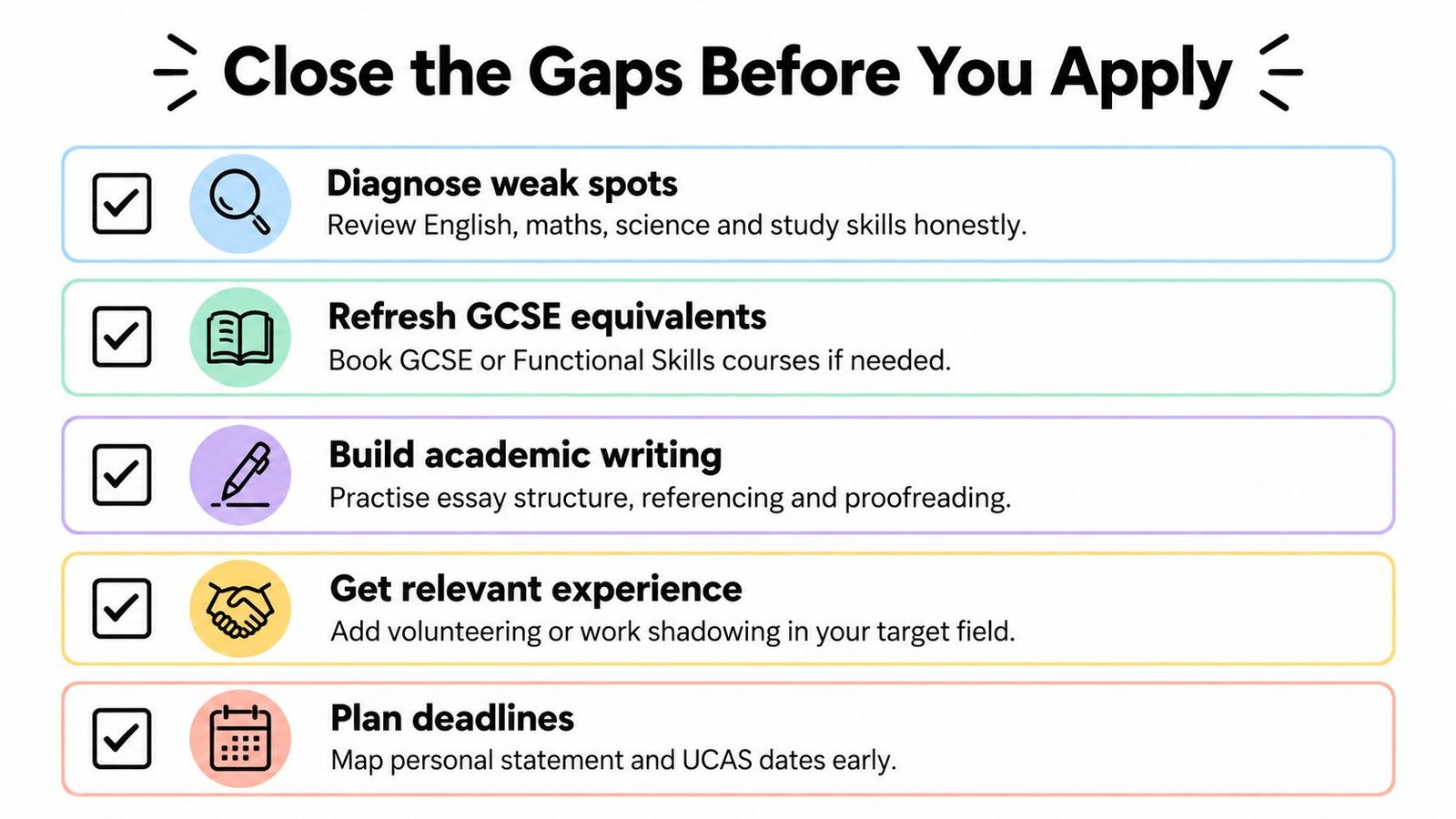
Start with a calm self-audit. Write down what you already have, what the university requests and what remains uncertain.
Your preparation checklist
- English: Check whether you need GCSE English Language, Functional Skills Level 2 or another accepted equivalent.
- Maths: Look for a stated grade and whether the course accepts Functional Skills.
- Science: Nursing and other health degrees may ask for science evidence or relevant Level 3 units.
- Study skills: Consider whether you need practice with essays, referencing, reading and deadlines.
- Experience: Note caring, volunteering or employment that connects with your intended subject.
For a missing English or maths qualification, compare a GCSE retake at a local college with Functional Skills Level 2. GCSE study may suit you if a university names GCSE specifically. Functional Skills can be a practical alternative where the admissions team accepts it.
Free resources can help you rebuild confidence before enrolling. BBC Bitesize offers accessible revision material, and The Open University provides free courses that can introduce academic topics and study habits. Some Access providers also offer short bridging modules or tasters.
Plan around real life
Work backwards from your intended September start. Some GCSE, Functional Skills and bridging qualifications can take 8 to 16 weeks, so leaving everything until the application deadline may create unnecessary pressure. Ask providers about assessment dates, study hours and whether online or evening learning is available.
Practise one small academic task at a time. Write a short paragraph, identify a reliable source, explain an idea in your own words and proofread your work. These habits will make the diploma feel more familiar.
Your gap is a plan, not a verdict. Showing that you've identified a weakness and taken steps to address it demonstrates commitment and resilience.
Your Next Steps Towards University
You can make progress this week without solving your entire future. Focus on three actions that turn a vague ambition into a realistic route.
Choose suitable providers
Use the official QAA-recognised information available for Access courses and shortlist two providers that offer a subject pathway related to your intended degree. Check whether they provide evening, weekend or online attendance, and ask how the timetable would fit around work, school runs and caring responsibilities.
Compare support as well as course titles. Find out how tutors give feedback, how assessments are submitted and who helps with university applications.
Prepare for guidance interviews
Book a guidance interview with both providers. Take your existing certificates, employment history and a rough personal statement draft. If you have previous qualifications, request a transcript review so a tutor can explain what may support your application and what you still need.
Write down your target degree and the universities you're considering. A clear destination helps the provider recommend the right Access pathway.
Confirm the university's rules
Contact admissions teams directly and ask which Access grades, GCSEs and Functional Skills qualifications they accept for your chosen course. The university application process guide can help you understand the wider application journey, but the university remains the authority on its current entry conditions.
Keep written replies in one folder. Requirements vary between institutions and can change, so a saved response gives you something concrete to check when you apply.
Returning to education may feel like a private decision at first. Over time, it becomes visible to your children, partner and wider family. They'll see that a person can begin again, learn after a long break and work towards a fulfilling career that supports the family and contributes to society.
Next Level Online College offers flexible online GCSEs, Functional Skills qualifications and Access to Higher Education diplomas with academic and pastoral support for adult learners. If you're ready to match your current qualifications and responsibilities to a university route, visit Next Level Online College to explore suitable courses and request further guidance.